Salut! – welcome to the France category of this blog. This is where I share anything that relates to the Republic of France, business issues relating to the France, the French people or culture.
France in some ways feels outside Europe. It has the biggest love of Japanese culture from all European countries. It has also cut a swathe in science fiction and graphic novels. France also does things differently like doing big infrastructure better than other European countries such as high speed rail or civilian nuclear power. Skills that the UK seems to have lost somewhere around the OPEC oil crisis of 1973.
On the flipside, there are aspects of France that define Europe, such as the George V Hotel or the country’s luxury powerhouses LVMH and Hermes.
Often posts that appear in this category will appear in other categories as well. So if Renault launched a new advertising campaign. And that I thought was particularly interesting or noteworthy, that might appear in branding as well as France.
So far, I haven’t had too much French related content here at the moment. That’s just the way things work out sometimes.
I don’t tend to comment on local politics because I don’t understand it that well, but I am interested when it intersects with business. An example of this would be legal issues affecting the media sector for instance.
If there are French related subjects that you think would fit with this blog, feel free to let me know by leaving a comment in the ‘Get in touch’ section of this blog here.
Partly due to Cambridge Analytica, General Data Protection Regulation (GDPR) is going to have a more profound impact on data usage globally. GDPR would have been seen as an extra-legal reach, but Facebook is making it look like a good idea.
I thought I would pull together a few resources that I thought would be of interest around GDPR since there is a lot of snake oil being sold as consultancy around it at the moment. I am not going to pretend that I am an expert, so I thought it would be useful to share some of the GDPR related resources that I have been looking to learn from.
Not only in terms of what the regulation is, but what techniques can be deplored to act in the spirit as well as the letter of regulations. Demonstrating a basic respect for the consumer won’t harm any brand, but might point to badly designed KPIs that direct and digital marketers might be measured from.
Andreessen Horowitz put together a good podcast on it.
What the Great Scud Hunt Says About War With North Korea | War Is Boring – pretty grime reading. The Great Scud Hunt was a key aspect of the Gulf War. The Great Scud Hunt pitted allied special forces units against the Iraqi army which had scattered its Scud launchers across the desert. The Great Scud Hunt was important to stop Israel coming into the war and fracturing the alliance against Iraq. it was also to prevent scud missile attacks on Saudi oil infrastructure and cities. Despite the terrain being reasonably flat and barren, the allies weren’t as successful the Great Scud Hunt as they would have liked. By comparison North Korea is mountainous and covered in vegetation making the job orders of magnitude harder. North Korean missiles could target the US, Japan and the whole of South Korea.
A relic of the Great Scud Hunt – a missile being examined after having been shot down in the desert by a Patriot missile
INMA: Pros, cons of EU’s General Data Protection Regulation for publishers – GDPR could lead to a reduction in programmatic ad spend because advertisers will struggle to measure whether their ads lead to purchases, according to Eric Berry, CEO of TripleLift. There’s uncertainty about how the law will be enforced, but if users have to give consent to individual publishers, demand-side platforms, and attribution vendors, the attribution companies won’t have enough data to make accurate measurements
Louis Vuitton personalisation feature is really interesting. It brings NikeID magic to their retail experience. Customisation makes even more sense in a luxury context like the Louis Vuitton personalisation feature. I think that it will also impact secondhand sales – flair is much more of a personal decision, which will impact secondhand sales.
If the Louis Vuitton personalisation could be done as an after-market, then that gives Louis Vuitton additional incremental retail revenue.
Nir Eyal took Fogg’s work and simplified it even further in his book Hooked. Adam Alter and Scott Galloway provide a good primer to the principles involved and the likely outcomes.
Jennifer Cardini
The soundtrack of my week has been this mix by Jennifer Cardini of Correspondent Records. Cardini has a background in DJing, music and sound design which explains some of the atmospheres.
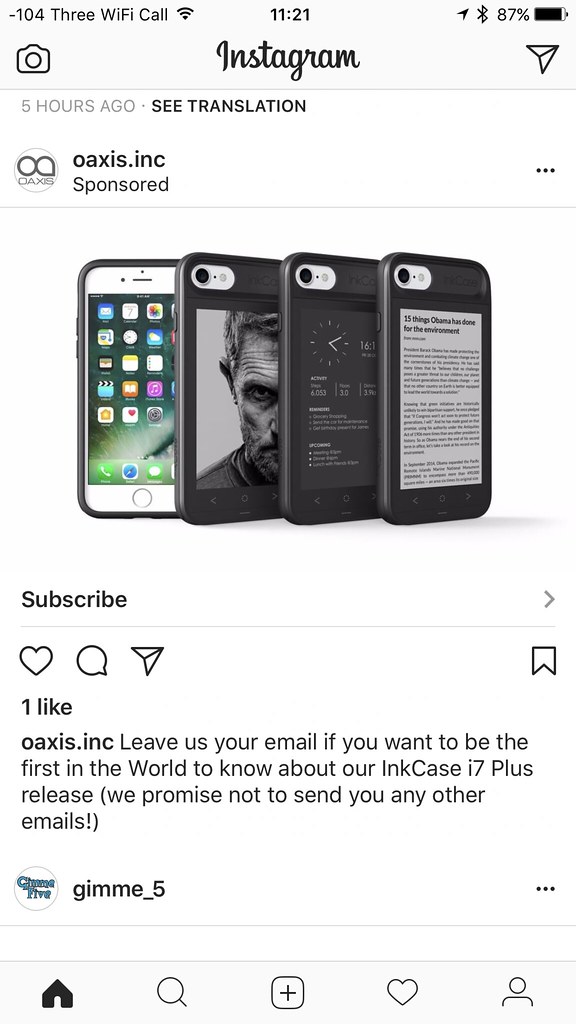
Instagram lead generation
This is probably old news, but it was the first time that I noticed it in my feed. Instagram has an email collection facility that reminded me of Twitter cards. Its a great idea that can help tie Instagram engagement closer to e-commerce sales
Flickr search
Flickr has been tweaking its design and has improved its search. These changes have largely happened under the radar. In my experience, the biggest move was that the ‘camera roll’ has been depreciated in menu positions so that you no longer click on it by accident. It’s good to see the continual improvements in a time of substantial change at Yahoo! / Oath or whatever Verizon calls it. Flickr talked about the changes it made to the user’s profile page on its blog.
The recent collaboration between New York’s Supreme and Louis Vuitton seems like a natural fit. The reality is that luxury and streetwear have been dancing around each other for a good while.
Snide started it all
Snide was slang in the 1980s for fake or counterfeit. Hip Hop and the Caribbean-influenced Buffalo movement in the UK each used counterfeit and real luxury in their own way.
Daniel Day, better known as Dapper Dan was a was a Harlem-based craftsman and business man who dressed a lot of New York based artists from the golden age of hip hop. Dan’s first hip hop client was LL Cool J back in 1985. Dan’s style was luxe, the finest silks and furs were standard issue – think Puff Daddy before Puff Daddy. They went for customised outfits with their branding on which Dan provided. As the scene took off Dan incorporated suit lining material (which replicated the likes of the Fendi, Bally or MCM brands) and Gucci or Louis Vuitton branded vinyl to make one-off products.
He customised trainers, clothing and even car interiors. Dan’s own Jeep Wrangler had an interior retrimmed in MCM branded vinyl.
Much of the luxury branding Dan used was coming in from Korean factories which at that time supplied the fake trade. Now similar products would have come out of China. I took a trip to the South China City complex in 2010 where fabric suppliers would offer Louis Vuitton labels and Supreme tags side-by-side. I can only imagine that the Korean suppliers of the 1980s had similar markets in textile industry centres like Deagu. Outside of hip hop, Dan was the go-to tailor for all the hustlers in Harlem – so you can see how he could have got the hook-up into the counterfeit suppliers.
At the time hip hop culture was not in a relationship with brands who where concerned about how it might affect them. LL Cool J was the first artist to get a deal with Le Coq Sportif. Run DMC got a long term deal with Adidas after their single ‘My Adidas’ became successful. But these were the exceptions to the rule. So with Dan’s help they co-opted the brands to try and demonstrate success.
Over in the UK, the Buffalo collective of stylists, artists and photographers including Ray Petri, Jamie Morgan, Barry Kamen (who modelled for Petri), Mark Lebon and Cameron McVey. Buffalo was known as an attitude, which threw contrasting styles together and filtered into fashion shoots and influenced the collections of major designers including Yohji Yamamoto, Jean Paul Gaultier and Comme des Garçons. Even if you didn’t know what Buffalo was, you would have recognised the aesthetic from the likes of i-D, Blitz, New Musical Express and Arena.
Buffalo mixed Armani jackets with Doctor Martens work boots, or a Puma bobble hat. Petri used music to sound track his process and this was pretty similar to the kind of stuff that influenced street wear pioneer Shawn Stussy over in California. Motown and hip-hop to dub reggae was the sound which explains the Feeling Irie t-shirts created by the white surfboard maker.
If you thought Bros looked cool in their MA-1 bomber jackets and stone washed Levi’s 501 jeans – there was a direct stylistic line back to Buffalo – rehabilitating the items from their link to skinhead culture.
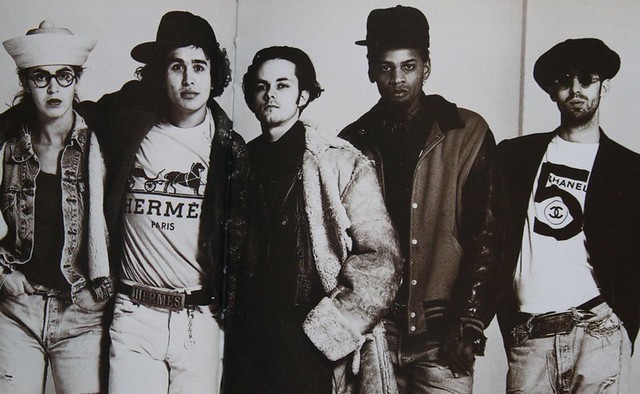
Buffalo permeated into the street style of the decade; influencing the likes of Soul II Soul. Meanwhile over in Bristol The Wild Bunch were yet to morph into Massive Attack. Two members headed to London; producer Nelle Hooper and Miles Johnson (aka DJ Milo who went on to work in New York and Japan). A shoot was organised by i-D magazine and they turned up wearing their street clothes alongside DJ Dave Dorrell and model / stylist Barnsley. At the time, it was considered to be ‘very Buffalo’ in feel, but Dave Dorrell admitted in an interview that they had just came as they were. Dorrell wore his t-shirt as ‘advertising’ for it.
The Hermes t-shirt and belt were snide, the Chanel Number 5 t-shirt sported by Dave Dorrell were being knocked out by a group of friends. Young people in London co-opted brands just like the hip-hop artists heading to Dapper Dan’s in Harlem.
Homage
From 1980, surfer Shawn Stussy had been growing an clothing empire of what we would now recognise as streetwear. Stussy had originally came up with the t-shirts as an adjunct and advertisement of his main business – selling surfboards. But the clothing hit emerging culture: skating, punk, hip-hop and took on a life of its own. It went global through Stussy’s ‘tribe’ of friends that he made along the way.
Stussy is known for his eclectic influences and mixing media: old photographs alongside his own typography. In a way that was unheard of in brand circles at the time, Stussy manifested his brands in lots of different ways. The back to back SS logo inside a circle was a straight rip from Chanel; the repeating logo motif that appeared in other designs was a nod to MCM and Louis Vuitton.
All of this went into the cultural melting pot of world cities like Tokyo, New York, London and Los Angeles. Stussy went on to do collaborations from a specially designed party t-shirt for i-D magazine’s birthday party to the cover art of Malcolm Maclaren records. Collaboration with mundane and high-end brands is baked into streetwear’s DNA.
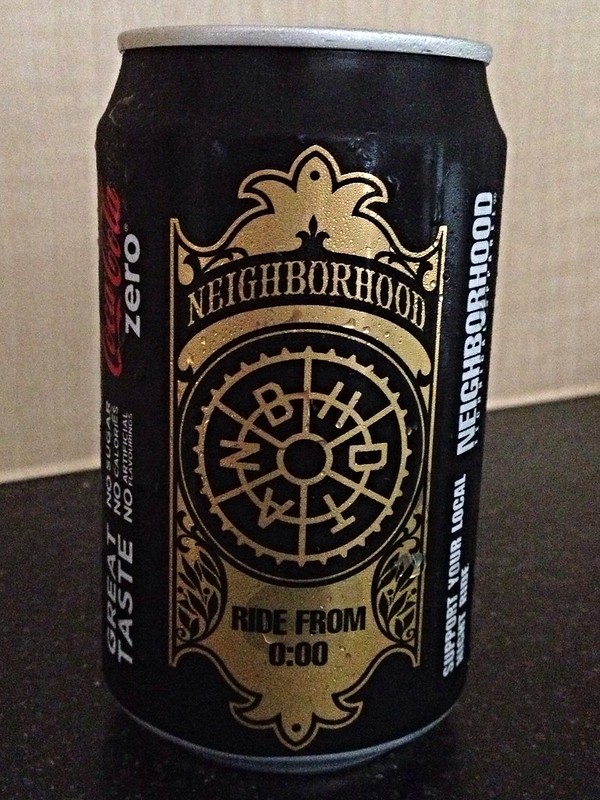
(Neighborhood x Coke Zero was something I was involved with during my time in Hong Kong.)
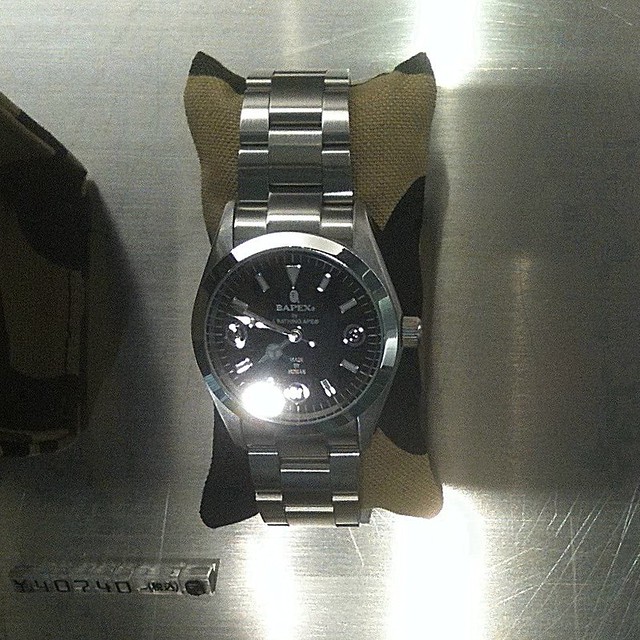
Japan with its engrained sense of quality and wabisabi took the Buffalo mix-and-match approach to the next level. Japan’s own streetwear labels like Visivim, Neighborhood, W-Taps, The Real McCoy and A Bathing Ape (BAPE) took streetwear product quality, exclusivity and price points into luxury brand territory. That didn’t stop BAPE from making a snide versions of various Rolex models under the ‘Bapex’ brand.
Some two decades later Supreme came up in New York. The brand takes design appropriation and homage to a new level. Every piece Supreme seems to do is a reference to something else. The famous box logo rips from Barbara Kruger’s piece ‘I shop therefore I am’. From taking a snide swipe at consumerism to ending up in the belly of the beast took Supreme a relatively short time. This heritage of appropriation didn’t stop Supreme from using legal means against people it felt had appropriated its ‘look’.
In an ironic twist of fate, Supreme was sued by Louis Vuitton in 2000 and yet the 2017 collaboration looks exceptionally similar to the offending items…
North East Asia’s fast growing economies had been borne out of learning from developed market expertise, state directed focus on exports and ruthless weeding out of weaker businesses. Intellectual property was cast aside at various points. Korea, Hong Kong, Japan and China went from making knock-off products to displacing Europe and the US as the leading luxury markets.
Asian luxury consumers, particularly those second generation rich in China were younger than the typical customer luxury brands cater too. These consumers bought product as they travelled taking in style influences as they went. First from nearby markets like Japan, Hong Kong and Singapore and then Korea. This drew from a melange of hip hop, streetwear, Buffalo styling and contemporary western designers like Vivienne Westwood – as well as the more matronly styles of the traditional European luxury houses.
The luxury brands had to adapt. They brought in new designers who themselves were drawing from similar influences. These designers also collaborated with sportswear brands like Alexander McQueen and Puma or Jeremy Scott and Raf Simons for Adidas.
Luxury brands got seriously into new product categories making luxe versions of training shoes that could be charitably called a homage to the like of Nike’s Air Force 1.
Bringing things full circle
As the supreme_copies Instagram account notes the collaboration with Supreme and Louis Vuitton brings things full circle with the pieces having a nod to Dapper Dan’s custom work as well as Supreme’s own ‘homage’. Luxury brand MCM (Michael Cromer München), which Dan borrowed from extensively in the 1980s was restructured in 1997 with shops and brand being sold separately. The brand was eventually acquired eight years later by the Korean Sungjoo Group. Korea now has its own fast developing luxury fashion and cosmetics brand industry. Textile city Deagu which was the likely source of Dapper Dan’s fabric is now a fashion and luxury business hub in its own right. The Korean entertainment industry is a trend setter throughout Asia. For instance, Hallyu drama My Love From A Star drove breakout sales for the Jimmy Choo ‘Abel’ shoe.
The only question I still have is why did a move like Louis Vuitton’s collaboration with Supreme take so long? The luxury brands spend a lot on customer insight, they were using social listening far longer than they had been on social media. They know that a customer wearing their jacket could have a Visivim backpack slung over the shoulder and a pair of Adidas Stan Smiths on their feet. Customers mix-and-match Buffalo style for all but the most formal occasions. For streetwear brands, collaboration is in their DNA and they get an additional leg-up in the quality stakes. More luxury related posts here.
The order on things being written and posted on this blog has been scrambled up a bit and I ended up spent some time in Madrid with nothing to show for it as my SD card from my camera disappeared, I have no ideas where I mislaid it. In Madrid, the Prado museum is unparalleled, Mandarin Oriental’s Hotel Ritz is nice. Madrid’s Museo Naval is not on the usual tourist trail, but well worth a visit.
Munich airport
Red Bull and Jason Paul put together a film with Munich Airport that owes as much to Harold Lloyd as the cool of free running
Concrete truck
I was stunned by the simplicity of Benedetto Bufalino’s ready-mix concrete truck as disco ball. This wasn’t for a brand but a crazy piece of art. I expect this to be to inspire experiental and and advertising agency creative at some point in the future.
Monki
With a lack of an iPod, I have been listening to Monki’s bootleg bundle a lot. Its a great mix of tracks, many of which I wasn’t familiar with. I can also recommend her mix for the Fabric Live series which combines oldies like the FPI Project through to upfront house tracks.
More things
I haven’t bothered with football videos over the past year, but this one from Nike shows why they do so well. Great concept and storytelling in the film. Just the kind of creative that one would expect from Nike and done by W+K
Maurice Lévy sent Publicis Groupe employees his last Christmas message as CEO. Publicis has had a tradition of humorous personal videos from Lévy that demonstrated the company’s creativity in terms of script writing and production. This is in sharp contrast to WPP’s emails from Martin Sorrell, which were more like a missive from a Goldman Sachs analyst.