Category: gadget | 小工具 | 가제트 | ガジェット

What constitutes a gadget? The dictionary definition would be a small mechanical or electronic device or tool, especially an ingenious or novel one.

When I started writing this blog the gadget section focused on personal digital assistants such as the Palm PDA and Sony’s Clie devices. Or the Anoto digital pen that allowed you to record digitally what had been written on a specially marked out paper page, giving the best of both experiences.

Some of the ideas I shared weren’t so small like a Panasonic sleeping room for sleep starved, but well heeled Japanese.

When cutting edge technology failed me, I periodically went back to older technology such as the Nokia 8850 cellphone or my love of the Nokia E90 Communicator.

I also started looking back to discontinued products like the Sony Walkman WM-D6C Pro, one of the best cassette decks ever made of any size. I knew people who used it in their hi-fi systems as well as for portable audio.

Some of the technology that I looked at were products that marked a particular point in my life such as my college days with the Apple StyleWriter II. While my college peers were worried about getting on laser printers to submit assignments, I had a stack of cartridges cotton buds and isopropyl alcohol to deal with any non catastrophic printer issues and so could print during the evening in the comfort of my lodgings.

Alongside the demise in prominence of the gadget, there has been a rise in the trend of everyday carry or EDC.

  • Open AI+ more things

    Open AI

    Is Open AI the equivalent of Sir Hiram Stevens Maxim? Maxim invented the Maxim gun. A belt fed machine gun that helped colonial powers grab territory in the scramble for Africa. It was reputedly used by one British official to help clear game from land that was soon to be put to farming use in Kenya. Later on it was used by both sides in the Russo-Japanese war and World War 1, due to Maxim’s business associate Sir Basil Zaharoff.

    Investors are betting that Open AI will have a similar role in the battle shaping out between tech giants over generative machine learning related processes.

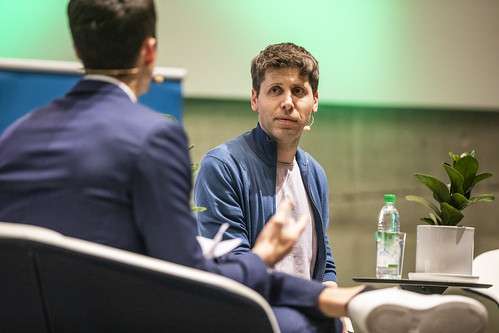
    OpenAI Deep Dive w/ Sam Altman
    Sam Altman of Open AI

    When a company that has issues with making profits can raise money at a valuation of $85bn, it becomes abundantly clear that investors in generative AI have taken leave of their senses

    OpenAI – Haymaker – Radio Free Mobile

    I can understand the argument that Richard Windsor is making with this argument. While others might point out how dominant funding drove Amazon’s present-day monopoly, there are other precedents like Netscape, General Magic, Uber and WeWork that others can point to.

    There are bigger questions about whether the LLM approach is in itself a limited model to pursue? If so, Open AI could look more like when IBM bet the farm on Josephson Junctions. The use of synthetic data implies that LLM scaling might already be at its limit. Nvidia looks like a better bet from this angle despite its own extremely high valuation.

    It looks like Amazon is not buying into the ‘Maxim’ hypothesis either: Amazon to invest up to $4B in generative AI developer Anthropic – SiliconANGLE – these are the people behind Claud.ai

    Consumer behaviour

    How Anthony Downs’s Analysis Explains Rational Voters’ Preferences for Populism – ProMarket

    Design

    “People living with disabilities are done waiting for accessible designs” | Dezeen

    Ethics

    Brand purpose has a lot of issues, but it’s worthwhile bearing in mind the kind of marketing Unilever was pushing out prior to buying fully into the concept. These efforts came to light from social sharing about the the British ‘vulgar wave’ that contextualised Russell Brand.

    Unilever Heart Brands UK

    While China’s ads skewed conservative compared to the UK’s vulgar wave of 1997 – 2012, this Axe (Lynx in the UK and Ireland) ad isn’t exactly on brand purpose. The spokesperson in the advert is Edison Chen. At the time Chen was a star in Hong Kong’s entertainment circles. But getting involved in street fights and a leaked hard drive full of pornographic images of girlfriends he dated meant he withdrew from the industry. Now he is better known for owning streetwear brand CLOT.

    And in the UK….

    Adidas Selling $500 Running Sneakers Only Meant to Last for One Race – is the ADIZERO Adios Pro Evo 1 the ultimate flex, or the ultimate green trolling move by adidas and why do they cost 500 USD?

    FMCG

    Dove Sparks Boycott Calls Over New Partnership—’Never Buy Them Again’ | Newsweek – controversial question, but have Unilever gamed out that conservatives are more likely to use Irish Spring or similar products over Dove? I suspect that there might be something in the semiotics of cleanliness in this. African Americans by contrast might have challenges like ashen skin that would benefit from soap that cleans and moisturises, hence the popularity of shea butter based products.

    Hong Kong

    Architect Demi Lee on Kowloon’s Walled City. The comparison with the idea of rhizome was very interesting.

    Ideas

    Demi Lee’s video on how elements of cyberpunk are leaking into our current reality.

    Dyson and the divide over working from home | Financial Times – this was true, then why is the Dyson vacuum cleaner and ball barrow held up as an exemplar of the plucky solo inventor / tinkerer toiling away in his potting shed / workshop?

    Innovation

    Intel Innovation 2023, Pat Gelsinger and the Future of the PC | Technewsworld – interesting areas of evolution, put efficiency and the right tool for the right job still need to be considered

    Q-Ships: An Option the Royal Navy Cannot Afford to Ignore | RUSI

    Legal

    Could ‘algorithmic destruction’ solve AI’s copyright issues? – Interesting article in the San Francisco Chronicle.

    Luxury

    Private equity company buys out family owned business and flips it as IPO: Birkenstock CEO Oliver Reichert: The Man Behind the Luxury Sandals – DER SPIEGEL

    The affluent Chinese tourist post-pandemic: What’s changed and how is luxury hospitality adapting?

    Europe’s Big Luxury stocks head into a bear market | RTÉ – I am surprised Hermés got belted seemingly harder than LVMH?

    Media

    DVD Rental Online – Rent DVD & Blu-Ray Films Online at Cinema Paradiso – better than Mubi and BFI Player

    Online

    Is the NFT Market Abandoning Artists? – Jing Culture & Crypto – not surprising

    Indonesian ban on social media transactions deals TikTok major blow | Financial Times

    Software

    ‘Robots can help issue a fatwa’: Iran’s clerics look to harness AI | Financial Times

    Schwab Network on generative ‘AI’ systems

    Web of no web

    The Metaverse – Volatile times – Radio Free Mobile 

    Google’s therapeutic smart speaker | Patent Drop – looking to emulate empathy

  • General Magic

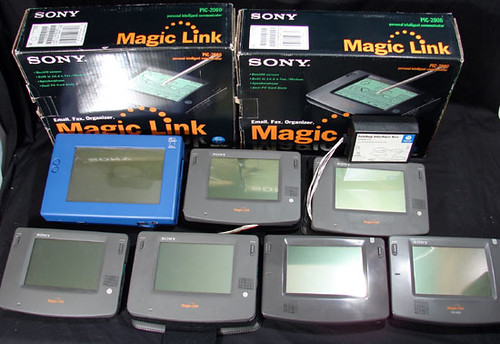
    General Magic has a reputation of being the technology equivalent of the Jordan-era Chicago Bulls, but it ended up going nowhere. I never got to see the device in person, it was only available in Japan and the US. It’s as famous much for its alumni, as it is for its commercial failure.

    Apple "Paradigm" project/General Magic/Sony "Magic Link" PDA

    This is captured in a documentary of the same name. For students of Silicon Valley history and Apple fan boys – the team at General Magic sounds like a who’s who of the great and the good in software development and engineering.

    General Magic started within Apple with a brief that sounds eerily like what I would have expected for the iPhone decades later.

    “A tiny computer, a phone, a very personal object . . . It must be beautiful. It must offer the kind of personal satisfaction that a fine piece of jewelry brings. It will have a perceived value even when it’s not being used… Once you use it you won’t be able to live without it.”

    Sullivan M. (July 26, 2018) “General Magic” captures the legendary Apple offshoot that foresaw the mobile revolution. (United States) Fast Company magazine

    The opening sequence tells you what the documentary is going to lay out. Over carefully curate images of Silicon Valley campuses, Segway riders and the cute bug like Google autonomous vehicle a voice talks about success and failure. That failure is part of the process of development. That General Magic has a legendary status due to its status as precursor to our always-on modern world and while the company failed, the ideas didn’t.

    Autonomous cars aren't nearly as clever as you think, says Toyota exec - Computerworld

    The genesis of the spirit of General Magic goes back to the development and launch of the Macintosh with its vision of making computers accessible. The team looked around the next thing that would have a similar vision and impact of a product. The Mac had got some of these developers on the front cover of Rolling Stone – they were literally rockstars.

    You get a tale of dedication and excitement that revolved around a pied piper type project lead Marc Porat, who managed to come to the table with a pretty complete vision and concept of where General Magic (and the world) would be heading. The archive of footage of the offices with its cool early to mid 1990s Apple Office products still amazes now. The look of the people in the archive footage, make my Yahoo! colleagues a decade later seem corporate and uptight by comparison.

    Veteran journalist Kara Swisher said that she started following the company because it was ‘the start of mobile computing, this is where it leads’.

    What sets the documentary apart is that it tapped into footage shot by film maker David Hoffman who was hired to capture the product development process. The protagonists then provide a voice over of their younger selves. Their idealism reaches back to the spirit of the 1960s. You can see how touch screen screens and the skeuomorphic metaphors were created and even animate emoticons.

    I’ve never known a development process with so much documentary footage. Having been in this process on the inside, the General Magic documentary portrays a process and dynamics that haven’t changed that much.

    The ecosystem that the startup assembled including AT&T, Apple, Motorola and Sony made sense given the ecosystem and power that Microsoft had behind it. It’s hard to explain how dominant and aggressive Microsoft was in the technology space. Newton came out as a complete betrayal and John Sculley, who is interviewed in the documentary comes across worse than he would have liked.

    The documentary also has access to the 1994 promotional film where General Magic publicly discussed the concept of ‘The Cloud’ i.e. the modern web infrastructure – but the documentary doesn’t dwell on this provable claim.

    Goldman Sachs was a key enabler, the idea of the concept IPO set the precedent for Netscape, Uber, WeWork and the 2020s SPAC fever.

    In a time when there is barely one thing changing the technology environment, General Magic were pursuing their walled garden of their private cloud and missed the web for a while. Part of this is down to their relationship with AT&T.

    The documentary covers how project management dogged the project. Part of the problem was perfectionism was winning over the art of the possible and not focusing on the critical items that needed to be done. The panic of having to ship.

    It’s about getting the balance between ‘move fast and break things’ versus crafting a jewel of a product.

    But shipping wasn’t enough, the execution of shopper marketing and sales training was a disaster. The defeat was hard given the grand vision. But the ultimate lesson is that YOU are not representative of the mainstream market.

    The documentary post-mortem featuring thinkers like Kara Swisher and Paul Saffo points out the lack of supporting infrastructure, that would take years to catch up to where General Magic’s Magic Link had gone. Paul Saffo uses a surfing analogy that I had previously read in Bob Cringely’s Accidental Empires about catching the right wave at the right time.

    John Sculley over at Apple made similar mistakes to the General Magic team which resulted in him being fired from Apple. Sculley makes the very human admission that being fired from Apple took him about 15 years to recover from personally.

    IBM Simon

    The documentary gives a lot of the credit (maybe too much of it) to General Magic as the progenitor of what we now think of as smartphones. The reality as with other inventions is that innovation has its time and several possible ‘inventors’; or what author Kevin Kelly would call ‘the technium’. This is the idea that technological progression is inevitable and that it stands on the layers of what has gone before, like fossils found inside rocks several foot deep. For instance, IBM created a device called Simon which was ‘smartphone’ which sold about 50,000 units to BellSouth customers in the six months it was on the market. Motorola – who were a General Magic partner also launched a smartphone version of the Apple Newton called the Motorola Marco in January 1995 and there are more devices around the same time.

    Reality is messy and certainly not like the clean direct line that the General Magic documentary portrays, even the Newton was only part of the story.

    The Wonder Years

    I was thinking about what I liked so much about the General Magic documentary. I immediately thought about it reminding me of my falling in love with the nascent internet and technology, which then bought me to the start of my agency career working with Palm (the company that eventually helped kill off General Magic’s product ambitions) and the Franklin REX which came out of sychronisation pioneers Starfish Software.

    But it was deeper than that. The Silicon Valley portrayed in the General Magic documentary wasn’t the dystopian hellscape of platform firms, generation rent, toxic tech bro culture and ‘churn and burn’ HR culture. Instead the General Magic documentary story represented a halcyon past of Silicon Valley portrayed in books like Where Wizards Stay Up Late, Fire In The Valley and Insanely Great. Where talented people motivated by a fantastic vision thing, with a user centred mission worked miracles. The darkness of fatigue and god knows what else is largely hidden by a Wonder Years TV show feel good nostalgia. Maybe it gives us hope again in the tech sector, despite Peter Thiel, Mark Zuckerberg, Tim Cook and Elon Musk? Maybe that hope might inspire something great again?

    Marc Porat’s personal tragedy and Tony Fadell’s business failure brings a hint of the real world through the door. The documentary uses Fadell’s link with the iPod and iPhone as a point of redemption, resilience, perseverance and vindication for General Magic.

    There’s also a cautionary tale full of lessons learned for new entrepreneurs, who often get the vision thing but forget about the details. More on General Magic here.

    More reviews here.

  • Enquire Within + more things

    Enquire Within Upon Everything

    Enquire Within tends to appear in book collections for people of a certain age, or, where the book collector has inherited part of their collection. Spending time on the family farm in Ireland during my childhood, I used to see a copy of an early 20th century vintage sit next to a dog-eared copy of Old Moore’s Almanac (not to be mistaken for a separate UK publication: Old Moore’s Almanack), Old Moore’s was used for deciding what to plant in the garden besides potatoes.

    During the bank holiday weekend, staying with my parents, emergency works on a water main managed to take out the broadband and electricity along their road. I went back though my Dad’s boxes of books and leafed through my parents copy of Enquire Within. My Dad thinks he had received the copy as a gift from a the owner of a second hand book store in Birkenhead market right after he had moved into the first house that my parents had bought. But he can’t be certain. Given that the outer gloss paper wrap around the hardback inner cover uses a font that looks similar to Eurostile and the price is in decimal – I guess it’s from the early to mid-1970s.

    Enquire Within could be thought of as a primer for everyday life. Topics included how to play a variety of card games, basic first aid, the basics on taxation and education with the addresses of the UK government departments responsible. There was a travel section with a few paragraphs on every western European country, which had been written by the Financial Times travel correspondent. The gardening section went into much more depth explaining what a hardy annual and hardy perennial were, alongside the correct way to build a compost heap, how to dig drills and prune roses.

    At the back there is an exhaustive list of children’s names together with their meanings.

    Enquire within

    Enquire Within and the origins of the web

    What I didn’t find out until later on was that Tim Berners-Lee was partly inspired to create a predecessor to what would become the world wide web by a Victorian vintage copy of Enquire Within that was in his parents house when he was growing up. The system was called ENQUIRE and seemed to be similar conceptually to HyperCard or a Wiki. The World Wide Web came out of Berners-Lee’s efforts to integrate disparate systems including ENQUIRE together to facilitate better collaboration between CERN research projects.

    Beauty

    Digital culture is changing our face: How South Korea is inspiring new cosmetic trends | Culture | EL PAÍS English 

    Economics

    MIT Economist Daron Acemoglu Takes on Big Tech: “Our Future Will Be Very Dystopian” – DER SPIEGELThe rich and powerful have hijacked progress throughout history, says Daron Acemoglu. They did so back in the Middle Ages and also now in the age of artificial intelligence.

    Decoupling isn’t phoney – by Noah Smith – Noahpinion

    Energy

    The Japanese Companies Pursuing a Hydrogen Economy – The Diplomat 

    Bosch starts production of 800V EV technology | EE News Europe 

    Finance

    This video on money laundering is as much of interest for the phenomenon of quality documentaries on YouTube as it is for recycling known truths about HSBC.

    Gadgets

    Global Smartphone Shipments Will Hit Lowest Point in a Decade, IDC Says – CNET – likely to be a mix of market maturity and indicative of inelastic pricing in the premium sector

    Hong Kong

    Language Log » Language and politics in Hong Kong: National Security and the promotion of topolect and Hong Kong national security police target Cantonese language | Quartz 

    Bigger, better, smoother? Hong Kong, Shenzhen border zone blueprint hopes to offer best of both worlds, as Beijing ‘exerts pressure’ to spur cooperation | South China Morning PostLeonard Chan Tik-yuen, chairman of the Hong Kong Innovative Technology Development Association, said the blueprint amounted to directives from Beijing that told both cities to become more integrated.

    Innovation

    Startup uses MEMS ultrasound to improve audio speaker | EE News Europe 

    Japan

    The Japanese student dorm that governs itself – The Face 

    Marketing

    First-Party Data Is Retail’s Next Growth Engine | BCG and CPGs may have embraced data collaboration, but they need to take it further | LiveRamp | Open Mic | The Drum. Yet more from The Media Leader: Retail media: were we right to get so excited? – The Media Leader  

    Media

    Podcast: Why OOH audiences have not hit a ‘new normal’ yet – with Route’s Denise Turner – The Media Leader

    Changes in the nature of the music industry

    Goldman Sachs Exchange

    Online

    Yahoo, taken private by Apollo Global, finds a new renaissance 

    Retailing

    The Forrester Wave™: Commerce Search And Product Discovery, Q3 2023, Surfaces The Challenges Of AI UncheckedDon’t let buzzwords distract you from what your customers — and your business — need. Vendors often use their own terminology, especially in a market that hasn’t had a Forrester Wave evaluation in place already. One will talk about how extremely relevant their results are, while another will scoff at “relevancy” as outdated methodology. You’ll hear semantic, vector, hybrid, ML, AI, and all sorts of branded names for products and functions

    Security

    The Cheap Radio Hack That Disrupted Poland’s Railway System | WIREDthe ability to send the command has been described in Polish radio and train forums and on YouTube for years. “Everybody could do this. Even teenagers trolling. The frequencies are known. The tones are known. The equipment is cheap. – This reminds me of the blue boxes used for phone phreaking decades ago.

    I Tracked an NYC Subway Rider’s Movements with an MTA ‘Feature’

    Software

    Adobe’s AI diversity auditor | Patent Dropis seeking to patent a system for “diversity auditing” using computer vision. Essentially, this system uses facial detection and image classification to break down photos of employees and slot them into categories based on certain physical traits and characteristics. Adobe’s system looks through several images and detects faces in each one, then classifies each face based on a predicted “sensitive attribute” relating to “protected classes of individuals,” such as race, age or gender. For example, Adobe noted, this system may classify images from a company’s website, then compare its predictions to a “comparison population.”

    Technology

    Mexico’s Microchip Advantage | Foreign Affairsthere are significant hurdles to making Mexico a bigger player in supply chains for chips and advanced technologies. The country lacks its Asian rivals’ existing networks of high-technology firms. Until now, investments in the sphere have been sparse. To change this situation, Mexican political and business leaders need a clearer strategy for attracting semiconductor investment. The dividends, both for Mexican industry and for U.S. supply chain security, could be significant. Today’s large-scale shift away from China-focused assembly operations offers a once-in-a-generation opportunity to create a more fully integrated North American semiconductor and electronics supply chain. Despite the United States’ major involvement in many segments of the chip industry, there is at present hardly any semiconductor packaging or assembly in the country and very little anywhere else in the Western Hemisphere. The United States maintains a leading role in R&D-intensive segments of the semiconductor industry, including chip design and manufacturing equipment. The CHIPS Act is intended to increase the amount of chip fabrication in the United States. Yet neither the United States nor any country in the Western Hemisphere plays a major role in the final stages of the chip manufacturing process—assembly, testing, and packaging (ATP)—in which semiconductors are tested and assembled into sophisticated packages. The Western Hemisphere also does relatively little assembly of advanced electronic systems that require a lot of chips, such as consumer electronics.

    Web of no web

    Surfings equivalent of a dive computer: Search GPS Test User Signup

  • Wonderlust Apple event

    The Apple Wonderlust event happened on September 12, 2023. The events timing fitted in with the two Apple events a year that we have grown to expect:

    • Worldwide Developers Conference – in June.
    • Autumn event in September / October.

    Unlike when I started buying Apple products these events are no longer hosted at external conference centres but at Apple’s own conference centre as part of its campus. For the past decade and a half Apple hasn’t participated at wider trade shows, in the same way that the likes of Samsung or Microsoft would at CES.

    Wonderlust iPhone 15 pro
    Apple Inc.

    Apple events from the late 1990s onwards built their reputation for being great live performances by Steve Jobs and the management team. COVID-19 seems to have allowed Apple to move to a pre-recorded keynote that the media and general public watch together either in person or streamed online, followed by the media being allowed to get hands on with the products.

    This allows for a polished event presentation, all-be-it one that might be out of touch with its audience. More on that later.

    Is wonderlust even a word?

    A quick look at dictionaries offline and online kept bringing up results for wonderlust – the hankering to travel. That was until I hit Urban Dictionary that categorised wonderlust this way:

    the desire to be in a constant state of wonder
    Joe had a serious case of wonderlust: he was bored of anything ordinary.

    There were other definitions, but I think that they were outside the scope of where Apple wanted to go.

    TL;DR

    If you’ve bought an Apple product in the past three years there weren’t any ‘must buy’ products showcased in the Wonderlust event. Your iPhone and Apple Watch will still be good enough and benefit from this years upgraded OS. If you have a device over three years old then upgrading to the new products is worth considering.

    Apple still hasn’t jumped on the folding screen bandwagon that Samsung has. Given that we don’t see question-and-answer sessions that Steve Jobs sometimes indulged us with we don’t know the definitive ‘why’ yet.

    The meh moments

    There was more to criticise in this Apple events than other recent ones.

    USB-C as a benefit

    The reality is that in order for Apple to sell in the European Union it has had to move the iPhone and AirPods to a USB-C connection, away from the the Lightning connector. Apple tried to play this off as an improvement that they’d made to their phones, but the reality is that it was a change forced upon Apple.

    Cringeworthy ESG update

    Part of the pre-recorded content was a skit where Mother Nature turns up at Apple HQ for a meeting with the team about improvements in their environmental record. The problem was that the film was out of touch with the audience and has been roundly criticised.

    For five minutes, we had the same thing over and over. It might be about materials one moment and packaging the next, but it was a single gag stretched out too far.

    It was stretched so thin that you could see the thinking behind it. Every single element was good by itself, and no one would cut anything. 

    But the result is that every single element was undermined by the repetition. And instead of Apple showing it was better than just sell-sell-sell videos, the result was that the sketch felt like padding in an event that’s like drinking tech data from a fire hose.

    AppleInsider – Apple’s ‘Mother Nature’ sketch was a complete dud, and didn’t belong in the iPhone 15 event

    I do think it went on too long — the whole segment (sketch plus details) in fact was just 10 minutes long, not 20. But seemingly everyone, including me, felt like it lasted 20 minutes, which is never a good sign.

    Daring Fireball (John Gruber) – Thoughts and Observations on This Week’s ‘Wonderlust’ Apple Event

    There were some good points highlighted:

    • Recycled materials usage. There were also claims made about leather usage, but these only applied to Hermés straps sold within Apple’s own retail channels.
    • Taking plastic out of packaging. Apple has been minimising packaging by taking items out of the box (iPhone earphones, iPhone charger being two high profile examples). But now it’s taking plastic out of packaging as well. Its able to do this due to control of all aspects of its manufacturing process and packaging re-engineering. This is also pleasing to Apple shareholders. Given that Apple’s packaging is bought at scale, decreased materials usage and size means less risk of damage and reduced cost of manufacture & transport – any increased cost in design and packaging development will be amortised across millions of units. You see a similar benefit in Apple’s product materials as well such as aluminium laptop chassis.
    • Carbon offset for energy used not only in the manufacture of Apple Watch, but also throughout their expected life.
    • A move towards more ocean freight to reduce logistics carbon footprint, compared to air travel. This will have had a direct impact on the flexibility and responsiveness of Apple’s global supply chain, particularly custom specified products like non-standard MacBook Pro configurations.

    Apple still has a lot of problems however and here are three of the biggest:

    • With the exception of the Apple Pro, Mac models can no longer be upgraded, which reduces reparability and product life.
    • AirPods can’t be repaired, only thrown away. This is a problem for the wireless earbud category in general, but Apple are a leading player in the market and can set the the tone in the market through innovation.
    • The very nature of Apple’s business could be considered to drive excessive consumption. In sharp contrast, one of the traditional reasons why one owned a Mac was that you got a computer that was useful for longer. I am currently using a couple of Apple Thunderbolt displays that are between 8 and 12 years old. Prior to the iPhone I was using Macs that may have been eight years old by the time that i parted company with them.

    Incremental product improvements

    The announcements would have felt like tweaks for consumers. Apple Watches got more powerful processors for the first time. The iPhone Pro titanium frame would marginally reduce the weight of the handset. Apple has previously used titanium in laptops between 2001 and 2003, so the material isn’t completely new to the brand. The camera can create video and photography with depth for the Apple Vision Pro. Camera performance with darker skin tones has been improved to match Google Pixel driven innovation. But battery life is ‘about the same’ as previous generations.

    Many of the software improvements including live stickers are likely to be be in the iOS upgrade available to previous generations of phones.

    Ok, so what if anything was interesting about the event?

    There were three things that while they wouldn’t make me want to go out and buy a new device are still important developments, based on the direction that they are taking Apple products.

    Service integration

    Apple iPhone is moving beyond emergency satellite text services to breakdown care via satellite as well. It’s interesting that Apple is continuing to go beyond cellular. It is starting to look like the kind of differentiation Vertu used to enjoy with its single button concierge service. It supports the viewpoint that Apple is a luxury adjacent, if not luxury brand.

    Mechanical engineering on the iPhone camera

    Apple has managed to cram in a lens with an equivalent focal length of 77mm into the iPhone 15 Pro through a novel prismatic lens design. The device also uses a similar mechanism design to that used on Pentax DSLRs to compensate for device shake. The titanium frame probably provides additional rigidity for this system to work to its full potential. However the weight loss of the device might drive increased shake so there is a careful calibration in choices that the engineering team made.

    On-device machine learning

    The Apple Watch had redesigned silicon to move machine learning from the cloud or iPhone device on to the Watch itself. This improves response time, but also points to a move of taking large language model systems and neural networks out of the cloud and on to the device. Given that the watch also features ultra wideband wireless connectivity, it’s an especially interesting choice decoupling the watch from the iPhone.

    More Apple-related content here.

  • Gatekeeping + more things

    Gatekeeping

    I wish gatekeeping was a thing back in 2005 and 2006 when I was working on the international launch of Yahoo! Answers. The problem that we had was getting people to contribute answers to questions. Gatekeeping and the exhortation to not gate keep is about sharing knowledge and opinions freely – an in real life version of what we saw in early social publishing. Ironically gatekeeping stands in sharp contrast to oversharing as a social faux pas. The kind of knowledge that concerns about gatekeeping is particularly opposed to is opinion based knowledge or NORA.

    Now ‘your jam’ is no longer your jam, but instead offered up to be other people’s jam instead. Your individuality ready to be cloned at a moments notice. Will everything descend to being ‘basic’ or mainstream? Does it disincentivise possessing good taste?

    gatekeeper

    What the Internet’s Use of ‘Gatekeeping’ Says About PowerThe rise of “Don’t gatekeep” has reframed keeping things to yourself as a selfish act. But not everything is for everyone! And sometimes the act of sharing does more harm than good. I’m thinking of how Anthony Bourdain felt conflicted about sending droves of tourists to mom-and-pop restaurants. I’m thinking of gentrification and what happens when certain neighborhoods are positioned as hidden gems.

    Beauty

    Why Groupe L’Occitane may delist from the Hong Kong stock exchange | Vogue Business

    Consumer behaviour

    My Generation, by Justin E. H. Smith – captures a sense of now rather than a generation

    Economics

    Study Times op-ed shoots down new policy options | Pekingologytranslation from an article from the Study Times. Comments on infrastructure are particularly instructive in terms of the view point that they reflect: To debunk views such as “infrastructure overcapacity is wasteful,” “promoting infrastructure equates to taking the old path that’s inconsistent with high-quality development,” and “limited space,” it’s crucial to fully understand the role of infrastructure investment from a holistic perspective of national economic development. Infrastructure investment doesn’t only interact with the expansion of aggregate demand to stabilize economic operations, but also enhances macroeconomic efficiency, improves people’s living standards, and robustly supports high-quality development. Overall, there’s no issue of excessive infrastructure. On the contrary, there are areas that hinder the efficiency of the national economy and the improvement of people’s living standards. China’s per capita infrastructure capital stock only accounts for 20% to 30% of the developed countries, and public facility investments per rural resident are only about a fifth of an urban dweller, indicating potential for investment

    New analysis reveals how Porsche-VW ‘short squeeze’ distorted the stock market | The University of Kansas 

    Energy

    US airlines ally with farmers to seek subsidies for corn as jet fuel | Financial Times 

    FMCG

    Reckitt Benckiser: too many sterile quarters leave share price flat | Financial Times 

    McDonald’s Hong Kong and Kevin Poon “Coach McNugget Art World” Exhibition | Hypebeast – via Ian at Deft. This was to celebrate 40 years of the McNugget. McDonald’s have always done some smart cultural marketing work in Hong Kong (such as an McDonalds Big Mac themed issue of Milk magazine). Hong Kong seems like a natural home for these things, I remember activating a Coke Zero x Neighborhood collab while there.) But it isn’t only a Hong Kong thing, McDonalds has done some strong cultural marketing internationally as well: from the Cactus Jack happy meal to a bounty programme for rappers that namedropped McDonalds on their mixtape over the years. As my friend Ian observed this is at odds with their current UK positioning ‘ McDonalds is the perfect place for estranged parents to meet their kids for awkward conversations’. The implication in that McDonalds restaurants are a lower rent third space (than Starbucks or Costa) positioning. I have welcomed their value-priced coffee and breakfasts at the end of an all-nighter on a pitch or a long drive. But the UK’s the third space aspect loses all the joy that McDonalds manages to imbue in their children experiences – the treat, the birthday party, the expectation of picking up a much wanted toy in a happy meal. The child to adult disconnect in the experience is something cultural marketing like this can help bridge if done in the UK.

    Gadgets

    US Feature Phone Market Stages Comeback as Gen Z, Millennials Advocate Digital Detox | Counterpoint Research – the reasons are more diffuse than this article is letting on. People like my parents are being forced to get new feature phones by network upgrades. Some people can’t use a smartphone and then there is the digital detox brigade which spans generations, people who need tough phones AND people still needing second phones

    Germany

    TSMC’s New Fab in Germany – by Jon Y – focus around automotive just has Germany has been caught on the wrong side of the move to electric cars

    Chinese responses to Germany’s China strategy: Attack abroad, assuage at home | Merics

    Health

    Unravelling the Link Between Socioeconomic Status and Obesity | INSEAD Knowledge

    Hong Kong

    Hong Kong’s corporate lawyers test boundaries as Beijing’s influence grows | Financial Times – legal practitioners, including corporate lawyers, are concerned the broadening scope of a sweeping national security law could jeopardise the independence of the city’s legal system, a legacy of British administration, as Beijing tightens its grip. “There is general concern . . . that people are not fully understanding where the boundaries lie,” said a senior corporate lawyer with a global firm who has worked in Hong Kong for more than two decades

    The Great Dilution: Hong Kong’s Changing Population Mix | Asian Sentinel

    Hong Kong delays Jimmy Lai trial as police question woman linked to exiled lawmaker | Radio Free Asia

    Innovation

    FDA Largely to Blame for Physicians’ Misperceptions on Nicotine | RealClearPolicy

    Materials

    DARPA looks to monetise the Moon | EE Times 

    Media

    Artificial Intelligence Lawsuit: AI-Generated Art Not Copyrightable – The Hollywood Reporter

    Online

    What is dark social and why does it matter for your brand? – New Digital Age 

    ICANN warns UN may sideline techies from internet governace • The Register – move towards China’s vision of cyber-sovereignty

    Retailing

    Small retailers and fans step in as Nike refuses to make replica Mary Earps shirt | England women’s football team | The Guardian 

    Security

    US nuclear submarine weak spot in bubble trail: Chinese scientists | South China Morning Post

    New Supply Chain Attack Hit Close to 100 Victims—and Clues Point to China | WIRED and Dark Reading’s take: Chinese APT Targets Hong Kong in Supply Chain Attack 

    Daring Fireball: ‘Changes to U.K. Surveillance Regime May Violate International Law’As I see it, the most likely outcome is that the U.K. passes the law, thinking that the grave concerns conveyed to them by the messaging services are overblown. That the platform providers are saying they can’t comply but they really just mean they don’t want to comply because it’s just difficult, not impossible. And when it becomes law, the platforms will hand it off to the nerds, the nerds will nerd harder, and boom, the platforms will fall into compliance with this law. That’s what they think will happen. What will actually happen, I believe, is that E2EE messaging platforms like WhatsApp (overwhelmingly popular in the U.K.), Signal, and iMessage will stop working and be pulled from app stores in the U.K., full stop. The U.K. seems to think it’s a bluff; I don’t

    Singapore

    Money Laundering Bust Puts Foreign Wealth in Singapore on Notice | Asia Sentinel – if that occurred at the behest of the China then we’re likely to see flight overseas from Singapore. It’s also interesting that these raids have come soon after China arrested a Shanghai immigration consultant to get hold of their database of UHNWI overseas (predominantly in the US). They second question I had would be why Singapore would cooperate with China on this?

    Software

    Now is the time for grimoires – by Ethan MollickWith the rise of a new form of AI, the Large Language Model, organizations continue to think that whoever controls the data is going to win. But at least in the near future, I not only think they are wrong, but also that this approach blinds them to the most useful thing that they (and all of us), can be doing in this AI-haunted moment: creating grimoires, spellbooks full of prompts that encode expertise. The largest Large Language Models, like GPT-4, already have trained on tons of data. They “know” many things, which is why they beat Stanford Medical School students when evaluating new medical cases and Harvard students at essay writing, despite their tendency to hallucinate wrong answers. It may well be that more data is indeed widely useful — companies are training their own LLMs, and going through substantial effort to fine-tune existing models on their data based on this assumption — but we don’t actually know that, yet. In the meantime, there is something that is clearly important, and that is the prompts of experts.

    Style

    Where Streetwear and Tech Cross Paths: ASUS Vivobook X BAPE® – one of the more cynical collaborations that I have seen with streetwear brands

    Technology

    Deal to develop generative AI on quantum computer | EE Times – how will quantum computing affect a GPT type Bayesian model?

    Web of no web

    Trybals is a YouTube channel that features people from the less developed parts of Pakistan and asks their reactions about different aspects of the modern world. It’s an interesting bit of anthropology. In this episode the panel gets to try a VR experience.