Ideas were at the at the heart of why I started this blog. One of the first posts that I wrote there being a sweet spot in the complexity of products based on the ideas of Dan Greer. I wrote about the first online election fought by Howard Dean, which now looks like a precursor to the Obama and Trump presidential bids.
I articulated a belief I still have in the benefits of USB thumb drives as the Thumb Drive Gospel. The odd rant about IT, a reflection on the power of loose social networks, thoughts on internet freedom – an idea that that I have come back to touch on numerous times over the years as the online environment has changed.
Many of the ideas that I discussed came from books like Kim and Mauborgne’s Blue Ocean Strategy.
I was able to provide an insider perspective on Brad Garlinghouse’s infamous Peanut Butter-gate debacle. It says a lot about the lack of leadership that Garlinghouse didn’t get fired for what was a power play. Garlinghouse has gone on to become CEO of Ripple.
I built on initial thoughts by Stephen Davies on the intersection between online and public relations with a particular focus on definition to try and come up with unifying ideas.
Or why thought leadership is a less useful idea than demonstrating authority of a particular subject.
I touched on various retailing ideas including the massive expansion in private label products with grades of ‘premiumness’.
I’ve also spent a good deal of time thinking about the role of technology to separate us from the hoi polloi. But this was about active choice rather than an algorithmic filter bubble.
The elections in Germany marks the end of 16 years run with Angela Merkel as the Chancellor of Germany. Helmut Kohl was in office for only slightly longer. It feels like the end of an age, and in one sense it is.
Most Germans believe their ‘golden age’ is over, poll finds – “These findings suggest that, while Angela Merkel has cemented Germany’s position as a great European power, the cornerstones of her legacy – neutrality and consensus building – will not be enough to defend the unity of the EU, and its place in the world, in the years to come.” Germans will head to the polls on September 26 to elect a new parliament and choose a successor to Mrs Merkel, who has served as chancellor since 2005. Her own party, the Christian Democratic Union, is lagging its coalition partner, the centre-left Social Democrat Party, in polls. Mrs Merkel’s SPD finance minister, Olaf Scholz, is likely to become the next chancellor.
Angela Merkel’s legacy is complex. She struck up relationships that were bad for Europe and strategic rivals of Germany:
The Other Side of Angela Merkel’s 16 Years as German Chancellor | Foreign Policy – Far more troubling was the substance of many of her policies, which we can simply label “Merkantilism,” defined as the systematic prioritizing of German commercial and geoeconomic interests over democratic and human rights values or intra-EU solidarity. From her coddling of Hungarian strongman Viktor Orban as he built the EU’s first autocracy to her active courting of Europe’s geostrategic rivals in Russia and China, Merkel has tended to place German profit and expediency above European principles and values
Germans Demanding New China Policy. Will the Next Chancellor Deliver? | National Review – no matter who wins, German public opinion, pressure from the United States, and the strong possibility of having to partner with the Green Party in a coalition government make it likely the victor will be pushed in a more hawkish direction. The same hardening found among the German public is also happening in Parliament and the foreign ministry. Conservatives in the United States rightfully lament how bureaucracies often influence policy outcomes against the wishes of the principals leading them, not the other way around. When it comes to the future of Germany’s China policy, those bureaucratic exertions might not be such a bad thing
Democratic capitalism in crisis
Angela Merkel helped facilitate the rise of Viktor Orban in Hungary and facilitated similar a populist movement in Poland. Not actively, but by inaction. Which makes this interview with Martin Wolf of the FT all the more pertinent. More related content here.
60 minutes on Hong Kong
The Hong Kong government finished its engagement with a PR agency called Consolum. This agency came up with messaging for a campaign to relaunch Hong Kong. Quite how these messages would work effectively, when there is so much material ripe for the media to work against their measurement.
Some of it is surreal. Trade unions are considered subversive. Providing allowed allowed gifts to prisoners such as shower gel and packets of M&Ms became a natural security threat.
To think about content in the online realm it makes sense to go back to 1964.
In 1964, the idea of being online and exposed to hypermedia was the stuff of information theory papers and the fevered dreams of researchers on government projects trying to build working packet networks.
The medium is the message
Canadian philosopher Marshall McLuhan published his book Understanding Media[1] introduced a concept in the title of the first chapter of his book, that would become common cultural currency. This was that ‘The medium is the message’. The expression neatly captures the idea that the communication being used— email, podcast, social media post, documentary film, white paper etc.—will affect how the message is perceived. Even, if the same message is communicated with different media. That is why an article printed on the salmon pink paper of the FT seems to carry more weight literally and figuratively than content in the online realm.
‘The medium is the message’ is often used in the context of media considered influential on society, including forms of media that are thought to have changed how people experience the world. An area that online communication fit neatly into, just in the same way that television and video cassettes would have in the 1980s, as illustrated by this scene from the movie Back to The Future.
When we think of content, particularly in the online realm, the medium itself helps dictate our thinking. From a marketers perspective, at least in theory, every action in the online realm is trackable. So marketers think that they can use content in the online realm to take the audience through a curated journey to adoption and beyond.
The marketer will have mapped out paths that customers will receive content on like a hunter baiting a trap. The idea clearly meshes with concepts like the sales funnel. Marketers would be able to track the audience through a journey and prompt them to take the next step through emails and advertising retargeting.
This cajoling might be triggered on customer responses through the power of artificial intelligence, that dynamically adapts to each customer, or a sales rep in a follow-up to conversation. This is would be considered to be part of the marketing function’s digital transformation.
Digital transformation
If you are reading this article, chances are you’ve read about digital transformation, seen internal presentations, listened to podcasts, been to the webinars and possibly in person conferences about the subject area.
Digital transformation typically offers an efficient technology-centred approach, but consider for a moment if it’s a consumer-centred way?
Which begs the question: As marketers and creators, what should we be doing for the estimated 95% of the time when the audience isn’t in a frame of mind to move towards adoption?
The sales funnel
The sales funnel is one of the most enduring ideas in sales and marketing. A recent article by strategist Tom Roach described it as ‘the cockroach of marketing concepts’[2]. It appears in various designs in the smart art function of Microsoft® PowerPoint® – such is its importance in the business world. The importance of the sales funnel is recognised by Mark Ritson, who believes in their use to marshal the thoughts of marketers in terms of periodisation, rather than its literal application[3].
In his article Roach makes the point that the sales funnel started out as the AIDA model. AIDA (Attention, Interest, Desire, Action) in turn came out of door-to-door personal selling in the late 19th century. It was a way to teach sales people how to navigate buyers to make a purchase in a single conversation on their doorstep.
The book Bond Salesmanship[4] in 1924 used a ‘funnel’ metaphor with the AIDA model to encourage a consumer to make a purchase.
One interesting aside by Roach was Bond Salesmanship was about facts being ‘forced down’ the funnel rather than people. The generally accepted use now is to convey customers through, stage by stage. All of which is completely divorced from its original use in a personalised single session.
When I had been in college the sales funnel was only mentioned in passing in foundational modules on consumer behaviour. The lecturer used it as way of conceptualising how marketing worked as a visual accompaniment to the AIDA model rather than being used in a literal sense. At the time, my lecturer felt that consumers were too post modern in nature to apply it.
The popularity of the funnel seems to have grown again with the rise of advertising technology and marketing automation platforms. Historically enterprise technology companies have relied on personal selling to their business customers. This may have had something to do with the model’s adoption and application in a multi-session customer journey by adtech development teams as their ‘model’.
A model is handy as a mental framework to simplify the understanding of a concept, but it often falls down in a real-world environment. The sales funnel is no exception:
The perfect customer fallacy. Customers will remember what you’ve told them in the previous stages, in the order that you told it to them. This point is a complete fiction, people often don’t remember what they’ve been told. Which is why a lot of work has been put into consumer memory encoding and revival as a subject area. It is why reach and frequency are important aspects of any paid media plan[5].
As designed, the sales funnel has no concept of memory. Is this a product that you’ve bought before? What was your experience like? Are you happy to use it again? Do you actively seek it out as a product that you want to use?
The reason for both of these limitations is that the sales funnel was originally developed for single session selling opportunities, not the kind of relationship that brands typically have with stakeholders today.
McKinsey came up with a circular journey that had been called the loyalty loop to allow for customer memory.[6]
McKinsey
James Hankins of Vizer Consulting came up with a conceptual model[7] that better addresses the perfect customer fallacy. Hankins model also implies the role of brand building as well as brand activating content in the customer buying process.
James Hankins
What does all this have to do with content in the online realm?
We know that we have a desired journey for content, that is often designed around the sales funnel. But we also need to build content around that. If the consumer journey is storytelling, then the content around it is more akin to world-building.
This has been called content continuity by others.[8] Content continuity supports the web of interactions that aren’t a purchase in the James Hankins model.
The storytelling provides our core content, the content continuity builds around that. Content continuity provides supporting information.
How do we think about content in the online realm in order to create content continuity? The key to thinking about this content is to think about it in two dimensions. The first dimension is around content themes. What are the content themes that the content journey relies on and what is the content areas that are tangential to these areas? This will vary based on the product, service or campaign.
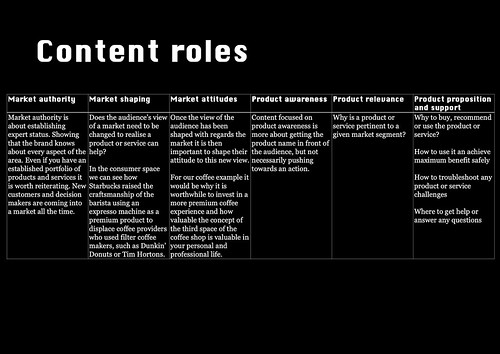
The second thing to consider is how this content affects the audience in terms of exposure to the brand, exploration, evaluation and experience. With this in mind consider how your content themes fit into the following six areas that impact exposure, exploration, evaluation and experience. Are there any obvious gaps that need to be plugged?
The author’s own creation
If you are marketing to a well-understood category with a well-understood idea of what is good, that your product or service fits into then you probably not need to consider market shaping or market attitudes. Otherwise, it makes sense to see how the content themes cover: market authority, market shaping, marketing attitudes, product awareness, product relevant and product proposition / support.
Tonality
The tone of content needs to be appropriate to the job that needs to be done. Safety instructions or a list of allergens in the product could do without a touch of levity. However, in other areas it is worthwhile thinking about how emotion could be used appropriately. Research shows that emotional priming content aids long term sales uplift.[5]
Remix, re-edit and reuse
Once you’ve created great content, the next thing to think about is how it can be put to the best use with necessary tweaks, expansions or modifications. A webinar can be turned into video on demand content. A presentation script can be turned into an opinion piece or white paper.
Think about how it connects with other content. This means connecting content together and treating your digital presence as an ‘embassy’.[9] This embassy approach facilitates audience exploration and evaluation.
Ignoring the digital dictatorship of the marketing automation black box
All of the processes that we’ve outlined take a human-centred approach, this means that they may not fit in with the algorithmic driven ‘black box’ approach beloved of marketing automation platforms. This means doing content for the right reasons, not just for the right numbers. It takes bravery to ignore the hectoring and dictatorial nature of the ‘black box’, but who should your organisation put its faith in, its marketing staff or a ‘one-size fits all’ algorithm? I would argue that data and metrics should inform, but not dictate an approach.
Netflix are doubling down on The Witcher franchise with their Witcher: Nightmare of The Wolf anime. The approach is very similar to the approach that Netflix took with Altered Carbon. Looking at how well that anime turned out, I have high hopes that Nightmare of the Wolf will live up to the trailer that Netflix has dropped.
The Witcher: Nightmare of The Wolf
OpenAI Codex demo
OpenAI demo-ed the use of AI to code from normal human language a web interface design. It’s a smaller move forward than you would think it is, but it has programmers worried. Secondly, its hard enough to work out what something does if it is coded by a human who doesn’t document as it goes. A machine learning based coder represents an even greater level of opaqueness, which poses challenges for when code would need to be updated. You can learn more about OpenAI Codex here.
Mercedes Benz 300SL
The 1950s saw Germany rebuilding after the war and its companies coming back after the war. Before the space race, there was the jet age and there was motor racing. Mercedes Benz looked to make a statement about its position in the motor industry and the way to do that was through motor racing. Stirling Moss driving a Mercedes 300SLR put the company back on the map. Two years later Mercedes released a two door version of Moss’ car to the public called the 300SL. It was light, expensive, exciting and had jet age vibes with its aerodynamic styling and gull wing doors. Something that still looked futuristic almost 30 years later on the DeLorean.
But the 300SL could also kill the unwary driver due to its rear swing axles. The car could go into sudden oversteer mid-corner if you stabbed the brakes or take the foot off the throttle in the bend. I know this, not because I had driven one, but because I was an avid reader of Car magazine from the mid 1980s to the mid 1990s.
Car magazine was in a golden age, when motor journalism was as much literature as product information. Journalists wrote up to the intellect that they wanted their readers to have rather than writing to a lowest common denominator. Something that I have tried to do with this blog over time, but not nearly as well. Back to the killer handling: and the expensive coupe.
Mercedes replaced the gull wing coupe with a roadster body shape and took the opportunity to change the handling.
Tyler Hoover of Hoovies Garage had a chance to drive one of the roaders.
Tyler Cowen interview
I have been following Tyler Cowen’s economics blog Marginal Revolution for years and posted links to it here. Ashish Kulkarni interviewed Cowen about some of his blog posts, the philosophy of economics and the challenges facing universities and their students. Cowen’s day job is a professor at George Mason University in Washington DC.
Fake reviews on products including Amazon Prime items (image via quote catalog
Shenzhen to support Amazon merchants | Trivium China – 50,000 merchants were banned from Amazon for astroturfing false reviews. The ban was worth up to 100 billion yuan in sales to these merchants. Half of the merchants affected are based in Shenzhen. Now the Chinese government is looking at what it can do to help the merchants practicing false reviews. Yet it wouldn’t tolerate false reviews if it was exposed in in the domestic market. One of the options being looked at is a platform to rival Amazon Marketplace, that would allow fake reviews
Study: Companies Aren’t Living Up To Chinese Consumers’ Expectations – Three in four (75%) informed Chinese consumers (defined as consumers interested or involved in one of 20 industries studied in the research) said CEOs should speak up on issues that “may not have a significant impact on the business but have a significant impact on society,” with particular focus on diversity and diverse representation within a workforce and its leadership. Yet just 35% of respondents in China feel companies in China can do more to make the workplace better. Similarly, 80% agree that CEOs should have a voice on the environmental policy debate, and three quarters (75%) say business leaders should have a role shaping health policy, the research found. Respondents ranked value and innovation as the top two drivers of brand perceptions in China. Only 35% of companies, however, are meeting expectations in those areas – the key term is ‘informed consumers’, I am sure that the Chinese government might not view things in quite the same way
The Hong Kong National Security Law: The Shifted Grundnorm of Hong Kong’s Legal Order and Its Implications by Han Zhu :: SSRN – the application of mainland laws in Hong Kong, the interpretation of the NSL, cross-border criminal jurisdiction, national security institutional infrastructure, and the legal language. To some extent, the enactment of the NSL is like a silent constitutional reform that has reshaped, and will continue to reshape, a wide range of aspects of Hong Kong law as well as the Basic Law. Due to the dualistic nature of the NSL as a national law which applies to both the mainland and Hong Kong, it has also expanded and deepened the interaction and conflict between legal systems in the two regions, highlighting the inherent tension of maintaining the unity of a heterogeneous legal order under one country, two systems
Influencers want to be paid more than ever. Blame the pandemic | Marketing | Campaign Asia – no one is asking the question in this article, are influencers overpriced, or even worth it compared to other “Industry can also factor in, with some influencer niches starting at a higher price point than others,” says Heather Rottner, director of social media at Coyne PR. For instance, she says the firm generally sees higher rates in high-end fashion and beauty, food and DIY. While there is no shortage of influencers looking for brand partnerships in these categories, “many influencers pride themselves on being selective and authentic which means they don’t jump on every partnership offer they receive or use just any product.”
Media
‘Spreading like a virus’: inside the EU’s struggle to debunk Covid lies | World news | The Guardian – Until the pandemic, there was no monitoring of fake stories originating from within EU countries or linked to countries other than Russia. While China Global Television Network (CGTN), an English-language cable news channel controlled by the Chinese Communist party, is considering a Brussels expansion StratCom until recently had just two people working on Chinese disinformation. Several former EU analysts said multiple state-backed disinformation campaigns, not just Russian, had taken advantage of Covid and Richter believed the EU’s limited focus on Russia “affected the legitimacy of the project.”
Security
The threat of a “cyber Pearl Harbor” is a red herring — Quartz – the damage of cyberattacks comes from a series of piecemeal hacks that are often hidden from public view and don’t always lead to immediate, tangible harm. The actual threat looks less like a barrage of bombs and more like a spy slipping a gloved hand into a filing cabinet or a mobster strolling into a shop to collect a “protection” payment
Who is being monitored? Tutanota – interesting data points, I would imagine that other western countries would have a similar split in use of monitoring
Huawei Accused in Suit of Installing Data ‘Back Door’ in Pakistan Project – WSJ – Another day, another dodgy security story involving Huawei – BES, says in a lawsuit filed Wednesday in California district court that Huawei required it to set up a system in China that gives Huawei access to sensitive information about citizens and government officials from a safe-cities surveillance project in Pakistan’s second-largest city of Lahore. Muhammad Kamran Khan, chief operating officer of the Punjab Safe Cities Authority, which oversees the Lahore project, said the authority has begun looking into BES’s allegations.
Haidt is a social psychologist by training and currently serves as professor of ethical leadership at New York University Stern School of Business. I heard an interview with Haidt on the the dark psychology of social networks and this book came up which was the key reason why I bought it.
Greg Lukianoff
Lukianoff is a lawyer by training and president of Foundation for Individual Rights in Education (FIRE), a US based group that free speech rights on college campuses. If it was Lukianoff on his own I would likely dismiss this book as partisan.
Premise of The Coddling of the American Minds
In The Coddling of the American Mind Haidt and Lukianoff discuss factors that are affecting the resilience of young people emerging from colleges in the US.
They suggest a number of factors for the increasing intolerance and threats to American life from the left and the right.
Intimidation and violence on campus – the book highlights examples on both the left and right of the political spectrum. Violence by left wing protestors at Berkeley was particularly disturbing due to the lack of action by law enforcement
Witch hunts against academics
Self reinforcing cycle of political polarisation
Paranoid parenting compared to the latch-key parenting that older people would have been used to growing up
The decline of outdoor play
Safetyism – the move of safety culture from improving physical safety promoted by the likes of Ralph Nader (safer workplaces, no lead paint on toys etc) to encompass mental and emotional safety as a priority
The quest for justice. The complexity of how you define justice is important
Haidt and Lukianoff are of the opinion that you need to prepare people for life and to be resilient. That this approach doesn’t detract from the desire to change the world seems to be ignored by advocates of the status quo.
How the book has been received?
The Financial Times generally praised the book and it ended up on the New York Times bestsellers list.
The book was perceived as an attack on progressive liberal values by some reviewers, whereas I think it wasn’t attack on those values, but the means by which they are being pursued. It confronts the hard truth that there is intolerance at both ends of the political spectrum and a lack of dialogue.