Category: london | 倫敦 | 런던 | ロンドン

Why London?

First of all I live in London, I put down my roots here because of work. Commuting from the outside towns into the city takes a long time. People only tend to do that when they don’t have to come in every day or getting their kids into a good school is important for them.

Secondly it is an area distinct from the rest of the UK, this is partly down to history and the current economic reality. It is distinct in terms of population make-up and economic opportunity. London has a culture that is distinct from the rest of the UK, partly due to its population make-up. Over 30 percent of the city’s inhabitants were born in another country. From music to fashion, its like a different country:

  • As one women’s clothing retailer once said on a news interview ‘The further north you go; the more skin you see’.
  • The weekend is a huge thing outside the city. By comparison, it isn’t the big deal in London. The reason was that there were things you could enjoy every night of the week.
  • You can get a good cup of coffee
  • The city was using cashless payments way before it became universal elsewhere in the country
  • The line has extended into politics. London opposed Brexit. London, like other major cities it is one of the last holdouts of Labour party support in the 2019 UK general election

London posts often appear in other categories, as it fulfils multiple categories.

If there are London subjects that you think would fit with this blog, feel free to let me know by leaving a comment in the ‘Get in touch’ section of this blog here.

  • The limits of digital

    A few articles that I read over the past few days highlighted the limits of digital. The FT published an analysis on the modern problems that digital has wrought on the advertising industry.

    Jeff Goodby, chairman of Goodby, Silverstein & Partners – a successful longtime American advertising agency said:

    In the past, he said, the only true measure of success was whether the public knew and cared about your work. “You could get into a cab and find out, in a mile or two, whether you mattered in life, just by asking the driver.” Now, “No one knows what we do any more.”

    In essence advertising campaigns had lost talkability, positive brand associations and long term memorability – the kind of things that you would think of being important in terms of marketing’s role in brand building. Digital has worked in performance marketing, brand building shows up the limits od digital

    Brands, particularly emerging brands like designers have it as bad as advertising agencies, here’s fashion site Man Repeller on the challenges of building a brand:

    When I first started working in fashion retail, coming from a fine arts background, I thought it would be completely different. Working with the clothes but also seeing the way it had to recycle every six months got me thinking about the branding that gets pushed upon designers. I think it happens in all creative fields because of social media. I see it with a lot of my peers. We see the same obsession with youth — young painters — in the art world that you have in fashion with young designers, the same pressure for a cohesive vision. At 25? Nobody knows what they’re doing at 25. And that’s totally fine. You’re still finding yourself. And there has to be more room to find yourself when you’re young as opposed to this pressure to emerge as a fully formed Greek myth coming out with her uncracked egg, or whatever.

    Which impacts the kind of businesses likely to grow in the future. They are likely to be ‘culturally stunted’.

    The noisy environment of social has meant that brands are also distorting themselves to get cut through, Vice magazine covered what can only be described as sociopathic brand personalities of independent coffee shop chains in London.

    Or Instagram baiting street side billboards like a pub landlord who misquotes Enoch Powell and thinks that the National Front aren’t serious on race issues

    More digital related posts here.

    More information
    How the Mad Men lost the plot | FT
    MR Round Table: The Burnout Generation – Man Repeller
    London Is Tearing Itself Apart Because of Coffee Shop Sidewalk Signs | VICE
  • On the sofa: No blood no tears

    No blood No tears – One of the best kept secrets in London is the free sessions put on by the Korean Cultural Centre just off Trafalgar Square. I caught the last film of the year to be shown at the centre. No blood No tears is a Korean heist story. Gyung-Sun is a former safe-cracker who has reformed and become a taxi driver.

    Her husband is in the wind and left behind a lot of gambling debts that local loan sharks try to collect on. She doesn’t know where her child is and to cap it all Gyung-Sun has a difficult relationship with the police and her short temper.

    A chance car accident brings her into contact with a petty gangsters moll and a plot ensues to rob the dog fighting arena where illegal gambling takes place. What ensues is a film that is part comedy, part Thelma & Louise and a healthy dose of ultra-violence that would be familiar to Hong Kong cinema and Tarantino fans.

    Over the next few weeks I will be getting my fix of Korean cinema at the London Korean Film Festival. I can recommend from personal experience:

    • Raging Currents
    • The Man From Nowhere
    • The Classified File

    More Korea-related posts here.

  • Louis Vuitton Series 3 exhibition, 180 Strand, London

    Having been involved in a number of events over the past couple of years where creative digital work intersected with experiential marketing I was keen to look at Louis Vuitton Series 3 exhibition before it closed.

    Burberry tends to get the plaudits for digital experiences in the luxury sector and they do a lot of interesting work. Louis Vuitton’s initiatives like an online service that allows ladies to personalise their bag a la Nike ID.

    I found it interesting that Louis Vuitton’s approach seems to have been guided by exclusivity not being the same as accessibility. There was a wealth of helpful staff, you were positively encouraged to take your own pictures – again unusual for a luxury brand, many prefer to give you content that upholds their standards.

    A few touches that I really liked at the Louis Vuitton Series 3 exhibition

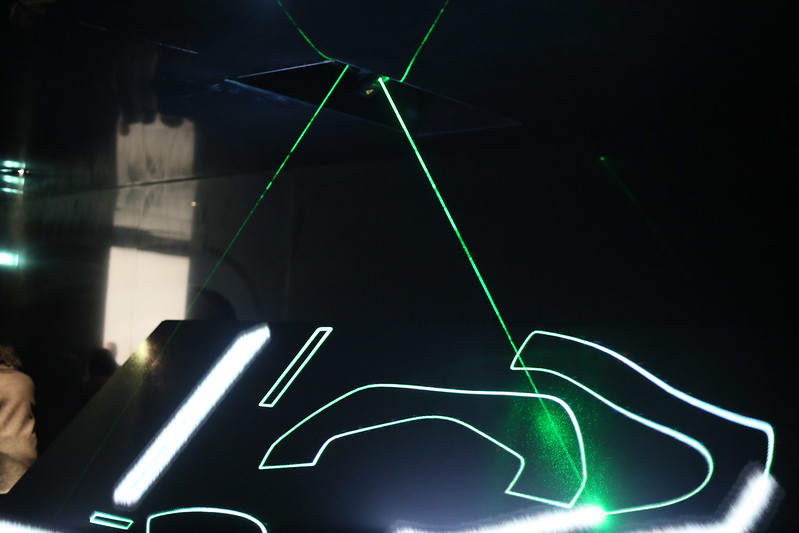
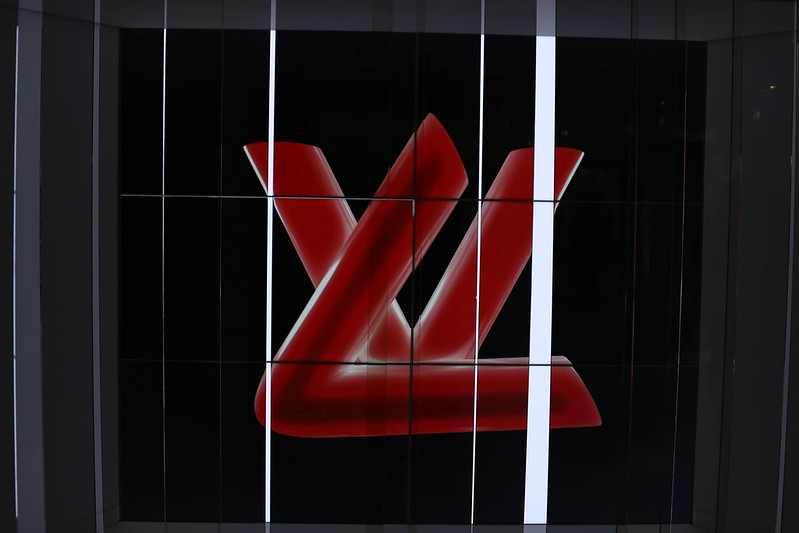
    #LVSeries3 Louis Vuitton Series 3 exhibition, 180 Strand, LondonLV logo motion graphics at the start of the exhibition, no real surprise right? What the designers did was remove the polarisers from the LCD screens so that the screens are apparently blank. The polariser is laid out in vertical strips at different distances and widths from the screen. This gives a kind of lenticular effect when you walk past it. This modern logo morphs through matrix-like digital noise and on to the more traditional LV design.
    #LVSeries3 Louis Vuitton Series 3 exhibition, 180 Strand, London
    It seems absurdly simple, but the idea of using projecting mapping techniques on a flat LED screen to emphasise how Louis Vuitton products are cut from a common material before being assembled was clever. Just because you have projection mapping technology at your finger tips means that one often looks for complex shapes like building fronts rather than a flat panel.
    #LVSeries3 Louis Vuitton Series 3 exhibition, 180 Strand, London
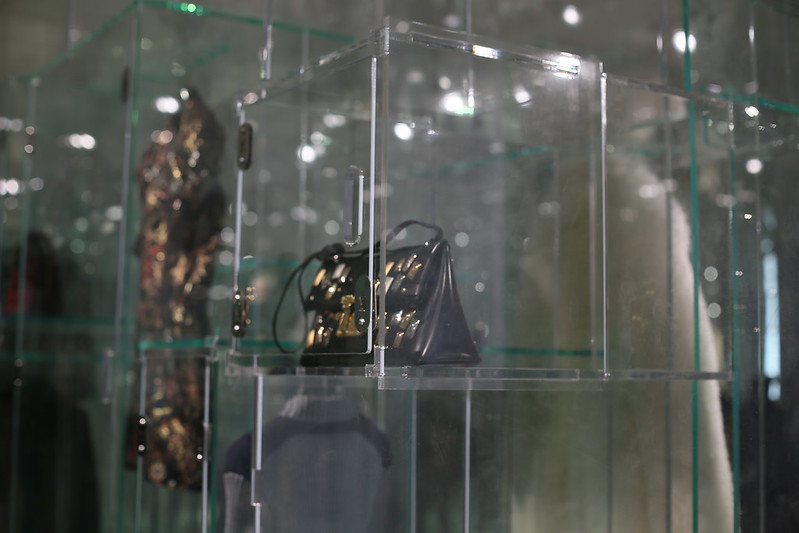
    The glass bins got the balance right between protecting the product so that it doesn’t look grubby from being over-handled, whilst still making it accessible and tactile rather than a museum experience.

  • Traackr – beyond the buzzword event

    Thanks to Delphine at Traackr UK for inviting me alone to their event last week. I started to make notes about what was being presented but in the end also started writing reactive notes as thoughts occurred to me.  Here they are below (with the spelling corrected).
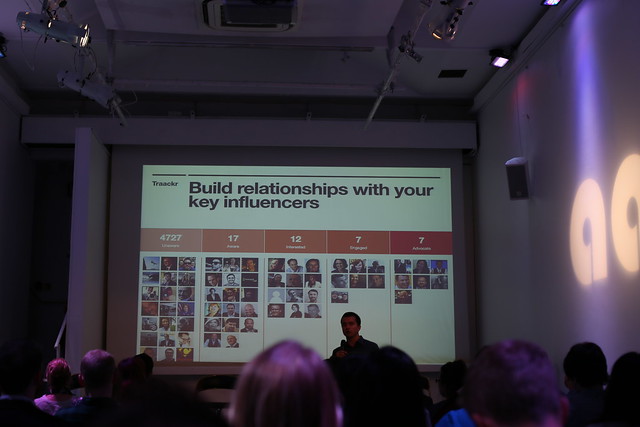
    IMG_7976The event was given the theme of ‘beyond the buzzword’ which has multiple interpretations – Traackr looks at influencers more like a granular taxonomy than around keywords, but it also signifies a mainstreaming of ‘influencer marketing’.

    There was an explanation of why influencer marketing
          • Authoritative content
          • The ability to better scale high touch relationships, something that traditional public relations isn’t able to do. The mix of people in the room from marketing agencies and PR agencies gives an idea of how ‘blended’ the concept of influencer marketing is. PR agencies see it as an extension of PR, specialist agencies see it in a different light and mainstream marketing agencies see it as an extension of their content marketing divisions

    What became apparent to me during listening to the introduction and the presentations was that Traackr and the people on stage hadn’t met the same requirements I’d heard from clients with regards a business case for influencer marketing. Influencer marketing wasn’t quite taken as an article of faith, but considered to be a good thing. There was a focus on measurement benchmarking and a lack of concern over RoI or the lack of econometric data to back up the decision. The lack of econometric data to support PR is starting to become an issue and may affect where PR sits (at least in B2B environments at least for those companies with a strong marketing automation programme in place). IMG_7966
    There was some hints that influencer marketing was looked at in a similar to customer services, in particular the advocacy journey above reminded me of customer service models.

    Coca Cola

    Coca-Cola focus the majority of their influencer relations programmes on what Brian Solis calls the Magic middle, the point at between the head and the long tail in a ‘long tail distribution’, the man from Coca-Cola defined this as  ‘people who don’t have agents and strong bonds with followers’. They are likely to know the majority of their followers personally. They use interaction and prize give-aways as a way of encouraging brand advocacy and continued heavy consumption patterns. In a similar way to on pack tokens and giveaways would have done in pre-internet times.
    They also like to do activities that encourage co-creation and in-real-life (IRL) interaction was consider the acme of these campaign interactions. When asked about whether they use sponsored / affiliate marketing of magic middle influencers – Coca-Cola generally don’t touch them. They only pay for a-listers and this seems to be on a market-by-market basis.
    Interestingly, they use Traackr to consolidate programme data, keep things up to date, integrate with rest of the toolbox. I wonder what would be economics of this approach rather than using Salesforce’s tools to provide the customer records?
     The objectives for influencer marketing at Coca-Cola where around brand love, brand affinity and purchase intent – which makes sense given the dynamics of the mature market oligarchy that they operate in.

    De Grisogono

    De Grisogono is a Swiss-based jewellery brand that also make mens watches. They discussed their use of influencer marketing as part of a panel discussion. Historically luxury brands had been slow to react to social platforms due to their perception of exclusivity and what it meant to be exclusive. In many cases social was imposed by customers on the brands. De Grisogono sees social and influencer marketing as an extension of their IRL social events. Since they are a relatively new brand there was  also no heritage as baggage.
    There overall intent is to drive footfall into stores, however it was interesting that they don’t look at location-based services like Swarm/Foursquare and instead focus on content channels. They don’t need to look at customer segmentation, since their approach to pricing does that for them.
    They qualify influencers based on expertise and passion. Generally their jewellery influencers have 30-50,000 followers, mens watch influencers have less. This is in sharp contrast to fashion bloggers who may have millions of followers.
    When thinking about influencer relations they put a focus on how they design content and experiences. They also pay a lot of attention to provide clients and prospects at any IRL events that influencers attend with adequate privacy.
    The brand produces content that features influencer, to keep the production levels high. User generated content is not obvious for for a luxury brand (despite customers taking selfies) – De Grisogono take a more graduated control of visual content than other brands.
    In trying to define the ROI, De Grisogono said that they don’t measure it explicitly but have noticed a causality between influencer coverage  and a 300 percent increase in press coverage.
  • Piggate scandal

    In case you’ve lived under a rock for the past few days, Piggate is something you will want to be over by now.

    What is Piggate?

    Piggate is an uncorroborated allegation. David Cameron is alleged to have put part or all of his genitals in the mouth of a dead pig. This alleged to have been part of an initiation ceremony of an exclusive dining club during his time at Oxford University. The allegation appeared in an unauthorised biography of Cameron ‘Call me Dave‘ co-authored by Lord Ashcroft.

    A couple of thoughts on Piggate

    • David Cameron lived out his childhood and young adult life in a world without social media. There will be countless people of his generation thinking ‘there but for the grace of God go I‘ due to the youthful high jinks in military barracks, schools and sports clubs around the world. This is what happens when male bonding gets ritualised. It’s not pleasant to think about, but it doesn’t surprise me. If true, it has be better than events like the Tail Hook scandal which resulted in sexual harassment, or fraternity hazing deaths. No one was harmed. I presume the pig wasn’t killed especially for the event
    • Lord Ashcroft has deliberately burnt bridges with this book and it would be more interesting to find out what persuaded him to take such drastic action. Also it wouldn’t be that hard to make a short list up of the likely MP who told Ashcroft the story (if they exist at all). It is the kind of story worthy of House Of Cards and shows how brutal party politics can be

    Finally, how did CassetteBoy manage to put together Getting Piggy With It so fast? This kind of video splicing is hard to do. The editing itself would only take up part of the time. The big time suck would be going through to research the right clips that can then be put together. 

    More meme related content here.