According to the AMA – Marketing is the activity, set of institutions, and processes for creating, communicating, delivering, and exchanging offerings that have value for customers, clients, partners, and society at large. This has contained a wide range of content as a section over the years including
Super Bowl advertising
Spanx
Content marketing
Fake product reviews on Amazon
Fear of finding out
Genesis the Korean luxury car brand
Guo chao – Chinese national pride
Harmony Korine’s creative work for 7-Eleven
Advertising legend Bill Bernbach
Japanese consumer insights
Chinese New Year adverts from China, Hong Kong, Malaysia and Singapore
Doughnutism
Consumer Electronics Show (CES)
Influencer promotions
A media diary
Luxe streetwear
Consumerology by marketing behaviour expert Phil Graves
Payola
Dettol’s back to work advertising campaign
Eat Your Greens edited by Wiemer Snijders
Dove #washtocare advertising campaign
The fallacy of generations such as gen-z
Cultural marketing with Stüssy
How Brands Grow Part 2 by Jenni Romaniuk and Byron Sharp
Facebook’s misleading ad metrics
The role of salience in advertising
SAS – What is truly Scandinavian? advertising campaign
Brand winter
Treasure hunt as defined by NPD is the process of consumers bargain hunting
Lovemarks
How Louis Vuitton has re-engineered its business to handle the modern luxury consumer’s needs and tastes
The inspiration for this post on every old idea is new again came from my opening up Rakuten‘s Viber messaging app on my iPhone. Viber is a messaging platform and also does voice over IP, including out to the phone network. It is a hybrid of Skype and WhatsApp in terms of functionality. Viber is popular in parts of Asia, much of central and Eastern Europe, Greece and Russia – often as a second string to Telegram or Zalo.
Scratchcards, giveaways
I saw the following image in Viber.
Viber’s scratch card giveaway promotion.
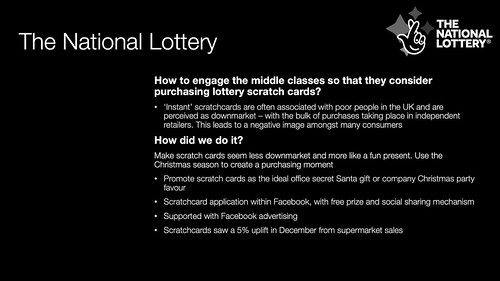
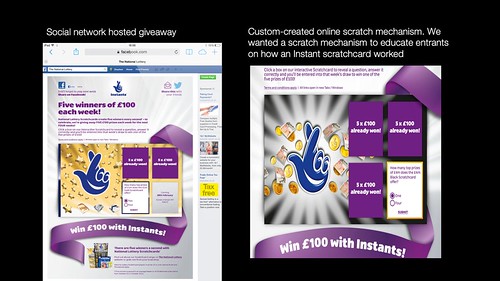
Which took me right back to roughly the same time of the year back in 2012, when I worked at Ruder Finn and did a similar digital scratch card execution to promote The National Lottery scratch cards in the run up to Christmas.
I was fortunate to work with a great creative and technology team: Stephen Holmes and Dru Riches-Magnier on the project. The promotion was executed within a high security environment because Camelot’s IT standards were way beyond what we usually worked with.
Here’s the case study that I wrote up about the scratch card project in my portfolio.
This was the most stressful time I had during my time working at Ruder Finn and one of two high points in terms of the work that we did.
So when I saw the Rakuten Viber execution, I had a deja-vu moment and the epiphany that every old idea is new again.
Strawberry fields forever & the square mile
So how do we get to a point where every idea is new again? Years ago I used to DJ in bars, clubs and parties. A couple of young lads on a music production course saw a record label release one of their assignments to tap into the psychedelia and dance-indie hybrid sound. The record was a cover version of a Beatles track with a Soul II Soul type break beat underneath. It became successful and topped the charts.
There were a surprising number of people who didn’t realise that it was artfully created cover version of The Beatles, I even heard the original described as a poor version of Candy Flip.
Newness is a matter of perspective. This was brought home to me at a talk that Damien McCrystal gave years ago. This was about the time that he was a business columnist at The Observer. I can’t remember the context but McCrystal said that the memory of ‘the square mile’ (think Wall Street in US parlance) was about eight years.
Which was the reason why the 2008 mortgage crash looked eerily like the savings and loans crisis of the 1980s. And that is despite most of the people in investment banks having a passing familiarity of Michael Lewis’ insider account Liar’s Poker which outlined how derivatives fuelled much of the 1980s Savings & Loans crisis.
I got to read it in college, despite having no interest in entering the world of finance. By and large I managed to stay clear of finance aside from being an in-house marketer early on in my career at what’s now HBOS and credit card provider MBNA. I also had a bit of early luck in my career timing, as I left MBNA before the payment protection insurance scandal hit the sector.
This was the classic example of every old idea is new again, but with the added wrinkle that a bad set of ideas can suddenly turn into good ones over time.
But as a strategist, this taught me to be careful on interventions pointing out a given concept is an old idea, given that every old idea is new again at some point.
The racket sport padel seems to have got the zeitgeist, if not the player numbers yet. We haven’t really seen a surge in sports fads since the 1980s. During that time skateboarding rose from a peak in the late 1970s, to a more stable underground sport that we have today. The closure of a squash racquet factory in Cambridge, saw the sport globalise manufacture and playing. In a few short years rackets went from gut strings and ash wood frames to synthetic strings and carbon fibre composite rackets. It was as much a symbol of the striving business man as the Filofax or the golf bag. Interest was attracted by a large amount of courts and racket technology that greatly improved the game.
Squash had its origins in the late 19th century and took the best part of a century to reach its acme in the cultural zeitgeist. Skateboarding started in the late 1940s and took a mere 30 years to breakout. Padel falls somewhere between the two. Padel was invented in 1969. But it took COVID-19 to drive its popularity in Europe and North America.
There is a new world professional competition circuit for 2024. And it has attracted the interest of court developers looking to cater to what they believe is latent consumer demand.
Finally, you can get three padel courts in the space for one tennis court. More on the padel gold rush from the FT.
The challenge is if padel is just a fad, or has it longevity? Skateboarding is popular, but many councils didn’t see the benefit of supporting skate parks built in the 1970s around the country. Squash still has its fans but doesn’t have the same popularity that it enjoyed in the 1980s.
What’s it like being a Disney adult? – The Face – this is much more common in Hong Kong, but then people had annual passes to go there. I found it interesting that The Face othered it as a sub-culture
Vittles Reviews: There Is Always Another Province – Province-chasing isn’t just a Western phenomenon; China is still so vast that when the barbecued food of Xinjiang, one of China’s border provinces, showed up in a former sausage shop on Walworth Road at Lao Dao, it didn’t need to open to the general public for months, choosing only to take bookings via Chinese social media. The paradox is that the success of regional Chinese restaurants has created a Western audience which wants more, but that same success has allowed these restaurants to bypass those customers altogether
Culture
Television: one of the most audacious pranks in history was hidden in a hit TV show for years. – Watch enough episodes of Melrose Place and you’ll notice other very odd props and set design all over the show. A pool float in the shape of a sperm about to fertilize an egg. A golf trophy that appears to have testicles. Furniture designed to look like an endangered spotted owl. It turns out all of these objects, and more than 100 others, were designed by an artist collective called the GALA Committee. For three years, as the denizens of the Melrose Place apartment complex loved, lost, and betrayed one another, the GALA Committee smuggled subversive leftist art onto the set, experimenting with the relationship between art, artist, and spectator. The collective hid its work in plain sight and operated in secrecy. Outside of a select few insiders, no one—including Aaron Spelling, Melrose’s legendary executive producer—knew what it was doing. The project was called In the Name of the Place. It ended in 1997. Or, perhaps, since the episodes are streamable, it never ended
Rode acquire Mackie | Sound On Sound – this is big for podcasters, but also for artists that record in their own studios. Mackie mixers have powered the home grown set-ups of artists like The Prodigy, The Crystal Method, Brian Eno, Daft Punk and Orbital.
Health
China e-cigarette titan behind ‘Elf Bar’ floods the US with illegal vapes | Reuters – In the United States, the firm simply ignored regulations on new products and capitalized on poor enforcement. It has flooded the U.S. market with flavored vapes that have been among the best-selling U.S. brands, including Elf Bar, EBDesign and Lost Mary. In the United Kingdom, by contrast, Zhang has complied with regulations requiring lower nicotine levels and government registration while building an unmatched distribution network — and driving a surge in youth vaping
Hong Kong’s first ‘patriots-only’ district council poll reflects political tale of two cities, as some eagerly rush to vote and others shy away | South China Morning Post – Hong Kong on election day splits into two camps, with one eager to vote out of civic duty and others giving polling stations wide berth over lack of political diversity. ‘I thought more people would come and vote because there has been more publicity,’ one elector says after discovering sleepy atmosphere at local polling station – the question is will Beijing take anything from this voter turn out? Does it signal suppressed but indignant separatists, or Hong Kongers who are more focused on prosperity and weekend Netflix? If they suspect the former then the security situation is likely to get more dire
Inside Louis Vuitton’s Hong Kong spectacle | Vogue Business – While Hong Kong is gradually recovering from the pandemic lockdowns, growth in Mainland China is slowing. According to HSBC estimates, luxury sales there are expected to grow 5 per cent in 2024, a sharp deceleration compared with 2023’s projected 18 per cent.
Breakin was a 1984 film which brought hip hop culture around the world. You can criticise the plot and awkward dialogue, but the break dancing and body popping was amazing. The film was a sufficiently successful commercial success that a sequel was made to the original film.
The broom sweeping scene
The broom sweeping scene in Breakin was inspirational drawing from mime, body popping and breaking sparked the imagination of people around the world. It made the dancer Michael “Turbo” Boogaloo Shrimp Chambers a global celebrity. Chambers himself credited stop motion animation of films like Ray Harryhausen’s works as being a key influence. He went on to teach Michael Jackson the ‘moonwalk’.
The broom sweeping scene from Breakin was shot at 4323 Melrose Avenue, which in turn has turned into a pilgrimage for fans. So a camera crew and Chambers went back to the site and reshot the scene over one night. The production team had wrapped the building to resemble the original in 1984.
Despite Chambers recovering from knee surgery, he still has the skills some 34 years later.
Caterham Project V
Caterham are famous in the car world for their evolution of Colin Chapman’s Lotus 7 design, which was the purest manifestation of Chapman’s design philosophy to make light, great handling cars. Caterham has been looking at making the jump from internal combustion engine powered vehicles to electric power. Like previous Caterham cars, much of the design process is about curating parts from other manufacturers parts bins with their own chassis and suspension design to come up with a perfect handling chimera.
‘Military Magic’
The role of innovation and military development has on each other is a subject that is often discussed. Our modern online world is down to cold war thinking about resilient data and telecommunications network. But Kuo’s research has found that innovation can also hurt combat effectiveness and highlights the kind of factors where this might occur. Innovation isn’t bad, but can be done badly. More on related content here.
Green Mountain Coffee Roasters
In the US, Keurig k-cup capsules are the default home brewed coffee standard, rather like Nespresso in Europe and much of Asia. Green Mountain Coffee Roasters worked with Kevin Costner to create signature roast varieties for him. The subsequent ad lampoons how brand partnerships often move from the authentic to the ridiculous.
7-Select
7-Eleven Hong Kong is a standby for workers wanting a grab-and-go breakfast, lunch or dinner at their desk. They have a range of foods called 7-Select. They promoted it online and via TV advertising this year using local celebrity Dee Gor and generative AI-based artwork.
The 7-Select range features many Hong Kong stables that merge western dishes like sandwiches in a local way that is emblematic of Hong Kong cuisine. Below is a video on the making of the advertisements including green screens and wire work – usually a staple of Hong Kong’s fantastical martial arts film industry.
Porsche committed to major long form content as it followed Michael Fassbender on the road to Le Mans.
Season one
Road to Le Mans started off over four years ago with six short form films, each no longer than 10 minutes in length. So far, pretty much what you would expect in a prestige luxury car brand film. I was reminded of BMW’s ‘The Hire’ film series over the years with Clive Owen as the driver.
Season two
Porsche must have had positive feedback to continue with a second series in a similar vein to series one of Road to Le Mans. But some of the episodes were double the length of series one and three more episodes in this series. Looking at the Porsche YouTube channel the two seasons were likely considered to be a complete arc. They build a playlist that holds only season one and season two.
The manage to switch around the voices in the narrative which I think adds more in season two and season three.
Season three
By season three, the series seems to have hit its stride. The episodes are as long as they need to be.
Season four
Season four seems to have more of Fassbender’s voice in it.
Feature film
The theme of resilience in the face of failure was an interesting, honest angle in the film. Road to Le Mans emphasises stoicism and resilience as much as it emphasises the performance of the car. The feature film is an edit together of season four.
Although it’s Fassbender’s journey and I respect what he’s done, it feels a bit self indulgent at times. I think that this is because the actor’s journey as a profession isn’t a team sport in the same way that most other roles are.
What Road to Le Man also brought through to me was the depth of achievement in Porsche’s 18 Le Mans overall victories. This film feels like a final chapter to this Road to Le Mans at least.
Porsche seem to have shouldered the cost of the film themselves, I was a bit surprised that the content wasn’t licensed to a streaming service like Netflix and then eventually put on YouTube. More related content here.
For some brands sponsorships aid in research and product development, motorsport and mountaineering are two sports where this the case. Other sponsorship deals, for instance college athletes and premier league footballers depend on the individuals effect as an influencer as much as their role on pitch. All of these complexities will affect the perception of the sponsorship value and effectiveness. Sponsorship being unmanaged and unmeasured isn’t a new phenomenon. – Sponsorship ‘unmanaged and unmeasured’, WFA warns – The Media Leader. Shirt sponsors are basically dependent on the amount of time on screen. Sponsoring celebrities like Jackie Chan is more about attracting eyeballs to the companies advertising campaigns.
(Jackie Chan represents a particular problem in this sector of sponsorship because he represented over 12 brands at the same time. From local companies that made game consoles suspiciously similar to Nintendo systems to Japanese multi-nationals Canon and Mitsubishi.)
Part of this focus on sponsorship measurement might be about the culture change digital advertising created: How the digital revolution led to a greater justification for advertising – The Media Leader. Famously, telecoms executives love of particular sports influenced sponsorship programmes of their companies. Sir Peter Bonfield was a keen sailor and BT sponsored the Global Challenge yacht race series.
Sir Chris Gent, over at Vodafone was a big cricket fan. The sponsorship would have been difficult to measure as a lot of the impact would have been in cementing existing relationships and facilitating new ones through corporate entertainment. With both, there would be some efforts to demonstrate the relevance of the sponsorship, but it was very much putting the cart before the horse.
Grateful Dead x Stundenglass Bong | Esquire – yes the Grateful Dead now have an official bong for resale, but the author’s deadhead memories are the thing to read on this article
Louis Vuitton is selling a €6,000 digital mini trunk by Nicolas Ghesquière | Vogue Business – Louis Vuitton is selling a €6,000 digital mini trunk by Nicolas Ghesquière. The next product available to LV’s exclusive group of NFT holders is a mini trunk bag designed by the brand’s women’s artistic director. Only 200 are available, and the physical will land in March.