Category: meme | 模因 | 밈 | ミーム

We think of the meme now as the lowest form of culture of a standard trope that is used to explain a situation by shorthand, but the reality is more complex.

The text book definition of a meme would be an idea, behaviour, or style that spreads by means of imitation from person to person within a culture and often carries symbolic meaning representing a particular phenomenon or theme. Richard Dawkin coined the word meme in his book The Selfish Gene, I have also heard the concept articulated as an idea virus.

So that would bring in things in everyday life that you take for granted like the way we tie up shoelaces. People who have been in the military tend to use a ‘ladder approach’ versus going criss-cross.

Its what can bind tribal affiliations together. Many people support the same sports team as the people around them such as neighbours, peers or friends and family. The initial choice about the team to support is memetic in nature.

Memes have moved beyond being an analogy to being a badge of belonging and even the lingua franc itself. If one looks at 4Chan’s /b/ channel mostly consists of anonymous users bombarding memes at each other. Occasionally there will be a request to customise a meme image from a user and the community piles in.

Memetics became a formal field of academic study in the 1990s. The nucleus for it as a field of study was Dawkins books and a series of columns that started appearing in the Scientific American during the early 1980s by Douglas Hofstadter and Media Virus by Douglas Rushkoff.

  • New Balance factory closure + more

    New Balance Boston factory closure

    New Balance to Layoff Dozens of Workers as It Closes Boston Factory – Footwear News – this is huge for New Balance. It is a major knock to the perceived wisdom around the New Balance brand and its differentation versus other footwear vendors like Nike or Adidas. New Balance his made US manufacturing a big part of its corporate story. Being private owned, it can take a longer view than competitors. But that doesn’t seem to have helped New Balance during the pandemic. It will be interesting to see how New Balance handles this moving forwards.

    Business

    The inadequate trials of Philip Green | Financial TimesThere is something else at work too — distaste for the wheeler-dealer made good. His parties and celebrity schmoozing were considered vulgar. He was accused by MPs of being a “spiv”. Three commenters under one FT article this week described him as a “barrow boy”. A campaign was launched to strip him of his knighthood, as if that is what mattered. – interesting op-ed that makes a valuable point about the discussion around Philip Green

    Consumer behaviour

    Streetwear in China: hip-hop influence and form of expression for the Chinese youth – Daxue Consulting – Market Research China 

    Economics

    Hong Kong chief has ‘piles of cash’ at home after US sanctionsA government survey taken between June and September registered for the first time in 11 years a reduction in the number of foreign businesses operating in Hong Kong. The survey found 9,025 companies had offices in Hong Kong compared with 9,040 the previous year. Only 15 per cent of the companies said they had plans to expand in the city in 2020, whereas last year 23 per cent expected an expansion. – I thought that this quote was interesting in the FT article. What becomes apparent is that the Chinese government thinks that internal circulation is more important than Hong Kong as a gateway to foreign direct investment (Paywall)

    Media

    NSFW TikTok Porn: Bree Louise OnlyFans Is the Future of Adult ContentAccording to Alex Hawkins, Vice President of xHamster, Gen Z and young millennials are “disproportionately” willing to pay for adult content compared to previous generations, especially if the star of the video is also the one creating it. “We see the shift from studios to performer-producers dramatically changing the industry,” he says. Aesthetically, this translates to “a surge in realistic situations and more natural bodies.” In other words, more of what you might find on TikTok, albeit with fewer clothes. “We believe that consumers are much more likely to pay for performer-created content than they are traditional porn,” says Hawkins. “It feels more intimate.” – Mirrors the record labels have been historically looked at from at least the 1980s.

    Francis Fukuyama: How to Save Democracy From Technology | Foreign Affairs – everyone hates big tech. Fukuyama is famous for his Warsaw Pact break-up era book The End of History and The Last Man. Here’s his opinion on social paltforms: But few recognize that the political harms posed by the platforms are more serious than the economic ones. Fewer still have considered a practical way forward: taking away the platforms’ role as gatekeepers of content. This approach would entail inviting a new group of competitive “middleware” companies to enable users to choose how information is presented to them

    How Biden’s Rebels Blew Up Trump’s Death Star | AdExchanger – on combating disinformation: “Instead of chasing down and knocking down every ANTIFA rumor, we knew that the best defense was convincing people that the Joe Biden they did like, whose values they shared, would be the author of his own presidency,” said BPI partner Danny Franklin. “And when we reminded them of those values … and validated that through trusted endorsers, we could win the argument and defeat the attack.”

    Technology

    Warning lights are flashing for Big Tech as they did for banks | Financial TimesThe pandemic has emphasised our reliance on technology. It’s not just the interminable video calls or the technology that underpins deliveries to our locked-down doors. It is the mountains of data that dictate the ads we see as we scroll through coverage of the latest coronavirus briefing. Digital transformation is sweeping through my industry, too. Consumers have squeezed years-worth of adoption of apps and online banking into just a few months. Yet the risks go much deeper than the risk of hastily managed change. The algorithms that determine how much work delivery drivers get and what we see when we go online are no better understood than the structured credit products that brought the banking system to its knees in the financial crisis. – Interesting and provocative analogy to the financial system

    Teaching in the Pandemic: ‘This Is Not Sustainable’ – The New York Timesvehement debates have raged over whether to reopen schools for in-person instruction, teachers have been at the center — often vilified for challenging it, sometimes warmly praised for trying to make it work. But the debate has often missed just how thoroughly the coronavirus has upended learning in the country’s 130,000 schools, and glossed over how emotionally and physically draining pandemic teaching has become for the educators themselves. In more than a dozen interviews, educators described the immense challenges, and exhaustion, they have faced trying to provide normal schooling for students in pandemic conditions that are anything but normal. Some recounted whiplash experiences of having their schools abruptly open and close, sometimes more than once, because of virus risks or quarantine-driven staff shortages, requiring them to repeatedly switch back and forth between in-person and online teaching. Others described the stress of having to lead back-to-back group video lessons for remote learners, even as they continued to teach students in person in their classrooms – I imagine that it is probably pretty similar levels of burnout in knowledge workers as well. (Paywall)

    Do serious games help you learn? – Hello Future OrangeSerious games are more effective than traditional teaching but they do not produce better results than more active forms of knowledge transmission and are often more costly to implement.

    Thailand

    Pornhub, along with several other adult entertainment sites have been banned in Thailand. This has been part of a wider political debate within the country on government performance and what role the royal family should play. Asian Boss asked Bangkok residents on their opinions. What pleasantly surprised me about this video was thoughtful opinions on both sides of the argument

    More Thai-related posts here.

  • US political reporting

    Like most people at the moment I have been following the US presidential election. What struck me was the state of US political reporting I was watching on US network ABC and foreign media coverage.

    Polling station
    Polling station sign

    Polls

    Something seems to have gone wrong with polling methodologies. There are a variety of explanations for this but the impact is felt on US political reporting.

    • There is a lack of polling coverage in areas that are more likely to vote Republican: white working class, working people in rural areas
    • Conversely the models tend to skew more towards urban and suburban based voters
    • The very nature of polling questions is usually done out of context

    Qualitative data

    What becomes apparent is the there are huge swathes of the country that there is no longer qualitative research from. There are no longer local newspapers in a number of areas and ‘local’ TV networks are often an agglomeration of several former stations. This impacts on the granularity of the US political reporting. The greatest impact of this is felt in areas that are also ‘under-polled’.

    Disintermediation of the media

    The campaign for incumbent president Donald Trump seems to have been organising under the radar on social media and seems to have focused on getting more people who share their world view to get out and vote rather than reach ‘new constituencies’. This aspect of the campaign seems to have been missed by media pundits.

    In many respects it resembles the UK leave referendum grassroots campaigners and supporters of Nigel Farage’s various reactionary political efforts. What they lack in absolute numbers, they try and make up for in commitment to getting out their base.

    This resulted in Republican supporters creating convoys of cars and pickup trucks in their neighbourhoods to show their visibility, creating a form of social proof.

    Opinions

    Instead of data, the US political reporting seems to be based on the opinions of pundits affiliated to both major parties. This allowed networks and audiences to ‘drink their own kool-aid’.

    While the Democrat presidential candidate Joe Biden’s campaign strategy was to try and build interest across the spectrum – there wasn’t a manifesto the way we’d understand it in Europe.

    Instead there was an exchange of negative character messages about each candidate bolstering this wider battle of opinions over substance. This hasn’t been questioned in the US political reporting that I’ve seen, which surprised me.

    More media related content here.

  • Holiday season e-tailing + more things

    Holiday season e-tailing links –

    Exclusive: Huawei in talks to sell parts of its Honor smartphone business – sources | Reuters – interesting move that move Honor out of the US sanctions. Less convinced that Huawei can focus on high-end phones as there was a supply chain and design synergy with Honor. More on Huawei here.

    Amazon launches an AR app that works with new QR codes on its boxes | TechCrunch 

    Why the Serverless Revolution Has Stalled | InfoqServerless computing refers to an architecture in which applications (or parts of applications) run on-demand within execution environments that are typically hosted remotely. That said, it’s also possible to host serverless systems in-house.

    China’s Games Streaming Giants Huya and DouYu to Merge – Variety – Twitch analogues

    EFFECTOR® -ROCK ON THE EYEWEAR- – amazing Japanese eyewear. More style related content here.

    Samsung pulls BTS-branded products from online Chinese platforms | Financial Times – this just makes Chinese netizens look ridiculous. It shows a fragile nature in Chinese nationalism. The kind of fragility that could drive China to conflict as the party tries to stay ahead of nationalist sentiment

    The ‘Fake Rich’ of Shanghai: Peeking Inside a Wannabe Socialite WeChat Group | What’s on Weibo – this shows the lengths people will go to be ‘living their best lives’. There have been examples of western and Russian netizens doing similar things for Instagram

    Caterpillar bets on self-driving machines impervious to pandemics | ReutersFred Rio, worldwide product manager at Caterpillar’s construction digital & technology division, told Reuters that a remote-control technology, which allows users to operate machines from several miles away, would be available for construction sites in January. – They’re not self driving as the headline says, but controlled remotely: think drones not robots. John Deere had done work on pre-plotted courses guided by GPS for ploughing and spraying in large fields. However in agriculture, this is also tied into a bigger issue around the ‘right to repair’ making automation to date non-viable for many farmers

    Taiwan academics told to identify as Chinese in journal | News | The TimesSpringer Nature claimed that under its editorial policy, authors alone could choose their affiliations, but said that it was “unable to enforce” the same standard on journals it did not own. It considered Eye and Vision, owned by the Wenzhou Medical University in China, as a “co-publisher” that operated under separate editorial guidelines. “The stipulations of this and other Chinese-owned journals with respect to Taiwanese affiliations are beyond our control,” it said. Its position has prompted outrage from leading academics in Britain, who have demanded that Springer Nature stop partnering with journals that operate under rules set by authoritarian regimes

    #MyLevisMyVibe Hashtag Videos on TikTokEarlier this year, Levi’s tested the TikTok ‘Shop Now’ button, which allowed them to provide their fans with a more integrated shopping experience within the app. We are truly moving towards the type of social commerce that has already been going on in China for several years. Now Levis has come back for another big TikTok campaign. This #MyLevisMyVibe is a simple, fun way for people to play around dressing up with Levi’s apparel. What better way for retail brands to connect with their fans than by highlighting them trying on actual clothes? It reminds me a bit of the Asos #AySauceChallenge we covered a few weeks ago. We’re starting to see so many brands now use TikTok that the total set of case studies to draw from is getting larger. I also noted that the language used by Levi’s in the hashtag challenge says “Show us your authentic self,” emphasising the trend of authenticity we are seeing across all modern advertising. I must say that by seeing random people creating their own videos to voluntarily participate in a challenge, it really does feel authentic. – the take from Good TikTok creative

    Orders from the Top: The EU’s Timetable for Dismantling End-to-End Encryption | Electronic Frontier Foundation – interesting that this appeared, alongside Five Eyes governments, India, and Japan make new call for encryption backdoors | ZDNet 

  • Dettol – back to work

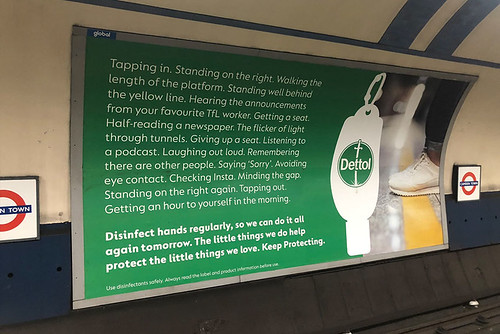
    At the beginning of the month, Dettol launched a ‘back to work’ poster campaign appeared on the tube as part of McCann London’s Keep Protecting series of adverts for Reckitt Benckiser.

    The ad campaign had been launched in July with out of home posters like this one celebrating a return to school and video spots.

    Dettol keep practicing
    McCann London for Reckitt Benckiser

    Here’s what Ads of the World had as an explanation of the ad’s rationale:

    Lockdown has taught us all to appreciate the little things in life we previously took for granted. As we move out of the lockdown phase, we are all at risk of forgetting the importance and impact of the other little things we have been doing to keep ourselves, our families and our community safe. To remind us of these, Dettol has launched a fully integrated behaviour change campaign ‘Keep Protecting,’ comprising TV, VOD, digital and OOH.

    Ads of the World^
    McCann London for Reckitt Benckiser

    Online conversations featuring Dettol went up 2245%*. In terms of sentiment**:

    • 22% of posts were assessed to be negative in nature
    • 11% of posts were assessed to be positive in nature
    • 67% of posts were assessed to be neutral in nature

    Was the Dettol campaign successful?

    Was the campaign successful? It depends. At the moment we don’t know how Reckitt Benckiser were assessing the campaign, or what they wanted to achieve.

    Reasons for thinking that it was:

    • Dettol would have been top of mind with regards to hygiene thanks to the increased talkability
    • The posters achieved reach far beyond tube travellers; which meant that the ads could be considered to be good value for money. I would presume that they already bought the posters at a considerable discount due to the overall surplus of inventory available in out of home advertising and diminished footfall
    • Any negative impact is likely to be short lived. Discussion peaked on September 3rd, with 3,286 mentions, declined to 414 on September 4th and 96 the following day. Whilst PR experts claimed that Dettol would have a hard time cleaning up after this mess – the quantitative online data tends to suggest otherwise
    • The (small) association of the Dettol ad with the government back to work campaign has potentially alligned Dettol’s personal care and household products to align more closely with the more socially conservative majority outside the big cities. And yet doesn’t seem to have impacted the appeal of the brand abroad in markets like India and Thailand
    • Prior to the ‘back to work’ themed poster, the campaign didn’t seem to have spurred a significant increase in online social discussions at all. Despite the investment in out of home advertising and video. No increased discussion about product usage, or preparing for back to school. The Back To Work poster gave Dettol a brief burst of cultural relevance.
    Dettol. Keep Protecting
    Data* from Meltwater Social.The mini-peak that occurred on August 24th is unrelated to Dettol marketing efforts ***

    Reasons for thinking that it wasn’t:

    • Dettol is already a by-word in the UK when it comes to antiseptic and disinfecting. It is already ‘verbing’ (as Faris Yakob would say) in UK culture. So there would be marginal gains
    • As much as the posters drove talkability, they didn’t seem to drive content on Instagram. So for youth-obsessed brand marketers after millennial Mums and gen-y office workers, it was a bit of a wash out.
    • Awareness and recall probably took a bit of a knock when 203 posts commented about how they thought the Dettol ad (with its prominent logo placement) was part of the UK government’s (currently postponed) back to work ad campaign. This connection has driven some of the media coverage that followed
    • Dettol is likely to remain top of mind for only a short time. Discussion peaked on September 3rd, with 3,286 mentions, declined to 414 on September 4th and 96 the following day. TfL claim that the footfall at the tube is running at less than 30% of usual capacity at the moment
    • The advert spawned memes that were negative to the brand and arguably more culturally relevant
    • The media is likely to have a longer memory than the general public about the Dettol advert. It has placed the brand as a potential football in wider culture wars currently going on. Whilst the brand marketers and advertising agency won’t care, the communications team will likely to have clean up any mess coming to Reckitt Benckiser.
    • The relative furore around the brand, looks bad compared to the results Dettol brand marketing teams have achieved across Asia. For instance Dettol India’s #HandWashChallenge got an astonishing amount of visibility on TikTok. It has achieved over 125.1 billion views across Asia****. More on that campaign here. And the Asian campaigns didn’t cause discord.
    • Only 67 of the 3,870+ mentions associated the Dettol brand with hand sanitiser. Yet a key part of the ad artwork was a silhouette of their personal hand sanitiser bottle
    Dettol at Camden Town
    Dettol ad in question at Camden Town tube station

    The copy:

    Hearing an alarm. Putting on a tie.

    Carrying a handbag. Receptionists.

    Caffeine-filled air. Taking a lift.

    Seeing your second family. Watercooler

    conversations. Proper bants. The boss’s

    jokes. Plastic plants. Office gossip. Those

    weird carpets. Face-to-face meetings.

    Not having to make lunch. CCing.

    BCCing. Accidentally replying-all.

    Hearing buzzwords. Leaving early for

    a cheeky afternoon in the sun.

    Disinfect surfaces we use throughout the

    day, so we can do it all again tomorrow.

    The little things we do help protect the

    little things we love. Keep Protecting.

    McCann London for Rickett Benckiser

    What about the craft?

    My issues with the campaign are more craft-related. The call to action at the bottom made perfect sense when associated with the ‘back to school’ creative iteration of the poster. It makes less sense in the ‘back to work’ and ‘back to commute’ posters, where it has been used unchanged.

    The language used in the ‘back to school’ poster would bring back emotive memories of school. The back to work poster evoked the ennui, awkwardness and embarrassing moments that Ricky Gervais skewered quite eloquently in the comedy TV show The Office.

    There was also a clear comparison to Renton’s ‘Choose Life’ speech in Trainspotting 1 & 2

    Original version from Trainspotting
    Updated Trainspotting 2 version

    This could have been done so much better. It would still have been controversial – instead much of the abuse has come at the expense of its mediocrity. I suspect that the ad was an unintentional troll.

    I am confident that this wasn’t a Dominic Cummings-type of deliberate trolling. It wasn’t designed to stir up brand relevance amongst the general public at the expense of the work-from-home metropolitan elites.

    What next for Dettol?

    The account planning team and client service staff members at McCann London will be wrapping together much of the reasons and data I’ve suggested above into a positive narrative for the client. If they manage to pull that off; they may even try to use it for award entries next year.

    Dettol is a well-loved brand in a relatively low-passion category. Everyone I know has a bottle in the cupboard under the kitchen sink with the cleaning supplies or in the first aid kit. It deserved so much more from the marketers at Reckitt Benckiser (UK) and copywriters at McCann London.

    More FMCG-related content here.

    Notes and references.

    ^ VOD means video on demand like Netflix, Hulu in the US, NowTV in Hong Kong or ITV Player in the UK. OOH means out of home. Poster adverts that could be on billboards, electronic Jumbotron type signage, trains, buses or taxis. They can be inside like the London underground (mass transit) posters or out on the street.

    *All data quoted from Meltwater Social. I looked at data only in English from the UK. The sources for mentions that I selected were: Twitter, forums, blogs, comments, Facebook, Instagram, Reddit and YouTube.

    ** Machine derived sentiment, so assume that it is only 65-85% accurate

    *** The mini-peak on August 24th was Twitter users sharing a meme about childhood in 1970s Britain. It associated Dettol with a simpler, if more deprived Britain. The original tweet that got things going said:

    I was moulded in the 70’s…when ya school jumper was knitted by an intoxicated grandma…when ya bath had Dettol not bubbles…ya phone was a pissy smelling red box..you was tucked in & couldn’t move….fish finger sandwiches & lard fried chips & I’d go back in a heartbeat ❤️

    Mark Norris on Twitter

    **** TikTok like other social platforms have issues with regards engagement metrics.

    UPDATE: September 15, 2020 – YouGov surveyed the British public on each of the concepts in the copy and you can understand from the results why it went over so badly. TL;DR – People really don’t like their alarm, they don’t miss the smell of the office or even eating out for lunch and your work colleagues definitely aren’t your second family (PDF)

  • Autopilot Whopper + more things

    Burger King’s Autopilot Whopper campaign reminds me of a lot of the classic work that Crispin Porter Bogusky have done for Burger King over the years. The Autopilot Whopper is based on the insight that Tesla cars machine learning powered vision system that helps with self driving function mistakes the Burger King logo for a Stop sign.

    https://youtu.be/A0cb7wZVFf4

    Autopilot Whopper entertaining with this schadenfreude around Tesla technology. And it also lands the message that the Burger King drive through is as good a place to stop as any.

    YouTube announced the winners of its 2020 YouTube Works awards. I would strongly recommend that any brand planners bookmark this in their browser and dip in on a regular basis.

    The one that really piqued my interest the most was Hulu’s campaign for live sports that tapped into a growing consumer cynicism around influencers. The sports linkage was using NBA basketball players as the influencers.

    The iconic Zero Halliburton briefcase stuffed with cash, that more money is thrown into as ‘Hulu has live sports’ is mentioned riffs on the old McDonald’s initiative. The McDonald’s scheme that paid rappers for name checks on songs and mixtapes. It also tapped into how consumers view influencers.

    Public Enemy came back when we most need them. Flavor Flav seems to have patched up his beef with Chuck D. Public Enemy have partnered with DJ Premier to capture the zeitgeist. Black Lives Matter, COVID19 and chaotic leadership feature in State Of The Union (STFU). DJ Premier’s product references earlier Public Enemy works scratching in sounds of early Public Enemy vocals in this track. The beat is more laid back than what one would expect from the Bomb Squad production team. But the Public Enemy fire in the belly is still there.

    The step chickens are a meme driven ‘cult’ that have sprung up on TikTok. More accurately they are a directed community. Here’s the founder on how they came about. Their heat has been parleyed in a community for a new app. From a product point-of-view, this means that something like TikTok could lose chunks of its user base IF the step chickens phenomenon was widely and successfully replicated. Given that it was a mix of smarts, happenstance and pure luck it isn’t likely: sorry brands.

    German China-focused think-tank MERICS had a thoughtful presentation put together on the Hong Kong national security law. The presentation focused on the impact for the financial services sector. But there similar lessons to be drawn for professional services (accounting, management consultancy, legal firms). And only for a a slightly lesser effect on the strategy and planning functions of creative agencies, or counsel based PR functions.

    On reflection, I would be concerned about how some of the creative briefs for China-focused campaigns that I have written would have faired against the Hong Kong national security law. Probably not that well.

    What immediately becomes apparent is the implications for quality research into companies and economics won’t meet international standards. Which means more fodder for the likes of Muddy Waters Research LLC. It likely indicates a conscious effort for China to decouple from the international financial system.

    The calculus behind the Hong Kong national security law seems to be that the Chinese government think yet another (internal) market for Chinese stocks will be a better deal than the traditional gateway to and from China Hong Kong has provided. I am not sure what this bet will mean. Shenzhen already has a robust stock market by Chinese standards; would China really need Hong Kong? Without the gateway role, Hong Kong would also find it harder to be the point of capital departure from China for high net worth citizens. Dampening capital flight would definitely hold some attraction to the Xi administration.