Category: online | 線上 | 온라인으로 | オンライン

The online field has been one of the mainstays since I started writing online in 2003. My act of writing online was partly to understand online as a medium.

Online has changed in nature. It was first a destination and plane of travel. Early netizens saw it as virgin frontier territory, rather like the early American pioneers viewed the open vistas of the western United States. Or later travellers moving west into the newly developing cities and towns from San Francisco to Los Angeles.

America might now be fenced in and the land claimed, but there was a new boundless electronic frontier out there. As the frontier grew more people dialled up to log into it. Then there was the metaphor of web surfing. Surfing the internet as a phrase was popularised by computer programmer Mark McCahill. He saw it as a clear analogue to ‘channel surfing’ changing from station to station on a television set because nothing grabs your attention.

Web surfing tapped into the line of travel and 1990s cool. Surfing like all extreme sport at the time was cool. And the internet grabbed your attention.

Broadband access, wi-fi and mobile data changed the nature of things. It altered what was consumed and where it was consumed. The sitting room TV was connected to the internet to receive content from download and streaming services. Online radio, podcasts and playlists supplanted the transistor radio in the kitchen.

Multi-screening became a thing, tweeting along real time opinions to reality TV and live current affairs programmes. Online became a wrapper that at its worst envelopes us in a media miasma of shrill voices, vacuous content and disinformation.

  • Hemingway + process

    I use a range of tools including Hemingway as part of my content creation process. This came out when I had a meeting with some junior marketing agency staff last week. The purpose of the meeting was to discuss content strategy across different clients. In the end an good part of the conversation went into process and content creation.

    Given that conversation I thought it might be fruitful to flag up some of the technologies that I use.

    Hemingway

    I use Hemingway ( a web application and a native OSX application) to write. Hemingway has two writing modes:
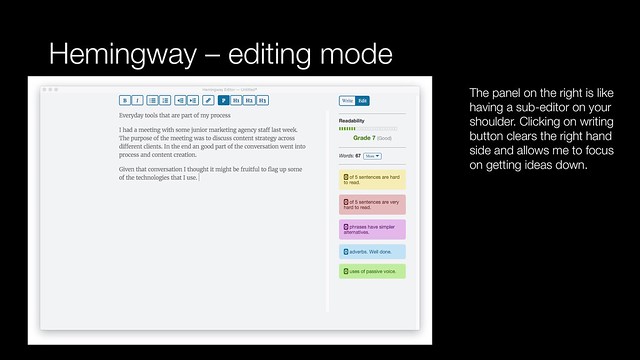
    Hemingway - editing mode
    Editing mode looks at your copy as you create it:

    • It looks at readability providing a reading age score. (Grade six is equates to 11-12 years old). The lower the reading age, the clearer the writing is. It has also aids in SEO
    • It examines sentence structure, the harder a sentence is to read, the more ambiguous it may be.
    • Hemingway suggests simpler alternatives to phases
    • It looks at adverbs and use of the passive voice

    Hemingway is like having a sub-editor sitting on your shoulder at the point of creation.
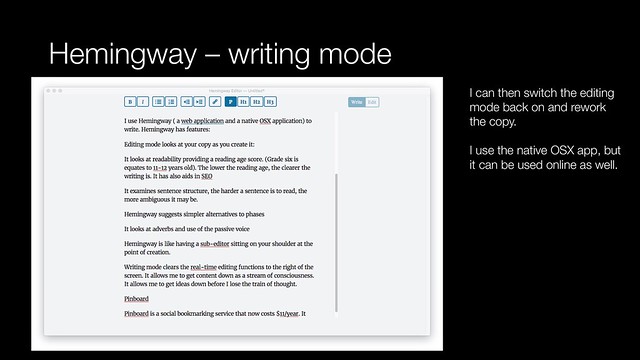
    Hemingway - writing mode
    Writing mode clears the real-time editing functions to the right of the screen. It allows me to get content down as a stream of consciousness. It allows me to get ideas down before I lose the train of thought.

    You can then switch to editing mode to go back and clean up your copy once you have it down.

    The OSX version allows you to save documents down as a HTML file, from which you can cut and paste into a destination. It just works whether its a presentation, document, WordPress or social platforms.

    Pinboard

    Pinboard is a social bookmarking service that now costs $11/year. It allows me to store links and notes about websites that I find of interest.
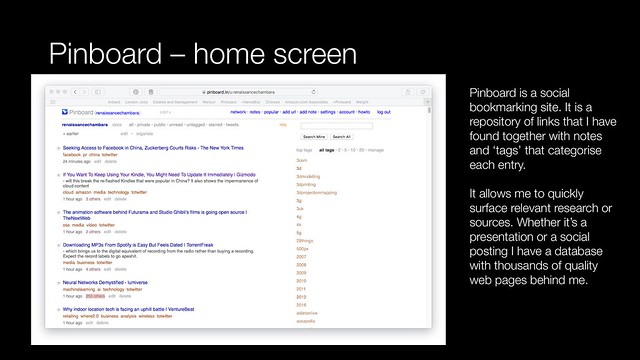
    Pinboard - home screen
    Pinboard is a web service so my bookmarks go where I can get a web connection.
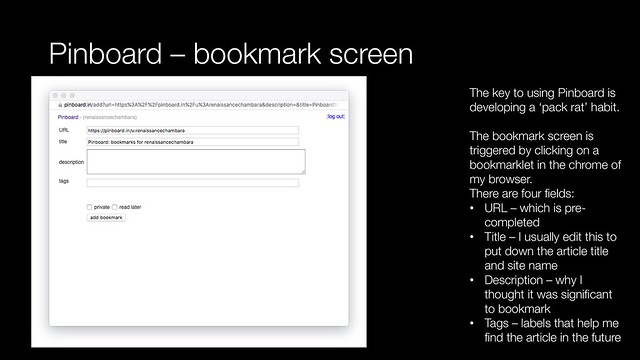
    Pinboard - bookmark screen
    I use a bookmarklet that sits in the chrome of my browser. Every time I come across something that might be of interest, I click on the link and complete a simple form.

    • URL – I only change the link if it is a temporary link such as ‘feedproxy.google.com’. I expand the link or change it to any permalink that is on the page
    • Title – I edit this as necessary to reflect the article title and the website name
    • Description – this is a quick explanation of why I thought the page was significant. It might be an article quote or top statistics mentioned
    • Tags – categories or labels that I assign to an article which allows me to find it based on a relevance. Tags are used by other applications as well

    I use Pinner for iOS on my iPhone. It integrates into the system level sharing functionality. I can create bookmarks on the move as well as at my desk.

    Terminal

    The Terminal app in OSX allows direct access to the power of the operating system. It is also unforgiving. Getting a command wrong can have serious consequences.

    Terminal app - introduction
    There are a few things that I can do faster in terminal than via other methods. From checking  differences in documents, to batch processing file archiving. To get you started here are two examples that you can try: to see if a website is up to getting a weather forecast.

    Terminal app - check the weather forecast
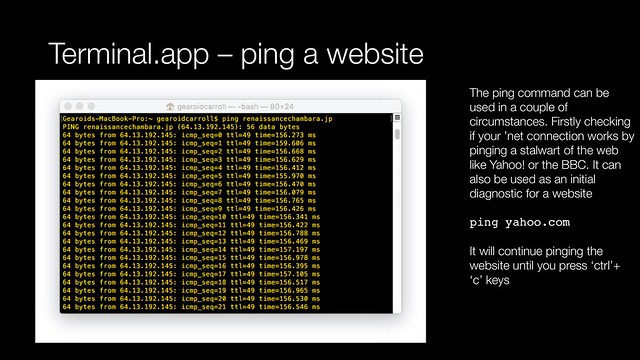
    Terminal app - ping a website
    I have a copy of UNIX in a Nutshell from O’Reilly Media on my bookshelf. I use this as a back-up when I can’t remember the proper  syntax or a command. I can also recommend Learning Unix for OS X: Going Deep With the Terminal and Shell also from O’Reilly Media.

    IFTTT

    At the beginning of 2007 Yahoo! launched an experimental product called Yahoo! Pipes. It was flakey, it was unreliable but also revolutionary. Pipes was an easy way to stitch together services without programming expertise. After years of flakey service it was shutdown by Yahoo! in June 2015.
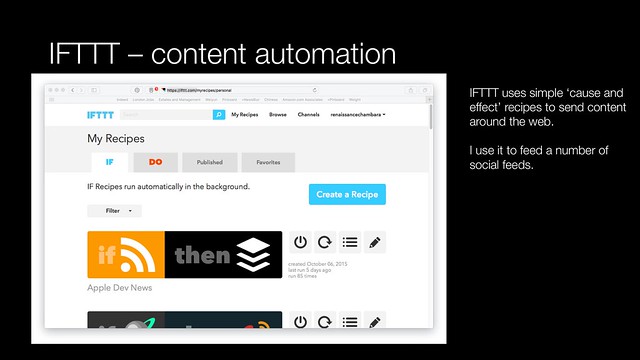
    IFTTT
    Pipes inspired another service IFTTT. IFTTT stands for ‘If then, then that’. It is a simple cause and effect framework that allows for the automation of actions over the web. These cause and effect formulas called recipes. It supports a range of web services and apps. Most of the discussion around this for Intenet of Things automation. I use it to automate my web content content.

    More in part two.

    I pulled part one together in a companion presentation.

    More related content can be found here.

    More information

    Hemingway OSX application

    Pinboard

    Pinner app for iOS

    IFTTT – (If Then, Then That)

    Books

    Learning Unix for OS X: Going Deep With the Terminal and Shell by Dave Taylor

    UNIX in a Nutshell by Arnold Robbins

  • VS250 online racism crisis

    VS250

    Virgin Atlantic flight VS250 had a tough finish to the week as Chinese social media users and their overseas counterparts united to hit the airline hard. The problem had percolated for the previous two weeks on Chinese social media as netizens fumed at the way cabin staff had allegedly treated a Chinese woman traveller.

    Chinese social media users are known for their direct co-ordinated action such as the ‘human flesh engine’ in a way that is similar to Anonymous or Reddit readers – but at a greater scale.

    Looking at the VS250 related social data we can see that there were two concerted pushes on social media. The first one happened on Twitter at 4am – 5am and then hours later it landed on Facebook. Interesting that the open nature of Twitter was the first place Chinese netizens went. Presumably because it was more visible and likely to get picked up. A second reason might be the superficial similarity with Weibo made it their first choice.

    The surge post volume would be enough to stress even the largest and most sophisticated customer services team.

    Key lessons for brands:

    1. A Chinese market problem has the potential to be an international one. The Virgin Atlantic team had a good two weeks to either shutdown the protest through a quick resolution or prepare for the Chinese netizen onslaught. They didn’t seem to do either
    2. The Great Firewall will not keep the protest isolated. In fact through benign neglect the Chinese government has encouraged patriots to jump the firewall on issues like Taiwan
    3. Expect a more co-ordinated approach if the protest jumps the firewall. It can be diagnosed by looking at realtime data
    4. Chinese netizens can effectively drive international media coverage, despite western scepticism or possible concerns of state collusion. (They often give the Chinese Communist Party too much credit, and not enough credit to the effective adhocracy Chinese netizens create)
    5. Sentiment analysis doesn’t seem to be a good trigger / escalation vector in this incident as the tweets mostly seemed to register as neutral based on the analysis tools that I used. On their own it wouldn’t indicate anything untoward – which negates some of the pretty command dashboards you see

    Here’s a similar analysis that I did on the Panama Papers.

    More information

    Trail of conversations on Sina Weibo – you need an account to log-in and see the content
    Virgin Atlantic targeted after racism accusations | Global Times
    Woman Was Called “Chinese Pig” on Flight by Passenger, Only to be Threatened by Crew to Leave the Plane in Mid-air | People’s Daily – probably the best write up of the incident by Chinese government’s paper of record
    Virgin Atlantic investigates abuse case as story goes viral | China Daily – London bureau breaks the western social media debacle for English language readers
    Chinese woman claims flight attendants ignored her after man called her ‘Chinese pig’ | asiaone – asiaone is a Singaporean news aggregator owned by SPH who own The Straits Times
    Richard Branson sends apologetic tweet after woman claims she was called a ‘f****** Chinese pig’ on Virgin flight by fellow white passenger… but cabin crew threatened to kick HER off the plane | Mail Online – the Mail Online piece is particularly importance as it validates the story for western audiences and other media such as The Metro
    Richard Branson apologises to woman called ‘Chinese pig’ on Virgin flight | Metro.co.uk

  • Samsung and de GRISOGONO + more

    Samsung and de GRISOGONO Make Baselworld Tick to Luxury Smart Time | Samsung Newsroom – a bit crass looking. Samsung and de GRISOGONO follows on from past luxury deals that Samsung and LG have done with brands like Prada. Those deals were just brand engineering to ‘premiumise’ phones – a bit like Huawei’s deal with Porsche Design now. It will be interesting to see if Samsung and de GRISOGONO come up with something that meets the needs of both brands

    Technology Isn’t Enough to Empower Employees, Even in a Digital World | HBR – CIOs and business managers are lagging – yep, sounds about right

    E-commerce Gets Its Own Consumer Price Index | FastCompany – at first blush this looks like a PR stunt, however if it isn’t and market analysts pick it up, it could be very interesting

    Here are the winners and losers of an Instagram algorithm | Digiday – Instagram moving from a stream to algorithm is inevitable, but changes the game

    Ferragamo works to stall Chinese counterfeiting with RFID microchip technology | Luxury Daily – a step up from the usual hologram

    Here’s why ‘Straight Outta Compton’ had different Facebook trailers for people of different races – just wow

    Waffle – Social Media – Android Apps on Google Play – not sure that there is a market for them, particularly in the face of well entrenched domestic Korean and international competition

    Julie Rubicon – interesting bit of Facebook Analytics based fiction

    Apple reveals new details of data centres in China – FT.com – Apple received requests from the Chinese government for data on more than 4,000 devices during the first half of last year, and complied with three-quarters of the requests. By comparison, Apple received more than 9,000 requests from the US during the same period.

    Facebook News Feed – Our goal with News Feed is to show you the stories that matter most to you every time you visit Facebook. – nicely done

    Metronome Card in Google Search – I love this Google hack

    Steve Jobs: The Next Insanely Great Thing | WIRED – interview from 1996 when Jobs was pimping WebObjects (NeXT’s great web development software platform)

    China Criticizes Subsidized Ride-Hailing Apps As Anti-Competitive – Slashdot – expect Uber in court at some point soon

    Ransomware: Chinese Hackers belived to be responsible for some attacks | BGR – the interesting thing about this is how ‘cyber weapons’ – the tools these hackers are using have effortlessly moved from the government to private sector. Something to think about with backdoor techniques etc

    Hong Kong Police hunt for social gurus to deepen their online presence | Marketing Interactive – they’ve hit a couple of off-notes in their social presence on Facebook, good to see that they’re looking to address it

    Financial Cryptography 2016 | Light Blue Touchpaper – great live blog of event

    Closer ties ‘will benefit not hinder’ Hong Kong: top Chinese official lashes Moody’s credit downgrade | South China Morning Post – not really much ‘how it will benefit’ in this response more knee jerk rhetoric – letting the story get away from them

    Peerio – interesting encrypted messaging platform with cloud message storage. I have no idea what their business model is though

    Twitter has changed. Get over it | The Drum – its about the passive audiences consuming tweets on and off network (like Siri). Reminds me a lot of Weibo consumer behaviour. The question is whether the shareholder sentiment will tear things up – which is where I was thinking when I wrote – The Trouble With Twitter

    Step-by-step guide: Switch from Evernote to OneNote without losing a thing | SiliconAngle – interesting that Microsoft is going after Evernote

    A New Weapon for Battling Cellphones in Theaters: Laser Beams | NYTimes.com – laser pointers have been used for years as disciplinary devices at many of China’s leading performance halls, including the National Center, the Shanghai Oriental Art Center and the Shanghai Grand Theater. (paywall)

    Deutsche Telekom takes aim at AWS with launch of new public cloud service | TelecomTV – Huawei components in a European cloud or an American cloud that’s insecure by FBI design? For many a tough call

    Optics See 56G Demos at OFC | EE Times – working to define requirements for 56Gbps electrical interfaces over various electrical reaches with multiple modulations to enable the next generations of data communications equipment.  Today’s growing array of computing and communications applications drives the need for multiple electrical interfaces that optimize latency, reach, power, cost, etc.

    Smart Glasses May Replace Smartphones | EE Times – according to the Game Developers Conference at least

    Quoted: Anonymous calls for ‘total war’ against Donald Trump | SiliconBeat – it kicks off on April 1, 2016

    Here Maps drops support for Windows Phone and Windows 10 | The Verge – this doesn’t mean that Microsoft won’t cook something up itself based on HERE data

    Why YouTube Is a More Important Platform Than Snapchat for Luxury Brands | Adweek – it makes sense for telling longer luxury heritage stories and providing immersive experiences

    Using Neuroscience to explore How Advertising Works: Building Brands in the Brain by Fuguitt and Stipp for The Advertising Research Foundation (ARF) (PDF)

    IBM iX global leader Paul Papas interview – For two years running, IBM’s Interactive Experience (iX) division has been named the largest digital-agency network in the world

    Strong encryption, weak encryption, plus Obama on finding ‘balance’ | SiliconBeat – Fatemeh Khatibloo, an analyst for Forrester Research who focuses on privacy, told SiliconBeat in an email Monday that “the seemingly rational case made by the president simply doesn’t square with reality.”

  • Platform utility

    Silicon Valley VC Andreessen Horowitz put togethers slides that cover platform utility and the role of network effects. The  presentation does a good job at providing a taxonomy on different products. It comes in handy when thinking about channel role / platform utility from a media planning perspective and also evaluating start-up ideas. They define platform in terms of development, but for advertisers we can think of it wider as we are likely to be making API calls in terms of data, targeting and ad placement. It is something that we are building demand or brand equity on.

    Key takeouts from the presentation

    • A network effect occurs when a product or service becomes more valuable to users as more people use it

    Network effect benefits

    • Create barriers to exit for existing users
    • Create barriers to entry for new companies
    • Protect from competitors eating away at margins
    • Creates a winner takes all style market

    Communications networks laws that provide indicators likely platform utility

    • Sarnoff’s law – the value of a network is proportional to the number of viewers
    • Metcalfe’s law – the value of a network is proportional to the square of number of connected users
    • Reed’s law – value of a group forming network is proportional to the number and ease with which groups form within it (subgroups grow faster than sheer number of P2P participants

    If it isn’t clear where they fall within these networks, it’s a warning flag for brands on whether to invest in the platform.

    User modes

    • Single ‘player’ mode – the product has immediate utility for a single user. Examples would be Flickr in the early days for photo storage, Foursquare in the early days to bookmark places you’d been to as a locative memory. Social bookmarking sites like Pinboard, or Delicious would have been in here had it not been retired
    • ‘Multiplayer’ mode – the product has no utility for a single user. This is particularly true for communications products. Examples would be Viber, Skype, Slack, Zoom etc.
    • Products can be both single player and multiplayer. So the community that built around Flickr for example.
    • Single player is more powerful when accompanied by an initial tactic to drive early network growth. Instagram photo filters was a way to post pictures on Twitter before there was enough critical mass. They help with adoption in the early days of a product when network effects aren’t sufficiently strong yet.
    • What’s the initial growth lever or tactic that will get it to scale?

    Case studies

    • Facebook found that connecting a new user to 10 friends within 14 days of sign-up was key to improving retention
    • Focus on daily usage (habit building) to help grow network. Focus on engagement rather than just overall number growth
    • Growth usage, even as user numbers grow is a sure sign of network effects at work
    • Facebook took a clustered approach: Harvard, then Stanford and eventually other universities in the US and abroad. Rather than focusing on growth. The immediate ‘single player’ utility they offered was an online school directory
    • WhatsApp had a different network type to Facebook. Each WhatsApp user had about 20 connections compared to approximately 980 friends on Facebook. Fewer connections also meant clustering around family, close friends of interest based WhatsApp groups with more engagement
    • AirBnB had two sides of their network. More hosts attract more guests and even become guests themselves. More guests means more business and money for hosts
    • Medium found that ‘single player mode’ can help get to ‘multiplayer mode’ through building sufficient critical mass.
  • Facebook messenger content + more

    Next Up: Facebook Messenger Content From Publishers? – will Facebook Messenger content as publishing platform happen? WeChat has already got a mature content platform offering. This provides a clear framework for how Facebook Messenger content could look and feel. A bigger challenge for publishers and Facebook is how to monetise it

    SMARTPHONES: Dakele Becomes First Smartphone Victim – Bottom line: The closure of small smartphone maker Dakele marks the latest distress signal from the sector, with one or more larger, more familiar brands likely to close shop within the next 6 months. Component makers have already gone under

    BMW Group THE NEXT 100 YEARS | BMW Pressclub Global – intersting concepts and ideas

    Facebook pulls demand-side platform from Atlas – Business Insider – bots and bad quality adverts

    Why “Go Viral” Is Not An Effective Content Marketing Strategy | Marketingland – bookmark this article, share it with colleagues, peers and clients

    WPP Reports 5.3% 2015 Organic Revenue Growth | MediaPost – By comparison, Interpublic reported 6.1% organic revenue growth for 2015, while Omnicom Group reported 5.3% and Publicis Groupe reported 1.5%

    How China’s rich shape national policymaking | The Japan Times – Prime Minister Li Keqiang, as part of his report on the government’s plans and activities, announced the launch of an “Internet Plus” strategy. Insiders immediately realized who had coined that term. It was none other than Pony Ma, who had started to use that phrase beginning in 2013, based on the concepts developed by his company’s own research institute. Even though Ma is not a member of the CPC, the “paternity” of the “Internet Plus” is undeniable

    Mutual Funds Sour on Startup Investments – WSJ – feels eerily like the end of the original dot com bust

    ‘Features-as-a-service’ is changing the game for app makers – looks and feels like mash-ups did during the height of web 2.0

    Capturing the Productivity Impact of the ‘Free’ Apps and Other Online Media By Leonard Nakamura and Rachel Soloveichik – or apps haven’t driven productivity any further in the 2000s. it is especially shocking when the product gains from internet connectivity from 1995 – 2000 are considered (PDF)

    Huawei MateBook shipments expected to reach 400,000 units in 2016 | Digitises – Huawei’s MateBook 2-in-1 is expected to achieve annual shipments of 400,000 units, a lot lower than market watchers’ expectations of 1-2 million units as Huawei is mainly pushing the device in the high-end enterprise market instead of consumer segment

    UK newspaper industry: Rewriting the story – FT.com – “The Internet is very tabloid-y,” says one Fleet Street executive. “Facebook is effectively a tabloid – short, attention-grabbing pieces of information.” – (paywall)