The online field has been one of the mainstays since I started writing online in 2003. My act of writing online was partly to understand online as a medium.
Online has changed in nature. It was first a destination and plane of travel. Early netizens saw it as virgin frontier territory, rather like the early American pioneers viewed the open vistas of the western United States. Or later travellers moving west into the newly developing cities and towns from San Francisco to Los Angeles.
America might now be fenced in and the land claimed, but there was a new boundless electronic frontier out there. As the frontier grew more people dialled up to log into it. Then there was the metaphor of web surfing. Surfing the internet as a phrase was popularised by computer programmer Mark McCahill. He saw it as a clear analogue to ‘channel surfing’ changing from station to station on a television set because nothing grabs your attention.
Web surfing tapped into the line of travel and 1990s cool. Surfing like all extreme sport at the time was cool. And the internet grabbed your attention.
Broadband access, wi-fi and mobile data changed the nature of things. It altered what was consumed and where it was consumed. The sitting room TV was connected to the internet to receive content from download and streaming services. Online radio, podcasts and playlists supplanted the transistor radio in the kitchen.
Multi-screening became a thing, tweeting along real time opinions to reality TV and live current affairs programmes. Online became a wrapper that at its worst envelopes us in a media miasma of shrill voices, vacuous content and disinformation.
I read about soft girls, when a friend shared an article from Glamour magazine with me.
Glamour
Glamour is a women’s magazine published by Conde Nast. When it launched in the UK, it was famous for its ‘handbag format’ size, which then spurred innovation in the summer editions of men’s magazines. Nowadays it’s important for its beauty-led content. But it covers other aspects of wellness through to personal finance.
What is a soft girl?
Soft girl seems to be an extension of quiet quitting. Soft girls was considered to be an aspirational lifestyle. Soft girls are about the now, they don’t want a high-achieving high-flyer. Instead it about being in tune with herself: energy levels, her moods and her menstrual cycle. They’d like to live slowly, read books, artistic pursuits and making dinner for their partner or family.
Many working women can’t to go ‘full soft girl’ and quit working due to having bills to pay. Ultimately, it’s a sub-set of an idealised lifestyle shared on TikTok and Instagram by some women.
Why soft girl mattered?
I received the article wrapped in a critique:
Soft girl lifestyle implies immense social privilege to live a life of leisure.
It would put feminist achievements back decades.
Sharing such content set a bad example for girls and teenagers.
It was a social conservative version of Elysian fields for women who knew their place.
It wasn’t a proper piece of journalism.
Like the gender neutral quiet quitting, it’s a rejection of the rat race at a time when the deck is stacked against workers. In this respect it’s rather similar to the story of generation X slackers who were dealing with Reagonomics and a jobs market devastated by globalisation and automation.
Why soft girls don’t actually matter.
The whole story is based on a central conceit – that cohorts of people, generations if you will are somehow unique and special. The reality is that doesn’t hold true as much as you think. We change as we go through life stages, but there is more that binds us than differentiates us from one and other.
Group cohesion scores ( a measure of how much a given community holds a common set of values measured across 419 statements). In the UK population as a whole, the average majority opinion is held by 48.7% of the population. BBH looked at how generations scored on this measure and found that they differed from the overall population about +1.3, ‘gen-z’ cleaved even closer to the population norm with a difference of -0.2. Generations have no stronger connections to each other than the rest of the population.
Longitudinal patterns.
Remember when I talked earlier about the story of generation X opting out, instead choosing to hold down a McJob and becoming a slacker due to cynicism fuelled by Reaganomics, the cold war and poor employment prospects? It turns out that a Stanford research project found that the cynicism-fuelled life view was down to cross-generational increase in cynicism, rather than gen-Xers. However, the label stuck and marketers missed out on a valuable insight.
The Economist recently highlighted Gallup’s State of the Global Workplace 2023 Report. A survey that it uses to promote its corporate employment engagement practice to help business managers become effective coaches to their teams and use ‘science-based management’.
Gallup describes the survey as ‘the voice of the world’s employees’. In their introduction Gallup discuss how low engagement is costing the global economy about 9% of global GDP, because 59% of employees are ‘quietly quitting’. A further 18% were ‘loud quitting’ or actively disengaged from work. On those numbers alone, quiet quitting is cross-generational in nature.
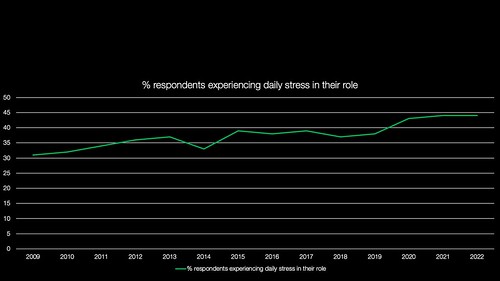
And actively engaged employees have been increasing over the past decade and a half. This increase in work engagement came against a background of progressively increasing daily stress levels at work.
The most reliable indicators of engagement were whether the person was able to work remotely (high engagement) or in a workplace (lower engagement) and management (high) versus individual contributor (low). Women were slightly more engaged than men and age showed no difference.
Soft girls might be just a dreamy balm to get them through the daily grind.
Old money style has been a pre-occupation behind the recent fascination with quiet luxury a la Zegna and Loro Piana.
Loro Piana advertising
The fascination with old money style isn’t new. Streetwear brands and hip-hop culture borrowed from preppy style over the years. Brands like Stüssy, A Bathing Ape, Phat Farm and Sean Jean had pieces that aped preppiness – a second old money style. Prior to Phat Farm, Ralph Lauren had trodden the same path and it inspired ‘Dad style’ in Japan.
Barbour jackets moved off the grouse moors and on to the backs of yuppies in the 1980s and 1990s UK – an urban preoccupation that is still maintained today.
Normcore is the practice of wearing great fashion basics that aren’t heavily branded. More related content can be found here and here.
Harry Farrell and Abraham Newman on the weaponisation of the global financial and trade system highlighted in their book Underground Empire. If I had one criticism it would be viewing this purely as an American trait. A classic example would be Chinese policies (cyber-sovereignty, shadow trade sanctions, coerced technology transfer), Russian food terrorism or EU sanctions on Russia.
Bill Gates feels Generative AI has plateaued, says GPT-5 will not be any better | Technology News – The Indian Express – Gates also predicted that in the next two to five years, the accuracy of AI software will witness a considerable increase along with a reduction in cost. This will lead to the creation of new and reliable applications. Interestingly, he also said that he anticipates a stagnation in development initially. The billionaire said that, with GPT-4, the company has reached a limit, and he does not feel that GPT-5 will be better than its predecessor.
I started thinking about Canon semiconductor manufacturing disruption when I read this article: Canon looks to nanoimprint tech for 2nm lithography | EE News Europe. Canon semiconductor manufacturing disruption looked on the horizon with the announcement of its nano imprint technology. Nano imprint approach is something that has been explored for a a couple of decades, but had so far been rejected due to challenges of implementation.
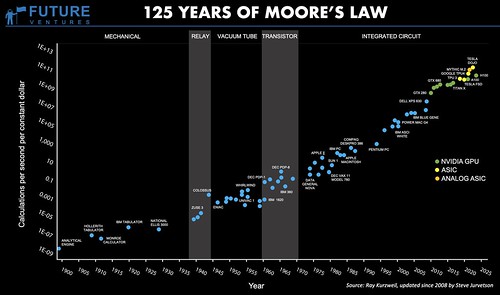
Future Ventures on Moore’s Law
Canon now claims that they have it ready for production on middle edge processes with a potential address current leading edge processes. Canon has stuck with nano imprint as a development approach because it is adjacent to Canon’s core technology expertise in inkjet printing.
Canon semiconductor disruption depends on whether it can change the technology roadmaps of memory chip makers and other fabs. This is going to be unlikely, but Canon semiconductor manufacturing disruption could disrupt the outlook for other vendors, notably Dutch equipment maker ASML.
Canon semiconductor disruption seems to be part of a wider movement to rethink how semiconductors and adjacent products are manufactured to better facilitate further scaling at reduced capital costs, but few if any will be successful: Dracula plans Europe’s largest OPV plant with inkjet printing | EE News Europe
A New Age Of Genderless Brands? – Branding Strategy Insider – Mikimoto pearls managing to attract men. I see this as an extension of century’s old ‘dandy’ culture from the pearly kings and queens, to 1970s African American style in Detroit and some of Dapper Dan’s work that looked to come up with ostentatious looks.
Chinese Bloggers Might Soon Be Required to Display Their Real Names on Social Media Platforms – the government already knows who they are, this seems to be an effort to expose them more to the general public – which can be volatile and vindictive. And so, this is likely to be an effort to use crowd pressure to reduce divergent or innovative opinions, so the party becomes the originator.
Amazon is thinking about quantumcomputing | Patent Drop – Amazon’s tech essentially acts as a middleman between a quantum computer and the user interface. First, a user makes a request with this service through an “edge computing device” — their own device that isn’t connected to the quantum computer itself. Then the system will “automatically translate the quantum task, quantum algorithm, or quantum circuit” into a representation that a quantum computer can understand. This system will then pick the right quantum computer for a certain job, and work with it on the back end to complete the request
You’re still reading? Great! Welcome to my November 2023 newsletter which marks my 4th issue.
I am not excessively superstitious – but living in Hong Kong rubbed off a bit on me.
I developed a love of milk tea, found the ‘hit women’ cathartic and am still leery of the number 4.
The number 4 is considered unlucky. In Hong Kong buildings, there is no fourth floor – in a similar way to their being no 13th floor in the UK high rise and office blocks. So I hope that this fourth issue doesn’t bring misfortune.
The clocks have gone back and the sun rises reluctantly over the horizon every morning, disappearing earlier each afternoon, but that doesn’t mean that inspiration stops. And it will be Christmas before you know it.
New reader?
If is your first time reading, welcome to my November 2023 newsletter! You can find my regular writings here and more about me here.
Things I’ve written.
Dimensions of Luxury based on a mix of stuff that I have read from Sense Worldwide, Horizon Catalyst and books on luxury trends.
Every wondered why its dot com rather than full-stop com? So did I.
Analysis on IPSOS research on the value to brands of reputation.
MCN – multi-channel networks. A business type popular in China and Japan is taking a record label approach to a stable of influencers.
Material World: A Substantial Story of Our Past and Future by Ed Conway. Prior to working in advertising, I had a background in manufacturing and consider myself reasonably well read, but some of the material in Conway’s book was completely new to me. Its narrative approach reminds me of the vintage TV documentary series Connections presented by James Burke, that can be found on YouTube.
Beyond Disruption by W. Chan Kim and Renée Mauborgne. This book looked at non-disruptive innovation. This is diametrically opposed to the way innovation is discussed in Silicon Valley and the mainstream media. More on my view of it here.
The New Working Class by Claire Ainsley. In the advertising industry, we have an acute perception that we might not understand life outside the M25 as we think we do. I thankfully have friends and family in the North to keep me somewhat grounded from the metropolitan elite lifestyle that I lead. Until I read this book, I didn’t realise how grounded the advertising industry was compared to our counterparts in national politics. That this book had to be written is a damning indictment of how out of touch politicos actually are.
Things I have been inspired by.
Project Gutenberg Open Audiobook project – Microsoft, and MIT have worked together to create thousands of free and open audiobooks using text-to-speech technology and Project Gutenberg’s open-access collection of e-books. Via Matt’s Webcurios newsletter.
IPSOS research video seminar on Unlocking The Value of Reputation. This is the closest I have seen to making the case for earned media activities. The full whitepaper is available here. Thanks to Stuart Bruce for the link!
My friend Ian recommended the Honest Brokernewsletter to me and I have found it to be a great read alongside my long time subscription to Bill Bishop’s Sinocism.
DDB Remedy’s meta analysis of marketing science work and academic scientific research on how emotion work for effective campaigns. How The Unexpected and Emotion Work to Influence Behaviour Change – focuses on how surprise when paired with emotion led creative had an increased impact. It all makes sense when you think about the power of salience and distinctiveness in communications; but it’s great to see that someone has drawn the multi-disciplinary research together in a cogent argument.
SEMRush have published a report for 2024 trends in social media platforms: The Vision in a Social Era that is worth downloading and pillaging for ideas that can be sold into clients.
I don’t know if inspired was the right term to use but I noticed 2023 Girlguiding Girl’s Attitudes survey thanks to a former colleague of mine from the start of my agency career. This is a survey that the Girlguiding movement has run over 15 years. Having freelanced on Dove’s ‘Real Beauty‘ campaign back in the day, this one statistic stood out to me.
DeBeers is returning to its ‘A Diamond Is Forever’ campaign. The print campaign image is beautiful with a great use of negative space. DeBeers is spending 20 million dollars on media in the US in China. In the US, I think this makes total sense.
DeBeers
I don’t know how well it will work in China? There isn’t the mental model built up in west over decades around the campaign theme. While the wealthy in China realise that diamonds are recognised as a store of wealth – the guo chao mindset may see gold (and possibly jade) jewellery favoured by at least some younger consumers.
This has been exacerbated by a decline in the number of marriages by just under 11% and a trend to prefer gold has an 18% reduction in diamonds sold in China over the past 12 months. In the meantime the sale of gold has risen by 12%.
I look forward to seeing how the campaign goes.
According to Numerator, online retail platforms will be the big winners from Christmas shopping. The news for the food and beverage services sector isn’t so great.
Finally ‘Knowledge is Power with Kidney Disease took me back to 1988. Rob Base has remade It Takes Two for Bohringer Ingelheim in the US to highlight the linkage between kidney disease and type two diabetes. The message is poignant as Base’s creative partner DJ EZ Rock died in 2014 and suffered from diabetes.
Producer DJ EZ Rock was responsible for the hype backing track based around Lynn Collins ‘Think (about it)’ and backing vocals from Rhonda Parris. (Parris has a short-lived recording career, releasing just one solo single No, No Love – a bit of a proto-House banger heavily influenced by freestyle if you like that kind of thing). Those that knew also had the Derek B remix of It Takes Two, with a heavy kick drum underpinning from a Roland TR-808 drum machine.
Things I have watched.
It’s cold and dark and I make no apology for my films being unapologetically escapist and and entertaining to try and counterweight the drab conditions. I do have some standards through and got material for this November 2023 newsletter.
Zerozerozero – follows a single drug deal between the Mexican cartel and the ’Ndrangheta. However things don’t go according to plan, so as the conspiracy unfolds we get a walk through the international drug trafficking trade across Latin America, Africa and Europe. This was done as a limited series, but I watched it as a boxset. It is directed by Stefano Sollima who did the Sicariofilms and Subarra.
Novembre – A French fictional dramatisation of the government response to coordinated terrorist attacks in Paris at Stade de France and the Bataclan concert venue through to the Saint Dennis raid that resulted in the death of police dog Diesel, which trended on social media with the #jesuisdiesel hashtag. Jean Dujardin shows the range of his ability as an actor from the comedy of his OSS117film series, to the deadly seriousness of this film.
Diva – I originally watched Diva as part of the Moviedrome series of curated films introduced by Alex Cox. At the time Cox personally disliked the film due to it being ‘a film of style’ rather than narrative. I loved it and revisited it on Blu-Ray. It was sharper and I got to appreciate the Vladimir Cosma soundtrack with its mix of opera, classical music and avant-garde compositions.
Alex Cox’s introduction to Diva for the much missed Moviedrome film seasons that used to run on BBC 2.
The Continental – Amazon Prime Video has some great tentpole content and The Continental adds to this. It’s a prequel of sorts to the John Wick universe and starts with a beautifully made feature length pilot. The action would find it hard to live up to the John Wick films, but the impeccable soundtrack manages to surpass them. The alternative past New York of the film has similar vibes to shows like Pennyworth and Gotham.
Useful tools
Better Miro, Mural or Figjam alternative
I have started using Milanote as an alternative to Miro for personal projects. Like Miro it has a mix of templates to get you started. There is an iPhone app and a native Mac app, so you don’t have to rely on running resource hungry pages in your internet browser of choice. It might even replace Omnigraffle in my personal software stack for some of the tasks that I do.
The sales pitch.
It was great to collaborate this month with my Hong Kong and Shanghai-based friends at Craft Associates on a prospective exciting new project. Now taking bookings for strategic engagements or discussions on permanent roles. Contact me here.
The End.
Ok this is the end of my November 2023 newsletter, I hope to see you all back here again in a month. Be excellent to each other. Let me know what you think or if you have any recommendations to be featured in forthcoming issues.
Dot as a post came out of me being zoned out and listening to a podcast while shaving as part of my weekend morning routine. Then it hit me whamo! The podcast I was listening to was by CSIS – a US think tank called The Truth of The Matter hosted by Andrew Schwartz.
The Truth of The Matter podcast in Apple’s Podcast app
At the end of the podcast I was listening to, they gave out the web address for the Center for Strategic and International Studies
C-S-I-S dot O-R-G
The Truth of the Matter
The first thing that struck me was ‘dot O-R-G’ rather than ‘dot org’; but then I started to think why wasn’t it period org (or O-R-G) for that matter.
In the UK and Ireland we call the dot at the end of a sentence a ‘full stop’. In the US they call it a period. Which made me wonder how we got to describing email and internet addresses in this way?
The history of top level domains has been well documented, but the history of the linguistics of top level domains hasn’t been.
Top level domain names potted history
What we would recognise as top level domain names like found in URLs and email addresses seems to have come about as part of the ARPANET developed and ran between 1969 and 1990. The Stanford Research Institute was responsible for the HOSTS text file that mapped IP addresses with domain names, it was assisted in this by part of the University of Southern California. It was a small network, so this ad-hoc system worked at the time. This evolved into a database based domain net system (DNS) in 1983, developed by University of Southern California when HOSTS performance started to slow the network down excessively.
Use of ‘dot com’ as a term
Since we are delving back into pre-web times, I used Google Books Ngram tool as a way of understanding the use of the term over time. 1993 was when the term took off.
This clip from NBC’s Today programme sees one of the presenters pause after each domain element rather than say ‘nbc dot ge dot com’
By the time I was watching The Site on my landlord’s cable TV in 1996, Soledad O’Brien, along with her animated co-host Dev Null* were dotting their way through email addresses and URLs like it was perfectly normal.
It’s usage peaked in 2001 and then declined as it became associated with the first internet business related bubble. Other domains such as org and net follow a similar track, but at a much lower volume.
Now the address in written form is enough, or even just a QRcode to be scanned. Oral usage lives on all around us.