Category: web of no web | 無處不在的技術 | 보급 기술 | 普及したテクノロジー

The web of no web came out of a course that I taught at the La Salle School of Business at the University Ramon Llull in Barcelona on interactive media to a bunch of Spanish executive MBA students. The university wanted an expert from industry and they happened to find me by happenstance. I remember contact was made via LinkedIn.

I spent a couple of weeks putting together a course. But I didn’t find material that covered many of things that I thought were important and happening around us. They had been percolating around the back of my mind at the time as I saw connections between a number of technologies that were fostering a new direction. Terms like web 2.0 and where 2.0 covered contributing factors, but were too silo-ed

So far people’s online experience had been mediated through a web browser or an email client. But that was changing, VR wasn’t successful at the time but it was interesting. More importantly the real world and the online world were coming together. We had:

  • Mobile connectivity and wi-fi
  • QRcodes
  • SMS to Twitter publishing at the time
  • You could phone up Google to do searches (in the US)
  • Digital integration in geocaching as a hobby
  • The Nintendo Wii controller allowed us to interact with media in new ways
  • Shazam would listen to music and tell you what song it was
  • Where 2.0: Flickr maps, Nokia maps, Yahoo!’s Fireeagle and Dopplr – integrated location with online
  • Smartphones seemed to have moved beyond business users

Charlene Li described the future of social networks as ‘being like air’, being all around us. So I wrapped up all in an idea called web of no web. I was heavily influenced by Bruce Lee’s description of jeet kune do – ‘using way as no way’ and ‘having no limitation as limitation’. That’s where the terminology that I used came from. This seemed to chime with the ideas that I was seeing and tried to capture.

  • Alphabet: what does it all mean?

    Social media went into overdrive on Monday evening UK time when Google announced a formal restructure of all its businesses, creating a new company called Alphabet. For the man on the street, Google means Search, YouTube, Drive (including Docs, Sheets etc.), email and Android. For the average marketer you can throw various advertising products and Google Analytics into the mix. For business IT managers, it is everything from productivity, software-as-a-service and possibly as a supplier of a search appliance for its internal servers.

    Google Logo in Building43

    Three different customer types exist and a product set that grows layer-by-layer like an onion. The bulk of Google’s revenue currently comes from advertising due to the clever technology behind it. One can see from Microsoft’s move to the cloud that there is less revenue in cloud computing than in Google’s current business, so when advertising reaches a natural ceiling for growth, services will provide an incremental benefit at best.

    Android was designed as a conduit to Google services and for advertising to venture out into the mobile space.  But the world’s most popular mobile operating system is not without its own issues. Despite all phones essentially looking the same, there is a massive amount of fragmentation in the Android marketplace, which makes life harder for developers. Google is also a developer, so building applications that it can build loyalty through and make money from becomes more difficult.

    Secondly, an appreciable amount of Android devices (those sold in China) and many sold in Russia don’t use Google services and provide little to no opportunity for Google advertising.

    This means that Google is forced to make big bets in very different sectors. Sergey Brin and Larry Page, partly because of their entrepreneurial nature to explore new opportunities, built in an ability to scale Google beyond the business lines that I have outlined above. This was apparent from their original IPO share prospectus and accompanying letter. Xerox is famous in Silicon Valley lore for fumbling the future, by inventing lots of products that would be recognisable to us today in the late 1960s and early 1970s, only to see a corporate head office miss the boat. Brin and Page would have had some awareness of this. Microsoft’s inability to leapfrog beyond its core business successfully is probably also a factor for consideration.

    Alphabet formalises the framework that Page and Brin had been working to for a number of years.

    So what does this mean to Google?

    For the foreseeable future Alphabet will be more of the same for Google. We’ve the seen the business scale back services. By September last year Google had closed down 30 services. It has cut back the functionality of Google Adplanner as a reference tool, to just focus on sales. Google has continued to prune back services such as Google+ (a challenging task given the tentacles + has across Google’s services). The changes inside Google for staffers also reflect similar moves towards profit optimisation, move away from experimentation and being a ‘mensch’.

    The biggest move was to get rid of the 20% of time engineers could devote to projects that interested them. The truth is since at least 2009, the Google myth of people working there to change the world rather than delivering profit hasn’t held sway for a great deal of their staff.

    On the outside Google will still likely have playful swag and cool offices, but the reality is that it will be more of a ‘normal’ business. That means that we won’t see the next Facebook coming from within Google and that whilst the speed of evolution will continue to run along at the same pace, substantial innovation probably won’t. This kind of business requires a different kind of leader to Page, and by appointing Sundar Pichai, will create a cultural break from the past. Pichai is likely to be able to get more revenue out of the Google ‘cash cow’ to help drive innovation in these other areas.

    Page and Brin are freer to bring their energy to the other businesses in Alphabet. For instance, keeping Nest out of Google allows it to work easier with Google competitors like Apple and Microsoft as part of a wider eco-system.

    Lastly, it could be an effort to ring fence Google’s anti-trust woes within the existing business and prevent restrictions being imposed against its newer businesses because of the past sins of the core business.

    So what does Alphabet mean for marketers?

    Google is likely to pursue a steady as she goes approach. The focus will be to optimise revenue, so there will be tension with agencies on advertising practices. We’ve already seen this, with Google restricting methods of buying YouTube advertising. These changes will impact the advertising technology business around programmatic advertising.

    The picture with SEO is more about slow and steady change; Google has evolved its Panda index changes to a rolling change rather than the massive shake-ups of old.

    More Google related articles here. Originally written for Racepoint Global’s now defunct CommsTalk blog.

    More information

    Android Fragmentation Report August 2015 – OpenSignal
    2004 Founders’ IPO Letter – Investor Relations – Google
    Fumbling the Future: How Xerox Invented, then Ignored, the First Personal Computer
    What’s eating Google’s brand | renaissance chambara
    Why Google Employees Quit? | TechCrunch
    Google Tightens How Advertisers Buy YouTube Ads | AdWeek
    Google’s $6 billion miscalculation on the EU | Bloomberg Businessweek

  • Native advertising + other news

    Native advertising

    Podcasting embraces native advertising | Digiday – interesting as podcasting historically has struggled with finding a advertising model and native advertising doesn’t fit that comfortably in the performance orientation of online ads. Native advertising does make sense in podcasting as it shouldn’t affect the podcasters flow and content integrity too much – more marketing content here.

    Beauty

    Sephora Launching Beauty Box Subscription Service | TIME – interesting that the retail brand is stepping into BirchBox territory, it’s not only about sales but product market testing and says something about the tyranny of choice. Sephora has also rolled out vending machines in high footfall areas like airports to tap into the tyranny of choice. I can see this working in high value areas but puzzled why subscriptions has caused so much universal excitement across FMCG sectors, yet not luxury brands

    Business

    California Court Gets One Step Closer to Deciding Uber’s Fate | TIME – important because California tends to lead legal trends in the US. Uber will be fighting this tooth and nail

    Culture

    Jungle, Raves and Pirate Radio: The History and Future of Kool FM | VICE – nice to see Kool FM getting some recognition, how did they manage to survive through the raids I wonder

    Economics

    Pepsi plant shuts down in Venezuela as desperation grows over product shortages | Fusion – soft drink becomes a form of currency exchange

    Gadgets

    How to be a cyberpunk, according to a 1990s tech magazine | Fusion – love this article image, but it shows how far Sony has fallen from prominence compared to where it was

     Web of no web

    Refinery29 – Time cover reinforces tech stereotypes – PCGamer calls the cover “the greatest threat to VR” because it “reinforces, rather than challenges, the perception that VR is a mask that nerds use to blot out the world.” – it also probably isn’t helped by photos from the Facebook F8 developer conference with a sea of coders wearing them whilst apparently staring into nothingness.

  • Apple Pay in the UK

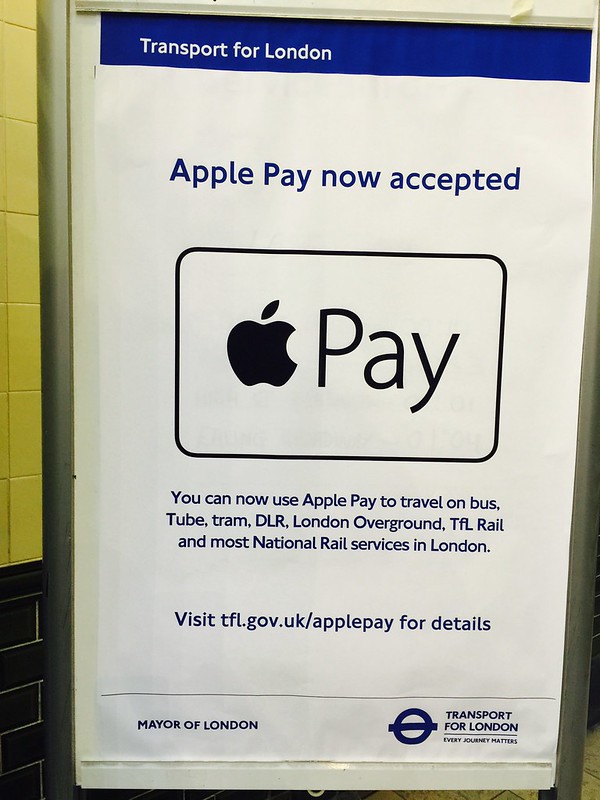
    Even if I wasn’t interested in technology I would have known about the launch of Apple Pay in the UK some eight days ago. My inbox was bombarded with emails from credit card providers explaining how I use their card on the service. Logos for the payment service appeared in retail partners and on billboards in tube stations.
    Untitled
    However despite this onslaught of media hype, educational material and free advertising for the service I have only seen one person use it. A tech forward looking gentleman twisting his arm around to pay for a coffee in Starbucks with his Apple Watch.

    Now this isn’t necessarily a big issue. It is a feature that Apple provides rather than being a money generating service (a la iTunes) in its own right. I tend to see the service as an emergency measure of if I left my wallet at home (as I do on occasion).

    For retailers and TfL there is not really a compelling argument for supporting Apple Pay, beyond the brand positioning of being ‘on trend’. Indeed TfL warns that transactions take longer than NFC enabled credit cards – which isn’t that desirable when you have a big queue of people looking to go through the gate during rush hour on the central line. That relative performance makes me wonder why Apple didn’t look at other uses like electronic building access or car keys that increasingly rely on NFC or RFID technologies.

    Finally, Apple Pay is less attractive for American Express than other card providers due to the lack of support of Amex on Apple Pay by many retailers that accept their NFC cards. More finance related posts.

    More information
    TfL cautions users over pitfalls of Apple Pay | The Guardian

  • Burberry turnaround + more things

    Jing Daily: Burberry’s plan to turn it around in Hong Kong – go local –  it makes sense that Burberry comes up with designs that better suit the humid subtropical climate of Hong Kong and southern China. Burberry has China as its biggest market Getting Hong Kong right is mission-critical for Burberry. More related posts here.

    Human Curation Is Back | Monday Note – The limitations of algorithmic curation of news and culture has prompted a return to the use of actual humans to select, edit, and explain. Who knows, this might spread to another less traditional media: apps.

    Is consciousness an engineering problem? – Michael Graziano – Aeon – interesting questions around artificial intelligence

    Intel chief raises doubts over Moore’s Law – FT.com – while Intel’s enduring pace of innovation has “disproved the death of Moore’s Law many times over”, the time between each new generation of microprocessor has widened.

    Boeing Patents Laser Nuclear Fusion Jet Engine – IEEE Spectrum – starred as most of the engine room in the most recent Star Trek movie

    China’s Xiaomi Building Patent ‘War Chest’ | Re/code – this makes sense as it will also benefit Xiaomi in China for dealing with Qualcomm

    The Next Wave | Edge.org – slowing rate of technological progress: Moore’s Law seems to have hit a problem, robotics like artificial intelligence is making very slow progress

    Apple Waits as App Developers Study Who’s Buying Its Watch – The New York Times – interesting how many app developers are struggling to envisage a good user experience through the Apple Watch

    Former Reddit CEO Ellen Pao: The trolls are winning the battle for the Internet – The Washington Post – interesting take on the state of trolling online

    Crimson Hexagon Now Offers Access To Tumblr Firehose | Marketing Land – are they still outrageously expensive?

    Best Practices: What Is the Optimal Length for Online Video? | Advertising Age – maybe it isn’t about length of time but quality of content?

    The socio-economic contribution of European shopping centres | ICSC – 90% of sales still occur in physical locations (PDF)

    What’s With All The Yoga Pants? | Fast Company – some interesting consumer insights into the American market. Yoga pants are an interesting crossover design in a way that Jane Fondaesque lycra isn’t

    Q&A: Martin Sorrell on innovation in China – Campaign Asia – nice write-up with Martin Sorrell on the Chinese market

  • Daihatsu + other news

    Daihatsu

    Daihatsu Releases 3rd Model of Copen Sporty Minicar – Nikkei Technology Online – the Daihatsu customisable car, with manufacturer kits to change the vehicle appearance dramatically. Daihatsu is one of Japan’s smaller manufacturers with budgets dwarves by Toyota and VW, so this move makes a lot of sense

    Culture

    Chevrolet Issues Press Release Written Entirely in Emoji | Technabob – nice gimmick

    Design

    How It’s Made Series: Beats By Dre — Medium – pretty damning. What is particularly disheartening is the weights to make the headphones feel like they are of a higher quality than the really are. More design related content here

    Beats By Dre Teardown Finds Metal Included to Add Weight | Digital Trends – not terribly surprising but interesting analysis on the product.

    Media

    WPP, Daily Mail and SnapChat launch content agency Truffle Pig | Campaign – its like war, pestilence and famine coming together to form an agency. I would imagine that it could be a struggle to sell into clients, at least in the UK

    The Mayor vs. the Mogul – POLITICO Magazine – challenges of ethics that Bloomberg faces

    Security

    Why We Encrypt | Schneier on Security – another good read by Bruce Schneier

    Software

    The Web is getting its bytecode: WebAssembly | Ars Technica – interesting asm.js is actually a subset of Javascript than something completely new

    Technology

    Google opens up on its SDN | Network World – what might suit Google. won’t necessarily work in the enterprise data centre or the telecoms network. Organisation optimised products do inspire more general purpose open source products and this might be no exception.

    Web of no web

    Enter the video helmet – a 130 inch world of your own | TelecomTV – interesting product in terms of immersion. If this was fictional, one would have to ask if this was part of the ‘deck’ used by console cowboy Case in William Gibson’s Neuromancer?