Category: wireless | 無線 |무선 네트워크 | 無線

This blog came out of the crater of the dot com bust and wireless growth. Wi-Fi was transforming the way we used the internet at home. I used to have my Mac next to my router on top of a cupboard that contained the house fuse panel and the telephone line. Many people had an internet room and used a desktop computer like a Mac Mini or an all-in-one computer like an iMac. Often this would be in the ‘den’ or the ‘man cave’. Going on the internet to email, send instant messages or surf the internet was something you did with intent.

Wi-Fi arrived alongside broadband connections and the dot com boom. Wi-Fi capable computers came in at a relatively low price point with the first Apple iBook. I had the second generation design at the end of 2001 and using the internet changed. Free Wi-Fi became a way to attract people to use a coffee shop, as a freelancer it affected where I did meetings and how I worked.

I was travelling more for work at the time. While I preferred the reliability of an ethernet connection, Wi-Fi would meet my needs just as well. UMTS or 3G wireless data plans were still relatively expensive and slow. I would eventually send low resolution pictures to Flickr and even write a blog post or two. But most of the time I used it to clear my email box, or use Google Maps if I was desperate.

4G wireless services, started to make mobile data a bit more useful, even if the telephony wasn’t great


  • Coinbase Super Bowl ad

    Coinbase advertises during Super Bowl

    On Monday afternoon, the buzz amongst my colleagues in New York was the Super Bowl from the night before. In particular the advertising and one advert by Coinbase sparked more discussions than others. The advert was divisive. Some people that there was something wrong with their smart TV which had triggered a dodgy screensaver. One person even first thought that the QRcode would take them through to a site that might explain whatever ransomware had hijacked their TV.

    They scanned the QRcode but it didn’t work properly. The reasons for it not working were twofold:

    • The contrast in the QRcode background and foreground wasn’t large enough for certain colours and so wouldn’t scan
    • The coinbase website fell over. This would be spun as unprecedented demand, but the reality was poor execution

    A game console style ROM screen revealed at the end that it was Coinbase. The management would likely pass the whole car crash off as growth hacking.

    Growth hacking

    Growth hacking as a term was attributed to a blog post by Sean Ellis back in 2010. But as a concept it goes back much further. A classic example of growth hacking could be considered to be FMCG staple of ‘buy one, get one free’ or BOGOF. The master of the growth hack was David Wallerstein came up with the idea of supersizing popcorn servings in the 1960s. Wallerstein came up with a behavioural change experiment as business idea based on the insight of that people might want to buy and eat more popcorn, but were simply ashamed of buying two bags at the cinema. Wallerstein was successful in his experiment. Wallerstein was appointed by Ray Kroc to the board of McDonalds in 1968 and then rolled out larger servings in McDonalds restaurants, if you’ve ever been asked if you want a ‘large meal’ with your burger Wallerstein was responsible. This created a whole range of products in restaurants and supermarkets called expandables, from large meals to multi-packs of products.

    A more recent example would be the signature on hotmail.com emails that encouraged whoever received them to get their own email address at hotmail.com. This was effective back when most people had a work or college email address and wanted a home account for personal communications like finding a new job. Gmail took a slightly different approach with an invite scheme that saw early adopters clamouring like they were trying to get in the door of Studio 54 on a Saturday night.

    The original idea of growth hacking is to try a small marketing tactic and refine it based on the feedback that you get. In reality that gets translated into poor thought out showy tactics focused on the short term. The reason for this is that test and learn is done over a short time period and doesn’t incorporate marketing science. The Coinbase advert was a classic example of this.

    Buzz marketing

    Growth hacking is influenced by a number of things. One of which was the concept of ‘scrappiness’ in start-up marketing.

    Startup scrappiness

    During the original dot com boom new online businesses wasted a fantastic amount of money on ineffective advertising. The most iconic example of this would be the pets.com sock pocket advert that featured in the 2000 version of the Super Bowl.

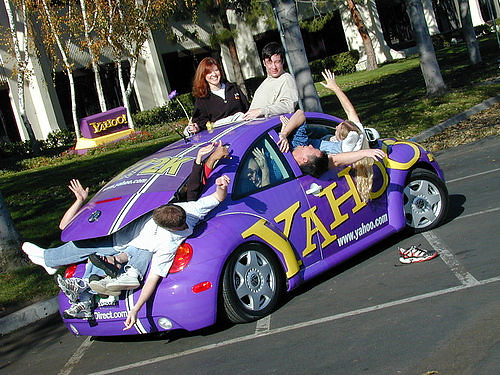
    Car with Yahoos
    Courtesy of Yahoo! Inc. Co founder David Filo is hanging from the rear of the car.

    You saw some businesses like Yahoo! try to do brand building advertising in a more cost effective way. This was known internally at Yahoo! as buzz marketing and in the US, it had its own team.

    Examples of buzz marketing included wrapping employees cars that had been volunteered in the Yahoo! brand. This was listed in the employee handbook as a free ‘perk’ of working at Yahoo!. There were some conditions like you had to keep the wrap on for year and a good behaviour clause.

    The world's first (only?) purple Zamboni

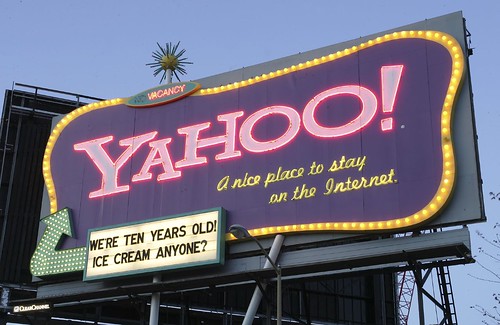
    There were also some sponsorships like the ice machine at the San Jose Sharks stadium and some high traffic billboards. Yahoo! used to have a billboard alongside the 101 freeway going into San Francisco and another in Time Square, New York.

    Our San Francisco billboard

    While the lesson of ‘go for business models that make financial sense’ seems to have been lost as we left the dot.com era further behind. The idea of ‘scrappiness’ stuck. It fitted with the wider concept of ‘struggle culture’ in entrepreneurship.

    In technology, marketing = sales

    On one level, the problem isn’t Coinbase but the technology sector. The truth is that for the most part technology companies don’t do good marketing. My hypotheses around the reasons for this are:

    • Technologists aren’t marketers. For the original technology firms, the products found their own market. Over time a salesforce was introduced and for complex products there might be pre-sales and post sales consultancy. They don’t really know much about marketing science. The sales funnel is the one ‘marketing model’ that managed to make it into Microsoft® PowerPoint® says a lot about the nature of this understanding.
    • To a technologist, every problem looks like a technology challenge. So the answer for great marketing is either in kludges aka hacks, like the Coinbase advert, or algorithmic in nature. And those algorithms are usually based on a poor understanding of marketing featured in the point above
    • Technologists think short term. Brands are transitory if you are looking to be bought out, or are built ‘organically’ in the hands of the victors (Oracle, Microsoft, Alphabet, Meta, Apple, Amazon, Tencent or Alibaba). So building a brand is an alien concept. Why build a brand in a world when you believe in disrupt, or be disrupted? Contrast that with the FMCG world where brands have considerably longer lives. The Nestlé Kit Kat chocolate bar is 86 years old at the time of writing. Procter & Gamble’s Bold washing powder (laundry detergent) is a spritely 57 years old. Baileys Irish Cream liqueur is 48 years old, as is the Mobil 1 range of synthetic engine oils, oil filters, chassis grease, transmission fluids, and gear lubricants. If we think of technology brands with that kind of longevity its likely to be the incumbent telecoms companies, Fujitsu, Hitach and IBM. At the younger end would be the likes of Verbatim, AMD, Intel, Oracle, Western Digital, Microsoft, Apple, Acer and Atari.
    • Disrupt or be disrupted creates delusion. If you believe in the disrupt or be disrupted manifest destiny of technology you probably believe that your ability to market is better than established brands that are actually marketing organisations

    I would guess that Coinbase marketers would tick at least some of these hypotheses. It probably doesn’t help that organisations who should know better are starting to buy into this ‘disrupt or be disrupted’ model.

    Cost of reach

    So, if you’re a technology company like Coinbase, who believes in disruption and ‘knows’ how to market better than marketers? The simple answer is that while digital has managed to get marketers to use its platforms, it has failed to offer the most competitive cost per reach. To achieve the same goals Coinbase would have had to spend an order of magnitude more on YouTube than TV to reach an equivalent audience.

    Brand building

    Finally the reason why the advert contrasted so sharply with the other content that ran during the Super Bowl was because everyone else focused on brand building rather than on brand activation. The reason why they are going for brand building is that the work will keep paying dividends for years. This is something that digital transformation doesn’t reflect well through its algorithms. The Coinbase approach was the equivalent of a TV ad that said click here.

    More information

    Find a Growth Hacker for Your Startup | Startup Marketing (July 26, 2010)

  • Rundle in Korea

    The rundle as a term was popularised by business academic Scott Galloway.

    Overvalued unicorns, by Scott Galloway

    It means ‘recurring revenue bundle’. In the technology world bundling meant concealing the real price and value of a product, and or maximising leverage from one industry into another. Here are two bundle examples:

    • Mobile carrier combined text, data and call plans were originally designed to make it harder to compare one carriers offering with another. That was supposed to reduce customer churn because it was like comparing apples and oranges, rather than voice minutes, cost per text or cost per MB of data used
    • Microsoft integrated its web browser in with its operating system Windows. This meant that life was appreciably harder for Netscape to build its web browser business. Web developers in large corporates optimised their websites for Internet Explorer. Western Mac users like me couldn’t use online banking. Korean Mac users couldn’t get online because they couldn’t verify their identity. Korean cybersecurity was based on a common identity platform that relied on Microsoft ActiveX – which got hacked by North Korea….

    Back to rundle

    Remember the ‘recurring revenue’ bit?

    The classic example of a rundle that Scott Galloway uses is Amazon Prime. A one-off annual payment made by Amazon customers for free postage. There are also some ancillary benefits such as content from the Amazon Prime Video service. But Amazon Prime has a secondary effect, Prime customers spend more with Amazon over a year. This made increased profits for Amazon and less profits for its competitors, further strengthening Amazon’s hand. By 2019, 82 percent of US households have an Amazon Prime membership.

    Another example would be Apple’s service businesses:

    • Apple TV+
    • iCloud+
    • Apple Music

    So what’s the Korea connection?

    korea temple

    The rundle in Korea story started with a flower market.

    The Seoul wholesale flower market. The first thing that you need to know about Korean flower sales is how small they are. Here’s a rough and ready industry comparison. On average per person, per market on an annual basis:

    • The UK sells about $150 worth of flowers per year, per person
    • Japan sells about $50 worth of flowers per year, per person
    • South Korea sells about $15 worth of flowers per year, per person

    The first week in January meant that the trade was starting to get back to normal. Imports of flowers from around the world had started up again as foreign businesses reopened from the Christmas break. This is when things started to go weird. Wholesalers claimed that an online-only mail order flower company was cornering the market across a wide range of flowers driving prices up. The company that they alleged was doing this was Kukka. According to their allegations, Kukka had managed to get a wholesalers licence so that the could bid directly on the spot market for flowers. There is some anecdotal evidence that this drove florists already operating on meagre margins into the wall.

    At the time, this story didn’t make the local Korean media. Why? There are a few hypotheses:

    • Korean journalists weren’t interested because Koreans don’t buy that much flowers
    • Korean journalists couldn’t get enough sources to make the story fly
    • Korean news media publishers tend to be leery of stories that involve large corporates. What the Koreans call chaebols, unless they can’t really ignore the story any longer

    So why would Kukka have allegedly done this now? A few changes happened at Kukka the previous year. At least one of the founders left, a new management team was put in place and Kukka signed up to be part of T-Universe in August 2021.

    SK Telecom's T Universe

    SK Telecom officially launched T Universe at the end of August last year with a number of subscription services. Think of T Universe as a platform for bundles. It encompassed a number of Korean and international brands into rundles:

    • Amazon Global Store: remember that Amazon Prime won’t cover buying items on Amazon Japan or US? Well for $7.20 per month Koreans can get an Amazon Prime like free shipping. Frankly that would scare the crap out of my bank manager, given the amount of vinyl records, Blu-Rays and books that I would be buying
    • Starbucks: unlike most of the rest of the world, Starbucks isn’t the cock of the walk in Korea. It has a range of fierce domestic and international competitors in Korea. Koreans are big coffee drinkers and pay more than people in the UK for their coffee to go
    • Paris Baguette: despite the name, this company is as Korean as Shin spicy ramen noodles. Think of it as falling somewhere between Pret a Manger and Paul in terms of its offerings.
    • AIA insurance: AIA is an American-founded Hong Kong multinational insurance and finance corporation. It is the largest public listed life insurance and securities group in Asia-Pacific. It formerly used to be part of AIG

    Kukka is also part of these subscription plans with consumer being able to get 9000 Korean won vouchers every month.

    SKT

    SK Telecom (or SKT as its often known) is a vast business in its own right and is part of an even larger group SK.

    SK or as it was originally known Sunkyong Group started off in textiles and then became vertically integrated from petroleum to polyester fibres. Now the business covers:

    • Construction: aka SK Ecoplant does a wide range of projects across oil and gas, chemical plants, power generation and infrastructure, environmental protection, industrial buildings, civil engineering and housing
    • Pharmaceuticals with a focus on drug discovery and development
    • Chemicals also known as SK Innovation. SKC specialises in making polyester films for LCDs and solar cells.
    • Energy from oil and gas to electric battery production
    • Telecommunications
    • Trading and services: loyalty schemes (similar to Tesco Clubcard or Nectar points), a wedding consulting firm and an IT services provider with a particular focus on mobile commerce products. Their US arm launched Google Wallet
    • Semiconductors. SK Hynix is the world’s third largest semiconductor manufacturer

    Even SKT on its own is vast in its own right

    • Mobile carrier
    • E-banking and mobile payments
    • E-commerce platform (Shopify analogue with a loyalty programme)
    • Nate online portal (think Google services but Korean)
    • Satellite communications
    • Broadcast networks
    • Cable TV and brandband
    • T-Map (an Uber like service in partnership with Uber)
    • Dreamus: the people who make the Astell & Kern music players beloved of digital hi-fi enthusiasts

    Market distortions

    SKT brings a number of strengths to the T-Universe rundle series.

    It already handles 100,000,000 customer service calls a year

    • A huge existing customer base
    • CRM software and marketing data-mining expertise
    • It has the scale to bring on a 1,000 (sales) consultants to just focus on growing and upselling T-Universe

    SKT also doesn’t care about margin at the moment, instead focusing on market making:

    “Instead of a profit margin, we are thinking about expanding customer services and believe that new business models will emerge in the process. Margin is not a priority at this early stage,” Ryu said.

    SKT executive Ryu Young-sang quoted in the Korea Times: SKT to boost commerce biz with subscription platform (August 25, 2021)

    All of which is likely to mean a bump in potential customers for flowers, that probably haven’t bought flowers previously. It is easy to see how this rundle could create a market distortion. For businesses like Starbucks and Paris Baguette this would mean reduced margins on higher foot traffic, nothing that they couldn’t manage.

    However in a smaller market scenario like flowers, things could get more interesting. Huge demand from new customers that Kukka would be obliged to fulfil at ANY cost, because being sued in a Korean court by a chaebol would be disastrous.

    Korean business environment

    Korea is a relatively unique business environment. A few large businesses drive the country. You can literally live a Samsung life:

    • Work at Samsung
    • Shop at Shinsagae
    • Commute in your Samsung car
    • Stay in a Samsung hotel paid for with your Samsung card
    • Watch entertainment from CJ on your Samsung TV, tablet or phone
    • Ensure your safety with Samsung insurance for your Samsung built apartment and should you feel ill go to a Samsung hospital

    Online brought additional pressure to large businesses. Internet giant Kakao moved from internet media and communications to taxi bookings and mobile payments. Korean banks feeling under threat have moved into online services. So it was only a matter of time for SKT to build its rundle series for consumers to pick and choose from. Unlike many businesses (Apple and Amazon) who have moved from a transactional to a hybrid transactional and recurring revenue model, SKT was always a recurring revenue model because of its sector. So the only way for it to grow would be to expand the number of sectors that it got recurring revenue from with its ‘subscriptions of everyday things’ in T-Universe. SKT and the flower industry (let alone Kukka) look like apocryphal story of a hippo and a chick sharing the same bed.

  • Handspring + more things

    Springboard a documentary on Handspring

    Handspring was a key part of my first agency job. It was the dot com era, Jeff Hawkins, Donna Dubinsky, and Ed Colligan had founded Palm Inc. and left after it was sold to 3Com. They then went on to make modular PDAs with the Handspring Visor – which tapped into the clear plastic designs pioneered by Apple’s iMac. And then they built the PDA with smartphone capability called Treo. 3Com had made a Palm device in 1999 that used the Mobitex mobile data network, which was more analogous to a two way pager with a limited walled garden of content a la vintage AOL. Palm’s version of the Palm PDA has a common connector that could be used to connect external peripherals, such as the OmniSky sled which converted your PDA into an internet connected smartphone.

    But it was Handspring who had the ‘heat’ and the wherewithal to provide a neat connectivity slot for its peripherals to sit in, providing a neater experience. Springboard is a documentary about Handspring

    Of course, the outcome of PDA based smartphones isn’t all sweetness and light as Scott Galloway shows with our modern mobile device usage.

    Myst

    Ars Technical are doing some great oral histories of games creation. This one on Myst is very close to my heart. What’s particularly interesting is how the game was developed at a moment in time with the transition to CD ROM media. This resulted in a huge leap forward in what the technology was capable of doing, comparable to the early web in terms of creative disruption. It also made me really, really miss HyperCard.

    Jimmy Wang Yu

    Taiwanese martial artist, actor and gangster Jimmy Wang Yu carved the way for Jackie Chan and Bruce Lee in Hong Kong cinema. This documentary on him is first rate.

    Windows

    Interesting CNBC documentary on the hegemonic position of Microsoft Windows in personal computers.

    Audi S1 Hoonitron and vehicles of Cyberpunk 2077

    Ken Block’s collaboration with Audi has produced some interesting material. Growing up in the 1980s, group B rallying held a fascination for me, so that’s what got me interested in the Block / Audi collaboration at first. But what’s interesting about Block’s prototype electric Audi Quattro S1 is the speed at which Audi is able to put together a prototype working car with modern technologies. All of which implies ever more opportunities for automotive customisation for customers and the potential for additive manufacturing at the luxury end of the market. Hoonitron does sound like a late 1970s Taiwanese or Korean copy of a Sony television set.

    While we’re on about car design, there is also this great video on the vehicles in Cyberpunk 2077. 14 out of 10 for pure style.

    Tudor Pelagos FXD

    Tudor have been on point in their marketing. Their new version of the Pelagos has some lovely design cues, even if its modern day association with the French navy is marketing fluff. PELAGOS FXD – more from the Tudor press room.

    Fake socialite

    A graduation project by an art student from the Central Academy of Fine Arts in Beijing did an experiment that has sparked a debate about class, inequality and the massive wealth gap in modern China. In the video you see her attempt to live 21 days for free in Beijing. She disguised herself as a socialite and slept in the halls of extravagant hotels and enjoyed free food and drinks. What surprised me is that the work hasn’t been suppressed and that she hadn’t been arrested. It also shows how Xi Jingping’s concept of common prosperity is designed to tap into a deep tension in society at the moment.

    Paper and glue

    MSNBC put together an amazing documentary on French street artist JR who does giant photo collages as street art. Here’s the trailer.

    https://youtu.be/7NmxynGAmrM

    Hong Kong Christmas

    Hong Kong’s relationship with Christmas is a complicated one. A substantial minority of Hong Kongers are practicing Christians. Until the opening up of China in the late 1970s, Hong Kong was a substantial supplier of toys, Christmas decorations and lights. And then there is the multinational community living alongside Hong Kongers, which brings the western commercialism of Christmas. For many Christmas is a ‘pre-lunar new year celebration, both are big on the colour red and the decorations for one used to bleed into the other in public spaces. So I thought the joy of this Christmas street market might appeal to readers here.

    https://youtu.be/Dpwm7nQGxcg
  • Apple Is Trash + more news

    Apple Is Trash

    Why Apple Is Trash? Because Apple has demonstrated a moral bankruptcy in its behaviour. In the west, it is pro-LGBTQI, pro-security, pro-freedom etc. However its conduct elsewhere shows that it supports and strives to please authoritarian regimes.

    The Information on Apple in China, Apple’s Deal, Evaluating Apple’s China Risk – Stratechery by Ben ThompsonThis analysis of what Apple did is, of course, distinct from the question of whether or not it was right. That is certainly something worth debating, but I suspect it is more of an academic question here in 2021. The time for Apple to decide whether to start the process of decoupling itself from China was when this deal was made; the company decided to go in the opposite direction — deepening its dependence in the process — and I don’t see it reversing anytime soon. The fact of the matter is that Apple isn’t simply the preeminent example of China’s manufacturing prowess – Apple Is Trash.

    Apple and China may renew their deal if both parties agree to do so, which means Apple may have continued stronger hold in China / Digital Information World – will Apple be seen in the same way by Xi now? How much lower will Apple need to? Will Apple Is Trash plumb new depths?

    What Apple’s removal of a Hong Kong protest app means for democracy – Vox – yet another example that – Apple Is Trash

    Despite all of the Apple is Trash things that they have done, it still doesn’t pay off: Apple’s nightmare before Christmas: Supply chain crisis delays gift deliveries – Nikkei Asia

    China

    Exclusive: Meet ‘Director K’, the MI5 spy responsible for keeping Britain safe from China and Russia

    President Xi of China lures Commonwealth with military diplomacy | World | The Times – which has implications for future demands of British military equipment sales and private military contractors in the developing world

    Chinese mining groups scour Afghanistan for opportunities | Financial Times

    Brief #98: sanctioning Lithuania, Didi delisting, China-Africa forum – the Lithuania sanctions move by China is interesting

    China-Pakistan Belt and Road Initiative hits buffers | Financial Times 

    China’s indebted property sector highlights a fading economic revival | China | The Guardian

    Chinese weddings fall to 13-year low as demographic crisis brews | Financial Times 

    Macao Casinos to Close Lucrative VIP Rooms in Wake of Junket King’s Arrest – Caixin Global – Melco Crown closing VIP rooms where whales from the Chinese junket trade would have gambled

    Exclusive: Lithuania braces for China-led corporate boycott | Reuters

    Consumer behaviour

    Is Britain entering an age of aggravation? – The Face“My own, lefty inclination is that this is what happens when you continue to grind people up against each other in an increasingly competitive society. That years of austerity rule and a ​“fuck off” discourse are really starting to show”

    The Uncanny Valley: The Original Essay by Masahiro Mori – IEEE Spectrum

    Ethics

    Investigating Facebook: a fractious relationship with academia | Financial Times

    Mediatel: Mediatel News: Are future freedoms of expression under threat?

    China in the WTO – 20 happy years and (at least) one unfulfilled promise | Merics – forced technology transfer

    Finance

    Do AI-Powered Mutual Funds Perform Better? – ScienceDirectAI-powered mutual funds significantly outperform their human-managed peers. AI-powered mutual funds show superior stock selection capability and lower turnover ratios to humans. – index trackers still important

    China property stocks rise as Beijing tries to ease Evergrande turmoil | Financial Times

    Facebook’s David Marcus, Creator of Embattled Diem Project, To Leave Company – Slashdot – its interesting, but then does Facebook need payments for a decentralised metaverse?

    Hong Kong

    China’s Didi to delist from New York and switch to Hong Kong | Financial Times

    Brain drain fears as Hong Kong secondary schools lose 4,500 pupils and 1,000 teachers in one academic year – survey – HKFP 

    Ideas

    Techno-optimism for 2022 – by Noah Smith – Noahpinion 

    Ireland

    How the bungalow took over the Irish landscape – great RTÉ documentary on how the plan catalogue Bungalow Bliss affected the Irish rural landscape

    London

    Calls grow for probe into Beijing’s influence after London Chinatown attacks — Radio Free Asia

    Luxury

    Pets Are Flying Private Like Never Before – Robb Report 

    Media

    Advertising Market Recovery 2022 COVID: Social Media to Overtake TV – The Hollywood Reporter

    Online

    SoftBank shares fall as value of portfolio companies plummets | Financial Times – not terribly surprising

    Retailing

    The Amazon Empire Strikes Back – Stratechery by Ben ThompsonFor years, Amazon has been quietly chartering private cargo ships, making its own containers, and leasing planes to better control the complicated shipping journey of an online order. Now, as many retailers panic over supply chain chaos, Amazon’s costly early moves are helping it avoid the long wait times for available dock space and workers at the country’s busiest ports of Long Beach and Los Angeles… By chartering private cargo vessels to carry its goods, Amazon can control where its goods go, avoiding the most congested ports. Still, Amazon has seen a 14% rise in out-of-stock items and an average price increase of 25% since January 2021, according to e-commerce management platform CommerceIQ… Amazon has been on a spending spree to control as much of the shipping process as possible. It spent more than $61 billion on shipping in 2020, up from just under $38 billion in 2019. Now, Amazon is shipping 72% of its own packages, up from less than 47% in 2019 according to SJ Consulting Group. It’s even taking control at the first step of the shipping journey by making its own 53-foot cargo containers in China. Containers are in short supply, with long wait times and prices surging from less than $2,000 before the pandemic to $20,000 today.

    Security

    Tech Exec Brags That New Phone’ Cameras Will Always Be Watching You – Qualcomm not at all creepy

    Hefty jail term for Hong Kong Telegram channel admin convicted of inciting riot, arson and violence during 2019 protests – HKFP – what I am more interested in is how he was discovered as the Telegram admin

    CS Energy hit by Chinese cyberattack that almost cost 3m homes power | news.com.au – the link between the ‘criminal hacking’ community and government hackers in China due to the way talent has been recruited means that cyber warfare incidents sit in the kind of grey space that China likes to operate

    Web of no web

    Scientists develop wireless IoT networks for brain control | EE News Wireless – I immediately thought of the Clint Eastwood film Firefox

    Wireless

    Mobile data traffic has increased almost 300-fold with 5G to soar | EE News Wireless

    COTS Software Defined Radio for 5G Development by Bob Munro, Pentek 

    5G driving mobile and fixed markets convergence | EE News Wireless 

    SpaceX’s Starlink Is Testing Internet Service for Aircraft – Slashdot – big threat for Panasonic who is the leading provider at the moment

    New report sheds light on Apple’s supply chain issues, highlights pre-pandemic problems | AppleInsider

  • Spanx + more news

    Spanx

    Spanx commits to all-female board after Blackstone investment — QuartzMore than  a quarter of board seats in the Russell 3000 Index belonged to women during the last quarter, compared to 15.1% just five years ago, according the corporate leadership research firm Equilar. Still, just 84 of these boards had achieved gender parity, meaning that they were represented by 50% women. And companies still struggle to achieve adequate racial and LGBTQ representation on their boards as well. Justine Smyth, chair of the New Zealand telecommunications company Spark, has suggested that while the first “diverse” appointees on company boards may feel like tokenism, those members can help advocate for change once they are given decision-making power – Spanx is an American underwear company that does foundation garments to make the wearer appear thinner. Spanx innovated around testing with real people, having multiple sizes and packaging colours that increased brand salience. The back story of Spanx is similar to the ‘founder in a garage’ story that was the starting point of many Silicon Valley firms. Spanx is a private company. It is interesting that Spanx are taking private equity money from Blackstone rather than going public. Will we get to a situation in the future where all-women boards like Spanx come under the kind of pressure that all-men boards come under now? If we got to that stage, then we’d have equality. I think that will be a while.

    Business

    Effects of China’s regulatory onslaught felt in Hong Kong as large IPOs fall by the wayside | SCMP – the Hong Kong government is involuting towards the mainland so this is to be expected

    With seaports jammed, cargoes are taking to the skies | Financial Times – the rise in air freight prices is fascinating

    Oil refinery woes raise concern in Westminster over financial backers | The Guardian – sounds like a later era Le Carré novel

    China

    Piraeus port deal intensifies Greek unease over China links | Financial Times

    Consumer behaviour

    British leavers and remainers as polarised as ever, survey finds | Brexit | The Guardian

    Economics

    China’s central bank says spillover from Evergrande crisis ‘controllable’ | Financial Times

    Chinese developer Sinic defaults as Evergrande deadline looms | Financial Times

    ‘We’ve woken up’: attitudes change as Saudi Arabia kick-starts job market | Financial Times

    America’s political and business elites no longer agree on China | Financial Times – more like Jack Welch created shareholder value mindset has severed the link between Wall Street and the public good and this is the most obvious fissure

    America, China, and the Tragedy of Great-Power Politics | Foreign Affairs

    U.S., trading partners urge China to liberalise further | Reuters – interesting WTO developments

    Ethics

    Microsoft Executives Told Bill Gates to Stop Emailing a Female Staffer Years Ago – WSJ – interesting that we haven’t seen this kind of expose about Larry Ellison or Steve Jobs. Secondly, there is the timing with Mr Gates’ divorce. Finally, all of the money and hard work to reinvent Mr Gates as a philanthropist looks as if its becoming undone. While Mr Gates

    The soft bigotry of America’s cultural left | Financial Timesimposing conformity through intimidation is not what is supposed to happen in democracies, still less on their most-prized campuses. Crushing free thought is McCarthyism. This new consensus is profoundly illiberal. It treats a person’s race as their primary fixed identity and assigns roles on that basis. This obliterates the individual moral autonomy on which liberalism rests. Since everything in society boils down to race, everything must change. California, for example, is trying to alter its mathematics curriculum to downplay the idea there are right and wrong answers in the science. The debate is fuelled by a proposal for new math standards called “A Pathway to Equitable Math Instruction”. The framework states that “objectivity”, “worship of the written word”, and “either/or thinking” are tools of white supremacy

    EVs Are the Future, but Are They Really All That Eco-Friendly? – Robb Report

    Finance

    Goldman Sachs granted full ownership of China securities venture | Financial Times

    Reforms in Hong Kong Encourage Homecoming of Offshore Funds | Winston & Strawn LLPIn July 2021, the Hong Kong government gazetted a fund re‑domiciliation mechanism to encourage offshore funds set up in corporate or limited-partnership form to register in Hong Kong as OFCs and LPFs, respectively. This mechanism does not create any new legal entity; therefore, it does not require the dissolution of the original funds or require investors to exchange their interests from the old fund to the new fund. Upon re‑domiciliation, these funds would be de‑registered in the original place of incorporation and would have the same rights and obligations as any other newly established OFCs and LPFs in Hong Kong. The Wealth Connect, which formally commenced trading on September 10, 2021, allows Hong Kong-domiciled funds to be offered to mainland Chinese investors in the Guangdong-Hong Kong-Macao Greater Bay Area. This adds to the Mutual Recognition of Funds scheme, which started in 2015, allowing Hong Kong-domiciled funds to be distributed in mainland China. These connect schemes serve as another incentive to encourage fund managers to re‑domicile offshore funds to Hong Kong – I suspect that this is designed to do a few things over time.

    • Allows Chinese citizens on the mainland access to more ways to do investments, whilst still being in full view of the Chinese government.
    • It allows the Chinese government to expand ‘capture’ of western financial institutions
    • It will allow China to put pressure on VIEs ran out of the likes of the British Virgin Island and similar territories out of scrutiny

    FMCG

    Procter & Gamble increases marketing spend by 30% | Advertising | Campaign Asia

    Unilever warns of even higher inflation next year | RTÉ News

    Hong Kong

    How Hong Kong’s Elite Turned on Democracy – The Atlanticthere is something performative about the face and patriotism on display that I suspect may be driven less by a drive to get on and more by the fear of what might happen to them or their loved ones if they didn’t

    Sleepy Hong Kong residents get 5-hour “Sleeping Bus Tour” | The Standard

    Innovation

    EETimes – Samsung Foundry Promises Gate All-Around in ’22 – Interesting new transistor type

    Synopsys, Dassault Systèmes team for lighting digital twin | EE News Europe – automotive focus

    ARM launches virtual modelling toolchain to boost AIoT development | EE News Europe – AIoT – AI in the internet of things

    Luxury

    Prada’s back-to-back game-changing campaigns: What drives a luxury brand from cat-walk to wet market? – reminds me of a project that Motorola was thinking of doing back in early 2005 linking London and Chicago

    Marketing

    Purpose could be ‘the death of brands’, warns Byron Sharp

    Media

    Mediatel: Mediatel News: John Lewis goes woke and the paradox of ESG – fraught creative

    Apple’s privacy changes create windfall for its own advertising business | Financial Times – “Apple was unable to validate for us that Apple’s solutions are compliant with Apple’s policy,” he said. “Despite multiple requests and trying to get them to confirm that their products are compliant with their own solutions, we were unable to get there.” Apple said its privacy features were designed to protect users. “The technologies are part of one comprehensive system designed to help developers implement safe advertising practices and protect users — not to advantage Apple.” – this has my spidey sense tingling right now

    What blockbuster? China spurns Hollywood’s advances | Financial Times – “If I was an investor, I would be very concerned about a strategy at this point that depended on access to the Chinese market and the good graces of Chinese film regulators,” said Aynne Kokas, the author of Hollywood Made in China and a media studies professor at the University of Virginia. “To make very expensive films in anticipation of being able to deliver them to the Chinese market and then not being certain that’s possible is actually a much more financially irresponsible strategy from my perspective.”

    Why your ad next to trendy pimple-popping, mukbang, and ASMR videos missed the target | Marketing | Campaign Asia – great research, context is everything

    Online

    China Said to Weigh Opening Tencent, ByteDance to Search – Bloomberg – this could be good for Baidu if it can show superior search

    Facebook confronts growth problems as number of young users in US declines | Financial Times – this isn’t news at all

    Retailing

    Alibaba Faces New Threat: an Evolving Chinese Shopper – WSJ – consumers have started to embrace new ways of shopping that favor browsing and interaction over targeted product searches. That trend has left Alibaba playing catch-up in some areas, and competitors have used the shift to gain a foothold in the world’s largest online retail market. Alibaba remains the leading platform in online shopping, but its share of China’s retail e-commerce market has fallen to a projected 51% in 2021 from 78% in 2015, according to research firm eMarketer. Interesting that WeChat, BilliBilli, Pinduoduo and Douyin are claiming part of the e-commerce pie. What this article doesn’t cover is the relative importance by comparison of O2O (offline to online) (paywall)

    Inside the John Lewis nightmare | Financial Times

    Security

    At least 13 phone firms hit by suspected Chinese hackers since 2019, say experts | Hacking | The Guardian

    US intelligence officials warn companies in critical sectors on China | Financial Times – many businesses were not aware of the direct and hidden links between Chinese companies and universities and state security, or that Beijing was using a “whole of government approach” to obtain technology – more likely that they don’t care

    Telecoms

    Half of Americans Might Switch to Starlink Once Widespread Service Rolls Out / Digital Information World

    Web of no web

    Insight SiP announces funding for IoT security program | EE News – securing RF modules in IoT devices

    Wireless

    Apple is Still the Most Profitable Smartphone Company in the World / Digital Information World