Why Are Teens Sharing Pro IRA Memes on TikTok? | Slate – pro IRA memes aren’t that they seem. The pro IRA memes aren’t literal support for the armed struggle. But are comments on the politics of the day. The helpless of COVID, BLM and access to healthcare. Provos have become meme fodder to discuss other issues. This give you an idea of how fast the Good Friday agreement has faded into history
Taiwan unveils new-look passports to avoid ‘China confusion’ | South China Morning PostSouth China Morning Post – it is all because of the confusion and discrimination created when our people travel abroad only to be identified as nationals of China,” he said. Wu said that since the coronavirus pandemic began in January, many Taiwanese people had faced discrimination at immigration checkpoints because they had been mistaken for mainland Chinese nationals. More Taiwan related topics here.
Wieden + Kennedy put together this impressive tribute to Kobe Bryant and riffs on their pivot to individual sports performance rather than elite performers.
The craft in the video is self-evident. There are bigger questions to be asked about addressing legacy and what we tolerate in greatness. The tribute to Kobe Bryant is a difficult one to reconcile with his legacy. On the one side, he was a great basketball player. On the other side the legacy of Kobe Bryant is also a messy sexual assault claim that he managed to pay his way out of.
Is a tribute to Kobe Bryant appropriate in a ‘me-too’ world? Is it the right message for Nike to send? Having worked both agency-side and in-house, I would have balked at it.
https://youtu.be/C9I-W1eTCbk
Silicon Valley icon Carver Mead talks about the history of semiconductors and the related science behind it. Mead has a unique perspective given the role that he played in the development of Silicon Valley. He did foundational science that contributed to semiconductor development and a lot of the conceptual work on VLSI (very large scale integration). VLSI is the process of creating an integrated circuit by combining large numbers of transistors on a single chip. Over time this has gone from thousands, to millions and then billions of transistors. Mead co-wrote ‘the book’ Introduction to VLSI Systems. Although technology has moved past Meads work on VLSI; there couldn’t have been a smartphone without Mead.
The Oxford Union hosted a couple of interesting web chats on Hong Kong that shared the perspectives of some of the pro-democracy camp and a former US diplomat and American businessman.
Interviewees: Nathan Law: Hong Kong politician and activist. A student leader during the 2014 Umbrella Movement, he served on the Hong Kong Legislative Council until his disqualification in 2017. Eddie Chu Hoi-Dick: Social activist and politician. He founded the Land Justice League, a conservationist, pro-democracy group and was elected to the Legislative council of Hong Kong in 2016.
Both provide a bit more context. What is missing is the Chinese government perspective delivered in a calm logical way rather than a shrill dogmatic manner. More Hong Kong related content here.
Interviewee: Kurt Tong: American diplomat, serving as Consul General of the United States of America to Hong Kong and Macau between 2016 and 2019. He previously served as U.S. Ambassador for Asia-Pacific Economic Cooperation.
The Avalanches have produced a track with the International Space Orchestra. The International Space Orchestra are musicians who happen to work for NASA or SETI as engineers. The whole things was filmed in lock down which is obvious from the Zoom-like theme in the video.
The Avalanches – Wherever you go featuring the International Space Orchestra (live in Lockdown)
I have been using a keyboard cover on my Apple MacBook Pro. It’s easy to wipe clean and keeps oil, grease and debris from clogging the individual key mechanism. This is particularly important for Apple keyboards with their infamous butterfly key mechanism keyboards.
I have been using keyboard covers by Mosiso. The first ones that I used were moulded silicone rubber. They fit like a glove and don’t affect your ‘feel’ as touch typer.
Finite life of cover
The big problem with the silicone cover is that it tends to change shape over time. It no longer neatly fits the keyboard and slides out of position. I have had two of them and they tend to last about five or six months.
Here’s what a tired keyboard cover looks like. I seem to cause most of my keyboard cover wear on the lefthand side of the keyboard by the look of this picture.
Worn Mosiso silicone rubber cover
TPU
Given that I seem to be wearing out my current covers at a rapid rate I chose to go with an alternative keyboard cover material this time. The current material I am using is TPU – thermoplastic polyurethane. Thermoplastics have the relative toughness of plastics, with rubber like qualities in terms of flexibility. So the keyboard cover is floppy rather than a rigid sheet.
TPU has a wide range of uses from high performing films to tough plastics, for instance the ‘indestructible’ Nokia 3310 phones had TPU moulded cases that would pop off to absorb some of the kinetic energy of a fall.
Nokia 3310 by Thomas Kohler
The caster wheels on your office chair will be predominantly TPU.
What I’ve ended up with is a cover this is more form fitted to my keyboard than the silicone version, thinner and more transparent. It has all the original benefit of being able to be wiped clean and keeping debris away from my keyboard.
It remains to be seen how hard wearing the keyboard cover will be.
More about the original Mosiso silicon cover that I’ve been using here, and the TPU version that I am now using here.
Ageism row: WPP CEO Mark Read apologises on Twitter | More About Advertising – interesting to see how this debate about ageism in marketing services has gathered steam. I was at Paul Armstrong’s conference TBD where it was talked about as an ‘unspoken issue’ and now Mark Read seems to have elevated it inadvertently. The concept of digital natives is becoming less tenable in general.
Although it is unspoken in Read’s interview and apology I think this strikes down a number of fault lines that advertising is trying to address. Digital is an analogue for performance media marketing and television an analogue for brand building. I believe that the pendulum is swaying slightly more in favour of brand marketing than it had been in recent years. I also believe that digital advertising platforms haven’t done that good a job in setting out their case for roll in brand building activities; but have instead tried to put old ‘performance marketing’ wine in brand marketing bottles. I suspect that the evidence of ageism cited is as much about the relentless cost-cutting of marketing combines as anything else
About — Yahoo Creative Dept. – interesting that they’re touting their wares to all comers, rather than being purely focused on inhouse work. And no exclamation mark on Yahoo! in the meta data either. Yahoo! is the company a Yahoo is someone who works (or has worked) for Yahoo! More Yahoo!-related content here.
“Article 77 of the State Security Law sets out an obligation on organisations and individuals to provide assistance with work relating to State Security”.
Sophie Batas, director for cybersecurity and data privacy at Huawei Europe
Google, Facebook Dump Hong Kong Cable After U.S. Security Alarm – Bloomberg – potentially huge given Hong Kong’s position in terms of international finance where high speed networks are key. Another thing to watch is the ratio is if the ratio of population to Cisco certified engineers starts to drop in Hong Kong which could be a real possibility with the departure of data centre occupants like Facebook, Amazon Web Services, Google etc… No cloud services again make international finance difficult.
I was reading Rob Manuel’s Facebook post about the origin of B3ta’s ‘magic donkey’ and its wider connection to the modern dystopian web experience.
B3ta and magic donkey
I guess it makes sense to first explain what B3ta is. B3ta is a community of bored driven people with a creative bent and a finely tuned sense of the absurd. The Guardian described it as a ‘purile digital arts community’. To be fair the works are more multi-displinary, than just digital in nature. Brands and memes get hacked.
By SR4K on B3ta. Unilever’s ice cream ‘heart brand’ gets flipped to become a stylised scrotum. The UK version of the heart brand is Wall’s which becomes Ball’s.
Its humour and its contributors are mostly British.
B3ta was founded as a website and forum back in 2001 and I found it as a passive consumer a few years later. The front page and weekly email sent to members curated a selection of the content in the forums. Whilst contributors weren’t paid, there was a lot of kudos to getting your content on to the front page of the website, or into the weekly email that went out to the community of creators and consumers.
This meant that Manuel was under pressure by contributors to put their work on the front page or in the weekly update email. The ego of the creator is familiar to anyone who has watched TV shows or films such as:
Manuel invented an imaginary editor to deflect pressure away from himself. Of course, imaginary editor had to be slightly absurd. Hence a magic donkey.
Flickr and the magic donkey
While Rob Manuel was responsible for trying to fend off B3ta contributors aspirations to get on the front page, Cal Henderson was responsible for the technology. He had been a co-founder of B3ta alongside Manuel.
Henderson is better known as a long time collaborator with Stewart Butterfield and CTO of Slack. But before that he was responsible for the technical aspects of B3ta and then moved on to Flickr.
Flickr had a strong tight community, with agreed well-adhered to rules. A large part of this was down to the Flickr team including co-founder Caterina Fake and Heather Powazek Champ. The community met up in real life; rather like users of Chinese network Douban had been known to do. Flickr users were also good at organising their pictures providing labels or tags for images. But as the community scaled, surfacing the right content at the right time would have been more difficult.
Henderson word on a algorithm-driven function called ‘interestingness’ that surfaced ‘the best’ content on a particular subject. Here’s what Steve’s Digicams said about is likely to go into the ‘Interestingness’ algorithm.
There are a number of factors that go into what makes a photo interesting including, the number of tags it has, the number of groups it belongs to, how many people have viewed the image, and how many people have made it their favorite.
Cal Henderson called the algorithm ‘magic donkey’. This would be a substitute for the curation done by an editor or a community manager and be applied across all subject areas. If the descriptions of Henderson’s interestingness algorithm reminds you a bit of Larry Page and Sergei Brin’s original working paper The PageRank Citation Ranking: Bringing Order to the Web, you’re probably right. At a base level both seem to rely on different feedback mechanisms to provide a reductive way of resolving what to show. Feedback as a concept is a hugely important role in computing and technology. Bell Labs were using feedback in its solutions to reduce noise on telephone lines at the start of the modern electronic age. Now feedback and analysis is done thousands of time a second to try and provide robots with some form of situational awareness.
Magic donkey, search and social search
Just over 12 months after it was formed, Flickr was purchased by Yahoo!. Yahoo! was interested in flickr for a number of reasons:
Yahoo! (and Microsoft) were fighting a losing battle against Google’s search engine and needed an edge
Web 2.0 had started to take off and Flickr was a cool property in this space.
At that time search lacked meaning and context. To help you understand what search was like back then. I used to use the analogy of a shop assistant
Imagine going to the supermarket and asking the assistant for an item, they run down the corridor and run back with their arms full of different stuff. They empty the stuff into your trolley and say to you ‘Your item is in there’. If you are lucky, the item is at the top of the pile, it you aren’t you may sort through it all and find you don’t have it anyway. You complain to the manager and he dismisses you with ‘Its your own fault, you asked in the wrong way’.
In order to deal with the meaning and context problem, all the main search engines brought out vertical search services
Video Search
Maps
Blog search
Google Scholar
Shopping search
And ‘easter eggs’ such as providing information on local time in different cities or countries and measurement conversions. Whilst these weren’t great at driving advertising revenue they encouraged usage. Search became a giant Swiss army knife for knowledge workers.
All the search providers had a keen interest to the GWAP (games with a purpose) work that was being done at Carnegie Mellon University by Luis von Ahn. von Ahn is a specialist in the field of ‘human computation’.
Human computation was providing machine learning something to learn from. You want to teach a machine learning algorithm how to identify cats? von Ahn’s ESP game was the ideal teacher. In the words of von Ahn’s own page at Carnegie Mellon University:
The first GWAP developed by von Ahn, the ESP Game displays images to two players who each try to guess words that the other player would use to describe the image. The game improves web image searches by generating descriptions of uncaptioned images. Google Inc. has licensed the game, which the company calls Google Image Labeler.
von Ahn went on to design other games that would have a similar utility
Matchin, a game in which players judge which of two images is the more appealing. (This might introduce cultural bias and would probably be much more problematic now.) Back in the late noughties this was seen as progress towards better search. Automating systemic racial bias just wasn’t on the radar and ‘bro culture’ wasn’t as prevalent in its engineers
Tag a tune – which looked to get genres and descriptors like happy or sad music
Verbosity – tests ‘common sense’ knowledge to build facts for machine learning platforms like ‘you shouldn’t walk under ladders’
You can still try Google’s use of GWAP here. Though most people are more used to engaging with GWAP functions as part of CAPTCHA and reCAPTCHA verification services. Google used reCAPTCHA and CAPTCHA technology to digitise the archives of The New York Times and libraries into Google Books.
Yahoo!’s answer to this has been variously termed knowledge search and social search. The idea was to improve the quality of results through people and provide context through human effort. A few of the things were in Yahoo!’s favour for this approach.
Heuristics that support social search
Search like many categories of commerce, tends to follow the principle of the long tail. The bulk of interest or transactions are the head. This existed pre-Internet; if you’re of a certain age you’ll remember that most people seemed to have a Sade or Dire Straits album in their CD collection. Ed Sheeran or Beyonce on their Spotify playlists would be a similar phenomenon now.
Search is quite similar. The biggest searches on search engines are likely to be something along the lines of:
Porn
Google (on Yahoo! or Bing)
Amazon
eBay
Facebook
(The lists that you see published of the top searches put out by Google, Yahoo! etc are usually cleaned first by the PR teams; so have limited value as trustworthy information sources.)
A lot of searches are looking for things that you’ve found before online. Whether it was a particular article or a website that you use on a regular basis.
Social search was manifested in a number of different ways. Questions and answer sites had originally got popular in east Asia, notably Korea, Taiwan and Japan.
Jerry Yang himself got behind the launch of what would become Yahoo! Answers following the popularity of a Q+A service launched by Yahoo! in Taiwan.
Yahoo! had an interest in tagging and folksonomies as a way of providing context around content. In a similar way to the way lexemes work.
So if you were listening to a report on the stock market. The report wouldn’t necessarily have to use the phrase stock market to indicate that was what the report was about. There would be lexemes – words associated with the concept of a stock market that would be indicators for instance:
Wall Street
Bull market
Bear market
Standard & Poors 500 (S+P500)
NASDAQ
Share price
FTSE
The Hang Seng
The Nikkei
There would be similar language for other subjects as well. This allows for one item to be in multiple categories. Yahoo! acquired Flickr which helped because it had a community that tagged their images.
Yahoo! also launched a series of social bookmarking services. Remember what I said earlier about people often searching for things that they’d found before? Well a social bookmarking tool offers a few benefits
Your bookmarks exist online so you don’t have to worry about getting access to your browser bookmark folder at home, at work or on the move
You organise things using the language that makes the most sense for you
You can search amongst links that you’ve found before
Searching amongst content that you and others like you chose to bookmark should raise the overall quality of the links that you are provided with
There was Yahoo! MyWeb, MyWeb 2 (beta) and it then acquired Delicious. Stewart Butterfield used to joke that Yahoo! bought flickr because they thought flickr were the ‘tagging people’; when they’d really just been copying the feature from Joshua Schacter at Delicious. Yahoo! then went on to buy social bookmarking site Delicious as well.
The problem is that to tag your bookmarks and content carefully requires a discipline that many people struggled to maintain. I have found it to be personally beneficial over time, but I had a strong incentive to stick with it; even then I have been far more lax on my photo tagging since I no longer use Flickr’s desktop app to upload my photos.
Changing behaviour is hard; when I worked there, reputedly a higher proportion of Yahoos used Google search than the general population. I heard that there was a similar behaviour pattern at Microsoft.
There is also a certain irony in Henderson et al falling back closer towards a Google PageRank citation / feedback-type model of algorithm given the nature of a more human-powered and humane ideal of social search.
Magic donkey and content firehose
Cal Henderson literally wrote the book on scaling websites to cope with the kind of growth you would see driven by social web applications such as photo sharing, bookmarking and social networks.
But social networks grew at a phenomenally fast rate. You could never log on to Friendster. That meant that the bar was set very low for MySpace to compete against Friendster.
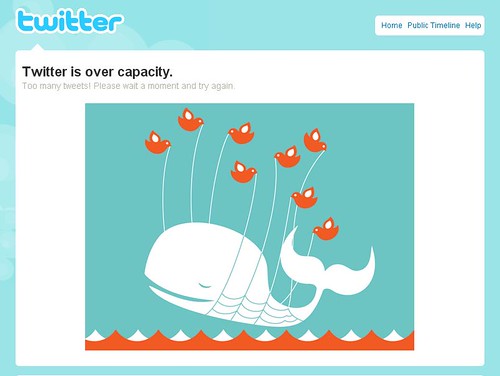
MySpace and Facebook were initially very sluggish sites. Twitter and the ‘fail whale’ of the site being down were a cultural touchstone of the late noughties.
Fail Whale via The Diva Rockin on Flickr.
This increase in audience, meant a consequent increase in content. YouTube for example was running at over 45minutes of video being uploaded every minute. I am sure that rate is even greater now. How to sort through this firehose of content?
To engineers the solution would look a lot like Henderson’s magic donkey. Algorithms slowed down the newsfeed to something more manageable, otherwise it would overwhelm the users.
On the commercial side, the social platforms need to show sticky content that will keep users on their site longer and that they can vend advertising against.
No great plot to up-end civilisation or spread hatred and bile. But algorithms can have unintended consequences. Content that polarises, engages. The algorithm doesn’t know that’s a bad thing. Soon those that want to engage with audiences in an emotive political way understand how the system can work with them.
A mix of trial and error with a bit of understanding of behavioural science and continual learning allows political actors to learn how to use the system. Incremental tweaks in approach that their rivals or peers make drives that knowledge at a faster rate than the algorithms seem to evolve. The algorithm is blind to it all. It sees the things it cares about ‘improving’. Time spent on service, engagement with content, commenting and sharing. A human-machine feedback mechanism is created.
In essence, it’s Google’s ‘stupid shop assistant’ all over again and this time human input in the feedback mechanisms is hurting rather than helping the magic donkey of social platforms.
More on flickr here and more on internet culture here.
UPDATE (September 24, 2020): Earlier this week the FT ran the story ‘YouTube reverts to human moderators in the fight against misinformation‘ – in an apparent indication that the ‘magic donkey’ model has reached its limits (at the moment). YouTube’s machine learning algorithms when given control had a false positive bias banning a ‘significant number’ of videos that broke no rules. In a three month period 11 million videos were taken down. (The usual number is about half that).