Blog

  • Sound from screen + other news

    Sound from screen

    Sony’s New OLED TV Emits Sound From Screen – Nikkei Technology Online – back in the 1970s and 1980s, Sony and Technics (Panasonic) experimented with flat audio speaker drivers. You can see the ancestor of the thinking behind sound from screen, by looking at the Technics SB-10 and Sony’s APM8. Sony’s accurate pistonic motion foreshadowed NXT’s ubqiuitous flat panel sound from screen technology. NXT originally was part of the UK speaker manufacturer Wharfdale. More information here.

    Noise Meter, Held at Logan Airport End of Neptune Road Records Over 86 Decibels

    Economics

    Theresa Maybe, Britain’s indecisive premier | The Economist – unflattering comparison with Gordon Brown

    Finance

    How Social Cash Made WeChat The App For Everything | Fast Company – if you look at WeChat you have some idea where Facebook Messenger is trying to go

    How to

    The Blueprint | The Expectations Game – managing expectations

    Luxury

    Visvim Dissertations: Boro (Aomori, Japan) | Union Los Angeles – great read

    Media

    Tommy Mottola Pens Open Letter To Mariah Carey | Idolator – “I would never have encouraged her or guided her to do something like a reality television show!!!!! I don’t get it!!… that does absolutely nothing for her integrity, her credibility, or her massive talent!! She should take a step back, think carefully and figure out what to do next.” I still don’t get why the music industry continues to go along with reality TV

    Online

    Edelman Digital Trends Report – (PDF) makes some interesting reading

    Security

    Hackers threaten smart power grids – POLITICO – really interesting data that shows for many countries the cost benefit analysis of smart metering wasn’t proven. Guessing security costs weren’t considered seriously by many who thought it was a good idea

    The polity that is Singapore cybersecurity | Marginal Revolution – go analogue

    Technology

    Babylon Health partners with UK’s NHS to replace telephone helpline with AI-powered chatbot | TechCrunch – Working with a number of health authorities in London, Babylon will begin a six month trial starting at the end of January to offer its AI-powered chatbot ‘triage’ service as an alternative to the NHS’s 111 telephone helpline that patients call to get healthcare advice and be directed to local and out-of-hours medical services. – more related content here.

    Cellulose Nanofiber-based Engine Cover Exhibited at Show (1) – Nikkei Technology Online – lighter than current GRP (glass reinforced plastic) covers

    Foxconn boosting automated production in China | Digitises – it would be interesting to see how they cope with the fine motor work required for iPhone assembly (I suspect not very well)

    Daring Fireball: Why Chris Adamson Bought a New Mac Pro Last Week – capitulation – the word a power Apple customer used to describe his purchase of a new Mac Pro. When you’re customers resent you there is a problem

    Apple’s 2016 in review | Chuqui – a great read

  • Lights out production lines

    Lights out production lines reminded me of my childhood. If you are of a certain age, ‘hand made by robots’ brings to mind the Fiat Strada / Ritmo a thirtysomething year old hatchback design that was built in a factory with a high degree of automation for the time.

    Fiat subsidiary Comau created Robogate, a highly automated system that speeds up body assembly. Robogate was eventually replaced in 2000. The reality is that ‘hand made by robots’ had a liberal amount of creative licence. Also it didn’t enable Fiat to shake off its rust bucket image. Beneath the skin, the car was essentially a Fiat 127. Car factories still aren’t fully automated.

    Foxconn is looking to automate its own production lines and create products that truly are ‘hand-built by robots’. Like Fiat it has its own robots firm which is manufacturing 10,000 robots per year.

    Foxconn has so far focused on production lines for larger product final assembly (like televisions) and workflow on automated machine lines: many consumer products use CNC (computer numeric control) machines. That’s how Apple iPhone and Macs chassis’ are made. These totally automated lines are called ‘lights out production lines’ by Foxconn.

    Foxconn is looking to automate production because China is undergoing a labour shortfall as the population getting older. Foxconn uses a lot of manual workers for final assembly of devices Apple’s iPhone because the components are tightly packed together.

    Forty years ago, Japanese manufacturers conquered high end and low end consumer electronics with pick-and-place machines to automate electronics production, Nokia went on to build its phone business on similar automated lines. Globalisation ironically facilitated hand assembly of exceptionally dense electronics devices.

    It will be a while before Foxconn manages to automate this as robotic motor control isn’t fine enough to achieve this yet. In order for that to happen you need a major leap forward in harmonic gearing. This isn’t a problem that software or machine learning can solve easily. More related pieces of jargon can be found here.

    More information
    Foxconn boosting automated production in China | DigiTimes – (paywall)

  • iQiyi IPO & more news

    iQiyi

    Baidu Plans $1 Billion IPO for Video-Streaming Site iQiyi.com – WSJ – (paywall) value nominally at $5bn – inflated value of the iQiyi media brand especially in the mercurial regulatory environment for online media in China around what might be construed as sensitive content. Secondly, China’s Tencent with QQ Video offers a real threat for iQiyi and a host of live streaming platforms. Finally, it is hard to build scale when you’re optimising for just one market like iQiyi is. So comparisons of iQiyi with Netflix aren’t that helpful. More related content here.

    China

    Britain’s view of trade with China sounds fanciful | FT – TL;DR version – UK will get fucked by China due to Brexit. Asset stripped, no negotiating power in any trade agreement,  expect nominal sovereignty in return for expected compliant behaviour. The Chinese may load up on UK treasuries for use as a financial cosh if necessary. Expect lots of Chinese immigrants

    Economics

    U.S. companies want to play China’s game. They just can’t win it. – The Washington Post – “When I think about Facebook in China, I think, ‘What’s their advantage?’ ” said William Bao Bean, a Shanghai-based partner at SOSV Ventures and the managing director of Chinaccelerator, which invests in start-ups. “Their product is so outpaced by the local companies.”

    Suddenly, Corporate Values Might Come With A High Price – Paul Holmes on corporate and social responsibility in a populist political environment

    Gadgets

    A Turntable Reborn Turns Its Back on Its Hip-Hop Legacy – The New York Times – The biggest competition is second hand 1200s because they are so robust and user serviceable. Technics need to do a lot of work to get hifi afficandos on board so if they want to grow the market and let it scale, you put your money on the hifi buffs and let the product be the marketing for the turntablist fan base. I am just glad to have it back

    Indonesia

    Indonesia and India set to ‘steal the show’ as APAC tipped to lead global ad growth in 2017 – Mumbrella Asia

    Indonesian puppets

    Security

    How Russia Recruited Elite Hackers for Its Cyberwar – The New York Times – the bit that I found most interesting is how Russia now relies on a series of private military contractors, rather like the US

    Software

    WeChat Update: Add Stickers To Your Pics – it will be huge, but that doesn’t mean I can’t shake my head and go tut-tut

    Thailand

    What’s really behind Thailand’s hostility to Chinese tourists? | South China Morning Post – instructive article on what happens when Chinese culture goes abroad

    Technology

    Japanese white-collar workers are already being replaced by artificial intelligence | Quartz

    Web of no web

    Quanta to make next-generation Apple Watch, says paper | DigiTimes – battery efficiency focus but little consumer-facing innovation apparently

    Wireless

    2G or Not 2G | CCS Insight – on GSM network shutdown

  • Brand communications

    Opportunities for brand communications – 2016 has been a watershed year in the western world. Political forces that were simmering, but previously untapped manifested themselves in populist victories. Political norms that were common currency for the past two decades have been brought into question and there will be societal impacts and changes in consumer tastes.

    Businesses are being buffeted by these changes and so will their business. In the case of the UK; supply chains will be re-engineered over the next two years to address the country’s departure from the European economic bloc. It will mean recalibrating the values of some brand communications. Most companies that I have spoken to are working on the assumption of the hardest Brexit:

    • No trade agreement with the EU
    • No customs union with the EU
    • No passporting for services such as banking
    • No agreement on storage of EU or US personal data in the UK
    • No free movement of EU talent
    • Problems with the WTO as countries look to settle scores like ownership of the Falkland Islands and Gibraltar

    This presents brand communications teams with opportunities and challenges:

    • There will be new regulatory and legal environments for companies to navigate
    • Corporate and social responsibility programmes will need to be recalibrated
    • There will be change management as jobs are moved abroad and facilities closed
    • Brands will have to work smarter with less
    • Consumer data based systems will need to be redesigned to meet the new legal and country boundaries imposed upon it
    • UK businesses will need to prepare for permanent handicap on their profits

    There is also a wave of change for consumer businesses. Whole categories of products – carbonated drinks, cereals and spreads are losing market share to substitute products. This is hitting the large FMCG (fast-moving consumer goods) brands including:

    • Unilever
    • Coca-Cola
    • General Mills
    • Nestle
    • Kelloggs

    Consumer brands have looked to counteract this in a number of ways:

    • Putting their spend where it will do the best work by using zero-based budgeting (ZBB)
    • Restructuring brand architectures – moving away from preventing brand damage through brand extension to brand consolidation to maximise the benefit of marketing spend. Coca-Cola is a prime example of this
    • Brand architecture will create a tension in the organisation. On the one hand the societal norm will be for local brands rather than global, on the other you have the corporate desire to cut and simplify to maintain margins. Whilst some companies may kill brands, others may sell them on to local companies, which will then try to squeeze as much value out of the brand equity as they can
    • Move away from micro-targeting to ‘smart’ mass-marketing – the key exponent of this is Byron Sharp at the Ehrenberg-Bass Institute at the University of South Australia

    Opportunities in terms of new products that communications agencies can offer

    • Internal communications programme – site shutdown or company shutdown as a product
    • CSR audit as product
    • CRM (customer relationship management) audit as product

    Brand communications vs. ZBB

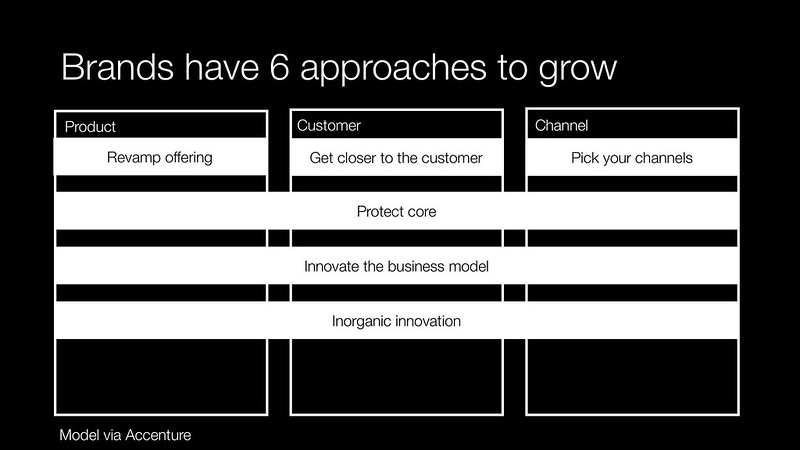
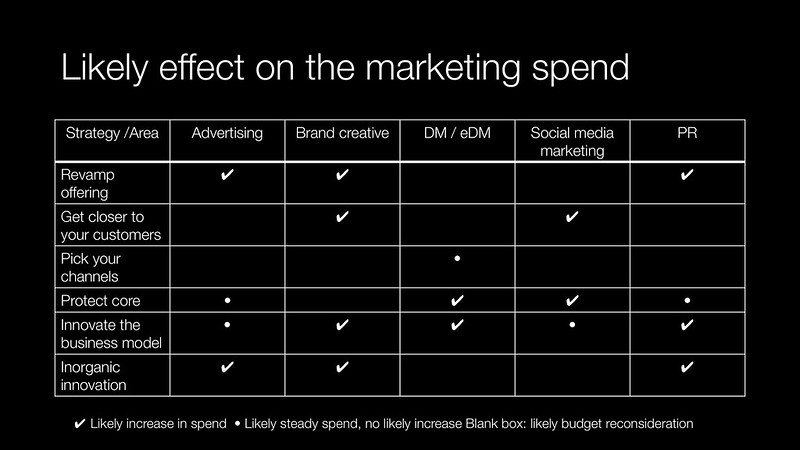
    Focus on clients based on their strategic intent if they are implementing ZBB, here’s a quick guide I did earlier this year.

    Businesses have six paths to growth
    Zero-Based Budgeting

    Path versus agency discipline
    Zero-Based Budgeting

    If your client programme lies in parts of the spectrum where you won’t benefit, then as an agency you have a few choices:

    • Identify and grow your business within other brands of a clients business
    • Look at rivals for opportunities
    • Treat the current business as a cash cow

    Effect of agency consolidation on brand communications

    A second aspect of risk analysis is brand consolidation. There is not much that an agency can do with the change in brand architecture like Coca-Cola. The clients are likely to cut costs.

    A clearer source of risk will be ‘local gems’ this is a consumer brand that is only sold in one country (it may be known under a different name in other countries). These brands are likely to be closed down or sold on, particularly if they are in declining growth sectors such as margarine spreads, cereals or carbonated drinks.

    If you have only started planning about looking for replacement brands in your portfolio, it may already be too late. Best case scenario is that the brand is bought by a local FMCG company.

    Looking at previous brand sales like Radion washing powder as an example the acquirers will not support it with significant marketing spend. Instead, they will look to maximise their investment by mining existing brand loyalty and awareness.  Depending on the product category and the target audience will depend on how fast inevitable brand decline will be.

    Either way it is not a particularly attractive piece of business or large or medium-sized agencies. An incumbent agency will have to repitch for the work as it will fall outside the purview of existing contracts and business relationships.

    Advertising agencies have a head start in terms of their planners having a clear grip on what Sharp’s concept of smart mass marketing means for their discipline. PR agencies need to articulate this and reflect it in their account planning. They are still struggling to get to grips with social and are championing concepts like ‘micro-influencers’; that don’t fit into Sharp’s world view. They are effectively burning client respect.

    PR agencies need to think much more in terms of programme audience reach and repetition for audiences, rather than the current focus on influence. More marketing related content here.

  • Smartwatches & more news

    Smartwatches

    Let’s Face It: Smartwatches Are Dead | Variety – interesting that Variety covered smartwatches. Apple is king of smartwatches. That market is at best immature, at worst dead in the water. Of course all this could change in an instant with a compelling use smartwatches case from a killer app – rather like Apple’s LaserWriter and Aldus’ PageMaker software completely changed things for the Apple Macintosh. Luxury as a sector has fallen down for smartwatches, health looks like a better candidate.

    Business

    Lessons from the Kingston Smith’s annual agency profitably survey | Chris Merrington | Pulse | LinkedIn – The top 30 independent digital agencies’ margin declined to 4.9%. 30% of them are making a loss

    Will Hong Kong’s OOCL be eaten up by the world’s biggest container lines? | Hongkong Business – expect further consolidation, Hamburg Sud has been acquired by Mearsk.

    China

    VIDEO: Embattled LeEco Sued in HK as Bills Pile Up | Young’s China Business – fascinating rise and probable fall.

    Consumer behaviour

    Men, Please Stop Manthreading | Gizmodo – errr no, this isn’t a gender issue despite the weak rationale

    Economics

    WSJ City – US Businesses Reconsider UK and EU Investment – interesting reading; serious implications for agencies who act as a hub or work on global briefs

    Major cut in EU migrants risks long-term damage to UK economy – report | The Guardian – and this all doesn’t seem to be taking into account automation and foreign competition reducing demand…

    As Brexit approaches, signs of a gathering economic storm for Britain – The Washington Post – “I can’t see any circumstance in which we’re going to get a good deal,” he said, noting the E.U.’s incentive to deter future defections by driving a hard bargain with Britain. “The U.K. is going to come out of this very badly. The impact hasn’t even started yet.” 

    Gadget

    Apple Extends Discounts on USB-C Adapters and Accessories Until March 31 – Mac Rumors – the MacBook Pro disaster continues. Having blown fortune on dongles to make my laptop work. I am now faced with 10 years of battery chargers, power adaptors for planes and automobiles and a variety of connectors that are now up for the scrap heap. Not exactly environmentally friendly design. A second thing is that the MagSafe connector is far safer than the new USB C connectors.

    Ideas

    Perfecting Cross-Pollination | HBR – research on more than 17,000 patents suggests that the financial value of the innovations resulting from such cross-pollination is lower, on average, than the value of those that come out of more conventional, siloed approaches. In other words, as the distance between the team members’ fields or disciplines increases, the overall quality of their innovations falls. But my research also suggests that the breakthroughs that do arise from such multidisciplinary work, though extremely rare, are frequently of unusually high value—superior to the best innovations achieved by conventional approaches

    Innovation

    The Sunk Cost Fallacy and the Future of Silicon Valley — The Information – an oblique criticism of Silicon Valley no longer being known for ‘hard’ innovation (paywall)

    AI Winter Isn’t Coming – Despite plenty of hype and frantic investment, a leading artificial intelligence expert says hardware advances will keep AI breakthroughs coming – hmmm not so convinced most of it is building on 1980s work rather than really moving things forward

    Japan

    Tokyo Thrift special: ‘It’s a Sony’ exhibit shows off decades of decadent design – The Verge – basically a love letter to Sony’s product design and obsession for engineering

    Korea

    Tour guides accuse South Korean departmental store of exploiting expatriates | SCMP – interesting given who Chinese shoppers are overwhelming large parts of central Seoul

    Legal

    The UK’s Investigatory Powers Act allows the State to tell lies in court • The Register – Section 56(1)(b) creates a legally guaranteed ability – nay, duty – to lie about even the potential for State hacking to take place, and to tell juries a wholly fictitious story about the true origins of hacked material used against defendants in order to secure criminal convictions. This is incredibly dangerous. Even if you know that the story being told in court is false, you and your legal representatives are now banned from being able to question those falsehoods and cast doubt upon the prosecution story. 

    Potentially, you could be legally bound to go along with lies told in court about your communications – lies told by people whose sole task is to weave a story that will get you sent to prison or fined thousands of pounds.

    Luxury

    Luxury Daily – Unwed, digitally savvy millennials affecting luxury jewellery business – and the luxury digital devices generally look hideous

    Marketing

    Harvard Business Review – whiteboard videos on Facebook – apparently successful tactics with roughly 100,000 views per video

    Media

    Vice Media Forms Alliance With Guardian Newspaper | Variety – interesting move in terms of media

    The Methbot operation | Whiteops – video ad fraud business worth $3-5m/day (PDF) Well worth reading despite the bot network name….

    Europe Presses American Tech Companies to Tackle Hate Speech – The New York Times – only 40 percent of material flagged as possible hate speech online (albeit in a relatively small sample of 600 posts, videos and other online material) had been reviewed by the Silicon Valley companies within 24 hours. Of those 600 postings, just over a quarter was eventually taken down

    China e-sports industry entering golden age, says IDC | DigiTimes – (paywall)

    Finding New Ways To Be Fearless | Media Post – content before channel – interesting take I would see them as having equal footing

    Case study: 3 years, 5M WeChat followers, and 300M RMB valuation – Uncle Tongdao, a WeChat Official Account about astrology just had an exit at a RMB 300 million valuation – character licensing. LINE (Brown and Cony) and WeChat are the platforms for the new Hello Kitty or Mickey Mouse

    Mr. Robot Killed the Hollywood Hacker | MIT Technology Review – a certain amount of conceit as the author is a sci-fi writer, but a great read

    China, new economies driving ad market growth: GroupM | Advertising | Campaign Asia – China continues to exceed expectations, with GroupM China revising upwards its initial forecast of 6.6 percent growth to 7.8 percent. This contrasts with the Magna report, released yesterday by IPG Mediabrands, which initially forecast China’s ad market growth at 8.4 percent and revised it down to 7.2 percent

    Online

    Vine Update – Medium – Vine becomes a feature (officially). Vine made the classic web 2.0 mistake of confusing being a feature with being a fully featured but minimal service for optimal user experience design. This is a hard line to walk during the web 2.0 era, let alone in the face of super-apps like WeChat that compress a whole operating environment into one app at a moderate sacrifice in usability

    Security

    OONI – urandom.pcap: Belarus (finally) bans Tor – double edged sword. On one hand good for a government that wants oversight like Investigatory Powers act; on the other Tor users flag themselves interesting by their use of it. I would expect an MP driven ban in the UK at some point

    Freedom of Press Foundation Asks Canon, Nikon, and Other Camera Manufacturers to Sell Encrypted Cameras | WIRED – another issue is that cameras are more likely consumer electronics than computers – firmware updates are often not used and cameras have a long life

    Congressional group says backdoor laws would do more harm than good – The Verge – smarter approach to cryptography than many politicians. There is a clear dichotomy between politicians desire for personal privacy and their clear advocacy against it in the name of national security. This sense of the other highlights the gap between politicians and the people. The congressional group conclusions are refreshing.

    YouGov | The risk of Britain being attacked by another country in the next 30 years; Websites used/ trusted – website data is interesting but I bet the self reporting percentages aren’t backed up by observed behaviour

    Software

    Tencent: Inside China’s ‘killer app’ factory | FT – (paywall)

    Technology

    MacBook Pro Launch: Perplexing | MondayNote – quite shocking review by Jean-Louis Gassée of his experience with the new MacBook Pro – less than 5 hours of battery life, buggy peripherals and software glitches don’t inspire confidence

    Web of no web

    Protecting the Apple iWatch Standby screenshot as a trademark Device in China? Sorry not possible. – too complex to be protected as a trademark: WTF. China still has ambitions with smartwatches, as part of a wider emphasis on wearables and 5G. Apple’s smartwatches are the only ones that are distinctive in nature and this could bring about copycats. More related posts here.

    Wireless

    Apple Explores Dual-SIM Capability in iPhones, Patent Filing Reveals – Slashdot – I’d have been more surprised if they didn’t look at it

    iPhone Camera Quality: Flickr Data Shows How Insanely Popular It Is | BGR – interesting that Flickr skews towards iPhone users

    Apple (AAPL) is opening up a bit on the state of its AI research — Quartz – still governed by Apple’s focus on computing power per watt

    Above Avalon: Milking the iPhone – interesting analysis