Category: business | 商業 | 상업 | ビジネス

My interest in business or commercial activity first started when a work friend of my Mum visited our family. She brought a book on commerce which is what business studies would have been called decades earlier. I read the book and that piqued my interest.

At the end of your third year in secondary school you are allowed to pick optional classes that you will take exams in. this is supposed to be something that you’re free to chose.

I was interested in business studies (partly because my friend Joe was doing it). But the school decided that they wanted me to do physics and chemistry instead and they did the same for my advanced level exams because I had done well in the normal level ones. School had a lot to answer for, but fortunately I managed to get back on track with college.

Eventually I finally managed to do pass a foundational course at night school whilst working in industry. I used that to then help me go and study for a degree in marketing.

I work in advertising now. And had previously worked in petrochemicals, plastics and optical fibre manfacture. All of which revolve around business. That’s why you find a business section here on my blog.

Business tends to cover a wide range of sectors that catch my eye over time. Business usually covers sectors that I don’t write about that much, but that have an outside impact on wider economics. So real estate would have been on my radar during the 2008 recession.

  • Beyond Disruption

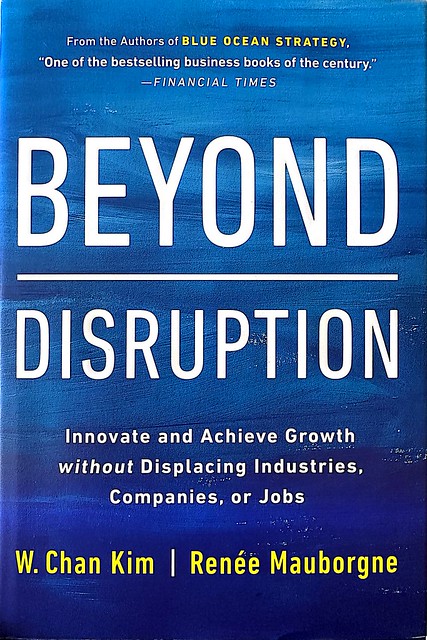
    Beyond Disruption by W Chan Kim and Renée Mauborgne moves their focus from general business strategy in their book Blue Ocean Strategy. You can read my review of Blue Ocean Strategy which I originally read a number of years ago. By contrast this book looks at the idea of non-disruptive innovation. Non-disruptive innovation as a topic makes sense within the blue ocean / red ocean model.

    Beyond Disruption
    Beyond Disruption book cover

    Success has its own challenges.

    Kim and Mauborgne face a Augean literary challenge. Blue Ocean Strategy was so successful at the time, that any subsequent book will look diminished in its success by comparison. Blue Ocean Strategy had something for everyone. To marketers it spoke of differentiation and salience, for business management types it was about differentiation and innovation. Beyond Disruption delves deeper into the nature of that innovation in a way that Blue Ocean Strategy didn’t.

    In Beyond Disruption the authors posit that their blue ocean strategy approach was a blend of disruptive and non-disruptive growth.

    Difficult narratives

    Disruptive innovation by its very nature means destruction of existing businesses as a new one is created. A classic example of this would be the battles between regulators and taxi drivers with Uber, or city governments looking to protect the needs of their citizens from AirBnB. The ideas of Joseph A. Schumpeter fit in with the innovation stories coming out of Silicon Valley. Apple and Google didn’t invent the smartphone, but they came up with a design that captured larger scale consumer interest than Nokia devices and captured the market.

    It is the predominant narrative in the media and business community at the moment around innovation. Disruptive innovation fits in with the conflict driven narrative of business. It is reinforced by adaption of military thinking in a literal manner to business strategy. The authors themselves point out about how much business decision-making is driven by aggression and fear.

    Approach of Beyond Disruption

    The approach of Kim & Mauborgne to ‘nondisruptive creation’ in Beyond Disruption is broken into two parts which cover

    • What it is and why it matters.
    • How to realise nondisruptive creation.

    What it is and why it matters

    Kim and Mauborgne focus a lot of time in the first part of the book explaining the economic and social impact of non-disruptive creation. The idea is that creating new markets doesn’t destroy existing marketplaces. In theory, value will be created on top of the existing economic order, rather than being substitutive in nature.That narrative is largely true, but there are exceptions to bear in mind.

    If we think about the smartphone as a device category, even prior to Apple and Google displacing Nokia, cell phones were displacing existing categories. Sales of answerphones dropped, as did the sales of chocolate to children and the incidence of children smoking. Instead the pocket money was spent on handsets and PAYG (pay as you go) mobile tariffs.

    Beyond Disruption outlines four sources of business advantage to non-disruptive creation:

    • Avoiding direct confrontations with established incumbents.
    • An effective way to respond to full-on disruption.
    • Support from internal stakeholders who will view non-disruptive innovation as less emotionally charged.
    • No evident backlash from external stakeholders.

    The authors see this approach as a way to address the challenges of ESG and the fourth industrial age of automation.

    How to realise non-disruptive creation

    The authors start with the idea of the right perspective. This involves:

    • Leaders moving away from the ‘startup story’ of an innovative founder or co-founder. Instead the problem to be solved needs to be recognised first.
    • Don’t confuse the means with the end.
    • Focus on the many, not the few. Have a product that is likely to be adopted by a range of customers.

    Identifying opportunities is considered in a separate section, the key point of which was the idea of empathetically observing newly emerging or unexplored problems. These ideas can then be explored further by understanding the scale of the challenge (amount of people affected etc) and understand the assumptions others have made that persuaded them to avoid the opportunity.

    In conclusion

    With Beyond Disruption, Kim and Mauborgne are looking to encourage a business more in keeping with the needs of stakeholder capitalism. More on Beyond Disruption here.

  • Beauty masks + more things

    Beauty masks

    Beauty masks have been mainstreamed by the mainstreaming of Asian beauty culture norms. There isn’t the faff of having to make something up or smear something on. Instead, pop the mask on, leave it on for a specified time (usually 15 minutes) and peel off. If Switzerland is the home of fine watchmaking or chocolate; then South Korea is the home of beauty masks. Beauty masks are really relaxing to pop on whilst bingewatching a show or film series.

    Beauty has its price

    This footage of beauty mask manufacture in Busan South Korea intrigued me. I was surprised by how small scale production was in this factory, even though it’s a batch manufacture process, I was expecting greater scale given how ubiquitous Korean beauty masks are.

    https://youtu.be/oTR0TByuX0A?si=YXXjl0QyZB2m4V07

    Beauty

    China economy: What anger over top influencer says about China today – BBC News

    A state-owned railway in China told women not to put on makeup on trains. Here’s how they responded | CNN 

    Radiation concerns: Japanese skincare products under scrutiny | Daxue Consulting

    China

    The rise and fall of a Chinese-Canadian pop star – Macleans.ca – Wu seems to have been doing similar antics to the ‘Black Sun’ night club management in Seoul, I can understand why he faced jail time

    WHO chief pushes China for ‘full access’ to solve Covid’s origins | Financial Times 

    Chinese defence minister under investigation for corrupt procurement | Reuters 

    Free speech law tackles Confucius interference | Telegraph Online – Confucius Institutes in focus

    Chinese shadow bank exposed to troubled property developers | Financial Times 

    Chinese netizens outraged over Apple employee photo | Wen Hat 

    Consumer behaviour

    How music emotionally affects us by Gresham College.

    Why don’t people leave bad jobs? | Financial Times 

    Economics

    Companies ease off on share buybacks as rising interest rates push up costs | Financial Times

    Why don’t people leave bad jobs? | Financial Times 

    Energy

    Toyota plans mass production of solid state battery for 2027 | EE News Europe 

    Finance

    Rival banks unite to take on Big Tech | Financial Times 

    Gadgets

    Can Echo Finally Break Through in Home Automation?Amazon has expanded the Echo line to include models that are tailored to certain use cases and certain rooms – like small screen models for bedside, large screen models for kitchens, high quality speakers for living rooms and dens, and small, inexpensive models for everywhere. We see efforts to get Echos into multiple rooms in Amazon’s promotions, where they sold multiple device packages of the least expensive models in the early days, and aggressively discount a variety of models regularly throughout the year. Amazon clearly has room to go in pursuing this strategy. Nine years in, most Amazon Echo owners still have only one device. In the most recent twelve-month period, 69% of US Echo owners have one, and about one-quarter have two or three

    Health

    Mental health screens using AI | Axios – UK ahead of the US in use of apps for therapy

    The Biden administration takes on the US drugs industry | Financial Times 

    Google DeepMind: Drug developers seek a structural advantage from AI | Financial Times

    Hong Kong

    China’s Language Police | Foreign Affairs 

    Innovation

    Intel gearing up for glass substrate production for advanced packaging | DigiTimes

    Those trying to pick AI winners should remember the dotcom days | Financial Times 

    Japan

    Changes in the Japanese economy and economic activity

    Asia Society

    Korea

    South Korean telco SK Broadband and Netflix call a truce • The Register

    SK hynix exec denies doing business with Huawei • The Register

    Suspected covert Chinese outpost sparks push for S. Korea ‘spy bill’ — Radio Free Asia

    Luxury

    Genesis Sells over 1 Million Cars – The Chosun Ilbo (English Edition): Daily News from Korea – Business > Business – as if German car manufacturers don’t have enough to worry about

    ‘The worst I’ve seen it for decades’: Australian wine glut leaves growers searching for new markets | Rural Australia | The Guardian – China continues to take a toll

    Marketing

    From followership to friendship: strategies for creating connection on TikTok | Mintel

    Materials

    Space Forge teams with Northrop Grumman for space materials | EE News Europe 

    Media

    UK DAB+ receiver sales exceed 50m – The Media Leader – by comparison Ireland is rolling back its DAB network to rely on FM

    BBC’s commercial arm to relaunch international news website | Financial Times 

    UK broadcasters develop free digital TV service to take on streaming | Financial Times  and UK PSBs to launch ‘online Freeview’ in 2024 – The Media Leader – this will be important for multiple occupancy homes

    Meme

    Coca-Cola Releases Brand-New Flavor That Was Created by AI – Tech 

    Online

    The murky world of online age certification raises privacy questions | Financial Times 

    Google faces multibillion-pound lawsuit from UK consumers | Google | The Guardian

    You need to talk to your kid about AI. Here are 6 things you should say. | MIT Technology Review – a variant of sage advice for everyone 
    1. Don’t forget: AI is not your friend 
    2. AI models are not replacements for search engines 
    3. Teachers might accuse you of using an AI when you haven’t 
    4. Recommender systems are designed to get you hooked and might show you bad stuff 
    5. Remember to use AI safely and responsibly 
    6. Don’t miss out on what AI’s actually good at

    EU fines TikTok €345mn for breaching children’s data rules | Financial Times 

    Retailing

    Amazon debuts generative AI tools that helps sellers write product descriptions | TechCrunch

    Security

    There’s now a Clorox cleaning product shortage, thanks to hackers | Fast Company 

    Thales chief on the lookout for acquisitions | Financial Times 

    How Estonia’s Military Intelligence Secretly Helped Ukraine – VSQUARE.ORG

    Former GCHQ chief joins security investment group Gallos as chair | Financial Times 

    Ukraine has provided the first “audit” of the US military | Quartz“For 3% of the US defense budget, Ukrainians won the Battle of Kyiv, won the Battle of Kharkiv, won the Battle of Kherson, won about half of the territory that Russia invaded in February 2022”

    Software

    Adobe’s Firefly generative AI tools are now generally available – The Verge 

    Style

    Peter Dundas’s label ceasing operations in the UK | Vogue Business 

    Race to the bottom? Temu takes on Shein worldwide | Vogue Business 

    Technology

    Intel’s China-specific AI chip in huge demand | DigiTimes

    Move over AI, quantum computing to be most powerful technology | VentureBeatLeaders in the military and cybersecurity community believe that quantum computing could become a potentially serious threat in 4 – 6 years. Quantum computers have been proven to vastly outperform traditional computers on specific sets of problems. A vastly outperforming computer like this could pose a serious threat to cybersecurity across several critical industries like banking and logistics. While potentially impactful in the future, the technology is currently limited by a lack of ability to reduce probabilities of errors. Extreme temperatures required to operate the computers are also a barrier.

    Web of no web

    How Do You Connect an Ecosystem? | LBBOnline – how QRcodes are continuing to be extended for APAC consumers

  • Foreign Correspondents Club of Japan + more stuff

    Foreign Correspondents Club of Japan

    One of the best YouTube channels that I currently subscribe to is the Foreign Correspondents Club of Japan. I used to enjoy visiting the Foreign Correspondents Club in Hong Kong. I particularly enjoyed their public talks. The Foreign Correspondents Club of Japan seems to run to a similar model as its Hong Kong counterpart. Its YouTube channel shares the regular public talks that they host by a wide range of experts. More Japan related content here.

    Ronnie Drew on the Dublin Pub

    Ronnie Drew of The Dubliners talks about the iconic nature of the Dublin pub. O’Donoghue’s was famous in Irish music and particularly famous for the short film O’Donoghue’s Opera, which Drew starred in.

    Incremental metal forming

    Additive manufacturing has managed to offer substitutes for short runs of moulded, cast or milled parts. Incremental metal forming offers a similar substitute for complex stamped parts. It’s an area that is is being currently developed. This has more potential than you would think due to the high cost and commitment to tool making needed if you wanted to use a process like progressive stamping.

    The Boy and The Heron

    The Boy and The Heron aka How do you live? is Studio Ghibli‘s latest film. I picked through the trailer with friends who are fellow Studio Ghibli fans. The Japanese movie title references a Japanese book How do you live? which features in the films universe. How do you live is a book where an Uncle documents his discussions with his nephew as the boy faces up to the challenges of childhood. In some respects How do you live? reminded of Jostein Gaarder’s Sophie’s World – in terms of feeling, if not style.

    How do you live? is as well known in Japanese circles as a children’s classic in the same way that Ursula LeGuinn’s The Wizard of Earthsea would be known to English speakers. But in English it doesn’t have the same cultural resonance, so hence the much more descriptive The Boy and The Heron. We were all relieved that the film is not a 3D CGI work like Earwig & The Witch.

    Looking at the trailer it evoked memories of other Studio Ghibli films

    I got to see the film at a special screening at London International Film Festival. But not going to share any spoilers until well after it goes on general release, save to say it’s well worth watching, but you knew that anyway.

    Create real magic

    Coca-Cola tapped into the trend for generative AI to allow consumers to remix existing advert artwork and make their own version. As far as I know Accenture was one of the main agency partners involved. This is less about the future of advertising and more about how the technology itself has become the meme, rather like all things cyber in the mid 1990s.

    A la Soledad O’Brien presenting with a Leo LePorte voiced avatar on MSNBC show The Site during 1996 and 1997.

  • TikTok quacks + more things

    TikTok quacks

    TikTok quacks is a bit of a harsh label for TikTok content. The reality is that similar content to that turned out by various TikTok quacks appear on YouTube, Instagram and other social media channels. Quack and quackery are synonyms for medical false claims or a ‘snake oil salesperson’.

    Snake Oil

    Social media not only spreads misinformation and false hope across a range of medical conditions, it allows the perpetrators to profit directly from their work. The rise of dodgy health businesses with commerce integrated into their social posts by the likes of TikTok (and Instagram) facilitates TikTok quacks.

    Below are just some of the content currently exposing this intersection between health, wellness, beauty and dishonestly obtained profits.

    More information

    China

    Country Garden facing ‘biggest challenges since our establishment’, chairwoman says, as debt woes, possible restructuring spur default fears – this implies deep structural problems in China

    Consumer behaviour

    What do lesbian, gay, bisexual and transgender Britons think the British public thinks of them? | YouGov

    AI Nation: Exploring Comfort With AI Applications – Harris Poll – how comfortable American consumers are with AI series across travel, financial services and healthcare

    Economics

    Can unions and industrial policy coexist? – by Noah Smith

    Gadgets

    Phones: dumb handsets outsmart high-tech alternatives | Financial Times

    Hong Kong

    Hong Kong’s corporate lawyers test boundaries as Beijing’s influence grows | Financial Timeslegal practitioners, including corporate lawyers, are concerned the broadening scope of a sweeping national security law could jeopardise the independence of the city’s legal system, a legacy of British administration, as Beijing tightens its grip. “There is general concern . . . that people are not fully understanding where the boundaries lie,” said a senior corporate lawyer with a global firm who has worked in Hong Kong for more than two decades – not entirely unexpected and a great opportunity for Singapore

    How to

    The Real Reason You’re Having a Hard Time Getting Things Done at the Office – WSJ – Bose noise-cancelling headphones and clear boundaries

    Use and abuse of Google Advanced Search

    Ireland

    Tesco to introduce free virtual GP service for staff | RTÉ – this makes sense in Ireland, given the two track private / public health system there

    Japan

    UNDERCOVER Jun Takahashi Solo Exhibition Info | Hypebeast 

    A weak yen helps Japanese carmakers compete in China | Quartz 

    Luxury

    ‘Quiet luxury’ trend gets a fresh spin in China | Financial Times – this makes sense give the cultural and economic environment in China at the moment

    Interesting for a few reasons:

    • Singapore’s bonded warehouses seem to be more ‘regional’ than Switzerland’s clientele
    • This indicates a continued interest in alternative investments
    • That the video repeatedly goes on to suggest that these items are from customers in ‘Southeast Asia’ i.e. not China, move along…

    Marketing

    APG Strategy Skills Survey 2023 – The Results 

    Materials

    Digital materials look to use different geometry of materials to replace other materials with special properties like foams. It does this through 3d printed lattices.

    Media

    Disney exits the metaverse | web3 is going just great and Disney+ with ads set for November launch in UK – The Media Leader 

    Multiple Google executives exit as UK MD restructures – The Media Leader – disclosure David McMurtrie was my client at ad-2-one Media and video transfer business IMD

    Mail launches football podcast amid audio expansion – The Media Leader – bit of an odd one as I wouldn’t have said that the Mail was well known for its sports coverage

    Online

    Sweden Is Not Staying Neutral in Russia’s Information War | New York Times – The Psychological Defense Agency also raised political concerns when it was proposed, but its leaders have emphasized that mandate allows it to address only foreign sources of disinformation, not content generated in Sweden. The challenge is one facing all democracies that, as a matter of principle, decline to enforce official ideologies, allowing divergent points of view of what is true or false. “The government can’t control the truth if it’s going to be a democracy,” said Hanna Linderstål, the founder of Earhart Business Protection Agency, a cybersecurity firm in Stockholm, and an adviser to the International Telecommunication Union, part of the United Nations. “The government can’t control the truth if it’s going to be a democracy,” said Hanna Linderstål, the senior cybersecurity adviser of Earhart Business Protection Agency.

    Why people — especially young people — are embracing voice notes – Vox – I read this and was reminded a lot of how older people were using WeChat a decade ago and thought about Push-To-Talk on Motorola’s iDEN mobile network technology

    Meta’s Twitter rival Threads unravels | Financial Times 

    Sound the Beats: Spotify’s AI DJ Spins Personalized Tracks | Gizchina – the next step on from Clear Channel’s pioneering of automated radio station selection and playing

    Retailing

    An Uber-backed robot delivery company is going public—but the industry has yet to really deliver – one of the biggest problems seems to be human opportunism and dishonesty.

    ‘The Brand Became Pointless’: Why Marketing Failures Lie At The Heart Of Wilko’s Downfall | The Drum – Wilko’s magic was at the till.

    Software

    ChatGPT In Trouble: OpenAI may go bankrupt by 2024, AI bot costs company $700,000 every day – not terribly surprising, it’s computationally intensive and hard to monetise. Look at how Google and Facebook have looked to squeeze computing power per watt out of their data centres, along with squeezing cost per server right down as well – they did this to reduce operating costs versus income. ChatGPT hadn’t gone there on design and instead uses 10,000 plus servers based around power-hungry top-of-the-range Nvidia graphics processors

    Style

    We’re All Preppy Now | The New Republic 

  • Bucherer

    The luxury sector was surprised by the acquisition of Bucherer AG by Rolex. Bucherer was founded in 1888 by Carl F. Bucherer. Over time, it grew to be a 100 store international network of watch and jewellery shops. In addition, the company owns a watch brand called Carl F. Bucherer. The chairman Jeorg Bucherer is the last of Bucherer family. His lack of a successor and the family’s close connection to the Rolex Foundation were given as a reasons for the sale.

    bucherer
    Bucherer in Lausanne

    Why should Bucherer sell?

    Bucherer pivoting to a sale was surprising. Part of this is down both companies being private. Neither publicly disclose finances or appear regularly in the media. We don’t know if the offer came from Rolex or if Bucherer approached Rolex with a view to sell.

    If Rolex made the first move

    If it was Rolex that made the move, then saying no would put the 100+ strong Bucherer retail showroom network at risk. While Bucherer represents 5 percent of Rolex’ global sales. Rolex means much more to Bucherer; 53 of their stores are Rolex authorised dealerships and 48 are Tudor authorised dealers. Having a Rolex franchise increases footfall and likely boosted sales of other brands in Bucherer stores.

    If Rolex were invited to make an offer

    If, like it was claimed that Bucherer’s decision was down to the lack of succession, why did Bucherer conduct a lot of activity to grow its business internationally?

    Bucherer has continued to expand its retail and service network. It reputedly spent up to $350 million buying US luxury watch retailer Tourneau five years ago.

    The Carl F. Bucherer (CFB) watch brand has put a lot of effort in terms of expanding its watch line-up, which are made in its own factory in Lengnau, Switzerland. This watch range uses some movements that are based on La Joux-Perret or ETA movements and some which seem to be complete in-house designs that look to mirror the kind of horology that the likes of Patek Philippe are better known for. A good example of this is the minute repeater below.

    Watch featuring their inhouse M3000 movement.

    The watch making side of the business has continued to design innovative movements including novel technology designs.

    The brand has worked on marketing its watches globally from a roster of Chinese and western actors as brand ambassadors, movie product placement including Deadpool 2 and the John Wick series. In 2018, they worked with JD.com to establish a watch brand-specific online storefront for the China market. Marketing activity continued through the COVID pandemic.

    At the beginning of July this year they launched a new watch model: the Heritage Chronometer Celebration in rose gold.

    This doesn’t sound like the brand was preparing for a sale due to a lack of family members to take over the reins. So why the sudden change?

    Why should Rolex buy Bucherer?

    Vertical integration?

    Bucherer apparently counted for five percent of Rolex’ global sales, but had showrooms in strategically important markets like Geneva, London, New York and Paris.

    Bucherer was the pioneer retail partner for Rolex’ CPO (certified pre-owned) programme; so their relationship was already very close. The programme was suspected to be rolled out for a number of reasons:

    • To try and deal with authorised dealers shortage of new Rolex stock, that had driven ‘watch flipping’ and allegations of corrupt sales practices at Rolex authorised dealers. If customers leave the authorised dealer network, Rolex loses control of the customer experience.
    • To allow Rolex additional profits from the inflated pre-owned watch market driven by pre-owned watch dealers catering to massively increased consumer demand.
    More on the allegations of corrupt sales practices

    While the CPO programme arrived just as the pre-owned watch market peaked (and at the time of writing its now at a two year low), it hints at the benefits to Rolex of having both circular and vertical integration.

    Buying Bucherer potentially gives Rolex 100+ owned outlets. Why would Rolex want to own its retail outlets? Let’s go back to 1977 and a seminal event in the current luxury industry history. Madame Renée Vuitton asked her son-in-law to take over the family business. Henry Racamier got under the hood of the business and found that franchisees were making the bulk of the profits. So, slowly but surely Racamier set the business on the path to vertical integration. Racamier’s only business mistake was getting involved with Bernard Arnault, who took the Racamier formula and built LVMH into the giant that it is today.

    Racamier, set a path that Audemars Piguet would eventually follow. Vertical integration would mean control and increased income for the Rolex Foundation.

    For Rolex, owning its showrooms is not without risk. The reactive statements by Rolex that the brand shops would maintain their brand and management seems to be designed to placate Swiss competition authorities. What the subsequent integration into Rolex Group operations would look like may depend on regulatory concerns.

    Swiss competition authority COMCO confirmed that was was analysing the deal. It accesses impact based on size and its possible effect to eliminate effective competition.

    Bucherer is a sales agent for much of the luxury Swiss watch industry

    • Baum & Mercier
    • Bell & Ross
    • Blancpain
    • Bregeut
    • Bulgari
    • Cartier
    • Chopard
    • Frederique Constant
    • Girard-Perregeaux
    • Hublot
    • IWC
    • Jaeger LeCoultre
    • Longines
    • Maurice Lacroix
    • Montblanc
    • Omega
    • Oris
    • Panerai
    • Piaget
    • Rado
    • Roger Dubuis
    • TAG Heuer
    • Tissot
    • Ulysse Nardin
    • Vacheron Constantin
    • Zenith

    Secondly, being a retailer and being a manufacturer is a very different business. If Rolex is going to learn about retail, it needs to spend years understanding Bucherer’s current business. Even then, there is no guarantee that it will follow the owned single brand showroom network model.

    CPO and circular economy

    The idea of the circular economy is now a big idea in the luxury sector and fits into the ‘Perpetual Planet’ tenet of the Rolex Foundation and at least part of the thinking behind the CPO programme. The idea is that a product can be serviced and or resold from its first owner to successive owners. This would require less new materials to be mined and less energy expended on the manufacturing process. The customer would end up with a product that is long-lasting and better for the planet.

    Rolex watches like the 1960s era 5513 Submariner are still worn as everyday watches and will likely outlast you and I, if they are serviced once every five years and parts replaced on an as-needed basis. Secondly, there is a premium set on authenticity – vintage items that may have already lived an interesting life. You see this desire for authenticity from fashionistas thrifting to Rolex collectors prizing COMEX and military-issued models.

    Finally, there is precedent for watchmaker participation in the circular economy; Richemont are already in the pre-owned market with their ownership of WatchFinder.

    Avoiding a retail power shift?

    Bucherer is the largest of independent privately owned Rolex authorised dealer networks. Rolex has about 2,000 outlets worldwide. If a rival or a private equity company bought Bucherer on its own, it wouldn’t be a big deal. But if the private equity buyer used Bucherer as a hub and bought up:

    • Wempe – which has a multi-country footprint (Austria, France, Germany, Spain, USA and the UK). Like Bucherer, Wempe is also a watch brand.
    • David Rosas that has a network of seven stores in Portugal.
    • Emperor Watch and Jewellery that has a footprint in Hong Kong, Macau, the Chinese mainland, Malaysia and Singapore.

    You then have a private equity run authorised dealership network that would be a substantial part of Rolex Group sales and more likely to try and dictate terms to the watch maker. Often this doesn’t work, a classic example of this is how Phones4U went under after trying to dictate terms to the mobile networks. Regardless of whether Rolex fended this off or were enthralled by the dealer network, it would be damaging for the Rolex brand, its global reach and customer experience.

    Realistically, Rolex dealers whilst profitable miss out on some of the things that private equity firms look for:

    • Huge cost-cutting potential – this might happen if you can scale to a dominant position in the Rolex dealership network and leverage it to get costs reduced. Stores tended to be staffed pretty lean already with Bucherer using one sales manager for three London showrooms. There would be limited scaling benefits for business functions.
    • Huge growth potential – maybe, but you’re still constrained by the nature of the luxury market and the complex eco-system of grey market and pre-owned specialists.
    • All of this would take time, likely longer than the 4 to 6 years that private equity investors typically look for their return. But that doesn’t rule out sovereign funds from the likes of the Gulf states.

    Taking Bucherer off the table means that the notional private equity firm would likely need to buy a larger publicly listed partner like Watches of Switzerland. This would likely cost more on a store-for-store basis and be less attractive to private equity.

    Watch servicing

    Bucherer has provided Rolex with watch servicing capability through its retail network, which gives you the high level of trust that Rolex had in the brand. Having greater service capacity would be beneficial as waiting times can take as long as six months for a Rolex service. At best this is a secondary benefit for the Rolex organisation. Purchasing it would be beneficial to prevent it falling into the hands of LVMH who have increasing ambitions in watchmaking.

    Manufacturing

    Rolex is building three temporary manufacturing units, for use until its new factory comes online in Bulle, Switzerland some six years from now. This will be the fifth Rolex-owned factory in Switzerland. The Lengnau factory would their add to the existing manufacturing capacity or offer additional capability. Lengnau manufactures a range of movements and complications with COSC chronometer certification. The question would then be, what would Rolex do with the additional manufacturing capacity and how would it fit into the Rolex system?

    In addition to manufacturing capacity, the brand brings innovation in movement design to the table from a novel balance wheel driving an automatic movement to a minute repeater movement.

    if Carl F. Bucherer were kept as a separate brand it would likely benefit from being part of Rolex’ larger materials purchases from suppliers and transfer of process technologies to further improve its own manufacturing line. Scale has its advantages.

    Rolex multi-brand strategy

    Rolex has more demand than it’s prepared to supply for its own brand watches and the brand has been moved upmarket into the luxury space by management since the 2000s. Its second brand Tudor has been reinvigorated through the use of innovative watch materials and playing on both the Rolex and Tudor brands heritage. Tudor seems to be moving into Rolex’s classic brand positioning, while Rolex moves its price and positioning even further upmarket. But both of these brands sit firmly in the tool watch space, despite Rolex being available in precious metals.

    Having a third brand would allow Rolex to move in a number of directions:

    • Have a brand that could slot in below Tudor, which the CFB Pratavi models could do.
    • Allow Tudor to go exclusively heritage in their design language. The CFB Pratavi models would represent a more contemporary looking alternative.
    • Go after the non-Rolex space of horological designs from the likes of Audemars Piguet, Blancpain, H Moser, Patek Philippe or Vacheron Constantin. Rolex hasn’t committed to going after this part of the market previously because of its Lexus-like reputation for reliability, even in their most expensive models. This could be done with the CFB Manero and Heritage ranges which have similar complications.

    Rolex has shown for decades with the Tudor brand that it was prepared to take its time, so reinventing and repositioning another watch brand isn’t out of the question.

    Watches of Switzerland

    The long squeeze?

    As news of the acquisition got out Watches of Switzerland (WoS) shares plummeted almost 30 percent. Rolex represents about 50 percent of WoS sales. So investors were concerned about the impact that this might have in the watch market.

    What if Bucherer represented, just a first move by Rolex? What if Rolex wanted to get a readymade wholly owned global footprint. Buying WoS at a depressed price would provide the ideal footprint. Porsche very nearly succeeded in a buy out of Volkswagen in 2008 that riffed on this approach.

    Like the Bucherer deal, it may receive competition scrutiny. However such an approach would likely face action from the Swiss regulator COMCO, even if the UK’s CMA didn’t step in.

    A second reason not to do an intentional long squeeze on WoS is that it might attract institutional investment from deep pocketed hedge funds and private equity firms who previously wouldn’t have looked at WoS as a target, to build a dealer network and in turn squeeze Rolex.

    Preference

    Rolex wouldn’t need to get rid of Watches of Switzerland in order to do damage to the brand. Just the perception that Bucherer had a more favoured status for Rolex availability would be enough to adversely affect footfall to its showrooms.

    This is something that could happen even if Bucherer remained an independently operated multi-brand watch retailer.

    More related content here.