Category: business | 商業 | 상업 | ビジネス

My interest in business or commercial activity first started when a work friend of my Mum visited our family. She brought a book on commerce which is what business studies would have been called decades earlier. I read the book and that piqued my interest.

At the end of your third year in secondary school you are allowed to pick optional classes that you will take exams in. this is supposed to be something that you’re free to chose.

I was interested in business studies (partly because my friend Joe was doing it). But the school decided that they wanted me to do physics and chemistry instead and they did the same for my advanced level exams because I had done well in the normal level ones. School had a lot to answer for, but fortunately I managed to get back on track with college.

Eventually I finally managed to do pass a foundational course at night school whilst working in industry. I used that to then help me go and study for a degree in marketing.

I work in advertising now. And had previously worked in petrochemicals, plastics and optical fibre manfacture. All of which revolve around business. That’s why you find a business section here on my blog.

Business tends to cover a wide range of sectors that catch my eye over time. Business usually covers sectors that I don’t write about that much, but that have an outside impact on wider economics. So real estate would have been on my radar during the 2008 recession.

  • BP & more news

    BP

    How the Gulf crisis made BP British again. – By Daniel Gross – Slate Magazine – interesting study in crisis communications. BP is one of the oil industry’s ‘seven sisters’ or supermajors. Although that term doesn’t reflect the power of national oil companies in places like China, Saudi Arabia, Norway, India and Qatar. BP is vertically integrated in all areas of the oil and gas industry, including exploration and extraction, refining, distribution and marketing, power generation, and trading. It has been steadily building out interests in alternative energy such as solar as well. The British positioning of BP is at odds with the fact that the company operates in 80+ countries. The company came out of British efforts at oil exploration in what’s now Iran at the beginning of the 20th century. BP has been in Alaska since 1959 and was one of the first majors in the North Sea.

    BP

    Culture

    Sissy Bounce, New Orleans’s Gender-Bending Rap – NYTimes.com – Derek B’s 808 roll on Rock the Beat is a cornerstone, immortalised like The Winston’s Amen Brother. Really interesting sound very similar in spirit to the roots of hip-hop like the live shows back in the day at Harlem World

    80 Blocks From Tiffany’s – gangland culture in 1970s New York

    Economics

    Long-term unemployment: Leaving the labour force, bit by bit | The Economist – interesting article on the economic impact of the long term unemployed

    How to

    Apple – Support – Manuals – goldmine of Mac stuff

    Japan

    中古レコード・CDの販売/買取 COCONUTS DISK – awesome Tokyo record store

    飛騨高山 留之助商店 本店 – amazing Japanese store full of modern pop art and cool kitsch stuff

    As Some Vow to Scale Back, Panasonic Pushes Vast Catalog – NYTimes.com – similar challenges to what Sony faces

    FT.com / Companies / Automobiles – Japan’s new rules change face of AGMs – will this make it harder for Yakusa to disrupt and hassle Japanese company AGMs and will it help corporate governance?

    In a Partnership of Unequals, a Start-Up Suffers – NYTimes.com – Bill Gates-owned Corbis convicted of fraud and ‘misappropriation of trade secrets’ – basically piracy

    Media

    People worry about over-sharing location from mobiles, study finds | Technology | guardian.co.uk – may hamper adoption of where2.0. Yahoo!’s FireEagle project was precient in the way it allowed users control over how exact location data was

    Online

    Will Zynga Become the Google of Games? – NYTimes.com – nice profile of Zynga

    People worry about over-sharing location from mobiles, study finds | Technology | guardian.co.uk – may hamper adoption of where2.0. Yahoo!’s FireEagle project was precient in the way it allowed users control over how exact location data was

    Yummly – Think outside the recipe box. – interesting take on the recipe site using semantic technologies

    Software

    Digital Domain – Even With All Its Profits, Microsoft Has a Popularity Problem – NYTimes.com – Microsoft’s financial performance is not not reflected in its share price and a far bit of that has to do with the corporate communications letting the organisation down

    Windows Phone 7 a ‘disaster’ says Infoworld after developer demo | Technology | guardian.co.uk – could Microsoft have a completely screwed ‘Vista-like’ mobile strategy on its hands? This isn’t the first time that a Windows demo had gone wrong for Microsoft, in the past the company still managed to do really well selling the Windows product in question

  • Influence singularity

    This post on what I am calling influence singularity (and some other trends) came from discussions whilst travelling. I have been on the road a fair bit and have speaking to a number of people coming from all aspects of communications and marketing. Speaking to these different people has covered a lot of areas but three trends stood out:

    • Influence singularity
    • Welcome to your new press spokesperson, your customer care rep
    • Inhouse vs. agency

    I have explored these trends in a bit more depth below.

    Influence singularity

    Increasingly we are seeing agencies of all ilks: PR, advertising, marketing, digital and everything in between are descending on the area of influence – creating an influence singularity. This influence manifests itself primarily through social media and digital; though it can manifest itself in experiential events like un-conferences and meet-ups. One of the best campaigns I have come across was the RNLI’s efforts to engage with young people.

    RNLI

    A social media campaign thought through and brought to life by a direct marketing agency: they saw the interaction in a similar way to the relationship between an organisation and the recipient of a direct mail piece. Instead of a purchase call to action, they provided a task to be completed. It is not only at agencies where this conflict is happening, I hear anecdotally that marketers are having PR discussions both online and offline actvities and carving it up with no PR people involved.

    The communications heads that were left out instead retreated to focus purely on corporate communications: outflanked, outgunned and out of their depth in a digital world. PR agencies where they have been involved, are often working with marketing managers as the inhouse PR people are not clued in.

    A secondary aspect of this, is that where the role is reversed and the PR department has led on social media, they are now having their efforts hijacked by marketers playing catch-up – because the marketers feel that they should be the owner, have better budgets and often have the ear of the board.

    This then begs the question: does PR the profession, its practitioners and the business need to have a rapid rebrand as a profession before it becomes roadkill?

    Welcome to the new press spokesperson: your customer care rep

    Back in 2004, I wrote a blog post about some comments that Microsoft CEO Steve Ballmer had made about iPod owners having devices full of stolen music. I dashed off a missive to Microsoft.com’s customer service form and got a response.

    At the time John Lettice, when writing about the affair in The Register said:

    We’re sure iPod owners will regard being called law-abiding by an exec from a company with Microsoft’s legal experience as a high point to end the week on. But, you ask, how the blazes did we get to this one? We have Ged Carrol’s blog to thank. Mightily offended by Ballmer’s original comments, Ged used the feedback system at microsoft.com to demand an apology, and he got one. The possibility of feedback systems of this ilk actually working had never occurred to The Register, so we’ve never bothered trying, but if you want your very own grovel, insert your outraged howls here.

    At that time, journalists didn’t think of customer care representatives as a source of comment. Six years later and with social media on tear, the customer care representative is increasingly on the frontline of reputation management.

    Some of the discussions I have been involved with has been about the interface between PR and customer services. Where is the overlap? How do you ensure efficient and effective task management between the two? The last question is being addressed with solutions from the likes of Brandwatch and Salesforce.com.

    Inhouse vs. agency

    I was discussing in-house versus agency with some people recently and one of the key points they made was that whilst agencies provide flexibility in terms of manpower and access to tools that an in-house team couldn’t justify because of cost, social media’s need for immediate and decisive responsiveness required organisations to re-address their in-house requirements and expand their current capability.  This is a great opportunity for measurement companies, other organisations that provide ‘horizontal’ services and e-lance digital communications people to interject as these considerations are being made. It may also cause some agencies to start thinking about what an agency means and how they can change the structure of their offering to ensure that they remain relevant.

  • Wonder Girls

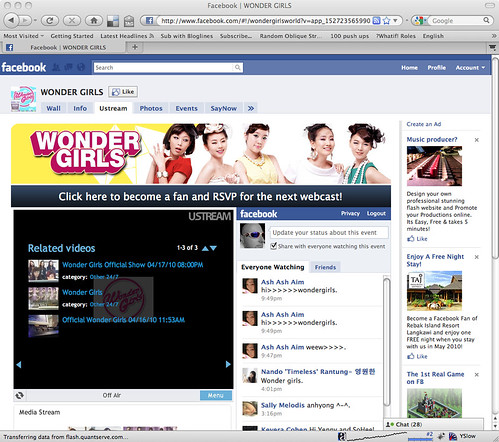
    The Wonder Girls caused me to reflect on pop music as a business. We are so used to manufactured pop music artists by the likes of Tom Watkins, Stock | Aitken | Waterman and more recently Simon Fuller’s 19 Entertainment. Some of these groups like Wham, Kylie Minogue and Take That had international success. We have gotten used to the dominance of western international recording artists.

    Wonder Girls Daum

     Wonder Girls Korean fan site.

    It is this heritage that makes the Wonder Girls phenomena: a Korean girl-band managed by a Korean team getting a Billboard top 100 hit all the more remarkable.

    Wonder Girls MySpace

    Wonder Girls MySpace page

    That kind of success takes more than talent and good looks – the world music industry is littered with talented beautiful failures. The Wonder Girls are creatures of the internet age, they started off conventionally enough in South Korea and then used their South Korean fan base to spring board into the US marketplace.

    There were two parts in this story which made a great use of social media:

    You could argue that they are a part of the ongoing Korean Wave: a rise in popularity of Korean music, television and film culture which has swept Asia and started to gain popularity in the west like the Japanese film, manga and anime industries before it.

    Wonder Girls Facebook

    Wonder Girls Facebook page

    However where the group breaks rank with the Korean Wave is in the proactive targeted nature of their marketing; which is more reminiscent of aggression and entrepreneurship of the Japanese car, camera and consumer electronics industries which shook things up in the 1960s and 1970s. More related content here.

  • Data that matters

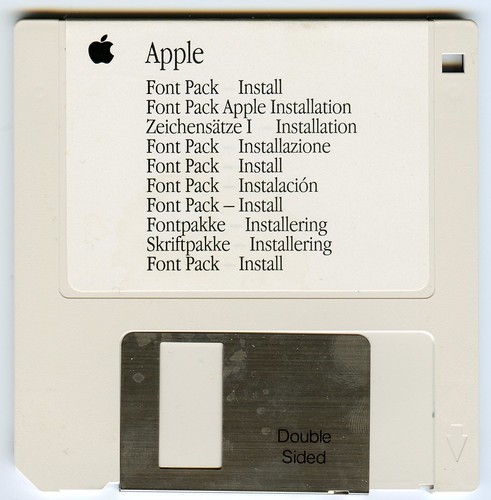
    Data that matters has impermanence – One thing that springs up periodically is how older electronic data becomes harder to access.

    Apple font pack disk from the mid 90s

    Whether its floppy disks that are no longer readable or optical disks which have become corroded through chemical reaction over time electronic data is generally impermanent.

    I lost a substantial amount of the posts on this blog two years ago when the server I used over at Yahoo! Small Business hosting went into meltdown 90 per cent of my blogging output between December 2006 and January 2008 disappeared. I managed to recover 10 per cent of the content from the Google cache of my blog.

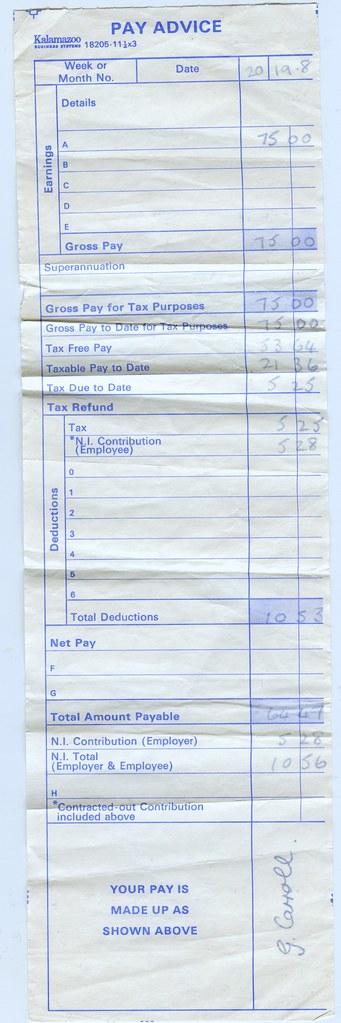
    However it isn’t only digital artifacts that are at risk. I was going through bags of old papers and found my old P60s some of which could no longer be read since they were printed on thermal paper and my first payslip which was barely readable.

    my first proper pay slip

    This was from my first full-time job cleaning and repairing equipment that was rented out to building contractors including lawn mowers, concrete mixers and Makita power drills.

    You can also see paper go yellow from the acid used in its manufacture as well as fade from the carbon paper print.

    I had obviously put it away to keep it for posterity, but I decided to keep it in the cloud as I figure that it might last longer that way now. Though your guess is as good as mine. The thermal paper and Flickr’s business model are both tough things to fathom how robust they will be.

    The problem with this is often the data we don’t want to keep stays like embarrassing pictures on Facebook or a drunken rant on a Usenet forum, whereas the stuff we want to keep too often fades away. So how do we get better at looking after electronic data that matters? More online and internet related posts here.

  • An unscientific assessment of Baidu

    Google has finally left the Chinese market for search, so I thought I would try the alternative, hence an unscientific assessment of Baidu. My trial is unscientific in nature and not particularly rigorous. I did what most consumers would have done and searched for myself.

    I was quite open-minded about this, on the one hand Google has been killing the search market in Europe, nothing can touch it in the EU and they have made moderately successful forays into other sectors as well. I also know that Google is not all conquering. In fact the wheels start to come off the Google search wagon when you venture into areas with non-Roman languages such as Russian, Korean, Japanese and Chinese.

    On the other hand, Robin Li over at Baidu is no slouch. Baidu is famous for is huge index and its continued appetite to crawl content whenever and wherever it can find it.

    Baidu like its Korean counterpart Naver has also managed a successful social search product running a question-and-answer service like a better version of Yahoo! Answers – largely free of spam and a more middle-class range of participants provide highly relevant quality content.

    It is also blatantly obvious that Baidu doesn’t care whether it attracts a potential English-speaking audience as the entire site apart from investor relations is in Chinese.

    Methodology

    Outcomes

    I was expecting some divergence between Google and Baidu search engine results pages for a number of reasons. Google crawls an estimated 15 per cent of the total web, and Baidu is likely to crawl a slightly larger amount. That means that their search indexes are likely to be slightly different. Secondly, both will have started with slightly different algorithms and these will change over time with a experience of what users want. Finally, the results are usually ‘flavoured’ according to local market preferences such as language and local content.

    I was a bit surprised at the level of divergence between Google and Baidu, which was great than I had seen between Google and Yahoo! in the past.

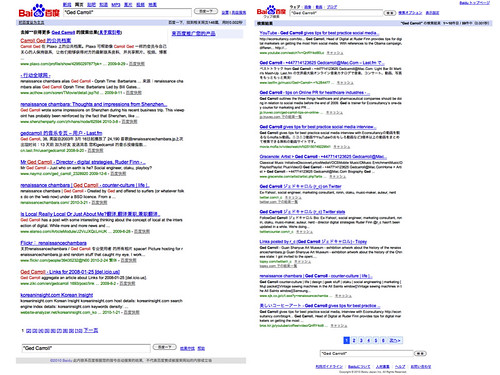
    First of all flavouring. A comparison between the Japanese and Chinese versions of Baidu show a high degree of variance between the two versions of the Baidu search engine.

    Baidu CN vs Baidu JP

    Part of the reason for the difference may be due to Chinese regulations around permitted services, for instance an educational video of me by Econsultancy on YouTube is the top result on the Japanese site and a couple of twitter related hits come in at six and seven. The Japanese site skews much more toward video services than the Chinese site which picked up profile services Plaxo and Naymz.

    Interestingly, the Chinese site picked up the re-direct URI for my blog (renaissancechambara.com), whereas neither the Japanese or the Chinese versions picked up my proper domain (renaissancechambara.jp) at all. Even when I clicked a few pages down.

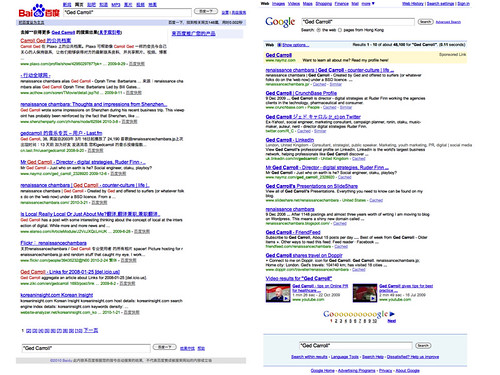
    Plotting Baidu China against Google Hong Kong produced an interesting diversity of the results.

    Baidu CN vs Google HK

    Their one point of correlation, my profile on Naymz. Again part of this may be because of my presence on services that don’t do business in China for instance YouTube and Twitter. Google rightly puts more weight and a consequently higher ranking on my Crunchbase and LinkedIn profiles than Plaxo which appears a couple of pages down on Google.

    Baidu obviously puts much more emphasis on a historic redirect URI I have for my blog than the ‘real’ one and doesn’t seem to crawl the site in any great depth. I am guessing that this is because of its largely English language content.

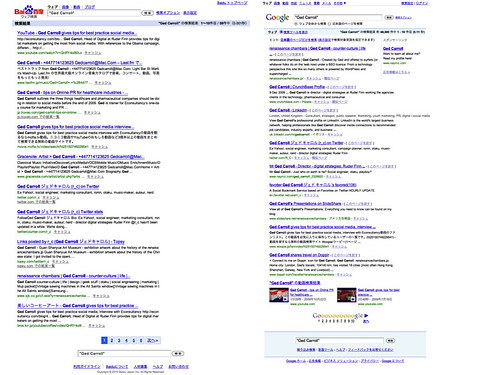
    Baidu JP vs Google JP

    In Japan, the Baidu | Google comparison told a similar story. The Google flavouring between Hong Kong and Japanese versions wasn’t that great only showing differences at position five and lower on the page. Baidu Japan managed to pick up my last.fm profile and twitter profile, but didn’t pick up my blog or any professional information on the first page.

    In conclusion, my unscientific assessment of Baidu has shown provides a great search experience for consumers. But I am uncertain how valuable it would be for people in a professional context, for instance researching foreigners with whom they may be doing business or finding foreign presentations. I can understand why Chinese scientific audiences would be concerned by the departure of Google.

    I also suspect that optimising content to make it searchable on Baidu is different to the process that I would go through for Google or Yahoo!, but that would merit far more investigation before I could blog with any confidence about it. More Baidu related posts here.