Category: business | 商業 | 상업 | ビジネス

My interest in business or commercial activity first started when a work friend of my Mum visited our family. She brought a book on commerce which is what business studies would have been called decades earlier. I read the book and that piqued my interest.

At the end of your third year in secondary school you are allowed to pick optional classes that you will take exams in. this is supposed to be something that you’re free to chose.

I was interested in business studies (partly because my friend Joe was doing it). But the school decided that they wanted me to do physics and chemistry instead and they did the same for my advanced level exams because I had done well in the normal level ones. School had a lot to answer for, but fortunately I managed to get back on track with college.

Eventually I finally managed to do pass a foundational course at night school whilst working in industry. I used that to then help me go and study for a degree in marketing.

I work in advertising now. And had previously worked in petrochemicals, plastics and optical fibre manfacture. All of which revolve around business. That’s why you find a business section here on my blog.

Business tends to cover a wide range of sectors that catch my eye over time. Business usually covers sectors that I don’t write about that much, but that have an outside impact on wider economics. So real estate would have been on my radar during the 2008 recession.

  • App constellations 2018 research

    I initially looked at app constellations back in 2014, when Fred Wilson put a name to the the phenomena. And every two years or so I have gone back and looked at a number of major internet companies to see how many different types of apps that they had in play.

    I originally selected the companies back in 2014 because I felt that they represented the largest and best of their ilk. It skews Asian because the west can be viewed as one eco-system represented by Google, Facebook and Microsoft.

    China is an enclosed eco-system; though Microsoft is actively engaged in the app eco-system there. I chose Tencent and NetEase as being my Chinese bellwethers. DaumKakao and Naver were representative of the Korean eco-system which blends highly-used domestic services with western platforms. Finally LINE of Japan (a subsidiary of Korean company Naver) provided a similar bellwether of the hybrid Japanese eco-system which mirrors Korea.

    App constellations survey methodology

    For the sake of convenience I have compared the contents of Apple’s mobile app store for each of the companies. While most of the internet companies have some Android-only or iOS-only apps; the iOS app store is still a good indicator of their app activity.

    I stayed true to the definition of app constellations in terms of deciding what kind of app should go in.

    App constellation definition

    I manually assessed each app, rather than relying on the category that the app had been submitted into. Tencent and Netease, had a number of mobile utilities that aided discussion and kept players updated on their favourite game. These didn’t fit within the definition.

    Changes in the environment

    Since 2016, a couple of things have changed:

    • Apple had a purge of apps that didn’t support 64 bit processing
    • They moved away from supporting the app store within iTunes application and on the web; to within the app store on the device

    2018 marks over a decade of mobile apps in the Apple store. Many of the major players have delisted almost as many Android and iOS apps as they currently have in the store. This happens for a number of reasons:

    • The app was serving a purpose for a fixed time
    • It is an application that has fallen so far out of favour that it is no longer worth maintaining
    • The code base no longer meets Apple’s or Google’s minimum standards
    Data analysis

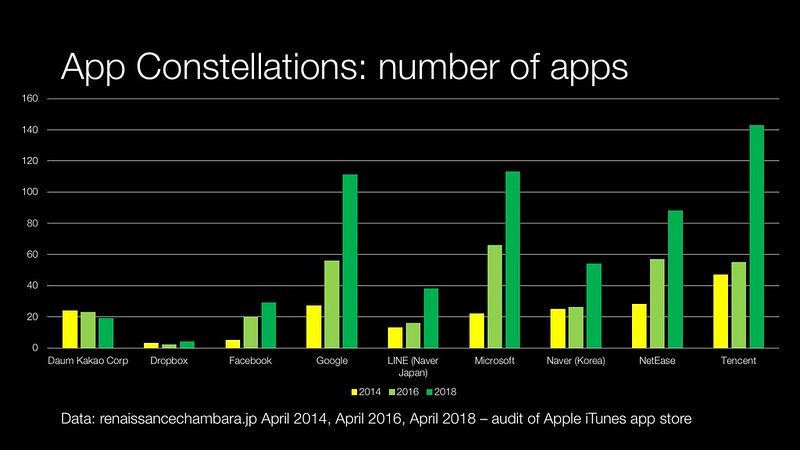
    I started off by looking at the number of apps. In terms of app constellations:  Tencent, Microsoft and Google were clear winners.
    Number of apps

    Both Microsoft and Google’s growth has been driven by ‘experimental’ apps that they have put out in the public for their own reasons and enterprise focused apps.
    compound annual growth in app number

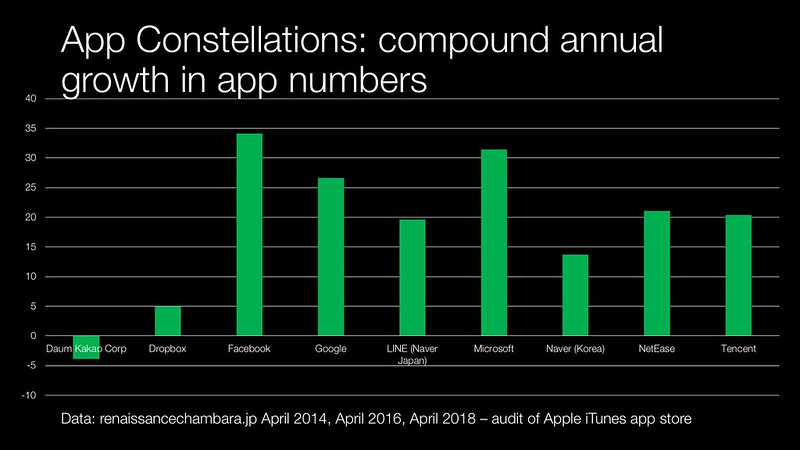
    But it was quickly apparent to me that the number of apps developed were only part of the story. What about the rate of change in numbers of apps developed? This would be indicative of the rate of change in moving to mobile. Here both Facebook and Microsoft’s pivot became immediately apparent. The Asian companies looked less impressive as they had been able to keep steady in their focus on mobile.

    All of this growth in the number of apps developed by major internet companies is all the more remarkable when you consider the following:

    • In mature markets consumers are not really downloading new apps
    • They are sticking with a few in terms of regular usage. Many of the apps on their phones don’t get used
    Notes on a few of the companies in terms of their app constellations
    • Daum Kakao – notable for being the only company who I looked at who had a decline in the number of applications versus 2016. A lot of this seems to be in service consolidation of both Daum and Kakao to remove duplications or non-core services. It is the Daum brand that has taken the biggest impact. This is understandable, since Daum struggled on the move to smartphones and Kakao is a mobile-first brand.
    • Dropbox – the growth in apps has been down to the larger business acquisition strategy at Dropbox. I don’t expect further growth like what we have seen with  Facebook’s pivot to mobile
    • Facebook – Facebook’s pivot to mobile was one of the reason why I decided to look at compound annual growth rate as well as the size of app constellation in terms of app numbers. In terms of raw app ‘SKUs’ Facebook is dwarfed by most of the other companies that I have looked at. It is only by looking at the growth in apps developed where one can really see their move to mobile
    • Netease – was interesting for its focus in a couple of areas. Like other Asian internet companies, education was a big target area, but Netease went into it with major commitment. Both NetEase and Tencent were big in magazine and book apps as well. I think this is down to the fact that ‘traditional’ web surfing is harder to do with (at the moment) when URLs are written in western script and numbers.
    • Tencent – the raw app numbers beggars belief. There are a number of reasons for this. Like NetEase, Tencent has a lot of apps solely optimised for the iPad and a separate iPhone app. There are free and paid-for product variants. Lastly Tencent will have four or five apps competing in a given category like streaming music which seems insane. Only time will tell if Tencent is spreading itself too thin; like when Yahoo! was described Brad Garlinghouse’s Peanut Butter Manifesto
    More information

    Jargon watch: app constellation – back in 2014 when I wrote this post, it still took me the best part of a week to research and describe each of the apps in the main eco-systems. It would take me much longer today due to the growth in apps

    Peanut Buttergate – analysis of Garlinghouse’s original memo about Yahoo! from back in 2006

  • Voice activated coupon + more news

    Voice activated coupon

    Google’s First Voice Activated Coupon – WPPGoogle distributed its first voice-activated coupon offering customers $15 off Target purchases placed on Google Express through Google Assistant –through desktop, mobile or Google Assistant enabled devices – I am surprised that Amazon didn’t introduce the voice activated coupon before Google.

    Beauty

    SK-II finds success in selling to younger Chinese: P&G | Advertising | Campaign Asia – luxury brand with an on ramp for college students

    China

    China Bans Online Bible Sales as It Tightens Religious Controls – The New York Times – I am concerned about Vatican appeasement of China. It looks like Neville Chamberlain

    Consumer behaviour

    Headline from China: Purchase Restriction and Red Streetwear | Jing Daily – interesting how streetwear brands are being cleared out of the way by the Chinese government to support Chinese originated brands

    How Americans Self-Sort Themselves by Age and Class – CityLab

    Culture

    The Overwhelming Emotion of Hearing Toto’s “Africa” Remixed to Sound Like It’s Playing in an Empty Mall | The New Yorker

    Molly Ringwald Revisits “The Breakfast Club” in the Age of #MeToo | The New Yorker – good read, what I remember is how those films nailed emotion

    Japan

    Japan to place accident liability on self-driving car owners – Nikkei Asian Review – makers liable only in case of a system flaw

    Online

    China’s Didi Chuxing prepares to launch Mexico operations | HKEJ Insights – China going global

    RSS is undead | Techcrunch – no RSS is alive, but Techcrunch haven’t worked out issues the RSS users have already. Much of the issues are solved by using NewsBlur and finding sources is organic rather than an instant end state. More online related topics here.

    Security

    Could Cambridge Analytica boss be probed for Philippine meddling? | SCMP  – This could get interesting. Putting aside arguments about whether Cambridge Analytica’s technology actually works as promised, Philippines law would still have been broken. It forbids all outside parties from participating in its election process.It is alleged that they were supporting Duterte, which would make the foreign reaction to it interesting as well.

    Technology

    ARM Mac: Piece of Cake Or Gas Refinery? – Monday Note – assumes that there will be a transition, which I am not convinced about

    API and Other Platform Product Changes – Facebook for Developers – reduces information that can be taken out to beef up privacy

    Wireless

    Smartphone shipments fall again in Q1 | Shanghai Daily – China looks saturated in terms of smartphones

    Cell Spotting: Studying the Role of Cellular Networks in the Internet by Rula, Bustamante and Steiner – (PDF)

  • Erooms Law – jargon watch

    Erooms Law is a metaphor that compares other business processes to the virtuous circle of Moore’s Law. It is literally Moore’s Law in reverse. Industries have developed processes that are getting ever more expensive.  Once could consider that is inversely proportional to the way semiconductor manufacture  reduced the relative cost of computing power over time.

    Some see this as a potential opportunity for the use of computing in a sector to reduce costs. As with most circumstances, what seems like a great idea inside an Excel spreadsheet doesn’t work out in the real world. But that doesn’t stop the management consultants, investment bankers or venture capitalists from trying.

    Eroom’s Law and the pharmaceutical industry

    The poster child for Erooms Law cited would be the biotechnology and pharmaceutical industry developing new drugs.

    Here’s how Nature Reviews Drug Discovery put it:

    Eroom’s Law indicates that powerful forces have outweighed scientific, technical and managerial improvements over the past 60 years, and/or that some of the improvements have been less ‘improving’ than commonly thought. The more positive anyone is about the past several decades of progress, the more negative they should be about the strength of countervailing forces. If someone is optimistic about the prospects for R&D today, they presumably believe the countervailing forces — whatever they are — are starting to abate, or that there has been a sudden and unprecedented acceleration in scientific, technological or managerial progress that will soon become visible in new drug approvals.

    You could argue that the defence industry would also fall into this, despite the benefits of technology. (The origins of the semiconductor industry lie in the development of missiles during the cold war. Integrated circuit technology is more robust and lighter than discrete transistors or vacuum tube based systems).

    Other areas were Erooms Law is prevalent include fintech or financial technology and the automotive sector, where massive assumptions are made about the rate of innovation in battery technology based on Moore’s Law rather than the rather prosaic improvements in materials science that underpin existing battery chemistry.

    More information

    Diagnosing the decline in pharmaceutical R&D efficiency | Nature Reviews Drug Discovery (paywall)
    Eroom’s Law | In the Pipeline | Science magazine
    EROOM’s Law of Pharma R & D | buildingpharmabrands
    More posts on the pharmaceutical industry on this blog.

  • Family & other things that made my day this week

    Untitled

    I spent a good deal of the week seeing the family. It was great to have homemade soda bread and finish off my Mum’s Christmas cake. Yes, you haven’t read that wrong, my Mum specialises in making rich fruit cakes for Christmas. They keep for a good few months afterwards.

    A good deal of that was spent watching Homeland and assorted  films with my Dad. This included Accident Man – a pretty accurate remake of the Toxic! comic book character from the early 1990s by Pat Mills (of 2000AD fame) and Tony Skinner. We didn’t watch them as a family for reasons that will become apparent.

    For a brief period from March to October 1991; the UK comic scene had a darker, more anarchic publication than had been previously seen. Toxic! was originally designed to address failings in 2000AD magazine.

    The film is so anachronistic in its nature that its audience will be niche. That doesn’t reflect on the quality of the action in the film. It features Ray Stevenson, Scott Adkins (you’d recognise hime host of Hong Kong and Hollywood movies) and Ray Park (who played Darth Maul). Adkins is a bit lean to play the titular character Mick Fallon, which is a surprise given his Boyka role in the Undisputed franchise. Adkins to his credit manages to make it all work.

    Both the director and the script writer managed to skilfully blend the unreconstructed misogyny of 1991 with with the great ‘unawoke’ attitudes of a post-Brexit Britain.

    Watching Wanted: Dead or Alive with Rutger Hauer shows how much the media portrayal of Islamic terrorism has changed over the past 30 years. The plot itself is a bit odd. Sex tape star Gene Simmons plays an Islamic terrorist looking to cause a Bhopal-type disaster as an act of revenge on the United States – where do you even start with that plot?

    Hauer’s car has an early generation cellular phone and what seems like some sort of satellite navigation equipment with a monochrome CRT display.

    Dated films weren’t the only things that I saw. The family car is still a Polo diesel that I helped them buy. Whilst I heard of a few people who had a Nissan Leaf; Merseyside is still firmly in the petroleum age. Most of the cars were a decade old on average and I didn’t see any obvious charging stations. Importation of secondhand cars from Japan is still a thing. Both J60 and J80 series Toyota Land Cruisers seem to have a loyal following.

    For something more recent and music-related, I can recommend this from Resident Advisor: How did UK garage become dubstep?

    I think that we must be pretty close to peak-vape. I was in a Wilkinsons store and wandered past the cough and cold medicine section. Wilkinsons is a discount retailer that does a mix of food cupboard staple grocers, household cleaning products and over the counter pharmacy products. A good analogue for Hong Kong readers would be 759 Store.

    On the top shelf of the unit above cough and cold remedies was vape fluid and e-cigarettes.

    Douglas Rushkoff | Present Shock Economies – great YouTube video which explains why Amazon is likely to be more trouble over time than Facebook ever will be. Well worth listening to during a lunch hour.

    Finally Asian Boss had some great vox pop interviews with Beijingers about what they thought of Sesame Credit which is a financial and behavioural credit system being rolled out in China.

  • Influence – The Psychology of Persuasion by Robert M Cialdini

    Cialdini’s Influence is now over ten years old and still stands up. It is a good guide on the psychology of why people say “yes”. The accessible style of Influence reminded of Douglas Rushcoff, or Malcolm Gladwell. Ok Malcolm Gladwell is a poor analogy, Cialdini’s work isn’t candy floss for the mind. This is deceptive as there is usually an inverse relationship between value and accessibility. Exceptions to this heuristic would be the likes of Sun Tzu – The Art of War.

    Influence by Cialdini

    Cialdini hasn’t been researched within an inch of its life in the same way Byron Sharp’s books have been.

    Cialdini provides planners and strategists with starting points for customer experiences. The book isn’t a how to guide for digital journeys but provides first principles. Psychology is not channel-specific.

    The Journal of Marketing Research described it as

    …among the most important books written in the last 10 years.

    The book’s style allowed me to pick it up and put it down, to fit in with my holiday schedule of train travel and family time.

    Why should you have Cialdini’s Influence?

    • If your work includes marketing planning or strategy, your bookshelf should have this book. If you are thinking about customer interactions, this book outlines the first principles that you need
    • If you’re a consumer and want to know how you’re being sold to; read this book
    • If you want to get on better with people ( your kids or co-workers); buy this book

    My copy is well-thumbed and stuffed with post-it notes around the edges as I go back and forth into it on a regular basis. More marketing related content here.

    SaveSaveSaveSave

    SaveSave