Category: business | 商業 | 상업 | ビジネス

My interest in business or commercial activity first started when a work friend of my Mum visited our family. She brought a book on commerce which is what business studies would have been called decades earlier. I read the book and that piqued my interest.

At the end of your third year in secondary school you are allowed to pick optional classes that you will take exams in. this is supposed to be something that you’re free to chose.

I was interested in business studies (partly because my friend Joe was doing it). But the school decided that they wanted me to do physics and chemistry instead and they did the same for my advanced level exams because I had done well in the normal level ones. School had a lot to answer for, but fortunately I managed to get back on track with college.

Eventually I finally managed to do pass a foundational course at night school whilst working in industry. I used that to then help me go and study for a degree in marketing.

I work in advertising now. And had previously worked in petrochemicals, plastics and optical fibre manfacture. All of which revolve around business. That’s why you find a business section here on my blog.

Business tends to cover a wide range of sectors that catch my eye over time. Business usually covers sectors that I don’t write about that much, but that have an outside impact on wider economics. So real estate would have been on my radar during the 2008 recession.

  • Benetton – new positioning

    Benetton was, from my personal perspective, a photo-streetwear brand of the 1980s and early 1990s. It had a particular European look.

    This was back when European tennis wear like Lacoste and Australian by L’Alpina were exotic. The Pet Shop Boys were singing about the Paninara sub culture that was obsessed with designer clothing and American movie style. Benetton made highly branded t-shirts and rugby shirts, but it was best known for its knitwear. It was a family run business that pioneered the use of technology to automate clothing manufacturing in the face of globalisation.

    At that time, thanks to Fiat adverts about its production line for the Fiat Strada, Italy was considered in the UK to be a highly sophisticated manufacturing power. There was a clear contrast with the striking British Leyland factory workers. Of course, the Fiats still rusted like their predecessor cars.

    Being a family business Benetton was also able to do a famous series of adverts that provided progressive social commentary through shock tactics.
    Benetton new positioning
    It’s new positioning is a marked move away from this heritage. It’s ‘Clothes for Humans’ tag line moves the brand towards the everyday – almost norm core in its message. It positions the brands as clothes for everyone – more Uniqlo or Gap than designer wear.

    More on streetwear here.

  • Android to iPhone & more

    Daring Fireball | U.S. Army Special Operations Switching From Android To iPhone – interesting comments on OS stability, from Android to iPhone,  more on security related stories here

    Digibarn Stories: Rob Barnaby and WordStar and much more (June 2008) – Barnaby’s ability to code in assembly was legendary – seems especially insane now when languages like Swift are being touted for app development.

    Blimey, it could be Brexit – the whole book so far | openDemocracy – probably one of the best readers on how things will work out post-Brexit

    Perry Anderson · The Italian Disaster · LRB 22 May 2014 – interesting read in the light of current things rolling out in Italian banking

    Boris Johnson booed at French Embassy – BBC News – and what did they expect to happen?

    When Virtual Reality Meets Data Journalism | Global Investigative Journalism Network – interesting takeouts for VR designs

    Gossip magazine group buys newspaper rival RCS Mediagroup – FT.com – looks like a professionalisation of Italian media ownership on first impression. Since the new owner seems to be less interested in political influence and more interested in profitable titles. Is this what Italy will look like post-Silvio Berlusconi? (paywall)

    The Difference Between VR and 360 – Gear Patrol – interesting examples about how modern technology marketing is ‘post factual’

    The demise of the California fitness brand | Marketing Interactive – spectacular corporate implosion

    Chinese $1.2 billion takeover of Norway’s Opera fails, but alternative deal set | Reuters – in some respects as significant as the ARM deal that dropped the same morning

    When Yahoo Ruled the Valley: Stories of the Original ‘Surfers’ – The New York Times  – When the Grateful Dead musician Jerry Garcia died in August 1995, Yahoo searches on him spiked immediately. The surfers put a Garcia link on the home page. “That was the birth of Yahoo News,” Ms. Srinivasan said. Today, it remains one of the most popular online news portals – whilst the internet has become The Man. The historic link between counterculture and online culture was extremely strong

    Holiday Season 2009
    (Yahoo! corporate account on Flickr: Yahoo! billboard Holiday Season 2009)
  • LBOs in Silicon Valley

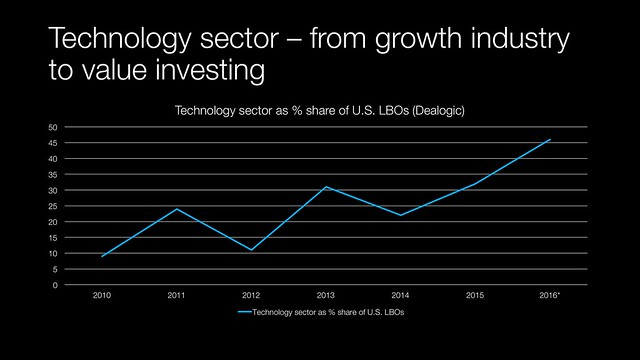
    With the rise of technology sector LBOs it makes sense to reflect on the Silicon Valley use of stock options and going public. In the past the Silicon Valley stock market dream was relatively simple. Hard graft with a possibility of a reward in terms of a stock market listing or a buyout by a larger technology company eager for the new, new thing.

    Now things are different, businesses like Google, Uber and Facebook held out for as long as possible to go public. Technology companies from Apple to Zynga have been punished repeatedly in the market for real and perceived mis-steps. Activist investors charge around Silicon Valley in a similar manner to the way they bullied the S&P index in the 1980s.
    160704 - private equity & the tech sector
    Now technology companies are making up almost half of private equity LBOs. An LBO is a leveraged buy out; its where a prospective owner uses a mix of loans and their own money to purchase a company. The company usually has a steady cash flow that is used to pay down the loans and associated interest. These businesses are generally discounted because they are no longer perceived as being high growth companies.

    The private equity owner looks to either flip the company to another purchaser, or flip parts of the company to pay down the loan. Either flipping or piecemeal sales are designed to raise more value than the original price paid.

    Since these businesses are servicing large amounts of debt, they are vulnerable to fluctuations in their business conditions or interest rate rises. For example, Irish telecoms network Eircom defaulted on corporate bonds in 2012, having been through a couple of LBOs in the previous decade.

    There always has been some LBOs in the Valley, Computer Associates bought up rivals and ran them as part of a conglomerate, with a focus on maximising the business cash flow rather than market share growth. General Atlantic Partners and Cerebus Capital Management had specialised for a long time in LBOs of mature ‘also ran’ business software companies with regular support customer support contracts. But the recent growth in LBOs is unprecedented for the technology sector. More on Silicon Valley here.

    *January, 1 2016 – July 1, 2016.

    More information
    Private Equity Has a Crush on Tech | WSJ – paywall
    What are the major reasons behind Yahoo’s drastic downfall?
    Barbarians in the valley

  • ABZU & other things

    ABZU

    I like my computer entertainment trippy rather than action packed like this trailer for computer game ABZU

    Best battle of the bastards meme after the Game of Thrones episode caused an outburst of video creativity. Equating Jon Snow to Leeeeeeeroy Jenkins was genius. Whilst we talk about the fragmentary nature of online content, mainstream media is still providing the key cultural moments.

    Design

    The outlandish Rolls-Royce self-driving car of the future: Vision Next 100 | ExtremeTech – it has more of the design language of a Bristol than a Rolls Royce. Mercedes has an interesting take implying that UNHW individuals would still like the choice to drive rather than a self-driving car

    Amazing analysis of typography in Blade Runner. The level of detail is impressive. It also speaks volumes of the set designers and visualisers like Syd Mead

    FMCG

    Even the world’s biggest candy company doesn’t think you should be eating this much sugar | Quartz – there is another explanation to consider. Does having M&Ms in a McFlurry cheapen the brand or act as an economic substitute for a bag of M&Ms?

    Philadelphia Is the Nation’s First Major City to Pass a Soda Tax | Time – research on the effectiveness of this could be decisive in future legislation. It is interesting how it has also being rolled out in Mexico and discussed at a policy level across Europe

    Online

    Grandma with incredibly polite Google searches | BGR – it reminds me of my parents ‘Ask Google about…’

    US asks to join Irish data protection court case – Schrems argues that the use of these clauses does not change the fact that Facebook is still subject to the US mass surveillance program, and that the CJEU has already found them to be in conflict with EU law

    Software

    Samsung to Buy Joyent | WSJ – interesting move by Samsung. It makes sense for them to by as software and cloud has been a weaker capability than hardware design

    WeChat Moments – The Holy Grail of Social Media Marketing In China | Racepoint Global – my ex-B-M and Racepoint colleague James on WeChat

    Web of no web

    Biz Break: Apple Watch outlook may be dimming | SiliconBeat – the rationale is interesting and is category-wide rather than an Apple-specific platform. More on the Apple Watch here.

  • Brexit part 2

    I was prompted to write Brexit part 2 based on the many questions from friends living outside the UK – who are trying to make sense of what is going on.

    Mod Churchill

    Brexit is a portmanteau of ‘Britain’ and ‘exit’. The exit being from the European Union. In 2013, David Cameron announced that a conservative government would hold an in-out referendum. The referendum would take place before 2017.

    Cameron is campaigning to stay in why did he call for a referendum?

    David Cameron had two main reasons for calling the referendum.

    The Conservative party has members in both camps. This has been a fault line in the party for a long while. The reasons for this split in the party boils down to two factors.

    In order for the EU to be more powerful on the world stage, it has to speak with one voice. The process of consensus that it uses to get there means the UK is part of the consensus not a lone actor on many issues. This has an impact on how sovereignty is perceived. The full name of the Conservative party is actually the Conservative and Unionist party. It has members who view that sovereignty argument is an attack on the sanctity of the state. The second argument is having a completely deregulated market will benefit business. This would annul workers rights and make government much smaller. Taxes would be lower since the government would be responsible for much less activity.

    The economic argument for remaining in the EU is that it provides access to an internal market. This has some ancillary benefits: as an English speaking country the UK is ideal for international investment. The EU provides a wider pool of workers to draw on. In knowledge economy work this is important. It is easier to do business across Europe with common laws and regulations.

    The second reason is that before 2009 if you wanted a right-of-centre party you only had one choice. Under the leadership of Nicholas Farage the UK Independence Party (UKIP) rose. This was down to his personality and right-wing populist policies. On the surface of it the Conservative party had to adapt to the reality of competition.

    Calling a referendum at a time of Mr Cameron’s choosing was a way of dealing with the bleed of support to UKIP and the split within his own party. I think it would be fair to speculate that Mr Cameron’s team underestimated the Leave campaign and the sentiment of the general public.

     What are the key issues for the electorate?
    The issues break down into what I will term surface issues and shadow issues. The surface issues are those issues that connect to the referendum in a rational, logical way. The shadow issues are issues that aren’t connected to the referendum. It is a bit like having an argument with a loved one, often the subject is an excuse to raise everything else that has led to this moment. Essentially the surface issues are rational, the shadow issues are emotive in nature.

    The Surface issues

    For leaving:

    • The UK would get to save the money that it currently contributes to the EU. The numbers talked about this vary. Much of the money that is sent to the EU is spent in the UK. Many leave campaigners argue that this notional pot of money would be better spent on the NHS. There is no guarantee that this would take place and it assumes that the economy performs at least as well in the future.
    • The UK is the fifth biggest economy in the world, people would still want to trade with the country. The UK could do a better job negotiating trade unencumbered by the EU. At the present time, the UK is part of a trading bloc of 26 countries. The EU is the world’s largest trading bloc and that gives it a helpful position in negotiations. The other EU states remain the UK’s largest trading partner. For political and business reasons the UK may not get particularly good trading terms out of the EU, beyond what it already has. It is speculative and we just don’t know.
    • The UK can take back control of its borders to limit immigration. There is some evidence to suggest that uncontrolled migration from the European Union affected wages. This impact was biggest on wages in unskilled or semi-skilled work. Whilst this impact is considered to be small, it affects voters living hand to mouth. They will perceive this impact as big. The government data on net EU migration has contrasting sets of figures which can give rise to concerns of under-accounting or a cover-up depending on your paranoia level.
    • Britain can take back control of its laws, cut red tape and become more competitive. This is largely conjecture. Once the vote goes through Britain’s position won’t change until it negotiates its exit from the EU. It’s not like dropping your subscription to Netflix. Future legislation would depend on the kind of trade deals that Britain negotiates. Depending who you believe, a reduction in EU legislation would stop further erosion of workers rights or remove restrictive workers rights from businesses.

    For staying:

    • Better the devil you know. At the present time, the UK economy is ok. It is part of the EU trading bloc. Leaving the EU brings with it uncertainty. How will the country trade? Will the UK have free access to the markets of its largest trading partners? How will this affect UK ex-pats currently living in other EU countries like pensioners in Spain? There would be uncertainty whilst the UK negotiates trading agreements around the world. The government hasn’t outlined a clear plan B for life after Brexit.
    • UK residents also have rights to freedom of movement in the EU. If you have your passport, a British citizen can go to work freely in any EU country. For young people and professionals, that is an attractive proposition. Leave campaigners would argue that Norway has managed to negotiate similar freedoms for its citizens and isn’t an EU member.
    • The impact of the UK leaving the EU is likely to be felt beyond the UK. This is based on conjecture, but a Brexit vote may trigger similar votes elsewhere in the EU. The EU has been something that has bound European countries together. Prior to the EU, mainland Europe was responsible for two world wars. Since all economies have a high degree of interconnection, the effects will reverberate around Europe and the UK for a long time. A leave campaign response would be to think about Britain first and focus on higher growth non-EU markets.
    • The UK outside the EU is likely to have a negative economic impact on the country. Economic predictions aren’t certain to happen but make sobering reading. The following international organisations think that it will be bad for Britain including: OECD, the US government, IMF, The World Bank and the Chinese government. This is probably the area that the leave campaigner have been least effective in countering.
    • British consumers will lose out from participation in the EU. A wide range of benefits such as anti-terrorism security co-operation, having their holiday mobile phone bill reduced through EU regulation or being able to study abroad. However, these issues won’t matter to many of the poorest voters who are behind the leave campaign.
    • A vote for Brexit may increase pressures for a break-up of the United Kingdom. A Scottish referendum on independence was recently defeated, but Brexit would re-open the debate in a pro-Europe Scotland. Northern Ireland currently benefits from the EU, Brexit could ramp up simmering tensions and possible bring a return to The Troubles. The Good Friday agreement currently revolves around an open border and North-South economic codependency. Leaving the EU would break this and require a more heavily regulated border to keep out immigrants and smuggling.  A leave campaigner would argue that this is speculation and nothing more.

    The Shadow Issues: a working class insurrection through the ballot box?

    Modern Britain as an economic power house has left behind wide swathes of the country outside London and the Southeast of England. These left-behind people are the engine driving the vote to leave.

    The UK was the industrial beating heart of the world in 19th century and it began a long slow decline due to a number of factors:

    • Much of the manufacturing was in relatively low value products
    • Much of the manufacturing base didn’t have a hard-to-replicate core competence. By contrast German industry is built around high value specialisation and niches
    • Favourable trading environments in former colonies dried up
    • Globalisation brought more competitors to the table. Though many of those competitors like Toyota and Nissan then went on to build factories in the UK
    • Structural issues:
      • A national banking and business finance system based on short-termism rather than the regional banking system with a longer term focus that drove German competitiveness.
      • The asset stripping ‘shareholder value’ approach pioneered by Slater Walker, James Goldsmith and James Hanson.
      • An adversarial worker – management relationship rather than the German worker-management councils
    • A short term attitude to the dividend of North Sea oil (by comparison, the Norwegian government have invested part of this money for the future)
    • A decision by the government to ‘bet the farm’ on financial services in the 1980s
    • A succession of debt fuelled consumer boom and bust cycles
    • Poor decisions made on worker training. UK apprenticeship schemes have lagged the quality of similar schemes in Germany and other European countries
    • Unfettered worker migration from Eastern Europe, which the Labour party has admitted was a mistake

    This has left Britain in a curious state:

    • For a country with a famous education system, you have unskilled workers who need to be supplemented by better skilled migrants
    • Their wages are stagnant or may have dropped in real terms due to increased job competition due to short-term or temporary migrant workers
    • A large amount of working poor who have an uncertain future
    • Large amount of consumer debt, often tied up in home ownership and distorted prices for rental and home purchase. When you can barely make the rent, an economic depression and housing crash looks quite attractive
    • Social mobility is in decline for many
    • University education is no longer a guaranteed entry ticket into the middle class – but it now comes with a vast amount of consumer debt

    The elephant in the room for Brexit is the rise of the poorest people in society as an important voter bloc. The UK political system is comprised of major parties who have not reflected the views of poorer people for the past 30 years. You have generations of frustrated angry people and the Brexit referendum gives them an outlet. Many of them know that life will not improve; but it gives them the opportunity to screw the people who haven’t listened over the decades.

    Their concern and anger is not new but has lacked focus. Prior to Brexit, it drew some of these people to the likes of the English Defence League and Britain First – alongside the usual collection of people with racially motivated agendas. The UK Independence Party tapped into that zeitgeist and the referendum has brought it to the fore.
    Both the main parties have been ill-equipped to deal with it. Immigration is a loaded term as it has been a historic touchstone for racial hatred and intolerance. My Dad faced the classic attitude of landlords with signs saying ‘No blacks, no Irish, no dogs‘.

    The impact isn’t only economic, older residents are seeing their neighbourhoods change beyond their comprehension.

    Voter concern about immigration is not bounded by race, creed or colour in the UK – which moves it away from being ‘politically incorrect’ to a subject of legitimate debate.

    In some respects, it is easy to understand why immigration was such a difficult issue for politicians. Enoch Powell was famous for a speech given in Birmingham in 1968 regarding immigration from Commonwealth countries. Powell’s speech touched on immigration issues that many would recognise now: strain on resources, the degree of change in neighbourhoods and society, issues with societal integration. His speech was also tied to anti-discrimation laws. In a country that had only recently recovered from the second world war, Powell objected to a law advocated by writers from newspapers which had been soft on the rise of Hitler, yet now wanted to impinge on the freedoms of the native British. He quoted from the latin epic poem Aeneid as a graphic way of illustrating his concern about possible conflict.

    Like the Roman, I seem to see “the River Tiber foaming with much blood”.

    This was allusion to his own foreboding about the future of Britain, partly driven by the riots that had racked US cities including in the 1960s including Watts (Los Angeles), Hough (Cleveland), Detroit, Chicago, Washington DC and Baltimore.

    From then on Powell was forever linked to his ‘river of blood’ speech. He lost his seat in Edward Heath’s shadow cabinet and his speech was roundly criticised as racist. Powell did seem to have his finger on the pulse of voter sentiment at the time. Just two weeks after the speech The Gallup Organisation released poll results showing 74% of respondents agreed with Powell’s speech versus 15% who disagreed. Powell was the unacceptable face of right wing populism.

    It was only with the rise of UKIP in 2009 that immigration was put on the ‘serious’ political agenda of the mainland UK again.

    The main political party members campaigning of remain don’t have easy answers for the intractable problems facing these people. Trying to control immigration is only a small part of any realistic solution. Back in 1981, members of Margaret Thatcher’s government talked about the difficulty in dealing with the economic issues:

    “I fear that Merseyside is going to be much the hardest nut to crack,” he cautioned. “We do not want to find ourselves concentrating all the limited cash that may have to be made available into Liverpool and having nothing left for possibly more promising areas such as the West Midlands or, even, the North East.

    “It would be even more regrettable if some of the brighter ideas for renewing economic activity were to be sown only on relatively stony ground on the banks of the Mersey.

    “I cannot help feeling that the option of managed decline is one which we should not forget altogether. We must not expend all our limited resources in trying to make water flow uphill.”

    The referendum has highlighted the distance between working class people and the Labour Party. This is especially striking; working class people are Labour’s traditional natural constituency.

    Will Britain Leave The EU?

    I don’t know, but at the time of writing the FT’s poll of polls gives the leave camp a 4% lead over remain, with just 10% of respondents undecided. If the polling data reflects voter turnout accurately then Brexit is likely.  We don’t know what the voter turnout will be, it could be affected by a number of factors:

    • Wet weather adversely affects voter turnout
    • Young people, who are generally more favourable towards remaining in the EU; but tend to do a worse job at getting along to the polling station. This referendum may change that dynamic
    • People in lower socio-economic groups tend to have lower voter turnout
    • Older people tend to be more diligent. For senior citizens, if either side of the debate has a better grassroots machine for giving their supporters to the polling booth that could make a difference

    Despite much of the fuss about getting eligible ex-pats to vote, they are likely to consist of only 1% of the electorate.

    The Euro 2016 football tournament has no matches on June 23 – a major game would have adversely affected voter turnout.

    You can find Brexit part 1 here.

    More information
    UK government documents on Brexit
    UK Independence Party – Wikipedia
    Conservative Party – Wikipedia
    The knowledge economy is a myth. We don’t need more universities to feed it | The Guardian
    Britain is in the midst of a working-class revolt | The Guardian
    Working-class Britons feel Brexity and betrayed – Labour must win them over | The Guardian
    EU position in world trade | European Commission
    The Great British trade-off The impact of leaving the EU on the UK’s trade and investment | The Campaign for European Reform – PDF
    The impact of immigration on occupational wages: evidence from Britain | Bank of England – PDF
    EU migration — the effects on UK jobs and wages | FT – Paywall
    The Economic Consequences of Brexit: A Taxing Decision – OECD
    Europe and Central Asia: Growth Struggles in the West, Volatility Increases in the East – The World Bank
    Remarks by the President Obama and Prime Minister Cameron in Joint Press Conference | White House
    Uncertainty Clouds the United Kingdom’s Economic Prospects | IMF
    China: Brexit Threatens to Tip Scale in Favor of U.S. | Money Morning
    The Brexit Index: a who’s who of Remain and Leave supporters | Populous
    1981 files: Lord Howe rejects ‘inconsiderate’ comments on decline of Liverpool | Daily Telegraph
    Analysis: the impact of turnout on the EU Referendum | YouGov
    FT – Poll of Polls on Brexit

    Books
    Heffer, Simon (1999). Like the Roman: The Life of Enoch Powell. London