Category: china | 中國 | 중국 | 中華

Ni hao – this category features any blog posts that relate to the People’s Republic of China, the Chinese communist party, Chinese citizens, consumer behaviour, business, and Chinese business abroad.

It is likely the post will also in other categories too.  For example a post about Tong Ren Tang might end up in the business section as well. Inevitably everything is inherently political in nature. At the moment, I don’t take suggestions for subject areas or comments on content for this category, it just isn’t worth the hassle.

Why have posts on China? I have been involved in projects there and had Chinese clients. China has some interesting things happening in art, advertising, architecture, design and manufacturing. I have managed to experience some great and not so great aspects of the country and its businesses.

Opinions have been managed by the omnipresent party and this has affected consumer behaviour. Lotte was boycotted and harassed out of the country. Toyota and Honda cars occasionally go through damage by consumer action during particularly high tensions with Japan.

I put stuff here to allow readers to make up their own  minds about the PRC. The size of the place makes things complicated and the only constants are change, death, taxes and the party. Things get even more complicated on the global stage.

The unique nature of the Chinese internet and sheltered business sectors means that interesting Galapagos syndrome type things happen.

I have separate sections for Taiwan and Hong Kong, for posts that are specific to them.

  • Facebook eroding & other news

    Facebook eroding

    The tweet about Facebook eroding is part of a greater issue of what Facebook is calling internally ‘context collapse‘. Facebook recognised the issue back in 2015. There are several likely reasons for Facebook eroding:

    • Negative network effects
    • Societal norming on social media content
    • Lack of trust in the facebook brand
    • People just don’t like Facebook as a platform that much

    Business

    After Anbang Takeover, China’s Deal Money, Already Ebbing, Could Slow Further – The New York Times

    Hello, mobile operators? This is your age of disruption calling | McKinsey & Company – lots of buzz words, diagnosis but not a glimpse of a way forward

    Edelman Revenue Up 2.1% In 2018 To $894m | Holmes Report – given that all the global PR groups have had exceptionally low growth or even declines

    How Douyin became China’s top short-video App in 500 days – WalktheChat

    Wireless

    Nokia on 5G at MWC, what struck me is the sales pitch was more like an enterprise software company like IBM or Oracle than a telecoms vendor. There is lots of tech in the networks but there isn’t a recognisable killer app. His warnings about 5G upgradeable products ring true though.

    Consumer behaviour

    Asian Boss do some really nice street interviews in different Asian cities and this one about Apple iPhones in Korea is particularly instructive. Samsung is seen as the default phone as they assemble phones (mostly for Asian markets) in Korea. Whereas in Europe all of the are made in China. When I lived in Hong Kong, both Samsung and LG emphasised that they made their phones in Korea with an implicit quality guarantee. 

    The iPhone seems to have won out on product design amongst younger people. but one shouldn’t ignore the desire to support the national brand. 

  • Chinese devices in Asia + more news

    Why the iPhone Is Losing Out to Chinese Devices in Asia – WSJ  – Xiaomi has an edge in many markets because it can customize for each country while Apple creates the same products for everyone, said Jai Mani, Xiaomi’s product manager for India. – the rise of Chinese devices in Asia are picking up the kind of clients that Apple doesn’t want. More related content here.

    In an Era of ‘Smart’ Things, Sometimes Dumb Stuff Is Better – The New York Times – nails the need for divergent design and use cases

    How This Guy Lied His Way Into MSNBC, ABC News, The New York Times and More – old news, many PRs have been case studies in newspapers and magazine articles – Janet or Jim who worked in marketing and had a medical condition or an embarrassing thing happen to them – chances are they’re a PR

    Secret HSBC memo turns heat on Topshop boss Philip Green | News | The Sunday Times – this makes a lot of sense, even more so than when Green started discussions two years ago. From a historic point of view HSBC helped KS Li and his counterparts buy out many of the then British owned conglomerates in colonial Hong Kong of the 1970s. It seems natural to have them help find Chinese buyers for his British interests. Hong Kong’s Hutchison owns mobile network (including shops) 3. It also owns Super Drug through its Watson’s subsidiary. House of Fraser also has a Chinese owner. Topshop trades on the UK being cool and trendy a la Rimmel’s iconic “Get the London look” – Brexit diminishes it with its xenophobic inward look. Domestic sales still outweigh overseas sales, I can understand why he wants out, especially if the business is leveraged

    China’s cutthroat smartphone market is coming down to a handful of major brands | South China Morning Post  – Huawei Technologies, Oppo, Vivo, Xiaomi and Apple – with a 77 per cent share of the market, up from 67 per cent in 2016, according to Counterpoint. – Quite why Oppo and Vivo aren’t viewed in aggregate rather like Huawei and Honor is beyond me due to their close ties to BBK

    Instagram is killing the way we experience art | Quartz – fine art gets the kind of screen intermediation problem that live music has had for years

    Dropbox saved almost $75 million over two years by building its own tech infrastructure – GeekWire – this makes total sense when you get that to that size and scale

    Assembly of ‘Aibo’ Robot Dog (1) | NIKKEI XTECH – Nikkei have a unique take on the teardown; working with a Sony engineer to document the process of assembling the latest generation of Aibo robotic dog. It quickly comes across where your money goes as it is fiendishly complicated to build

    Young Japanese are surprisingly content – Seventh heaven at 7-Eleven | Economist – but concerned about the future

    From the Name to the Box Logo: The War Over Supreme — The Fashion Law

    Why Chengdu Spends More on Luxury Than Wealthier Cities | Jing Daily

  • Siri vs Siri + more news

    Siri vs Siri: What Apple’s AI can and can’t do on every Apple device | Macworld – Siri vs Siri implies context based on device, but they need to raise the game in particular on the Mac. More related content here.

    How Russia’s ‘red tourism’ is luring wealthy Chinese visitors bored with Paris and Milan | South China Morning Post – Russian department stores TSUM and GUM become important for foreign Chinese luxury sales

    May braced for Unilever decision on headquarters | FT  – Unilever: ‘stichting’ up a move to the Netherlands, which would make sense. 100VE is a leased building, its overcrowded and a number of the people there were contractors like me. The team that I worked in had already upped sticks to the Netherlands with the roles moving but not many of the people were redeployed, let go or didn’t have their contracts renewed

    Millennial insecurity is reshaping the UK economy – interesting impact – not moving out of region to take a job like I did when I had a degree affecting productivity and entrepreneurship. One could see how Brexit will exasperate things further. It doesn’t imply that there will be a corresponding youthquake to overturn it at a later date

    The Case Against Google – The New York Times – the problem with Found’em and the way the story was started is that it came off a bit cray cray a decade ago when it first popped up. They weren’t cut from the same cloth as Silicon Valley wunderkinder. That and they looked like Microsoft finger puppets. You had the SCO vs. Novell court case over the future of Linux at the time and there was evidence of Microsoft’s finger prints all over it (via Wikipedia): “On March 4, 2004, a leaked SCO internal e-mail detailed how Microsoft had raised up to $106 million via the BayStar referral and other means. Blake Stowell of SCO confirmed the memo was real. BayStar claimed the deal was suggested by Microsoft, but that no money for it came directly from them. In addition to the Baystar involvement, Microsoft paid SCO $6M (USD) in May 2003 for a license to “Unix and Unix-related patents”, despite the lack of Unix-related patents owned by SCO. This deal was widely seen in the press as a boost to SCO’s finances which would help SCO with its lawsuit against IBM” – And at the time if it had the taint of Microsoft involvement that overwrote any Google wrong. People seem to have forgotten the Judge Jackson trial and what an evil sack of shite Microsoft was shown to be. It would have been really hard sell to the media

    NASA Is Bringing Back Cold War-Era Atomic Rockets to Get to Mars – Bloomberg

    Amazon is merging Prime Now and AmazonFresh – Business Insider – it should add clarity from a brand point of view as well. Now they just need to get the Prime Now app to work properly

    Apple in Talks to Buy Cobalt Directly From Miners – Bloomberg – sounds like a smart use of their capital pile given the rising cost of cobalt due to electric vehicle batteries

    Dr. Penelope Boston: “Seeking the Tricorder: The Hunt for Extraterrestrial Life” | Talks at Google – YouTube – interesting challenges in terms of identification, methodology and analysis

    APAC Millennials Lead for Sharing Branded Social Content – GlobalWebIndex Blog

    George Soros may invest more in fighting Big Tech – Axios – the noose is slowly tightening around big technology

    You can call me Al (but you really shouldn’t) – The overclaims of Artificial Intelligence « Comms Planning « Planning Above and Beyond – many technologies take a number of runs to get it right; machine language translation or VoIP being the classic case study. AI takes much more to get it right; this is a timely reminder that we are in an ‘AI summer’ at the moment and may hit an AI winter

    “Just an Ass-Backward Tech Company”: How Twitter Lost the Internet War | Vanity Fair – to be fair this is probably a similar situation with Facebook as well

  • CNY 2018 ads that have made my day this week

    CNY 2018 – Chinese new year of the dog.

    CNY

    Whilst Christmas is the big ad time in the UK market and the Super Bowl dominates American advertising – the Sinosphere is dominated by lunar new year. You see Chinese new year adverts (in the Motherland obviously), Hong Kong, Singapore and Malaysia. They are generally exceptionally sentimental and mawkish, but beautifully shot. It is a time for for family get togethers and when childhood memories are made. Things that symbolise Chinese new year include special food, getting given money in red envelopes and wearing new outfits for the first day of the new year.

    Here are some examples I have found of this years ads.

    KFC

    A film director goes back in time to see his younger self and tries to give him advice. I found this interesting given the Chinese government’s ban on time travel in dramas.

    Apple

    This was done for Apple China by Peter Chan and reposted on Apple Singapore’s social channels. They’ve done a really good job of capturing the gruelling journey home that many Chinese make every year.  Shenzhen’s main railway station is anarchy at this time of year.If this one doesn’t wring your tear ducts out you’re one heartless bastard.

    Digi Telecommunications

    A mobile carrier in Malaysia. the largest shareholder is Telenor. This one has a slight twist in the tail. I was expecting it to be a family matriarch – but it touches on wider connections and childhood memories. Education is much more highly prized in Chinese culture than British or Irish culture.

    Maybank – Malaysia’s largest bank

    Nothing quite like a bit of TVB style family melodrama to be squeezed into this four and a half minute film. A family in financial hardship gets pulled apart as the daughter grow up and ambition put a rift in the tight family unit.

    AirAsia

    My favourite one is this ad by AirAsia, who managed to weave in a deft bit of storytelling through the camera PoV and reference the symbolism of the Chinese horoscope for this year through the main character Ah Boy.

    More CNY related posts here.

  • Mercedes’ China Syndrome

    China Syndrome definition: a hypothetical sequence of events following the meltdown of a nuclear reactor, in which the core melts through its containment structure and deep into the earth. A term the American’s used to imply an accident so bad that hot nuclear material burnt through the centre of the earth and out the other side (to China). It seemed an appropriate metaphor of Mercedes recent marketing debacle.

    A seemingly shallow innocuous social media post by Mercedes Benz managed to stir the passions of Chinese netizens. Many of whom broke Chinese law to jump the great firewall to complain on Instagram. A corporate meltdown ensued.
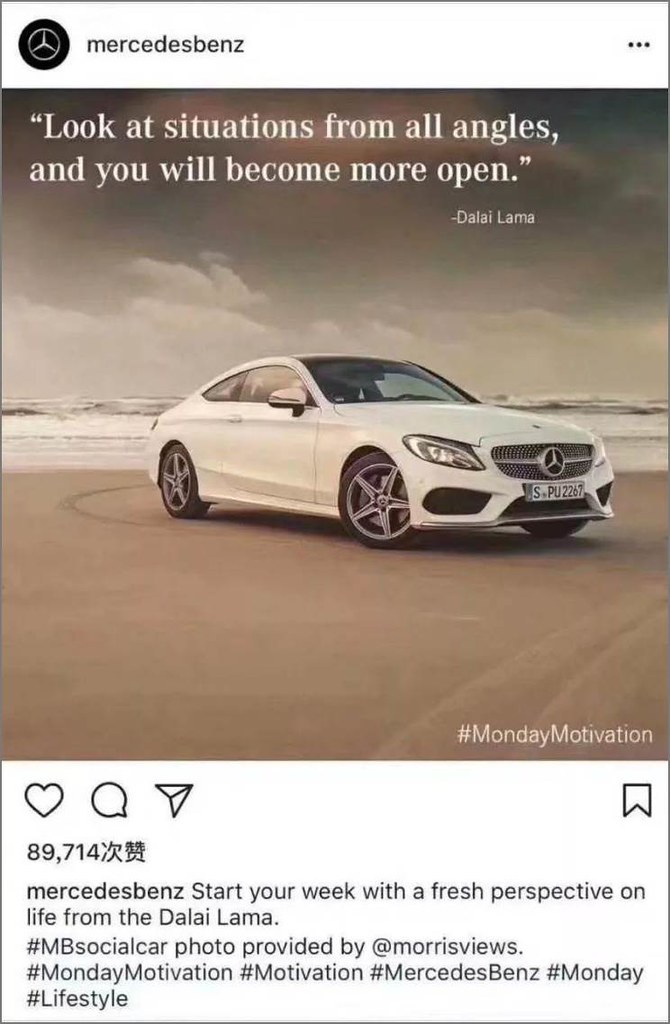
    mercedes benz

    When one looks at it from a brand marketing point-of-view two questions immediately pop up?

    1. Why were Mercedes doing filler motivational quotes in the first place?
    2. What does Chinese exceptionalism mean for brand marketers around the world?

    Motivational quotes

    Motivational quotes a tried and trusted tactic for social media marketers. But that doesn’t mean that they are any good. It really depends on what job the post is supposed to fill.

    I can’t imagine that it would have driven a lot of sharing (controversy nonwithstanding) or greatly expanded the reach of the Mercedes Instagram account.

    Motivational posts can performs really well if you are measured on engagement particularly in markets like the Philippines,Myanmar and Thailand. In the case of Myanmar, brand content serves as entertainment due to an under-developed media industry. Again I don’t know why the team would have been focusing on markets like this?

    Where they looking to tap a wider audience and position Mercedes as a brand that one would aspire to own? In developing markets where the urban middle class drive Toyota its a possibility if they were focusing on Mercedes as a luxury brand (S-class, SL-class, GT, GLS and G-class models certainly are).

    However those posts would be less likely to appeal to serious car buyers or petrol heads. Mercedes has a rich heritage in car-making and motorsport that it could have drawn upon instead.

    I imagine the problem comes down to the way goals were set for the Instagram account. They may have been lacking a clear view of who they wanted their audience to be. I don’t have any insider insight so that’s about the best that I offer.

    The Dalai Lama is a divisive figure. The Chinese view him as a ‘separatist’; whilst in the west he is respected as a religious leader and he comes across as an affable old man in media interviews. They view Tibet as an indivisible part of China.

    The quote was published within a day of American motor manufacturer Dodge being criticised for using the words of Martin Luther King in an advert. A curious social media operative should have looked at the Dodge debacle and thought ‘what does this mean for my brand’? It doesn’t seem to have occurred and that is on the social media team involved.

    Some times it is worthwhile going back to basics:

    • Treat others like you would like to be treated yourself
    • Don’t discuss politics or religion in polite conversation
    • Put three times as much effort into listening, as you do speaking

    Chinese exceptionalism

    China is an ascendancy, in the same way that a post war-era US saw the rise of US influence around the world. President Xi  echoes Chairman Mao’s China has stood up quote. His power hinges on two things:

    • The legitimacy of the party which is deeply linked to its ability lift Chinese people out of poverty.  From the Deng era onwards China has lifted over 650 million people out of poverty. It’s essentially the Chinese Dream. The ongoing crackdown on corruption in the party is linked to the legitimacy of the Chinese Dream: do what we ask and things will continue to get better in a step-wise manner. You maybe poor at the moment, but your life will continue to improve
    • Chinese nationalism: China going back out and taking its place on the world stage. Prior to the mass production of the industrial revolution; China accounted for roughly one third of the world’s total economic output. It slipped back as the industrial revolution took place in the west. Its current economic growth is seen by the party as China’s journey to regain its place

    This means that a constituency of the Chinese population and the party is extremely sensitive to perceived slights, whether they were intentional or not. Chinese sensitivity to the world accelerated since 1999 when the US air force managed to bomb the Chinese embassy in Belgrade by accident.

    I don’t think anyone believes that the Mercedes social media team thought about ways that they could offend the Chinese people – on a platform that is unavailable in China. It was negligence rather than malicious in nature.

    Timeline

    February 5: Mercedes posts a filler motivational post on Instagram with a quote from the Dalai Lama.

    Despite Instagram being blocked in China, Chinese netizens became enraged about the post.

    February 6: Mercedes apologises on its Weibo account. Chinese netizens are still angry and want the apology to also run on Instagram. Mercedes is between a rock-and-a-hard place. Pissed off Chinese netizens, or pissed off netizens from the rest of the world

    February 7:  A Chinese government spokesperson comments on the apology, with a statement that said in diplomatic language that it was prepared to get medieval on Mercedes Benz if necessary

    February 7: Senior management in Germany send a letter of apology to the Chinese ambassador in Germany.

    February 8: Second apology is reported on Xinhua. Xinhua is the Chinese government’s wire service think AFP or Reuters.

    February 9: People’s Daily – a government newspaper often considered a herald for the Party describes Mercedes as an ‘enemy of the Chinese people’

    February 13: Mercedes-Benz (China) Automotive Sales Co. will recall 1,886 imported S-class, C-class and GLC sport utility vehicles (SUVs) manufactured between July 2016 and December 2016, according to the statement. Its joint venture company Beijing Benz Automotive Co. will recall 18,893 C-class and GLC SUVs manufactured between October 2016 and February 2017. These recalls don’t seem to be mirrored in other countries, which is unusual for the 1,886 imported models – it might be a coincidence…

    The constituency

    The main critics of Mercedes seem to be particular faction of it young people with extreme nationalist tendencies called 愤青 fenqing (said fen-ching).

    They are a diverse group in terms of beliefs, but a simple view would be to think of the nationalism of Britain First supporters, but with Chinese sensibilities. They tend to come from lower tier cities and will have been less exposed to world beyond China.

    Their antics are curbed through censorship and further actions when it suits the Chinese government. It is rarely desirable to allow the fenqing enough space to run unchecked.

    When China was unhappy with South Korea; it chose not to curb protests and damage against Korean business Lotte by fenqing. Lotte owns the golf course on which the THAAD anti-ballastic missile system was placed to stop a North Korean nuclear attack on the South.  Chinese demonstrators closed Lotte stores throughout China, cause a huge amount of damage and forced Lotte to withdraw completely from the Chinese market. Those stores that weren’t picketed by protesters were closed down by Chinese local government department for (non-existent) fire code violations and fined over breached in advertising regulations. Chinese tourists boycotted Korea and Korean stores.

    They will have been supplemented by students living outside China whilst attending foreign universities.

    Context

    One has to consider Mercedes faux pas in context. It came on the back of apologies by Delta Airlines, Zara and Marriott Hotels when netizens realised that Taiwan and Hong Kong were treated as different countries on these websites.

    In Marriott’s case it was an loyalty programme research survey that caused the controversy.

    Posts like this one on Instagram have the comments section stuffed full of protests from overseas Chinese and their mainland brethren who have jumped the great firewall.

    The government forced Marriott to close its site and app in China. In addition Marriott’s social channel went dark AND the company made an apology aimed at a global audience.

    Their western social channels went dark for four days to a week depending on the channel. The implication in an article in China Daily the Chinese government ordered a shutdown GLOBALLY on Marriott’s social channels as part of the punishment.

    “To regain confidence and trust, the first thing is to admit the mistake, then fix it, and it would come back slowly as we prove we really mean what we say,” Smith told China Daily in Shanghai on Wednesday, one day before the company’s digital platforms are scheduled to be back online.

    What is conveniently forgotten is that the international websites of Chinese state-owned companies like Air China made similar mistakes.

    Why did Mercedes apologise?

    Chinese netizens weren’t going anywhere. They are angry and persistent.

    Implicit government pressure, here is a quote from a Chinese government press conference about it

    Q: According to reports, on Monday, Mercedes-Benz quoted the Dalai Lama in an English language post on Instagram. Yesterday, the company apologized and deleted the post. Was this at the behest of the Chinese authorities?

    A: I have seen relevant reports. To acknowledge your wrong and fix it is the simplest truth, universally accepted both in China and in other countries.

    I want to stress that over the forty-year course of reform and opening-up, the all-around cooperation between China and foreign enterprises has not only boosted China’s development, but also benefited the latter. As the 19th CPC Congress ushered in a new era for China’s endeavors in various causes, a China in the new era will be more open and more confident. We will continue to pursue cooperation with foreign companies, and we are also ready to share China’s development opportunities with them. However, it is needless to say that they must observe some basic rules.

    That’s diplomatic language for expect a beasting from the Chinese government and Chinese people for any perceived slights.

    Mercedes-Benz probably looked around at what its peers with major exposure to the Chinese market have done. Marriott being the most obvious analogue. Marriott’s capitulation to the Chinese government was complete and global – even at the risk of provoking the ire of Donald Trump supporting Americans. They were one Donald Trump tweet away from American First outrage over their capitulation to China, but it was a risk that they were prepared to take.

    It is worthwhile remembering that Boeing had a billion dollars wiped off its market value thanks to Donald Trump complaining on Twitter about the price of a new Air Force One plane. He has also shown an ability to mobilise his political base via social media.

    Conclusion

    The takeaway for many brand marketers in multinational firms, regardless of where in the world that they work is that they are the Chinese government’s pawn and they best get used to it. Chinese buying power has given the Chinese government the kind of exceptionalism that was previously only available to the US; then mostly because that was were many multinational companies were headquartered.

    One has to wonder how long western brands will survive by bending to the will of the Chinese government when it wants its homegrown brands to expand globally?

    Contrast Marriott and Mercedes’ behaviour with the rage-filled tone Huawei takes, particularly  in the US in the face of government criticism or negative partner actions.

    More information
    Use of Martin Luther King Jr. speech in advertisement causes controversy at Super Bowl | The Independent
    China inflicted a world of pain on South Korea in 2017 | Quartz
    China asked Marriott to shut down its website. The company complied | Washington Post
    Statement from Arne Sorenson, President and CEO, Marriott International, Inc.
    Marriott announces ‘rectification plan’ to regain trust | China Daily
    Doing business in China: Politics is still in command | HKEJ Insight
    Foreign Ministry Spokesperson Geng Shuang’s Regular Press Conference on February 7, 2018 – Chinese Ministry of Foreign Affairs
    Daimler apologizes to China for quoting Dalai Lama | Xinhua News
    Mercedes-Benz to recall 20,779 cars in China | Xinhua
    Donald Trump just took a shot at Boeing in Trump Tower | CNBC
    Huawei fed up, tells US critics ‘shut up’ | ZDNet
    The CEO of Huawei Totally Went Off Script at CES and Ripped U.S. Carriers After an AT&T Deal Fell Apart | Entrepreneur