Culture was the central point of my reason to start this blog. I thought that there was so much to explore in Asian culture to try and understand the future.
Initially my interest was focused very much on Japan and Hong Kong. It’s ironic that before the Japanese government’s ‘Cool Japan’ initiative there was much more content out there about what was happening in Japan. Great and really missed publications like the Japan Trends blog and Ping magazine.
Hong Kong’s film industry had past its peak in the mid 1990s, but was still doing interesting stuff and the city was a great place to synthesise both eastern and western ideas to make them its own. Hong Kong because its so densely populated has served as a laboratory of sorts for the mobile industry.
Way before there was Uber Eats or Food Panda, Hong Kongers would send their order over WhatsApp before going over to pay for and pick up their food. Even my local McDonalds used to have a WhatsApp number that they gave out to regular customers. All of this worked because Hong Kong was a higher trust society than the UK or China. In many respects in terms of trust, its more like Japan.
Korea quickly became a country of interest as I caught the ‘Korean wave’ or hallyu on its way up. I also have discussed Chinese culture and how it has synthesised other cultures.
More recently, aspect of Chinese culture that I have covered has taken a darker turn due to a number of factors.
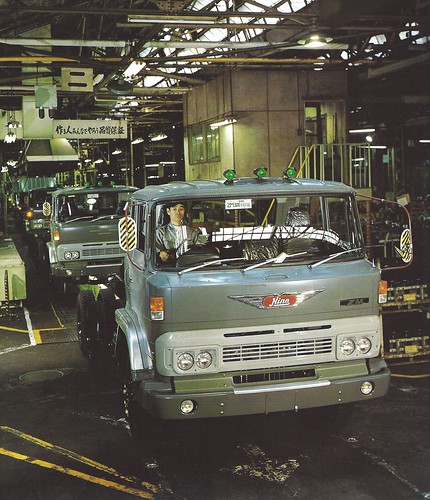
Hino Motors is a car and truck manufacturer best known for its iconic Hino trucks. It started its convoluted origin story spinning out of manufacturing company owned by Tokyo Gas.
Before there was Hino trucks, there were a small amount of half tracks and armoured personnel carriers made for the Imperial Japanese Army. After the war Hino got into the truck business and for a brief while also made cars. The pretty Hino Contessa coupé showed potential, but becoming part of the Toyota group saw Hino focus on commercial vehicles under its own name.
Hino trucks with their winged logo marked my childhood in Ireland. Hino trucks pulled palleted loads on taunt liner trailers, shipping containers and flat bed trailers of hay. The supermarket delivery wagons, the bakers lorry, skip deliveries, ready mix and the dairy picking up milk from my Uncle’s farm were all using Hino trucks. The distinctive unblinking three green lights on the roof of oncoming Hino trucks stood out of the total darkness of rural Irish roads.
I had Robert ‘Pino’ Harris to thank for making Ireland the Hino trucks capital of Europe at the time. And his Hino trucks success story is one of a singular focus on relationships and customer service.
Adidas ousts China chief as sales suffer after consumer boycott over Xinjiang | Financial Times – Allison Malmsten, sportswear analyst at China-focused consultancy Daxue Consulting, said that since the boycott, Nike and Adidas have ceded their top position on ecommerce apps such as Alibaba’s Tmall. In their place, local online retailers have promoted Li-Ning and Anta, making the “competition a lot stiffer”.Jonathan Cummings, Asia-Pacific president of brand consultancy Landor and Fitch, said that after years of market dominance, Adidas and Nike were being challenged by “cheaper domestic brands that have become stronger”.Adidas generated nearly a quarter of its sales in the Greater China region in the first half of last year, the bulk of which came from mainland China. – it will be interesting to see where adidas will try to go in China and whether they feel it is worth riling western customers to arrest their decline in China
The rising costs of China’s friendship with Russia | Financial Times – When the Russian invasion of Ukraine started two weeks ago, Jane Yan, a senior executive at a machine parts maker in eastern China, says she was not too worried about the impact. After all, buyers in Russia and Ukraine accounted for less than 5 per cent of the company’s overseas sales last year. But as the full ferocity of the Russian onslaught started to become apparent, the outlook shifted dramatically. Important clients in countries such as Poland and Germany cancelled orders with the Zhejiang-based company. “A Munich-based client said ‘it feels terribly wrong to send money to a country that is tolerating war in Ukraine — sorry’,” said Yan, who asked that her employer not be identified. She added that inquiries from European buyers have also fallen sharply since the conflict started. “I hope the war ends as soon as possible.” – I wonder how prevalent this consumer boycott actually is of Chinese products?
Culture
Why disco will never truly die — Quartz – interesting, but full of American privilege, but no love for producers like Giorgio Moroder, Luxxury, Dimitri from Paris, Late Night Tuff Guy or The Reflex
Ideas
How factory robots lead to human deaths – Futurity – “For decades, manufacturers in the United States have turned to automation to remain competitive in a global marketplace, but this technological innovation has reduced the number of quality jobs available to adults without a college degree—a group that has faced increased mortality in recent years,” says lead author Rourke O’Brien, assistant professor of sociology at Yale University.
“Our analysis shows that automation exacts a toll on the health of individuals both directly—by reducing employment, wages, and access to healthcare—as well as indirectly, by reducing the economic vitality of the broader community.”
Since 1980, mortality rates in the United States have diverged from those in other high-income countries. Today, Americans on average die three years sooner than their counterparts in other wealthy nations.
EACH NEW ROBOT PER 1,000 WORKERS LED TO ABOUT 8 ADDITIONAL DEATHS PER 100,000 MALES AGED 45 TO 54 AND NEARLY 4 ADDITIONAL DEATHS PER 100,000 FEMALES IN THE SAME AGE GROUP. Automation is a major source of the decline of US manufacturing jobs along with other factors, including competition with manufacturers in countries with lower labor costs, such as China and Mexico.
Previous research has shown that the adoption of industrial robots caused the loss of an estimated 420,000 to 750,000 jobs during the 1990s and 2000s, the majority of which were in manufacturing.
Can Intel out-design Apple in terms of chips? I think that is certainly possible, possibly even extremely likely
Can Intel compete with Apple on process? Possibly soon, if they managed to partner with Samsung or TSMC. Certainly in the longer term if Intel’s process engineers get their mojo back, or they continue to partner with TSMC or Samsung
Roundtable: A Brutally Honest Conversation on the Metaverse – Web 2.0 Is about the individual/the corporation, and Web 3.0 is about the collectivist statement, or the community / collectivist environment, in some ways. – interesting that there is a whole piece missing about web 1.0 being about personal and organisation publishing and communications. Web 2.0 being a web of data and creativity
3G graduation sees DoCoMo celebrating 3G wireless services and how they fitted into consumers lives. While DoCoMo has its service running for another couple of years, rival Au has shut down its 3G network this year. The ‘Graduation’ in 3G graduation is used in a similar way to how US technology companies use ‘sunset’ as a euphemism for shutting down a service.
In sectors outside technology like the 3G graduation film, the term graduation is signify an artist leaving an idol group. Japanese Idol groups like AKB48 and Morning Musume mirror the interchangeable team nature of Puerto Rican boy bandma Menudo. Like Japanese idol groups, Menudo appeared in adverts for big brands like Pepsi and McDonalds across Latin and South America (including Portuguese speaking Brazil). They even appeared in a Pepsi ad that ran in the Philippines. They also did two TV specials. Japanese idol groups contain pop stars with the following characteristics:
a type of entertainer marketed for image, attractiveness, and personality in Japanese pop culture. Idols are primarily singers with training in acting, dancing, and modeling. Idols are commercialized through merchandise and endorsements by talent agencies, while maintaining a parasocial relationship with a financially loyal consumer fan base.
When members leave the group due to contract violations, ageing out, or wanting to build a career of their own, they ‘graduate’. Like the 3G graduation film idols share an association with school imagery.
https://youtu.be/dKxjw3YntBk
Kit-Kat anime advert
Nestlé Kit-Kats are popular in Japan. They are especially popular during exam time. The reason for this is that the Japanese pronunciation of KitKat, “Kitto Katto,” sounds similar to the phrase “Kitto katsu,” which means “I believe you will win/you can do it.” The homophone nature of Kitto Katto meant that Kit-Kats became a good luck charm, with people having them or giving them as gifts for big days such as school entrance exams or even job interviews.
This explains why this anime advert directed by Naoko Yamada is around the theme of “Kikkake wa Kit Kat de,” or “Kit-Kat Creates the Chance,” and has a school related setting.
This is apparently the first of what promises to be a series of adverts being done by Yamada for Kit-Kat.
Modern car mechanical design
For someone who hasn’t bought a car in 25 years, hearing about how unreliable BMWS and Mercedes cars have become is a bit of a shock. I have driven hire cars and am aware that cars are now heavily reliant on computers. What I hadn’t realised was how cheap mechanical parts had become under the hood. The reason why they had been engineered down to a price, was to allow for the price of all the new electronics that make up the car driving experience now.
I started my work life off in a corporate research lab were we were developing a way of making a plastic manifold cover for a small Ford of Europe engine. This engine was destined for the Ford Fiesta and the first Ka if we had managed to get everything to work. The idea was that the engine would be a sealed unit. When it needed to be replaced it would undergo a factory recondition, or would be recycled. This was about reducing environmental impact, without impacting profits. But looking at some of the parts going into these cars now, I am shocked.
More in this video here.
Amazon luxury watch copies
Amazon is a den of iniquity in terms of shoddy products and fakes. German watch YouTuber shows the variety of watches that steal the design language of watches from the likes of:
Nomos
TAG Heuer
Breitling
Rolex
Audemars Piguet
Patek Philippe
All of these come in at about $100 price. It is interesting how the Chinese factories turning these watches out have managed to get their way around the brand police. Finally, I am surprised to see Chinese manufacturers relying on a cheap, but reliable Seiko movement for the most part. Which is probably down to the weird deficiencies in Chinese engineering that means that you don’t see Chinese made rollerball pen refills.
The amazing design of the jerry can
Great video by a Scottish YouTuber who covers why the jerry can was such a clever product design and the history of the fuel container. I did not realise that they were tested in the Spanish civil war. More here.
NFTs and Ralph Bakshi’s animated adaptation of The Lord of The Rings
The problems with NFTs. NFTs sprung out of the move to decentralised finance or cryptocurrency. NFT are smart contract linked artefacts. These were seen as a panacea for creatives to make money during COVID. This video is an interesting discussion on NFTs, and uses the analogy of investors buying real estate that drove the 2008 mortgage crisis. The crypto-economy has many of the same drivers.
The guy who made this video also did a really good exhaustive history of Ralph Bakshi‘s The Lord of The Rings film that preceded Peter Jackson’s The Lord of the Rings trilogy by a couple of decades, and the BBC’s radio adaptation by a few years. I am a fan of all three, but am in no doubt that Peter Jackson’s film in some places is a shot-for-shot copy of Bakshi’s film and borrows dialogue from both Bakshi and the BBC.
Sony and Honda reveal plans to jointly make and sell electric vehicles | TechCrunch – this might also explain why Sony’s ‘concept’ car seemed to have a lot of money put into it, to make it look like a finished product a couple of years ago. Sony and Honda’s EV venture is a lesson for corporate Japan | Financial Times – the FT makes a number of good points about the relatively junior role that Honda is taking in the endeavour and that Sony making a decision to go independent indicates that consolidation of vendors in the electrical vehicle space is far off. I expect that the Sony and Honda deal in this respect is partly the pressures driven by the amount of ‘dumb capital’ chasing electric and automotive vehicles.
Sony and Honda likely see their deal as an antidote to that pressure. There were also fair comments made about relative software expertise between Sony and Honda, however I would argue that there is still a need for stable underpinnings of the software from the likes of QNX. But in the critique of the previous motor industry partnerships isn’t fair. For instance, Yamaha has a long history of taking concepts and designs to Toyota for them to build them. The most iconic of which was the Toyota 2000GT. So in many respects Sony and Honda are working on similar heritage to others.
It is interesting that we haven’t seen a similar pairing to Sony and Honda between Samsung and Renault, given their Korean car assembly joint venture. It is also interesting that Apple has failed to secure a similar partnership to Sony and Honda in its car efforts so far.
China’s Two Traps by Keun Lee – Project Syndicate – China’s economic slowdown suggests, the next phase of its development is rife with challenges. The country risks being ensnared by two traps: the “middle-income trap” (the tendency of fast-growing developing economies to lose momentum once they reach middle-income status) and the Thucydides Trap (when tensions between an insecure incumbent hegemon and a rising power lead to conflict)
Why are Chinese students so keen on the UK? – BBC News – The initial attraction of Glasgow – as well as its solid academic reputation – to many was how the Victorian university buildings looked on the brochures, rather like Hogwarts from the Harry Potter films
How China’s Ambitious Belt and Road Plans for East Africa Came Apart – The Diplomat – Chinese actors typically approach BRI deals with two contradictory assumptions: First, the political leadership with whom they are dealing is either too weak or too venal to challenge contract terms that decidedly favor China; and, second, these same leaders will be strong enough to fend off resistance to ambitious infrastructure projects by opposition politicians and civil society groups while also mobilizing the financial resources necessary to sustain expensive, long term projects. – they expect the kind of smooth running process that they would have in China, but not surprisingly don’t get it
Chinese lenders squeeze African borrowers even harder | Financial Times – Chinese lenders are imposing even more stringent collateral requirements on low-income country borrowers than previously known as they seek to hedge risks from their extensive overseas development finance programme. Under a $200mn loan from China Eximbank for the expansion and modernisation of Entebbe airport, the Ugandan government is required to channel all revenue from the country’s only international airport into an escrow account, according to the contract obtained by AidData, a US-based research lab. The document highlights a long-running controversy over the loan to Uganda’s government, which damaged its relationship with the bank. And more here: China cobalt mine deal was ‘injustice’: my country did not get anything, ex-DRC leader says | South China Morning Post
Hong Kong
Chinese fitness app Keep files for Hong Kong IPO · TechNode – interesting that this is going ahead given the kind of data that Keep would have. One only needs to look at the opsec failures that Strava revealed of American forces in the Middle East and Afghanistan
The war in Ukraine is going to change geopolitics profoundly | The Economist – Japan, Singapore, South Korea and Taiwan joined in sanctions against Russia, as did Australia. The change of mood in Japan has been particularly striking. Over the past decades it has tirelessly wooed Russia, in part to counterbalance China but also in the hope of settling the problem of four northern islands seized by the Soviet Union. Abe Shinzo, the former prime minister, met Mr Putin 27 times, including a trip to an onsen bathhouse. Now, under Kishida Fumio, Japan has frozen the share of Russia’s central bank reserves held in the country and is urging fence-sitters to take a clearer stance against its former pal. The end of the cold war was never going to usher in perpetual peace. But the Ukraine crisis is giving new form to the possibilities for future conflict and ways in which it may be averted. It is raising the previously outré possibility of territory being stripped from a developed country by force. By bringing Russia and China closer together, it is putting a new burden on the system of American alliances that partially encircles them. It has started consolidating Europe’s belief in itself and its ideals, and may increase its willingness to fight for them; it may also be seeing Germany and Japan, a lifetime after their defeat in the second world war, taking on new martial roles – the military rise of Japan will be worrying for China
Ukraine conflict risks uncontrollable escalation of cyberwarfare – Nikkei Asia – When and if Russia, or some other advanced-hacking state, pulls these tricks against a better-prepared adversary, resulting in a tit-for-tat escalation that could quickly spin out of control. Given the historical weakness of digital security in much of the U.S.’s civilian infrastructure, notably the electric utilities and grid, we can imagine a situation in which Russia or China, or some other entity causes not just inconvenience but casualties, including deaths. What would the U.S. do then? If Russia took down electricity from Boston to Washington, New York to Chicago, the American people would get very, very angry. What would an American government do next? The U.S. has said, with strategic vagueness, that an attack on critical infrastructure, including digital infrastructure, could ultimately trigger a military response. Then what? In 1962, futurist Herman Kahn published “Thinking the Unthinkable,” pondering nuclear-war scenarios in ways that few of the people who had control over those civilization-killing weapons had ever considered. No one wanted to prevent nuclear war more than Kahn, in part because he understood what it would mean. We do not believe that nearly enough thinking about cyber-unthinkables is taking place today, nor the escalation scenarios that would bring them on.
Chinese telecoms giant Huawei has been helping Putin’s efforts to stabilise Russia’s internet | Daily Mail Online – Huawei, which reportedly has five research centres in Russia, is said to have ‘rushed to Russia’s aid’ to support its internet network in the face of the attacks. A report, which appeared on a Chinese news site but was later deleted, claimed that Huawei would use its research centres to train ‘50,000 technical experts in Russia’. – The Mail on Sunday is now covering the kind of stories that previously only featured on the English language pages of late lamented Apple Daily Online published out of Hong Kong.
Arm China CEO asserts semiconductor joint venture’s right to pursue an IPO independent from its SoftBank-owned British parent | South China Morning Post – “Arm has written to Chinese authorities that Arm China won’t survive without [the British firm’s] support,” Wu said. He indicated, however, that Arm China has already developed the capability to continue its operations separately from Arm in the UK. The stand taken by Wu in Arm China forms part of a larger effort by the country’s semiconductor industry to overcome US trade sanctions and build a world-class chip supply chain. The dispute with Arm has not slowed down its Chinese joint venture’s business under Wu. Last year, Arm China generated US$700 million in total revenue, including intellectual property licensing and royalty fees. Arm’s share in its China venture was about US$500 million last year, according to Wu. “Arm can’t afford to lose its share of revenue from the Chinese market,” Wu said. He indicated that the Chinese joint venture has hit all its goals – including revenue, net profit, and research and development spending – which were set five years ago. Wu said Arm China’s biggest contribution to the Chinese chip design industry was to open the company’s source codes to domestic customers, “giving them freedom to develop their chips and raise their capabilities to a global level”. He also said he was displeased by Arm’s decision in May 2019 to cease business with Huawei Technologies Co, following Washington’s decision to add the Shenzhen-based telecommunications equipment maker to the US trade blacklist. – I suspect Mr Wu is working on behalf of the Chinese government in ‘war by other means’
Political polarisation between Democrats and Republicans
Political polarisation has been talked about for years. The schism in UK society caused by Brexit has been exhaustively examined including sometimes on this blog. This video is based on research by PRRI, you can see more about the research here. There are a number of outtakes in the data including the different party supporters relative openness to diversity and by implication societal change which was covered by Vox a couple of years ago. Republicans were reluctant to have a trans person in their family. Scott Galloway highlights that prejudice isn’t only about colour or gender identity.
We’re seeing Democrat supporters who believe that their personal identity is intrinsically entwined with their political opinions. They believe that a confrontation with your opinion is the same as a confrontation with your identity. All of which implies an underlying brittleness and lack of resilience to their prejudice rather than ignorance.
When Shinto became a religion
Really interesting video on the history and nature of Shinto, the Japanese belief system.
Artist creates personas for Singapore
I loved this project design that uses iconic every day items to reflect what Singapore might look like as a person. In many respects the items selected also reminded me of everyday live in Hong Kong. Which I guess goes to show that we have more in common than things that separate use.
Pets.com
I was looking at vintage ads as part of a wider internal project at work on Super Bowl advertising. During that time I delved into Pets.com content. One of the things I found was some outtakes that TBWA\Chiat\Day shot for use by San Francisco interactive agency Lot21. (Interactive agency ages this to the late 1990s, back to when the agency wanted to do both CD-ROM type experiences and websites in their agency in case this web thing turned out to be a fad.)
This content was designed to be held on the Pets.com puppet profile page, think a Geocities type page or author profile page on Blogspot or Live Journal. It all feels like the kind of things that brand teams would so for social platforms now.
Koyaanisqatsi
Philip Glass’ soundtrack for movie Koyaanisqatsi gets the 8-bit treatment with a remake by Shiryu. Shiryu calls it a remix, but really its a cover version.
Product design is pain
Mike Glover talks about how he and his colleagues problem solved to come up with the specification for the modern Opscore military helmet. Its an interesting story from a product design point of view.
You can hear about how they modified their old equipment and these alterations were then parleyed into the current industrial design by the manufacturer.
Ghost ships tankering black market oil to and from sanctioned countries around the world
Tanker companies warn of rise in armada of ghost ships | Financial Times – older ships are being bought and then used for sanctions running as these ghost ships. Ghost ships have safety implications due to their age. Given that these ghost ships are operated on the down low, they won’t have the same maintenance and you don’t know how their sailors are treated. What’s also interesting is the economic data implied by the ghost ships. Looking at this article black market oil (excluding pirate ships stolen in places like the Straits of Malacca) shipped by the ghost ships fleet is running at about 10 percent of all oil consumed worldwide. The fleet of ghost ships must have suddenly increased if the supply of ships being sent to be scrapped has dropped in the way it has. How have the operators of ghost ships managed to short circuit the ship breaking business? How are the ghost ships avoiding the world’s largest navies and surveillance networks? Will the number of ghost ships continue to grow?
Here’s a picture of Chinese tanker vessel, just to give you an appreciation of how big each of the ghost ships must be.
China’s Self-Defeating Economic Statecraft | Foreign Affairs – Observers routinely worry that by throwing around its ever-growing economic weight, the country is managing to buy goodwill and influence. During the COVID-19 pandemic, Beijing has exploited its dominance of manufacturing supply chains to win favor by donating masks and now vaccines to foreign countries. And it has long used unfair state subsidies to tilt the playing field in favor of Chinese companies. – the lesson that China seems to take away is that bullying works. Until China sees that bullying doesn’t work it won’t listen
Enemies of My Enemy | Foreign Affairs – The strongest orders in modern history—from Westphalia in the seventeenth century to the liberal international order in the twentieth—were not inclusive organizations working for the greater good of humanity. Rather, they were alliances built by great powers to wage security competition against their main rivals. Fear and loathing of a shared enemy, not enlightened calls to make the world a better place, brought these orders together. Progress on transnational issues, when achieved, emerged largely as a byproduct of hardheaded security cooperation. That cooperation usually lasted only as long as a common threat remained both present and manageable. When that threat dissipated or grew too large, the orders collapsed. Today, the liberal order is fraying for many reasons, but the underlying cause is that the threat it was originally designed to defeat—Soviet communism—disappeared three decades ago. None of the proposed replacements to the current order have stuck because there hasn’t been a threat scary or vivid enough to compel sustained cooperation among the key players – until now China’s belligerence in East Asia and wider
‘Lying flat’: Why some Chinese are putting work second – BBC News – there are young rural migrants in Beijing or Shanghai, who now realise “how far behind they are, in terms of being able to make enough money to buy a house, or compete with the city kids who grew up speaking English and wearing sophisticated clothing”. Dr Johnston explains some of this group may now be thinking of returning to their home towns and taking lower-paid jobs instead to be with their families. On the other side, there are the children of richer, successful parents who are not “as hungry as the super-achieving kids from poorer families”. Dr Johnston thinks China’s so-called “tiger” culture is an added barrier, where parents feel under intense pressure to help their child achieve, that school on its own is not enough
The Pandemic Changed Youth Culture in the Asia Pacific – What Does that Mean for Brands? – “proactively making fundamental life changes to shape a new future in a post-pandemic world which will never be the same again,” says Vice Media. ‘The Next Chapter – Re-Emergence’ is the latest from VICE Media Group’s ongoing series of youth culture tracking studies which monitors behavioural change to forecast the future of culture. The online quantitative study of 1,740 Gen Z and Millenials was conducted via VICE, Refinery29, i-D websites and social channels in Australia, India, China, Japan, Korea, Singapore, Indonesia, Malaysia, Philippines, Thailand and Vietnam. – it looks like they expect to change how they work. If that means greater balance it might go down badly with Chinese and Vietnamese authorities who would be concerned that this looked like ‘lying down’
Pandemic triggers exodus of older people from UK workforce | Financial Times – interesting that businesses aren’t adapting to these new dynamics in the workforce, much of what is in the article is also echoes in this US IBM case. IBM Execs Call Older Workers ‘Dinobabies’ in Age Bias Lawsuit – Internal emails show IBM executives calling older workers “dinobabies” and discussing plans to make them “an extinct species,” according to a Friday filing in an ongoing age discrimination lawsuit against the company. The documents were submitted as evidence of IBM’s efforts “to oust older employees from its workforce,” and replace them with millennial workers, the plaintiff alleged. It’s the latest development in a legal battle that first began in 2018, when former employees sued IBM after the company fired tens of thousands of workers over 40-years-old. One high-ranking executive, whose name was redacted from the lawsuit, said IBM had a “dated maternal workforce.” “This is what must change,” the email continues, per the filing. “They really don’t understand social or engagement. Not digital natives. A real threat for us.”
Which London-listed Russian firms could be hit by sanctions? | Russia | The Guardian – Under the most extreme scenario, companies operating in the UK, US or EU – including most of the world’s major financial institutions – could be forbidden from any transactions with sanctioned entities. That could mean the indefinite suspension of their shares, and an inability to issue new debt or shares in London. Asked whether the UK was likely to impose sanctions that would damage the interests of big British companies, Bernardine Adkins, a partner at the London law firm Gowling WLG, said: “I’ll believe it when I see it.” “The modern way of sanctions tends to be very focused, and they’re not sweeping to hurt the economy,” she added.
Norton Rose directs Hong Kong office to make China pivot | Financial Times – Norton Rose, whose biggest clients include HSBC and AIG, is the latest international business to reconsider its Hong Kong strategy. Both the Mandarin Oriental hotel group and Pernod Ricard have asked executives to move temporarily out of Hong Kong in response to strict pandemic restrictions. Bank of America is reviewing whether to relocate some of its staff to Singapore. The head of a large recruitment consultancy in Hong Kong said similar changes were happening at other global companies. “As expats retire they are most likely to be replaced by Mandarin-speaking people,” he said. “The old set-up of having a local team who speak Mandarin doing the deal, but the guy at the top is white, that will change across the board.” – Hong Kong refocusing on being just another city in China – Chinese banks’ Hong Kong ranks on track to outnumber global rivals | Financial Times
Next China: Hong Kong Elections Uncertain as Covid Crisis Spirals – Bloomberg – there was little surprise this week when Tam Yiu-chung, Hong Kong’s sole representative member of China’s top legislative body, suggested postponing the election. His logic was simple: Some of those who might run will be too busy dealing with the outbreak to campaign. If more voices begin jumping in with the same line, a delay could very quickly become fait accompli. – way before COVID got out of control there were no candidates putting themselves out there. Even self publicist CY Leung hadn’t throw his hat in the ring
Why Are Luxury Labels Cheaper Online? – The Chosun Ilbo (English Edition): Daily News from Korea – Business > Business – According to Statistics Korea, purchases through overseas online retailers last year surpassed W5 trillion for the first time ever and surged 26.4 percent compared to 2020. Clothing and accessories accounted for W2 trillion of the total. The Korea Consumer Agency said a survey last year showed consumers here believe products are around 25 percent cheaper from foreign online retailers than in Korea. Yet importers insist they have no choice but to slap huge margins on goods due to high operating costs as well as tariffs and delivery fees. One staffer with a major importer said, “Department stores charge 20 to 30 percent in fees to sell our products, plus we have to cover advertising and store overheads.” But industry insiders say big businesses and department stores in Korea compete fiercely for exclusive import deals with foreign luxury brands, which ends up costing them a lot of money. They end up agreeing to unrealistic volumes and expensive advertising to bring in popular luxury brands and pass the cost on to the customer. Another reason is simply that demand seems insatiable, so people will pay whatever is asked. The head of a foreign luxury brand’s Korean branch said, “The market is changing in Korea and China where the more expensive products are, the higher the demand is. For instance, handbags must cost at least W9 million and coats more than W4 million to be considered a ‘luxury’ product. That means lower-tier brand prices are also rising.”
Musicians like Neil Young lack the market power to force Spotify’s hand over Joe Rogan – It’s a simple case of gigantic supply and relatively limited distribution. As the world turns to music streaming, only a handful of global players led by Spotify, Apple and Amazon control the market. Five companies represent 80% of the global streaming opportunity. Now, turn that around and think about it from an artist’s point of view. Spotify currently has 70 million songs and adds an additional 60,000 each and every day. These stupendous numbers have two implications. First, even when an artist like Young pulls his music from the service there are literally millions of potential replacements to fill the gap in a listener’s playlist. Second, artists cannot fuck with any of the big distributors of their music, because losing access to 31% of the market is the difference between success and failure for many of the record companies that run these artists
Foreign money funding ‘extremism’ in Canada, says hacker | Canada | The Guardian – A hacker who leaked the names and locations of more than 90,000 people who donated money to the Canadian trucker convoy protest has said it exposed how money from abroad had funded “extremism” in the country. In an exclusive interview, the hacker told the Guardian that Canada was “not safe from foreign political manipulation”. “You see a huge amount of money that isn’t even coming from Canada – that’s plain as day,” said the hacker, who belongs to the hacktivist group Anonymous. The leaked data showed that more than 90,000 donations were made via GiveSendGo, with most funds appearing to come from Canada and the US. According to the data, individuals in countries including the UK, the Netherlands, Ireland and Denmark also donated. Amarnath Amarasingam, a professor at Canada’s Queens University and an expert in extremism and social movements, tweeted that of the 92,844 donations, “51,666 (56%) came from the US, 36,202 (29%) came from Canada, and 1,831 (2%) came from the UK.” US-based donations totalled US$3.62m, while Canadians donated US$4.31m, he added.
Want to buy an Ineos Grenadier? Here’s how | CAR Magazine – In some very rural parts of the UK, for example, we will partner with companies whose franchises are agricultural franchises – JCB, Massey Ferguson, those kind of franchises. They are next to auction centres and livestock centres. Their neighbours are NFU regional offices, that kind of thing. Because that is where the customers go and they live and they work.