FMCG or fast moving consumer goods sprang out of the mass industrialisation. Brands sprang up originally as a guarantee of quality. Later on as these brands needed to be promoted, we saw the foundation of the what we think of as modern marketing and advertising.
Today media and entertainment takes up an increasing amount of the household spend, as does housing, but FMCGs are a crucial part of their essential and disposable income spend.
They have nostalgia wrapped up in them, distinctive aromas, taste and packaging designs. From the smell of my Granny using so much Pledge on the TV that I was surprised it didn’t burst into flame to the taste of Cidona and texture of Boland’s Fig Roll biscuits in my mouth.
The sound of their advertising jingles was the soundtrack of my childhood. Digital advertising is largely rationale, it lacks the fluent devices that provide the centre to advertising and made FMCG advertising iconic. Fluent devices like the Peperami ‘Animal’, the M&M characters or the Cadbury Smash robots were embedded in deep marketing research. FMCG brands still sponsor the best research in marketing science.
I had the good fortune to work inhouse at Unilever and agency-side for their brands. I also managed to work on Coca-Cola and Colgate during my time in Hong Kong.
Microsoft Executive: Netbooks Risk Cannibalizing Windows – netbooks are considered to be part of a wider consumer trend on downshifting technology. Consequently netbooks affects a business that relies on the consumer believing that continual innovation is a good thing. ASUS’ iconic eeePC netbooks even ran a Linux desktop application. Netbooks were a realisation that a lot of people use the web to check their email and create basic content. I don’t think that Google’s thin client Chromebooks are the antidote to netbooks either due to patchy networks.
ElfYourself by OfficeMax – Powered by JibJab – viral from OfficeMax for Xmas 2008. Interesting the way they went with the same concept. This isn’t as sophisticated (from a technical perspective) as their previous viral
New York Times Finds Success with Facebook Campaign – ClickZ – reading this is a bit meta: media company which makes its money by advertising, uses Facebook advertising to successfully market itself (presumably offsetting the amount it spent in acquiring traffic by advertising on Facebook with selling advertising on its own site)
UK media set for thousands more job cuts-analysts By Kate Holton LONDON (Reuters) – British media companies could cut tens of thousands more jobs in the coming years as the economic downturn hits an industry already ravaged by the Internet revolution. British newspaper groups and broadcasters have…
James Earl Jones has one of the most distinctive voices in the entertainment industry as you can hear in this Sesame Street clip. You might recognise from his appearance in Conan the Barbarian film, but James Earl Jones has a surprising variety in his career across film, television and stage performance. James Earl Jones has done voiceover work for everything from Disney’s The Lion King to CNN station idents.
Hollow Spy Coins – talk about niche businesses, this is definitely on the long tail. You have to admire their dedication to engineering this.
Economics
Boomtown of Dubai feels effects of global crisis – International Herald Tribune – Until recently, credit in Dubai was growing by 49 percent a year, according to the Emirates’ Central Bank — a rate almost double that of bank deposits’ growth. That unnerved some bankers here, who felt it could lead to a collapse. “In the U.S., the challenge is about keeping the banks going,” said Marios Maratheftis, chief economist for Standard Chartered Bank. “Here, the economy has been overheated, a correction is needed, and it’s about making sure the slowdown happens in a smooth, orderly manner.”
Klein Verzet: Freaking doomed – the premise is that the demand for shipping of raw materials like coal, bauxite and iron ore have ground to a stand still and soon even the factories of China will be a lot quieter – so the economic outlook is nothing short of ammegeddon
P&G to launch washing gel that cleans at 15 degrees – Brand Republic News – Brand Republic – “According to P&G, Ariel’s Cool Clean campaign encouraged more than five times as many customers than normal to switch to low-energy washing programmes, with Ariel customers twice as likely as the average consumer to wash at a lower 30 degrees temperature (28% of Ariel customers in 2007 versus 13% of those using other brands). P&G has a partnership with the Energy Saving Trust, which encourages people to use energy efficiently and reduce their carbon footprints.”
I, Cringely . The Pulpit . Data Debasement | PBS – cloud computing versus DBMS, interesting reading, I need to go back and look at it a few more times to understand it fully. But initial take is that parallel computing as well as parallel processing changes how computing works and databases have to be adapted (like Oracle’s Grid database concept from the tail end of the dot com era and cloud computing. It’s the failings of Moore’s law rather than progress that is driving this change
Cloud computing is a trap, warns GNU founder Richard Stallman – while I have sympathy for some of what Mr Stallman says, his argument misses the point about the benefits of social software. Open formats and APIs allow you to move from one service to another as needs must.
I, Cringely . The Pulpit . Collateral Damage | PBS – interesting take on the mobile market, not one that I necessarily agree with, but interesting none the less. Cringely expect that Microsoft Windows Mobile software will fail and has some interesting ideas around the why. I think Microsoft has everything to play for with enterprise users and can leverage items like security authentication and Outlook email access – they might not be dominant but they could still be in with a shout
Beginning of end of megapixel marathon – Pixel count gives phones and cameras the ‘Dixons Factor’ – being able to be sold easily by some pimple-faced oik; but doesn’t mean you will have better quality pictures. I have a digital SLR which takes pictures at 5.1 megapixels and a phone camera that will do the same – no prize for which one takes the better pictures.
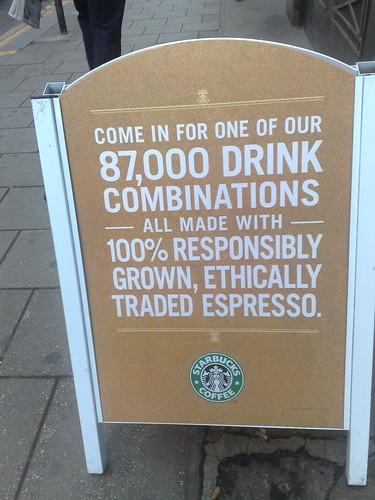
I saw this notice talking about 87000 possible combinations and was reminded of the car industry. Back in the 1990s, I remember being told that car maker Volvo had over 30,000 combinations of vehicles available as passenger cars. This included: body shell variants, diesel and petrol engines of different sizes and power, manual or automatic transmissions, interior design options, in car entertainment options, safety features, paint jobs, body accoutrements. Since then Volvo has hinted at electric vehicles and now has at least two models of SUVs.
While I don’t doubt the statistical capability of Starbucks marketing department, I was surprised to see that the coffee shop could serve up 87000 possible combinations of drinks based on relatively few options. This could be even larger in Starbucks other markets like Hong Kong or Japan, where there are more beverage varieties like Milk Tea or Matcha lattes, and more seasonal variation such as sakura season and mid-autumn festival alongside the usual Starbucks products.
All of which brings home the impact of mass-customisation to a business. How would the Starbucks EPOS (electronic point of sales) system handle 87000 possible combinations? How does this impact the training of their baristas? Is there an operational model like a decision tree for these coffee options?
I wonder is there a Starbucks long tail? What is the split between cold coffee drinks and hot drinks? Has this long tail altered itself over time, as the popularity of flat white drinks have taken off due to the influence of Australian coffee culture? How does the long tail affect the relative prioritisation that Starbucks might put on the different ingredients that go into their drinks? Mass customisation has gone mainstream. What does this degree of customisation mean for other service and retail businesses? How does this compare to what is seen in personalised products like NikeID or MyAdidas?
FT.com – Vodafone slams curb on rates – The curb on rates is complex. I agree with Vodafone that consumers would not like to pay to receive calls as well as paying to make them – this would bring the UK more in line with the US experience. However, I can understand why a curb on charges is proposed. The curb in charges is inspired by roaming charges that are expensive and the stuff of modern-day horror stories. The curb on charges will be implemented More related content here.
Yahoo Bleeds Purple. And You Thought Microsoft’s Marketing Campaign Was Weird – not sure that as a consumer I would be clear about what the call to action is, but some of the elements in this are quite nice. For sneaker freaker completists; you may want to catch on to a set of limited edition Yahoo! vs Pony in a purple and white colorway. Without giving too much away I have spoken to people in the know and it will all make sense over the next couple of months. Keep an eye on Yahoo! UK for some changes sooner, rather than later
Urban Tours – interesting way for Blackberry to try and differentiate itself from the ubiquitous mapping applications now on smartphones. It also breaks out of the Brooks Brothers-clad Crackberry image
Japanese Women Shy From Dual Mommy Role – washingtonpost.com – “The stakes are high here in the world’s second-largest economy, which now has the world’s highest proportion of people over 65 and lowest proportion of children under 15. According to a recent forecast, population loss will strip Japan of 70 percent of its workforce by 2050.”