Category: gadget | 小工具 | 가제트 | ガジェット

What constitutes a gadget? The dictionary definition would be a small mechanical or electronic device or tool, especially an ingenious or novel one.

When I started writing this blog the gadget section focused on personal digital assistants such as the Palm PDA and Sony’s Clie devices. Or the Anoto digital pen that allowed you to record digitally what had been written on a specially marked out paper page, giving the best of both experiences.

Some of the ideas I shared weren’t so small like a Panasonic sleeping room for sleep starved, but well heeled Japanese.

When cutting edge technology failed me, I periodically went back to older technology such as the Nokia 8850 cellphone or my love of the Nokia E90 Communicator.

I also started looking back to discontinued products like the Sony Walkman WM-D6C Pro, one of the best cassette decks ever made of any size. I knew people who used it in their hi-fi systems as well as for portable audio.

Some of the technology that I looked at were products that marked a particular point in my life such as my college days with the Apple StyleWriter II. While my college peers were worried about getting on laser printers to submit assignments, I had a stack of cartridges cotton buds and isopropyl alcohol to deal with any non catastrophic printer issues and so could print during the evening in the comfort of my lodgings.

Alongside the demise in prominence of the gadget, there has been a rise in the trend of everyday carry or EDC.

  • WWDC 2015: you know the Apple news, but what does it mean?

    I watched the introductory keynote to Apple’s Worldwide Developer Conference (WWDC 2015) with my colleague Ed. The overall take was one of ‘is that it?’. Though it is worthwhile acknowledging that even Apple can’t do miracles all the time.

    I thought that it was worthwhile picking through the announcements at WWDC 2015 to see what they mean.

    With OS X, it was like some of Apple’s earlier releases like 10.2 ‘Jaguar’ which was a discernible step up in performance and stability in comparison to 10.1 ‘Puma’ or 10.6 Snow Leopard in comparison to 10.5 Leopard. It gives Apple an opportunity bed in the flat design of Yosemite, make third party application development easier and improve performance across the OS. (As an agency person, the idea of more powerful integrated development tools that would provide a better performing user experience on iOS and OS X was interesting). The name El Capitan implies a a derivative relationship to Yosemite. (Yosemite is the national park and El Capitan is a granite monolith at the north end of the park).

    There has been tightening up of the interface design, which Apple’s own news releases allude to:

    Mission Control®, the quickest way to view all open windows, has a cleaner design so you can find the window you need even faster.

    Apple has also looked at improving internationalisation of the operating system with new Japanese and Chinese system fonts and improved keyboards. Announcements at WWDC 2015 kept building on Apple’s increasing focus on markets outside the traditional western ones. This is a trend that I expect to see continue over time with additional focus on Korean, Indian and southeast Asian markets

    Part of the improvements in services like Spotlight were part of the ongoing war of attrition with Google. Pinned sites and performance improvements in Safari where aimed at Google Chrome.

    At each step of the announcements Apple was at pains to emphasise its efforts in providing users with privacy. Apple genuinely believes that privacy is a point of differentiation, not just amongst developers, but also amongst consumers living in a post-Snowden world.

    Preparing for a programmable world

    The services put into OS X (and across iOS) try to be smarter and anticipate the needs of a user. Natural language search in Spotlight has similar aspirations to the kind of experience Facebook aimed for when it launched its Graph Search functionality in 2013.

    These are baby steps to position Apple products as the front door of a programmable world, ‘a web of no web’ where device intelligence behaves as if it understands user intent like a good valet.  In the improvements of iOS 9 Apple was much more explicit in describing its aims:

    Siri features an all-new design in iOS 9, contextual reminders and new ways to search photos and videos. Proactive assistance presents the most relevant information without compromising users’ privacy and suggests actions at a particular moment — even before you start typing — automatically suggesting apps to launch or people to contact based on usage patterns, and notifying you when you need to leave for appointments, taking into account traffic conditions. iOS 9 can even learn what you typically listen to in a certain location or at a particular time of day, so when you plug in headphones at the gym or hop in the car before work, it can automatically display playback controls for your preferred app.

    These baby steps at WWDC 2015 towards a programmable world are important, mainly because the Apple Watch is currently a solution looking for a problem and would make much more sense in the context of a programmable world. Looking at the Apple search interface on iOS 9, Foursquare’s area exploration app looks particularly vulnerable as search seeks to recommend coffee shops and the like in the immediate area surrounding the user.

    If one looks at the things Apple is doing in home automation and wireless payments it is all about producing a frictionless process needed for a programmable world to happen. And iOS and OS X hint at the next stage of trying to build in intelligence (at least in small increments). There is a tension between the privacy positioning and being useful in a programmable world which requires interaction and real time data exchange with the world around you. WWDC 2015 only hints at how that might play out.

    Apple Pay

    Apple Pay is most interesting when one considers it as part of a wider play by Apple to reduce the processes that act as friction in a programmable world. Despite the high profile launch, it hasn’t taken off in the US as dramatically as anticipated by pundits. It’s expansion to the UK is likely to be a steady slow burn. It will be interesting to see if Samsung’s phone payment system due in the autumn (fall for our American readers), will do a better job of moving payment technology along. The feature of being able to use your iPhone as an Oystercard substitute in an emergency on Transport for London has a certain amount of appeal that would be balanced against the likelihood of being mugged for the phone depending on which tube station you are using. My home station of Mile End is likely to be a laggard for just that reason.

    The News app

    The News app on iOS take direct aim at Flipboard, which is hardly surprising given Flipboard’s previous overtures to the likes of Samsung in the past, offering media access as a differentiator on the Android platform. Apple’s News Format™ challenges responsive web design and provides publishers with alternative to full-scale app development. The curation engine behind News app could be as important in the future as Techmeme, Hacker News or Google News are today – which makes it important to communications professionals as a distribution channel for coverage and own brand content. It is only like to be power news junkies who are likely to stick withn RSS readers like feed.ly or Newsblur.

    Apple Music

    I won’t comment on the cringeworthy Dad dancing that happened on stage, or the cliched advertisement Apple showcased. Apple Music service was a clever mastery of marketing over technology. Whilst the keynote was going on my colleague James had been persuading his mobile carrier to raise his monthly data package up to 15GB in order to cover his streaming of music. It was with this in mind that I thought about Apple’s new mobile application. It was interesting that streaming was positioned as a mobile app only thing, in stark contrast to to the likes of Spotify, Pandora and Soundcloud which provide desktop streaming (which is important for the millennials that I work with).

    The interface reminded me initially of the Chinese app: Doumi which goes to show that this isn’t just about Apple versus Spotify and Pandora, but Apple against a range of services throughout the world. What the K-pop and Mando-pop playlists are like will be as important as whichever ‘hottest band in the world’ Zane Lowe latches on to this week. WWDC 2015 presented a very white liberal middle class view of what good music is with the launch of Beats 1 – a clone of BBC Radio 1 FM which is available around the world for free thanks to the British TV licence fee.

    The curation feature felt a bit like back to the future for iTunes which used to have artists curate their favourite songs in a playlists of tracks that you could purchase, and users like you could share lists of tracks curated around genres or ‘special moments’ as Jimmy Iovine called it, like commuting, exercising or setting a mood in your home. In the office, this curated list will have to compete with Spotify, random play on my iPod and YouTube playlists depending on how the mood catches us.

    The social aspects of Apple Connect were interesting as an assault on Bandcamp, Soundcloud and a plethora of services which allow musicians to build up social and email contact databases. I am not convinced Apple will give musicians the same ability to build a listener relationship programme in the same way.

    A second part of Apple Connect is if it will allow labels or brands to build profiles? In certain genres of music where the artists may have several or shifting identities, have profiles build around labels that have a certain sound or producers and remixers would be more important. Brands such as Starbucks and Battersea Dogs Home have used music curation effectively in the past as part of their marketing campaigns, will Apple Music provide a similar opportunity?

    More information
    Apple Announces OS X El Capitan with Refined Experience & Improved Performance | Apple Press Info
    Facebook Announces Its Third Pillar “Graph Search” That Gives You Answers, Not Links Like Google | TechCrunch
    In the Programmable World, All Our Objects Will Act as One | Wired
    Apple Previews iOS 9 | Apple Press Info
    Apple Announces News App for iPhone & iPad | Apple Press Info
    Introducing Apple Music — All The Ways You Love Music. All in One Place. | Apple Press Info

  • OLED + more news

    OLED

    Samsung Display to invest $3.6 billion in new OLED production line | Reuters – interesting that they are doing this after Sony abandoned OLED technology.

    Sony had an early lead in OLED display technology. Like many inventions OLED technology has a long history. The first practical OLED was created in the National Physical Laboratory at Teddington in the UK. Eastman Kodak built practical OLED devices in 1987. A team at Yamagata University in Japan achieved the commercialisation of OLED backlit displays and lighting with white OLED technology.

    Samsung’s display business came out of a partnership with NEC for mobile phone displays. Kodak had partnered with Sanyo. Pioneer, TDK and Sony got involved in production as well. The Sony XEL-1 in 2007 herald a range of future TVs that could be hung like a picture frame it was that thin. But Sony struggled with production and withdrew from OLED manufacturing. Meanwhile Samsung took over their joint venture with NEC.

    Business

    There is no internet bubble, and never was, according to this tech visionary | Quartz – semantics

    China’s Xiaomi to open shop in the US this year, but not for phones | The Verge – no phones due to likely intellectual property related issues for Xiaomi. However even with accessories there will probably patent disputes involving these as well

    Accel and DJI Will Introduce a Fund to Invest in the Drone Ecosystem | Re/code – interesting move positioning DJI at the head of a drone movement and at the centre of an ecosystem a la Android or GoPro. I met them a couple of years ago and they felt marginally more squared away than your typical Chinese start-up

    The Short Life and Speedy Death of Russia’s Silicon Valley | Foreign Policy – (paywall)

    Grindr Said to Explore Sale of Gay Men’s Dating App | Bloomberg Business – this could be an interesting social barometer if they manage to go public or what value they sell for, in comparison to the challenges AdultFriendFinder faced a number of years ago due to its niche product offerings

    Banjo Announces $100 Million in Additional Funding | Banjo – not too sure about the valuation, but it seems to think that social media war rooms and real time marketing will continue to be a thing

    Consumer behaviour

    Luke Johnson – Animal Spirits: Silicon Valley robber barons tuck into Mad Men’s lunch – on an emotional level it struck a chord, but then I am sure the luddites would have said similar things if they were part of the Islington chattering set

    Computers aren’t making us better workers like they used to | Quartz – I wonder if this is similar to effectiveness of online marketing, some of Nigel’s Scott’s analysis would tend to suggest yes

    Gadgets

    LG launches a ‘try before you buy’ program for the G4 | BGR – reflects confidence in the product

    US phablet market soars – Kantar Worldpanel – driven by iPhone 6 Plus

    Media

    Shazam’s struggle to become a profitable verb (Wired UK) – classic web-of-no-web model, it’s time maybe now as native apps struggle for attention, but I could see this tech eventually being in LINE or WeChat

    Apple pushing music labels to kill free Spotify streaming ahead of Beats relaunch | The Verge – do record labels really need to be pushed on this, when one thinks about how they have moved away from licensing content for magazine cover mount CDs, which seemed to peak in the late 1990s

    Online

    Twitter Confirms Google Firehose Deal To Target Logged Out Users | TechCrunch – also benefits Google in terms of search quality

    Google Shuts Down PageSpeed Service For Accelerating Websites | TechCrunch – interesting piece on PageSpeed, it is part of Google’s retreat including getting rid of 20% projects and making Adplanner less useful

    Retailing

    Amazon doubles free delivery minimum spend in UK – BBC News – you can see the strain delivery costs take on Amazon’s finances

    Competition becomes tougher in the Chinese slowdown economy – Kantar Worldpanel – international retailers taking a kicking from local retailers

    Security

    AP Exclusive: Chinese banks a haven for web counterfeits – not terribly surprising given that these are also China’s most widespread banks

    The World’s Email Encryption Software Relies on One Guy, Who is Going Broke – ProPublica – indicates the precarious nature or some of the most critical open source projects

    Russia and China Pledge Not to Hack Each Other – WSJ – the technology exchange is much more concerning given that the U.S. considers Russia the more dangerous cyber threat

    Keeping Your Car Safe From Electronic Thieves – NYTimes.com – fridge as a Faraday Cage

    Software

    Android Switchers Drive iOS Growth in Europe’s Big Five – Kantar Worldpanel – some interesting stats

    Deep Learning Machine Solves the Cocktail Party Problem | MIT Technology Review – does that mean in five years from now we won’t need stems for remixes?

    Technology

    Robot makers from China look to expand into global market|WantChinaTimes.com – interesting clean room focus – semiconductors?

    A Chinese company is replacing 90 percent of its workers with robots | Fusion – robotic factory a la Fiat, for product assembly they aren’t likely to have fine enough movement, at the moment

    Why Eurogamer dropped review scores for games | SiliconAngle – implications for gaming PRs

    Telecoms

    Utility: Verizon To Exit Wireline Business Within 10 Years | DSLReports – which has to make one ask what is the long term value of wired/wireless or triple play models in Europe and APAC?

    Web of no web

    How A Computer Can Anticipate Users’ Needs (Without Driving Them Crazy) | Fast Company – interesting essay on the web-of-no-web and user intent

    Why Google Glass Broke – NYTimes.com – product not ready for prime time and team ripped apart by personal relationships. Ego drove out quality management. More on web-of-no-web related technologies here.

  • Nokia N900

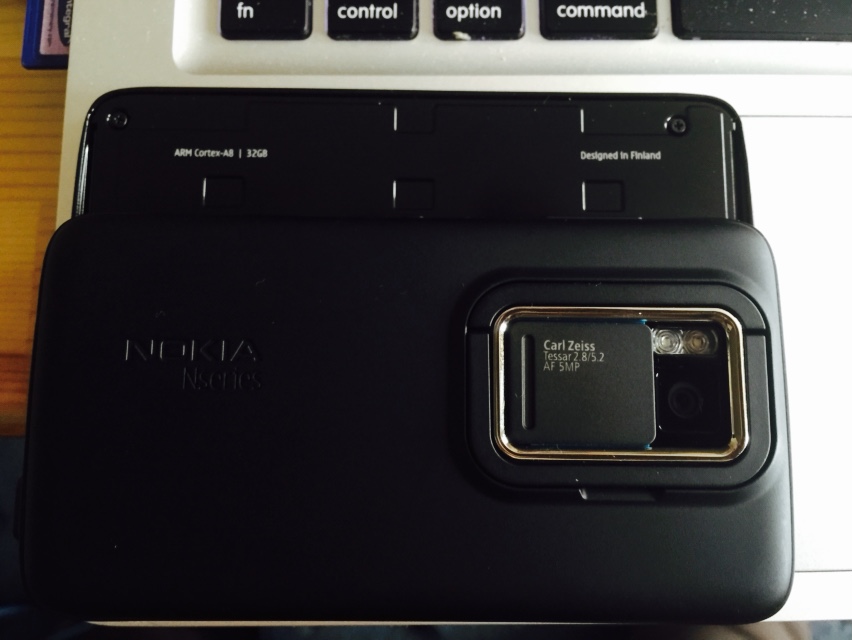
    This throwback gadget the Nokia N900 comes from before Nokia decided to go with Windows Mobile as its smartphone operating system. It had started to develop Maemo as a successor operating system to Symbian Series 60. Meamo was a Linux kernel based mobile operating system which owed its heritage to the Debian Linux distribution.

    The N900 was the first phone which showed Nokia’s ideas in developing an alternative to the Android and iPhone eco-systems. Symbian was a powerful operating system, with true multitasking but there were issues that just tidying up the UI and introducing capacitive touch wouldn’t address.  For a mature operating system, I had to reboot my Nokia phones surprisingly often, basic apps like the address book didn’t work if you had over a thousand contacts – so most sales people out there.

    The predecessor of the Nokia N900 was the 770 internet tablet which was launched back at the end of 2005, which was the iPad before the iPad.
    Nokia N900
    Trying to trial this device is a bit hard as it relied on web services such as an app store that no longer exists. Secondly it offers an experience comparable to an Android or iPhone powered by a processor that is several generations older, so you have to make allowances for the fact that the Nokia N900 can feel slow at times.
    Nokia N900
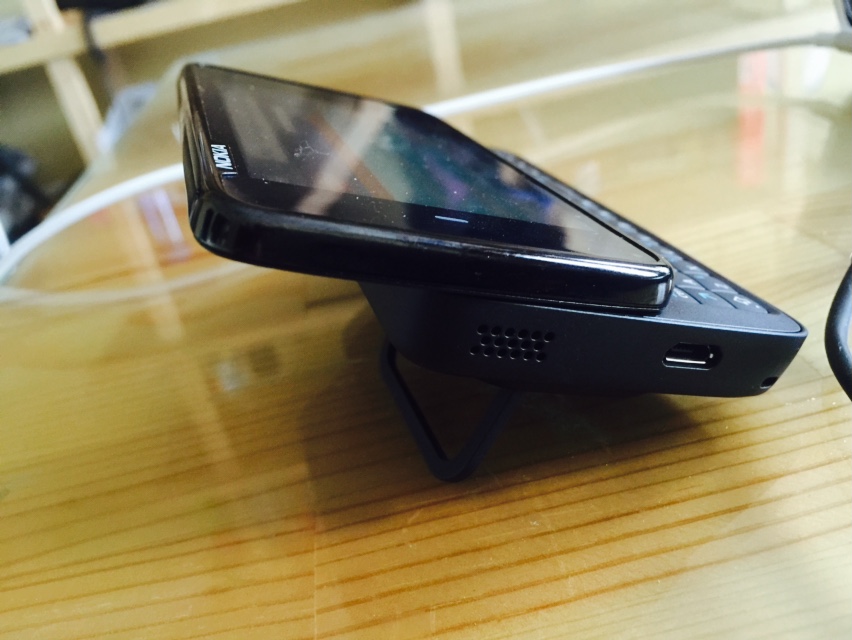
    Let’s start with the industrial design. The phone is relatively thick, partly due to its keyboard and replaceable battery design feels good to hold.

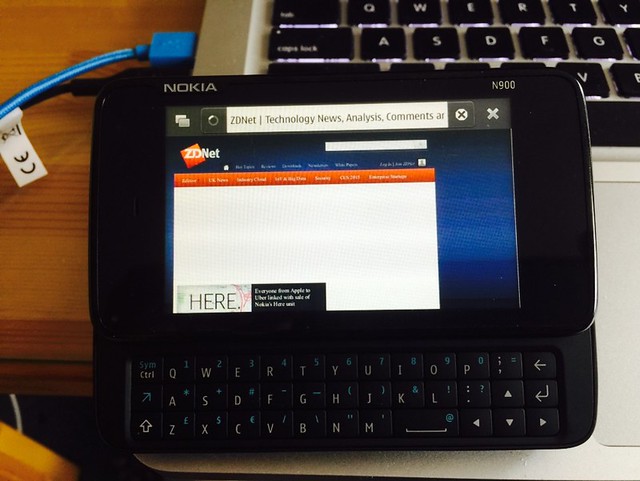
    The Danger Sidekick-esque slide-out keyboard which would be handy for the world of OTT messaging services like WhatsApp, WeChat and LINE. It isn’t a full keyboard like the Nokia E90 Communicator that I used to own but it is more usable than say a Blackberry Bold. The keyboard feels solid and stable.
    Nokia N900
    The camera surround on the back has a stand that pops out for when you want to use the phone to watch content or as a glorified desk clock.

    The dialler on the phone is easier to use than the iPhone and did what it came on the tin – its slight gradient feels like Apple pre-iOS7. Nokia’s HERE mapping service was responsive, it seems to be the one thing on the phone still supported.
    Nokia N900
    Nokia’s Mozilla-based browser still works and provided an experience similar to modern smartphones, but slower (this is partly due to the processor inside the phone).

    Now the Nokia N900 stands a testament to lost potential, the following Nokia N9 and N950, looked like polished products. Stephen Elop saw things differently and despite the Nokia N9 selling well in the few markets that he allowed it to sell, put the company on its fateful relationship with Microsoft. Presumably Elop and his team felt that they couldn’t sustain the innovation of Maemo, which would have required a move to Qualcomm processors away from Intel. Nokia had backed WiMax rather than LTE with Intel, so the company was on the wrong foot. The decline is now a matter of well recorded history with Microsoft having eventually taken over a much diminished phone business. Some of the N9 team went on to build Jolla – a small phone company that built a smartphone and tablet to showcase their SailfishOS operating system. It remains to be seen if other phone manufacturers will launch products using it. But it does offer consumers outside North America a more secure option to an Android handset. More gadget related content here.

  • The Amazon Dash button post

    At the beginning of this month Amazon launched an addition to their Dash ordering hardware with the Amazon Dash button. There was a lot of incredulity amongst the media heightened by the unfortunate timing which overlapped with April’s Fool Day.

    Why the incredulity?

    I would break the cynicism down into two broad buckets:

    • The Amazon Dash button has a very singular usage / use case, narrower even the Yo! app which was a bit of a tech fad last year. Critics are at best uncertain that consumers would use them? I generally buy toilet rolls every 4-6 months, do I really need a button for that?
    • The Amazon Dash button implies that the hardware required is ridiculously cheap. How many boxes of washing powder, packets of Mac & Cheese or toilet rolls would be required for a button to break even?
    Business perspective

    Rather than ripping into this into too much depth I thought I would share Benedict Evans’ interesting hypothesis about the Amazon Dash button:

    Amazon is trying to eliminate both vendor and brand decisions, and turning itself into a utility company – get your house connected to power, water, gas and Amazon. And choosing which commodity product you need is just another piece of friction to be removed by Amazon’s kaizen

    There are some interesting directions that come out of this view point. Let’s break Benedict’s analysis down chunk-by-chunk:

    • Eliminating vendor decisions: there are two prongs to this. Firstly, it would reduce the basket size for supermarkets and also reduce impulse purchases. Let’s think about the Walmart ‘beer and diapers’ retail urban legend for a moment – if you weren’t shopping for the diapers, you aren’t likely to have picked up the beer next to it as you would have had no reason to go near those shelves. By implication it is also an attack on some of the categories carried in convenience stores. Given that the button is about ‘just-in-time’ shopping it implies that the users are not likely to have rooms in their lives for big box retailers or CostCo. The buttons are likely to aimed at urban dwellers rather than the suburbs were larger homes and larger vehicles to do the big box store shop are the norm – Sam’s Warehouse is safer than Walmart in this scenario
    • Eliminate brand decisions: since sales are diverted from supermarkets this also affects their private label sales, especially where they are acquired by accident as lookalikes stacked next to well-known brands. Challenger brands find that switching becomes much harder as they can’t intercept the customer at the point-of-intent through shopper marketing and the opportunity cost for the consumer gets raised due to the comparative nature of the friction in purchase.  It also begs a question about how much it affects the share price of WPP and other marketing combines who have spent big on shopper marketing acquisitions over the past few years. Do buttons offer a net gain or loss of value to them? I do know that the button puts Amazon in a much more powerful position versus vendors in terms of discount pricing to retailer and warehousing. The key to understand the power  that Amazon would bring is ‘choosing which commodity product you need…’. The very idea of a product being boiled down to a commodity buy would scare the living daylights of the average brand manager in an FMCG mega-corp
    • Turning itself into a utility: for Amazon this is about locking the consumer in via Prime to the consumer life. At the present time, logistics costs have been an increasing proportion of the cost of sales for Amazon, there must be a hope that the scale of grocery shopping will bring down the price of Prime and drive profits higher?

    There is no reason why the likes of Tesco, Ocado or Iceland couldn’t have done this. The wider Dash technology would make it easier for consumers to do grocery shopping and reduce the friction of online purchases. Instead they seem to have wanted to reduce cashier numbers inshore and focused on self-service tills. Time will tell if they made the right technological choice.

    What about the user?

    This is designed to make the consumers life easier and I can see how it makes purchase of otherwise annoying to shop for items frictionless, but it only works within reason. You can’t have a wall of buttons on the front door of your fridge freezer and just when do you press the button in the bathroom to order up more razor blades or toilet roll? What happens during the run up to Christmas when Amazon has had sub-optimal performance with regards deliveries on occasion? What is the buying frequency required to make the button habit forming, used without thinking about it, without consideration. When does the opportunity cost for the consumer tip in their favour regarding button usage?

    What I don’t have yet is a clear understanding on depth and breadth of the customer problem being solved by the Dash button.

    Product design

    The original Dash device was interesting because it represented a rejection of the broader theme of convergence where functionality is subsumed from dedicated hardware into a software layer running on a computer, via a web browser, tablet or smartphone. Instead Dash is a shopping appliance and wouldn’t look out of place in a cupboard full of Braun kit.

    The Dash button represents a further evolution of specialist hardware, a brand-specific, tactile hardware interface. It mirrors software like IFTTT’s ‘Do’ application, the Yo! messenger app and the Dimple smartphone button project.

    For non-food products like toilet rolls that come in a plastic bale that is quickly discarded, there may not be a barcode to scan in on your Dash device. Instead you would have to ask for a new pack of Charmin’ or more Mach3 razors. Processing each voice message is expensive, which makes the opportunity cost around creating dedicated buttons for certain classes of product much more attractive. Amazon first and foremost is a data-driven company, they will know which product categories that they want to have buttons for. However, what makes on an Excel spreadsheet doesn’t always make sense to the consumer…

    More information

    Amazon Dash button
    Benedict Evans newsletter edition 106
    Investing in smart logistics | Fidelity Worldwide Investments
    Amazon, in Threat to UPS, Tries Its Own Deliveries | WSJ (paywall)
    Supply Chain News: A 360-Degree View of E-Fulfillment Part 1 | Supply Chain Digest
    Amazon joins numerous startups in building delivery networks to disrupt Fedex and UPS. | DataFox
    The Amazon Dash post
    Dimple smartphone button project | Indiegogo
    SpinVox: the shocking allegations in full | The Kernel

  • BlueFocus + more news

    BlueFocus

    BlueFocus FY 2014 profit up 62.8% | PR Week – Sir Martin Sorrell will be concerned. BlueFocus is at the centre of a high growth market. BlueFocus has access to cheap capital due to its high share price on the Shenzhen stock exchange and it demonstrates the kind of dynamism that WPP no longer has due to its physical size.

    Consumer behaviour

    Founding Fuel Hunting with the hounds – Indian consumers, by and large and across product categories, gravitate towards lower prices and more features instead of passionate brand loyalty

    Design

    The Story of the “Save the Memory Project” | Ricoh Global – impressive dedication and process

    Economics

    4 steps to getting your business model ready for emerging markets – interesting that The Economist’s tongue-in-cheek Big Mac Index is used as a serious pricing reference point in this article

    Finance

    80% of Bitcoin is exchanged into and out of Chinese yuan | Quartz – capital flight or something more criminal in nature?

    Gadget

    Why I changed my mind about the new MacBook | VentureBeat – nice run down on the MacBook’s limitations

    Keacher.com » How I introduced a 27-year-old computer to the web – interesting article, especially since he has to use at least two pieces of external tech to pre-process required applications to develop a web connection and render the web content itself. It puts into perspective how powerful a smartphone is. More technology related posts here

    Legal

    German duo to be caned, jailed for spraying graffiti on Singapore train | South China Morning Post – and they weren’t good graffiti artists either. Singapore has public spaces laid aside for graffiti

    Luxury

    How Jony Ive made Apple a luxury goods company – Business Insider – interesting technology is a substitute product for luxury sector goods argument made at the end of the article

    Marketing

    Tinder Users at SXSW Are Falling for This Woman, but She’s Not What She Appears | Adweek – sci-fi film Ex Machina uses a bot on Tinder to market the film at SXSW. More marketing related content here.

    Software

    iPhone 6s specs rumors: SiP processor reportedly in the works | BGR – computing power is likely to be below what an iPhone 6 would need, but interesting