Ideas were at the at the heart of why I started this blog. One of the first posts that I wrote there being a sweet spot in the complexity of products based on the ideas of Dan Greer. I wrote about the first online election fought by Howard Dean, which now looks like a precursor to the Obama and Trump presidential bids.
I articulated a belief I still have in the benefits of USB thumb drives as the Thumb Drive Gospel. The odd rant about IT, a reflection on the power of loose social networks, thoughts on internet freedom – an idea that that I have come back to touch on numerous times over the years as the online environment has changed.
Many of the ideas that I discussed came from books like Kim and Mauborgne’s Blue Ocean Strategy.
I was able to provide an insider perspective on Brad Garlinghouse’s infamous Peanut Butter-gate debacle. It says a lot about the lack of leadership that Garlinghouse didn’t get fired for what was a power play. Garlinghouse has gone on to become CEO of Ripple.
I built on initial thoughts by Stephen Davies on the intersection between online and public relations with a particular focus on definition to try and come up with unifying ideas.
Or why thought leadership is a less useful idea than demonstrating authority of a particular subject.
I touched on various retailing ideas including the massive expansion in private label products with grades of ‘premiumness’.
I’ve also spent a good deal of time thinking about the role of technology to separate us from the hoi polloi. But this was about active choice rather than an algorithmic filter bubble.
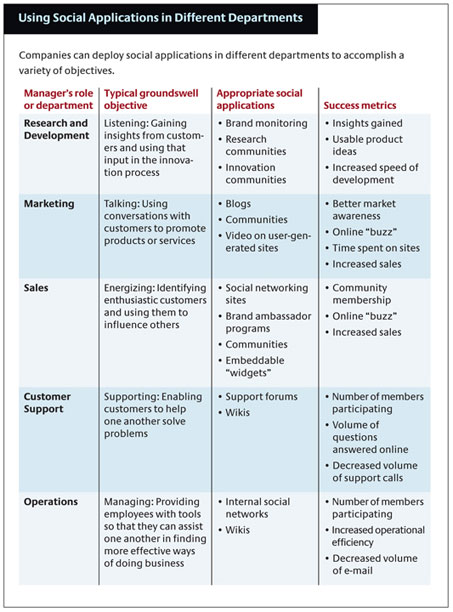
Before I delve in to Harnessing the Power of Social Applications I need to get something out of the way. Normally I don’t highlight articles in the same way I will review a book, they would normally appear in links of the day, but I really liked Bernoff and Li’s article in the latest edition of MIT Sloan Management Review. I know that it is designed to help build up a head of steam before their book launch ‘Groundswell’ however it is a great article to put in front of the noses of business people about the value of social media and taking online marketing beyond search engine marketing (SEM).
Their simple guide on how different business functions can be impacted and how success can be measured is something that social media types should have as a laminated card on their cubicle wall.
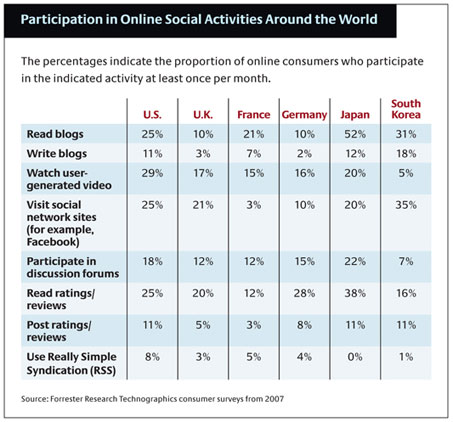
Some of the data points that Li and Bernoff used in the article additional items of interest that weren’t covered by article. Whilst in the UK we think that social networks like Facebook are having real take up and impact that is nothing compared to the level of online engagement by Japanese and Korean web users. Much of this engagement is likely to driven using mobile devices. Overall PC penetration was lower than the US, mobile device adoption was higher in Asia. The handsets were more sophisticated in terms of networks and access to online services.
It is also interesting to see how low the level of adoption of social media is in Germany. The bulk of activity being focused on consumption and anonymous participation in traditional forums. This is down to the experience of privacy invasion that happened during the Nazi era and in East Germany with the Stasi’s network of informants.
On Leaving Yahoo… : Elatable | Bradley Horowitz – Bradley Horowitz leaving Yahoo!, on its own a bit of a sad day for the big Y! as Bradley is probably the smartest guy I have ever stuck in front of a journalist. Bradley Horowitz had come to Yahoo! as part of the surge on search under then CEO Terry Semel. He was one of a senior management team that reported into Jeff Weiner
The Manga Bible – Pages – Japanese artists have done the story of Buddha and text books in manga, so I guess this is the logical extension. Its not really drawn in a manga style but has a good pedigree with one of the artists having worked for 2000AD
Economics
The dark reality – interesting realistic economic analysis on India that could apply to China just as well
The Green Lantern – green and quality concerns kick in on Japanese restaurant offerings
Marketing
SMS Text News » Archives » Text a Mars Bar! – UK agency copies Korean idea for Mars / Masterfoods. Nate.com has had this on a social network-wide level for a good while. It just goes to show you that there is no such thing as a new idea
Media
Half Of All Clicks On Display Ads Are Worthless – A study put out yesterday by comScore, Starcom Media, and Tacoda suggests that half of all clicks on display ads (as opposed to clicks on paid search links) are generated by only 6 percent of Web surfers.
Here is the notes that I made mostly from the morning sessions of the mobileYouth trend workout. There will be presentations and videos of the event available from their site next week. I was speaking on a panel later in the afternoon so was able to pay attention to the earlier panels.
Graham Brown – mobileYouth, the organisers of MobileYouth trend workout
Event introduction
Young people spend about 1.3 trillion USD per year, 130 billion of which is spent on mobile services (or roughly ten per cent of their total income). This impacted the sales of chocolate, music (in the form of CDs) and cigarettes
Young people spend an average of 20 – 25 GBP per month
Mobile services of young people grow at about 4.5 – 5.0 per cent year-on-year. This growth comes at the expense of, and in competition with television, entertainment and clothing
Brown asked the audience of mobile operators to think beyond ARPU and instead think about lifetime spend. By the time that consumers are 33, they have already completed half their lifetime spend. Yet this is the age group that is currently most attractive to carriers looking at the ARPU model. It was an interesting counterpoint to marketers viewing the grey market as the next big opportunity.
Mobile marketers run the particular risk of ending up with an aging or aged brands due to the virtue of a misplaced focus. Brown delivered a case study on Harley Davidson to prove his point. In the 1960s circa Easy Rider, Harley Davidson was a youth brand, now their average customer age is 51 years old.
If things carry on this way, in a little over twenty years, their customer base will be 70, possibly only ready to ride a zimmer frame. According to Brown the consumer lifecycle begins at 10 years old.
Geoff Goodwin and Marc Goodchild – BBC
Children still view as much children’s television as ever, however their consumption of television overall has declined as expected
The BBC is now looking for integrated media properties and partnerships. No one organisation has it right, hence the need for partnerships. Young audiences churn at an incredible rate so the BBC is constantly having to rework itself to remain relevant, rather than having the brand advantage that most people thought they had.
Important mobile technologies for young people are FM radio, SMS and Bluetooth. This low-level tech is because most young people get by with found technologies: hand-me-down mobile phones, an old TV from the living room or a discount model picked up at ASDA or Tesco and vintage computers from work or the living room.
Roundtable: Johan Winbladh mobile channel editor – Danish Broadcasting, James Davis head of mobile – News International, Michiel de Gooijer business development manager – Endemol, Giovanni Maruca director interactive and mobile EMEA – Paramount and Tim Hussain head of mobile monetisation – AOL UK
Mr Winbladh was the hawk in the discussion: mobile devices weren’t ready to put to the kind of mobile experience that users wanted and the industry thought was appropriate, whereas the other audience members felt that the latest generation of mobile handsets and all you can eat tariffs are readdressing the issue.
Maruca was excited about the way that advertising could be delivered in a context aware manner. By adding value to the advertising it can become unobtrusive and essentially no longer be advertising, but information.
Roundtable: Richard Miller general manager for consumer convergence – BT and Derrick Heng director segment marketing and communications – Singapore Telecommunications Limited
BT’s vision of Wi-Fi as a mobile technology is at odds with the GSM/W-CDMA orthodoxy of the mobile industry.
SingTel in contrast has complete fixed and mobile integration and pay TV. SingTel segments its customer base and actively manages the customer relationship with a long-term view. They provide email to mobiles on an ad-funded revenue model. In Singapore the killer apps for mobile usage by young people were email and SMS. By comparison audience member Jonathan MacDonald sales director of Blyk pointed out that for UK mobile users the three killer apps are voice, SMS and the phone’s alarm clock.
The audience debate then raged, the killer application for young people is doing the basic things well, providing decent customer service, having a decent relationship with the clients and not charging them excessively for that relationship. More related content here.
Bill and Dave were better known now by their surnames: Hewlett-Packard. It is familiar to consumers as a brand of printer, laptops and digital cameras sold in supermarkets up and down the country. Some may remember that they had a Watergate-type moment recently and a woman CEO who made a dogs dinner of things.
I visited Boeblingen (near Stuttgart) – the European headquarters of Hewlett-Packard in the late 90s and left deeply unimpressed by a large but seemingly directionless technology behemoth. We were on the cusp of the internet, while they were talking about printing brochures on demand. While this was happening the best internet search engine at the time, Alta Vista, had been built by their long time rival Digital Equipment Corporation.
Malone in his book Bill and Dave gave me a better appreciation of Hewlett-Packard. He brings into perspective how important Bill Hewlett and David Packard were to the technology sector and modern business practices.
From a PR perspective, I found facinating the way Bill and David self-consciously built their own personal legends which helped support and extend the HP Way. The company’s culture was built, extended and modified in a deliberate, planned manner unparalleled in any other company. Their culture was what PR people would now call thought leadership – which feels very now given the start of interest around brand purpose.
Bill and Dave wrote the book on corporate reputation without the help of big name agencies and invented the elements as they went along, combined with a wisdom worthy of Solomon. More book reviews here.
I chose The Strength of the Wolf by Douglas Valentine as I needed a good paperback to read as I travelled back to Liverpool. It seemed strangely appropriate that I read a book about narcotics travelling there; given that Liverpool’s recent history and cultural renaissance has been intertwined with its association as the UK’s narcotic equivalent of the Square Mile. Characters like Curtis Warren as it’s big swinging dicks as Liars Poker author Michael Lewis would have called them.
The premise of The Strength of the Wolf by Douglas Valentine is that the US and other foreign governments have had their fingers in the drug trafficking pie for hundreds of years.
Indeed Great Britain fought two wars over the opium trade. However, this is thought to be history.
The US as the 20th century empire ‘ruler’ is alleged to have carried on the practice supporting Chinese nationalists running heroin through the golden triangle, right-wing military figures in South America, friendly factions in the Middle East to smuggle opium to the French Connection and allowing the mafia a degree of freedom in return for using their supply.
Valentine also describes how drugs were used as a way of controlling minorities and how politically-motivated drugs laws fanned demand in the US rather than choking it off.
These allegations are made as Valentine tells the story of the FBN (the federal bureau of narcotics), its successes, it’s failures and its politics. How officers trod the line between doing their job, whilst not upsetting the establishment players who most benefited from the drug trade that they combated.
The book covers the inner real politik that tore the FBN apart and the global narcotics market as it evolved from the early 20th century.
Valentine eventually decides to pursue so many leads from Jack Ruby’s involvement with drugs, the CIA and narcotics business associates link with the Kennedy assassination (which sounds only slightly more credible than the Warren Commission finding that Oswald did it on his own with an Italian carbine), DeGaulle’s link with Corsican criminals to fund French intelligence work and Mossad’s alleged involvement with money launderers and Lebanese narco power-brokers.
At times these allegations and avenues come out like a stream of consciousness and the thread of the plot leaps around like an epileptic break dancer. Whilst Valentine has obviously done a very thorough and comprehensive job in researching the book, it seems that he had too much material to work with in too little time.
The book becomes hard to follow because of the huge amount of information and cross-linkages that it tries to convey and not exactly ideal reading material for travelling.
I stuck with the book, not because of the drugs and intelligence drama, but the more human tale of how the agents careers were created and trashed like failed drafts being thrown in the paper basket. The book on balance, deserves the plaudits that have been heaped upon it, but who will recognise the achievements of the reader who pushes through to the end? More book reviews can be found here.

 gave me a better appreciation of Hewlett-Packard. He brings into perspective how important Bill Hewlett and David Packard were to the technology sector and modern business practices.
 by Douglas Valentine is that the US and other foreign governments have had their fingers in the drug trafficking pie for hundreds of years.