Ideas were at the at the heart of why I started this blog. One of the first posts that I wrote there being a sweet spot in the complexity of products based on the ideas of Dan Greer. I wrote about the first online election fought by Howard Dean, which now looks like a precursor to the Obama and Trump presidential bids.
I articulated a belief I still have in the benefits of USB thumb drives as the Thumb Drive Gospel. The odd rant about IT, a reflection on the power of loose social networks, thoughts on internet freedom – an idea that that I have come back to touch on numerous times over the years as the online environment has changed.
Many of the ideas that I discussed came from books like Kim and Mauborgne’s Blue Ocean Strategy.
I was able to provide an insider perspective on Brad Garlinghouse’s infamous Peanut Butter-gate debacle. It says a lot about the lack of leadership that Garlinghouse didn’t get fired for what was a power play. Garlinghouse has gone on to become CEO of Ripple.
I built on initial thoughts by Stephen Davies on the intersection between online and public relations with a particular focus on definition to try and come up with unifying ideas.
Or why thought leadership is a less useful idea than demonstrating authority of a particular subject.
I touched on various retailing ideas including the massive expansion in private label products with grades of ‘premiumness’.
I’ve also spent a good deal of time thinking about the role of technology to separate us from the hoi polloi. But this was about active choice rather than an algorithmic filter bubble.
Æon Flux’s surprisingly modern take on privacy and surveillance. | Slate – Æon Flux was a name that I hadn’t heard in at least a decade. I remember when it came out as I enjoyed cable TV in our student house. It fitted in with the wider cyber culture. The big beats and brash gravity defying visuals were everywhere from WipeOut to anime. The media was tech artefacts from a future counter-culture.
Macromedia Director and Flash produced animated video hardwired straight into our cortex. It was psychedelia but not as it had been experienced before. Asian animated and real world films weren’t mainstream but serious culture.
Æon Flux & The Matrix
The series came out in the early 1990s as part of a series of experimental animation on MTV called Liquid Television. It came out before The Matrix, yet drew from many similar influences:
Cyberpunk
Biopunk
Anime
Asian ‘gun fu’ action films
European comics in particular the space opera works of Möbius, Mézières & Christin. You can also see the influence that Chung had working with Ralph Bakshi on his fantasy animation
Gnostic beliefs
In another Matrix link; Æon Flux creator Peter Chung (피터 정) went on to create a segment for the Wachowskis’ The Animatrix which told part of the back story of The Matrix quadrology.
Privacy and the surveillance state
Each episode saw a conflict play out between an anarchic city and its authoritarian rival. Flux was an assassin from the anarchic city on undercover missions.
The animated series had been released on VHS, DVD and UMD – the Sony Playstation Portable (PSP) disk media that was the ultimate manifestation of cyberpunk storage. For some reason, it hasn’t been released on Blu-Ray yet.
It was truly transmedia with computer games and graphic novels to complement the animated series. Eventually Hollywood did a live action version that was vaguely related to the original Æon Flux. The original was too difficult and avant garde to be a Hollywood franchise, which is probably why the animated version has slipped back out of view.
Given that Æon Flux was influenced by cyberpunk was inevitably seen as a prescient take on privacy and the surveillance state.
Consumer behaviour
Taking Affection Back | No Mercy / No Malice – some interesting and intractable problems in society revolving around how men are set up for failure. Contrast the diagnosis with this article: The Great Feminization of the American University | City Journal – Female students and administrators often exist in a co-dependent relationship, united by the concepts of victim identity and of trauma. For university females, there is not, apparently, strength in numbers. The more females’ ranks increase, the more we hear about a mass nervous breakdown on campus. Female students disproportionately patronize the burgeoning university wellness centers, massage therapies, relaxation oases, calming corners, and healing circles. Another newly installed female college president, Dartmouth’s Sian Leah Beilock, claims that the two “most pressing challenges of our time” are the “mental crisis among young people” and climate change. College institutions “really have a part to play in how we support students” suffering from that mental health crisis – correlation and causality aren’t the same thing
Why social class is advertising’s biggest diversity blind spot | Advertising | Campaign Asia – Social class might bring up antiquated ideas of British snobbery, but it exists everywhere. In Asia, social class is very pronounced. From obscenely wealthy ‘Crazy Rich Asian’ types, to a much reported on ‘rising middle class’, and a majority who are working class or live in poverty. The pandemic certainly brought class differences in Asia into sharp focus. Yet, despite making up the majority in society, advertising often fails to represent working class people. And when adverts do feature working class people, they usually perpetuate class-based stereotypes. Instead, the advertising industry is obsessed with targeting middle-class 18 to 34-year-olds, resulting in advertisements that seem to overlook the genuine diversity of society and instead mirror adland’s own demographic.
話題のChatGPTをLINEで使える「AIチャットくん」リリースから3日で20万登録突破 | みんなの便利な使用例を紹介 #AIチャットくん|株式会社piconのプレスリリース – LINE adds ChatGPT gains 200,000 users in 3 days. ChatGPT speaks and understands Japanese, but uptake in Japan has been hampered, apparently, because you need to speak English to sign up. Line is the dominant messaging platform in Japan, and last week they added ChatGPT. You just add “AI Chat-kun” as a friend and start chatting. Up to five messages per day are free, and you can upgrade to unlimited messages for ¥680/month (about $5).
The Daring Ruse That Exposed China’s Campaign to Steal American Secrets – The New York Times – China publicly denies engaging in economic espionage, Chinese officials will indirectly acknowledge behind closed doors that the theft of intellectual property from overseas is state policy. James Lewis, a former diplomat now at the Center for Strategic and International Studies in Washington, recalls participating in a meeting in 2014 or so at which Chinese and American government representatives, including an officer from the People’s Liberation Army, discussed the subject. “An assistant secretary from the U.S. Department of Defense was explaining: Look, spying is OK — we spy, you spy, everybody spies, but it’s for political and military purposes,” Lewis recounted for me. “It’s for national security. What we object to is your economic espionage. And a senior P.L.A. colonel said: Well, wait. We don’t draw the line between national security and economic espionage the way you do. Anything that builds our economy is good for our national security.” The U.S. government’s response increasingly appears to be a mirror image of the Chinese perspective: In the view of U.S. officials, the threat posed to America’s economic interests by Chinese espionage is a threat to American national security.
YouTuber aini does good videos that analyse sociological and cultural subjects, so a video on East Asian beauty standards was inevitable. East Asian beauty standards are even more important now due to the cultural impact that they have:
Korean and Japanese beauty products that have become popular from BB cream to SK-II
Filter / camera effects mobile apps – you can see their influence looking at how Cardi B does her make-up
Soft power assets: Hallyu and anime popularity – it affects the aesthetics of this content
China
Huawei building automotive ecosystem without making its own cars – Huawei will not build cars on its own, but will continue to strengthen its automotive ecosystem alliance and platform, integrating R&D efforts of related carmakers to provide diverse resources of smart systems, software, chips and other aspects – interesting profile by Taiwanese technology news outlet DigiTimes
Interesting that proposes that cyberpunk owes as much to Japanese psyche during late bubble Japanese miracle culture as opposed to the writings of American authors Bruce Sterling and William Gibson. It reflects angst, consumerism and accelerated technology.
Cybersecurity Label for U.S. Coming as Early as April – EE Times – 600-plus companies that have joined the ioXt Alliance to help it build confidence in Internet of Things products will be among the first to experience the national cybersecurity label NIST is developing for consumer Internet of Things (IoT) products and consumer software products—as soon as April
Why The Chinese Balloon Was a Necessary Wake-Up Call – Recent events have shown that terrorism is not the only threat to the U.S. homeland. Moscow’s invasion of Ukraine shattered not only the 75-year peace in Europe but also Americans’ sense of security, particularly when the Kremlin has threatened nuclear escalation. Relations with Beijing have also deteriorated to a 40-year low, punctuated by the threat of Chinese aggression against Taiwan and other regional allies and covert activities within the United States
Political theorist and author Francis Fukuyama wrote one of the mis-understood books of the late 20th century. The End of History (And The Last Man) was written in 1989 and the title and Francis Fukuyama have been misquoted endlessly since.
At the 2020 Munich Security Conference Francis Fukuyama gave a talk about the book and what it actually meant from his perspective.
This one on tribalism on and populism is also very interesting.
Business
Great video on the history of HNA, which went under a mountain of debt and was unwound by the Chinese government.
HNA started off as Hainan Airlines before expanding internationally and across sectors.
Wokeness as mainline orthodoxy – Noahpinion – Musa al-Gharbi has a recent article with quite a bit of data showing that journalistic and academic attention to the topics of diversity, bias, privilege, and so on seems to have peaked, while “cancel culture” incidents have decreased on campuses and in corporations, and political opinions on various social issues have moderated a bit. Anecdotally, corporate interest in DEI seems to be waning as well. Other observers like Tyler Cowen have noticed the trend.
Luxury
Survey Finds Japanese People’s Dream Car Is a Lexus | Nippon.com – bad news for Mercedes & BMW. This isn’t about Japanese nationalism as Mercedes and BMW have enjoyed healthy sales in the country in the past. Much of this is about the massification of these brands and the decline in quality in comparison to the single-mindedness of Lexus engineers.
Marketing
The Drum | How Nestlé Is Using AI To Set Creative Rules For Its 15,000 Marketers – In 2021, Nestlé started to put all its creative through an AI platform that would rank ads based on their suitability to different online platforms and pull out the key elements that are required for maximum ROI. That process created a set of ’rules’ for successful campaigns and early tests generated transformational results, finding that ads that meet the new creative requirements generate a significantly higher return on ad spend. Now, Nestlé’s 15,000 marketers across 2,000 brands in 200 territories have to test the ads in the machine learning platform prior to rolling a campaign out – my biggest concern is that this becomes reductive in terms of creativity and self reinforcing rather than facilitating the picking of true winners. Secondly, I could see it over-indexing on brand activation rather than brand building spend and ultimately destroy value
Last week I heard the acronym NORA mentioned with regards the kind of problems that Microsoft’s algorithm could solve. NORA stands for no one real answer. Search is already pretty good at answering questions like ‘what time is it in Osaka’ or ‘what is the capital of Kazakhstan’.
In the mid-2000s NORA would have been called ‘knowledge search‘ by the people at Google, Yahoo! and Bing – who were the main search engine companies. So its not a new idea in search, despite what one might believe based on the hype around chatbot enabled search engines. ChatGPT and other related generative AI tools have been touted as possible routes to get to knowledge search.
Knowledge search
Back when I worked at Yahoo! the idea of knowledge search internally was about trying to carve out a space that useful and differentiated from Google’s approach as defined by their mission:
To organise the world’s information and make it universally accessible and useful
Google was rolling out services that not only searched the web. It also covered maps, the content of books including rare libraries and academic journals. It was organising the key news stories and curating which publications were seen in relation to that story. It could tell you the time elsewhere in the world and convert measures from imperial to metric.
Google’s Gmail set the standard in organising our personal information, making the email box more accessible and searchable than it had been previously. We take having a journaled hard drive for granted now, but at one time Google Desktop put a search of the files on your computer together with online services in one small search box.
Being as good as Google was just table stakes. So when I was at Yahoo! we had our own version of Google Desktop. We bought Konfabulator, that put real time data widgets on your desktop and were thinking about how to do them on the smartphone OS of the time Nokia’s Symbian S60. Konfabulator’s developer Arlo Rose went on to work on Yahoo!’s mobile experiences and Yahoo! Connected TV – a photo-smart TV system that was before the modern Apple TV apps. Tim Mayer led a project to build out an index of the web for Yahoo! as large, if not bigger than Google’s at the time. And all of these developments were just hygiene factors.
My colleagues at Yahoo! were interested in opinions or NORA; which is where the idea of knowledge search came in. Knowledge search had a number of different angles to it:
Tagged content such as my Flickr photo library or social bookmarking provided content from consumers about a given site that could then be triangulated into trusted context, or used to train a machine learning model of what a cat looked like
Question and answer services like Quora, Yahoo! Answers and Naver’s Jisik In Service improved search. Naver managed to parlay this into becoming the number one search engine for Korea and Koreans. Google tried to replicate this success with Knol and failed
Reviews. Google managed to parlay reviews into improving its mobile search offering. Google acquired Zagat in 2011. This enabled Google to build a reputation for good quality local restaurant reviews. It eventually sold the business on again to another restaurant review site The Infatuation
The ChatGPT type services in search are considered to provide an alternative to human-powered services. They create NORA through machine generated content based on large data sets trawled from the web.
Energy consumption
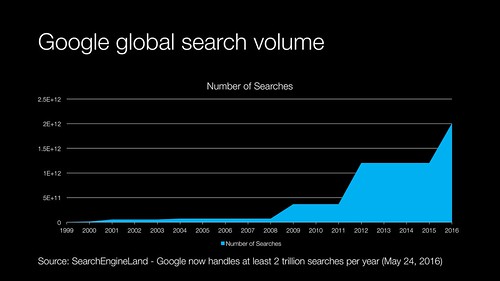
A conventional Google internet search was claimed to consume 0.3 watt/hours of power according to Google sources who responded to the New York Times back in 2011. This was back when Google claimed that it was processing about one billion (1,000,000,000) searches per day. It accounted for just over 12 million of the 260,000,000 watt hours Google’s global data centres use per day. The rest of it comes from app downloads, maps, YouTube videos.
But we also know that the number of Google searches ramped up considerably from those 2011 publicly disclosed numbers
The driver for this increase was mobile search including more energy intensive Google Lens and voice activated searches thanks to Android.
Large language models (LLMs) are computationally intensive and this will result in a corresponding rise in energy consumption. That also has implications in terms of business profit margins as well as ESG related considerations.
Legal liabilities
With NORA content being created by machine learning services, it might be different to the previous generation of knowledge search services. These services were platforms, but machine learning services become publishers.
This becomes important for a few reasons
Increased costs (while they aren’t using an army of writers, they are using a lot of computing power to generate the responses)
Legal protections (in the US)
Intellectual property and plagiarism issues, currently they can handle it just by taking down the content. Once they become a publisher rather than a platform things become more complicated
“no provider or user of an interactive computer service shall be treated as the publisher or speaker of any information provided by another information content provider”
Communications Decency Act of 1996.Section 230
Section 230 has been repeatedly used to regulate Facebook, Google et al in a lax manner as they haven’t been ‘publishers’, with ChatGPT this may change. The question of whether an algorithm is a creator has some precedence. Financial reporting has used machine learning to create news reports on company financial results over a number of years. Combine that with the general political antipathy towards Meta and Alphabet from both of the main US political parties and things could get interesting very fast.
It is interesting that OpenAI is putting a lot of thought around ethics in LLM, which will impact future services and they probably hope stave off regulation.
Regulated industries and liability
Given an LLM’s ability to make things up it can:
Gives advice without pointing out health risks by creating a workout plan or a weight loss diets
Gives bad legal advice
Infringe regulations surrounding different industries like financial services
This is just the tip of the iceberg that NORA content powered by LLMs face.
Business model disruption
Search advertising as we know it has been the same for the past two decades. The disruption to the look and feel of search results through Bing’s chat response has a negative impact on Google’s advertising model with the search ads along the top and down the right hand side of the search engine results page. Instead you’ll end up with the ‘correct’ answer and no reason to click on the search adverts.
Currently if a non-relevant site shows up in Google. The lack of relevance is blamed on the site rather than the search engine. However an error in a machine learning created NORA response will see the search engine blamed.
Which is pretty much what happened when Google demonstrated their efforts in the area. Inaccuracies in a demonstration held in Paris cause the share price of Alphabet to decline by 7 percent in one day. Technology news site TechCrunch even went as far as to say that Google is losing control.
Microsoft probably doesn’t have a lot to lose in Bing. So integrating ChatGPT’s LLM might give them a few percentage points of search market share. Microsoft thinks that each percent gain would be worth 2 billion dollars in extra revenue.
The 2 billion number is an estimate and we don’t know how the use of NORA results generated by LLM will affect bidding on search keywords. That 2 billion might be a lot less.
Is NORA the user problem that Google and Bing’s use of LLMs are fixing?
Around about the time that Google enjoyed a massive uptake in search it also changed search to meet a mobile paradigm. Research type searches done by everyone from brand planners to recruiters and students have declined in quality to an extent that some have openly questioned is Google dead?
Boolean search no longer works, Danny Sullivan at Google admitted as much here. While Google hasn’t trumpeted the decline of Boolean search, ‘power’ users have noticed and they aren’t happy. That narrative together with the botched demo the other week reinforced each other.
Unfortunately, due to the large number of searches that don’t require Boolean strings, Google wasn’t going to go back. Instead, chat-based interfaces done right might offer an alternative for more tailored searches that would be accessible to power users and n00bs alike?
Technology paradigm shift?
At first the biggest shock that myself and others had seeing the initial reports was how Google and Microsoft could have been left in the dust of OpenAI. Building models requires a large amount of computing power to help train and run.
Microsoft had already been doing interesting things in machine learning with Cortana on Azure cloud services and Google had been doing things with TensorFlow. Amazon Web Services provides a set of machine learning tools and the infrastructure to run it on.
Alphabet subsidiary DeepMind had already explored LLM and highlighted 21 risks associated with the technology, which is probably why Google hadn’t been looking for a ChatGPT type front end to search. The risks highlighted included areas such as:
Discrimination, Hate speech and Exclusion although there is research to indicate that there might be solutions to this problem
Information Hazards – there has already been a case study on how an LLM can be influenced to display a socially conservative perspective.
Misinformation Harms – researchers claimed that LLMs were “prone to hallucinating” (liable to just make stuff up)
Malicious Uses
Human-Computer Interaction Harms
Environmental and Socioeconomic harms
Stories that have appeared about ChatGPT and Bing’s implementation of it seem to validate the DeepMind discussion paper on LLMs.
The Microsoft question of why they partnered with ChatGPT rather than rolling out their own product is more interesting. Stephen Wolframs in-depth explanation of how ChatGPT works is worth a read (and a couple of re-reads to actually understand it). Microsoft’s efforts in probabilistic machine learning looks very similar in nature to ChatGPT. As far back as 1996, then CEO Bill Gates was publicly talking about how Microsoft’s expertise in Bayesian networks as a competitive advantage against rivals. Microsoft relied on research and the Bayesian network model put forward by Judea Pearl which he describes in his book Heuristics.
Given the resources and head start that Microsoft had, why were they not further along and instead faced being disrupted by OpenAI? Having worked in the past with Microsoft as a client, I know they won’t buy into anything that they can build cheaper. That raises bigger questions about Microsoft’s operation over the past quarter of a century and its wider innovation story to date.
Flash in the pan
At times the technology sector looks more like a fashion industry driven by fads more than anything else. A case in point being last years focus on the metaverse. The resulting hike in interest rates has seen investment drop in the field. Businesses like Microsoft and Meta have shut down a lot of their efforts, or have scaled back. It is analogous to the numerous ‘AI winters‘ that have happened over the past 50 years as well.
Bing’s implementation of LLM is already garnering criticism from the likes of the New York Times. This new form of search may end up being a flash-in-the-pan like Clubhouse. The latent demand for NORA in search will still be there, but LLM might not be the panacea to solve it. Consumers may continue to rely on Reddit and question-and-answer platforms like Quora as an imperfect solution in the meantime.
In summary….
NORA content generated by LLMs represent a new way to solve a long known about challenge in online search
NORA as a concept was previously called knowledge search
NORA content competes with: social media including Reddit, specialist review sites including Yelp or OpenRice and question and answer services including Quora
ChatGPT and similar services affect human perceptions of search and the experience makes them more critical of the search engine response is not of an acceptable standard
LLMs represent a number of challenges that large technology companies have discussed publicly, but were still attractive for some reason
ChatGPT shows up the the decades of research that Google, Microsoft and Amazon have put into machine learning, this will negatively affect investors attitudes to these companies and merits a more critical nuanced examination of ‘innovation’. These large companies seem to be struggling to put applied innovation into practice. Microsoft buying into ChatGPT is essentially an admission of failure in its own efforts over at least 3 decades. Even ChatGPT’s deeply flawed product is considered to be better than nothing at all by these large technology companies
Use of ChatGPT like services expose Google and Bing to business risks that are legal and regulatory in nature. It could even result in loss of life
ChatGPT’s rise has surfaced deep seated concerns amongst technologists, early adopters, power users and investors about Google’s ability to execute on innovation successfully now (and in the future). Google’s search product has been weakened over time by its focus on mobile search dominance. Alphabet as a whole is no longer seen as a ‘leader’
LLMs, if successful would disrupt the online advertising business model around search engine marketing
ChatGPT and its underlying technology do not represent a paradigm shift
There is evidence to suggest that ChatGPT and other LLM powered chat search interfaces could turn out to be a fad rather than a future trend. The service as implemented has underwhelmed
Patriotic Alternative wasn’t a name familiar to me when I first heard about them instigating a riot in Liverpool on Saturday night. It doesn’t take that much to create a ruckus in some of the poorer areas of Liverpool.
I wasn’t particularly surprised by the burnt out police van; it sounds like a Merseyside Saturday night that went a bit out of control. That’s as Liverpudlian as a fried breakfast served in a ‘bin lid’ – a large white bun or bap large enough to contain bacon, sausage, a fried egg or two and brown sauce.
But there were aspects that did surprise me and all signs point to Patriotic Alternative. It’s a multi-cultural city, everyone has relatives abroad whether its extended Irish family, West Indians or deep connections within the Chinese diaspora. Which is why I was surprised that Patriotic Alternative managed to stir up so much trouble against an asylum hotel in the Knowsley area of Liverpool.
The city does have a certain degree of prejudice; primarily sectarianism. Its one of the few areas in England that has a marching season rather like Northern Ireland with an Orange Order parade held annual in Southport back when I lived up there. But Knowsley was something else. Patriotic Alternative managed to do something that I never thought was possible in cities like Liverpool or Bristol.
So reading about the event and the role of Patriotic Alternative in Dazed was an eye opener. It portrayed a city that I no longer recognised. Patriotic Alternative apparently organised the protest on a Telegram channel. What Dazed claim happened is that mainstream political statements and mainstream media coverage created an environment ripe for trouble makers like Patriotic Alternative.
According to Hope Not Hate, Patriotic Alternative shared members with prescribed far right organisation National Action. For an organisation that has a couple of hundred core members Patriotic Alternative has an outsized footprint. This footprint seems to be driven by the Patriotic Alternative Telegram channel with some 5,000 followers
Consumers in the 1970s on the changing nature of growing old, unfortunately attitudes and biases haven’t improved in the last 50 years.
Economics
US chip packaging firm Amkor closes its Shanghai plant for a week amid global market downturn | South China Morning Post – this is signalling a recession, as was AP shipments to Chinese smartphone brands stay in decline in 1Q23, says DIGITIMES Research – Fourth-quarter 2022 smartphone application processor (AP) shipments to China-based smartphone vendors amounted to 137 million units, plunging 24% from the prior quarter and 20.3% from the prior year, and will continue to experience a double-digit decline in the first quarter of 2023, according to figures from DIGITIMES Research’s latest report covering smartphone AP shipments. Because of shrinking demand and high smartphone inventory at the channel in both China and emerging markets, AP shipments to China-based smartphone vendors had already experienced on-year declines for five consecutive quarters
How China Fell In Love With Cheap Wine | Sixth Tone – reminds me of my time working on the Bordeaux wine marketing board as an account at the agency I worked for in Hong Kong. The work was focused on mainland China and promoted Bordeaux as a lifestyle brand for wine consumption rather than just gift giving
Massachusetts Democratic organ donation proposal sounds like prisoner organ harvesting. | Slate – Democratic state representatives Carlos González and Judith García introduced legislation that would allow incarcerated people to go home early—if they “donated” their organs. Specifically, the bill would “allow eligible incarcerated individuals to gain not less than 60 and not more than 365-day reduction in the length of their committed sentence” if they “donated bone marrow or organ(s).” Gonzalez argued that the bill was a step towards advancing racial equity in health care and making it easier for people of color to obtain transplants.
Hong Kong
The Hong Kong government must break its habit of relying on property developers | South China Morning Post – the article itself isn’t that interesting, but the author is. Regina Ip would be what the conservative party in the UK would call a big beast. She is a former minister level politician in the pro-China camp. Add to this the fact that despite mainland Chinese companies now outnumber local and foreign firms in Hong Kong and the economy is in decline. I expect Ip’s op-ed to be the tip of an iceberg of a shift in economic drivers that will occur sometime after John Lee leaves office. The clock is ticking on the big five families to diversify their wealth out of Hong Kong and China, following Jardines example to go into Indonesia might be a prudent start
Hong Kong reopens with post-Covid charm offensive | Financial Times – Johannes Hack, president of Hong Kong’s German Chamber of Commerce, who sits on a new task force to promote the city, said a “long-haul” effort to change business perceptions would have to go beyond plane ticket giveaways. “If you have relocated corporate functions to another place, half a year later you are probably not going to reverse the whole thing,” he said. “People who have moved to Singapore with their teen kids, there is no way they are going to do that again . . . They are not going to come back.” – feeds into the ‘its just another city in China now’ narrative
UK universities starting to lose allure for Chinese | News | The Times – well that’s screwed the Ponzi scheme that universities have engaged in via over-priced student accommodation real estate investments for reasons that aren’t exactly clear given their ownership structure and charters
Japanese fashion magazine Popteen ends physical version, switches to web installments instead – move to online only and moving away from monthly updates. Popteen ended its physical publishing as of February 1, 2023, with the February 2023 edition (released on December 28, 2022) being its last. web-based articles will be released on the first and the 15th of every month, known as “Popteen media”, and full editions of the fashion magazine will be updated a few times annually. The main reason for switching to the web edition was to make the magazine more accessible to middle and high-school students, who may not receive an allowance or be able to work part-time to afford physical copies of Popteen
Great video on microchip counterfeiting and recycling. The Japanese are doing some of the best work authenticating chips. Also if its bad for US defence contractors, just imagine how bad it will be for the sanctioned Russian defence sector.
Seeing for the Sightless – Luo, 26, suffers from congenital cataracts and is pursuing a degree in acupuncture and massage therapy at a college in Beijing. He needs help on the scales as there is no voice assistant function at the training center. On a mobile app called Be My Eyes (BME), he sends out a video call. Pointing his phone camera at the scales, he asks, “Hello, can you read the number for me, please?” A volunteer on the other end tells him, “91 kg.” Luo says thanks and hangs up. Usually, these exchanges only last a few seconds. Being tech savvy, Luo wrote a program back in high school to help the visually impaired memorize English vocabulary, something he himself struggled with. The app would randomly pick a word from a list he composed and he would spell it out after hearing the word. BME, developed by Hans Jørgen Wiberg, a visually impaired man from Denmark, drew Luo’s attention as soon as the Android version was available in China in 2017. Currently, there are 445,000 visually impaired users from all over the world and more than six million volunteers on BME.
Style
Adidas Tumbles as Losses From Its Kanye West Venture Pile Up – The New York Times – interesting how badly Ivy Park is doing and this on their business in China: Adidas in China: a brand seeking its redemption – In the second half of 2022, Adidas CEO Kasper Rorsted estimated losses of revenue of more than 35% in the Chinese market. He declared that such a violent drop was caused by some mistakes. For instance, the struggle of keeping up with the local brands, the failed recovery after the zero-covid policy, and the scandal of Xinjiang cotton.After the winter Olympics, the trend of Guochao, or the “national trend”, started to develop. More young Chinese consumers prefer buying local brands rather than western sportswear brands. In August 2022, the local firm, Anta, overtook Nike and became the biggest sportswear brand in China with a revenue of more than USD3.79 billion. Li-Ning, another Chinese firm, also registered revenue of USD1.76 billion against Adidas’ USD1.72 billion, pushing the German brand out of the podium. The zero-Covid policy has been a big problem for Adidas. In 2022, the company had to deal with closed shops and rising costs. In particular, the general lockdown which paralyzed China for the last few years resulted in the desegregation of the complex system of supply chains built up by the German brand. The disrupted supply chains cost Adidas a loss of USD427 million in the first quarter of 2022.
SMIC expects 10-12% revenue drop in 1Q23 | DigiTimes – China-based pure-play foundry Semiconductor Manufacturing International (SMIC) expects to post a revenue decline of 10-12% sequentially in the first quarter of 2023, with gross margin falling further to 19-21%.
MotherDuck: Big Data is Dead – Jordan Tigani spent ten years working on Google BigQuery, during which time he was surprised to learn that the median data storage size for regular customers was much less than 100GB. In this piece he argues that genuine Big Data solutions are relevant to a tiny fraction of companies, and there’s way more value in solving problems for everyone else. I’ve been talking about Datasette as a tool for solving “small data” problems for a while