Category: ideas | 想法 | 생각 | 考える

Ideas were at the at the heart of why I started this blog. One of the first posts that I wrote there being a sweet spot in the complexity of products based on the ideas of Dan Greer. I wrote about the first online election fought by Howard Dean, which now looks like a precursor to the Obama and Trump presidential bids.

I articulated a belief I still have in the benefits of USB thumb drives as the Thumb Drive Gospel. The odd rant about IT, a reflection on the power of loose social networks, thoughts on internet freedom – an idea that that I have come back to touch on numerous times over the years as the online environment has changed.

Many of the ideas that I discussed came from books like Kim and Mauborgne’s Blue Ocean Strategy.

I was able to provide an insider perspective on Brad Garlinghouse’s infamous Peanut Butter-gate debacle. It says a lot about the lack of leadership that Garlinghouse didn’t get fired for what was a power play. Garlinghouse has gone on to become CEO of Ripple.

I built on initial thoughts by Stephen Davies on the intersection between online and public relations with a particular focus on definition to try and come up with unifying ideas.

Or why thought leadership is a less useful idea than demonstrating authority of a particular subject.

I touched on various retailing ideas including the massive expansion in private label products with grades of ‘premiumness’.

I’ve also spent a good deal of time thinking about the role of technology to separate us from the hoi polloi. But this was about active choice rather than an algorithmic filter bubble.


  • Creativity in data

    I had the honour of being part of a panel for the PRCA on the creativity in data run in association with The Work Crowd.

    Creativity and data

    Here was the synopsis of the panel discussion that the PRCA put out.

    Communications is frequently seen as all about ‘big ideas’. But increasingly, it’s being recognised that to develop a big idea that’s really going to have an impact, it’s not just about creativity. Now, the winning formula is creativity + data.


    Of course, data has always played a role in the creative process, but historically through a more ‘rear view’ measurement of past behaviours. However, with technology advancing and predictive analytics utilising newly available data, the data we have access to is more forward-looking than ever.


    The ability to synthesise these insights is super-powering strategic planning for businesses, but it’s definitely not just the boardroom who should be interested in ‘running the numbers’. Maths and data may not be seen as natural bedfellows of storytelling and creation, but have we been underestimating the power of creativity in data? Ultimately, is data a friend or foe to the creative process?

    I kicked this around with Camilla and Richard. Here are my thoughts that came from this process in no particular order below:

    I wondered what the forefathers of the communications industry would have thought about the question? Leaving ethical considerations aside for a moment about the legitimacy of their techniques, what would they have thought?

    Edward Bernays was famous for using consumer insight, research and psychology in his work. It would likely have felt very alien to Bernays that we were even asking such a question. He would have felt that the answer is self-evident a 100 years later.

    Data isn’t a friend or foe to the creative process. It is part of the creative process. The sieving of data to get down to the grain of truth – the insight that you can hang your creative idea off.

    Thinking about the nature of data itself is muddled. Over the past couple of decades the communications industry has struggled with measurement. This then shaped its perception of data.

    • Data is quantitative
    • Data is tech dependent
    • Data is precise

    All of which is wrong:

    • Data can be quantitative, but qualitative data is also important, particularly to the creative process. Qualitative data is the stuff of stories and storytelling
    • A lot of data is technology dependent, but a lot of good stuff from a creative perspective isn’t. Marketing communications as an industry, has increased its use and importance of cultural insights in planning
    • Quantitative data isn’t always precise. Correlation and causality aren’t the same things. In addition, if online ad fraud has taught us anything, it is to be skeptical of data quality

    I am not saying that communications should move away from obtaining and using quantitive data. But this should be balanced by a focus on qualitative data as well.

    Data is seen paradoxically as ‘all around us, pervasive’ and expensive to obtain.

    So what data should the creative planners of the communications industry care about? Some of the sources listed below are free, some are books that are worthwhile investing in and others are expensive services that even the largest agencies struggle to afford in many markets.

    The data that the client has already

    Clients are already sitting on a wealth of information inside their organisation:

    • Past marketing campaigns. What has worked, what hasn’t.
    • Web analytics – what content is doing well. What do we know abut site visitors?
    • Key words that they use for SEO. What language should we be using for coming with messaging?
    • Sales data. Not just qualitative data, but what is coming out of sales calls and customer services enquiries? What concerns prospective and current customers? Why do they buy? Do they stay loyal? Do they have great stories? Who buys and who is likely to influence a buying decision?
    • Competitor research including brand tracking data if available
    • Planning work and creative briefs done by the clients other agencies. Chances are that a comms agency will have been brought in after other agencies. What channels are those agencies looking to leverage. Where can you complement their work? What is the human truth that they are hanging their creative from? Are there any design cues in their artwork?

    Work smarter, rather than harder. It is foolish to try and do the same information gathering twice. A client’s willingness to dig and get this for you gives you a rough read on how important your work is for the organisation.

    Best practice data on efficiency and effectiveness

    The marketing industry as a whole has put a lot of money into the Ehrensberg Bass Institute and they have compiled decades of marketing science research to some accessible books. How Brands Grow parts 1 and 2 are constant references for me.

    The IPA’s publication The Long and The Short of It by Les Binet and Peter Fields is another reference for me. Binet has updated this research to cover B2B recently.

    They help me answer questions such as:

    • Is PR the right tool to solve the client’s current problem?
    • Is our creative likely to be effective?
    • How much should be focusing on brand building versus activation?

    To make your life easier, here’s a slide where I distilled optimal channel choice versus marketing strategy.
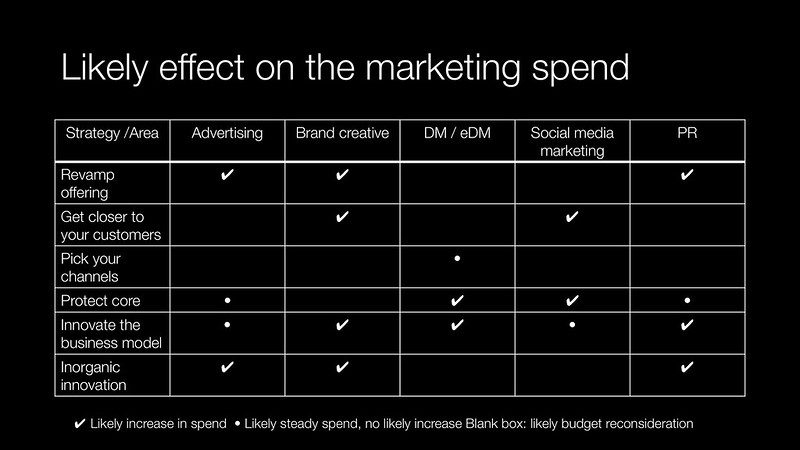
    Zero-Based Budgeting

    Where you see ticks, that’s when the marketing tool (PR, advertising etc) will do the most good.

    The Holmes Report and WARC have collaborated so that if you have a WARC subscription you can access award winning case studies and learn from campaigns that have solved similar problems to the ones that you face. None of the industry organisations or communications have distilled this kind of data down into a comms agency equivalent and Binet and Fields.

    Desk research

    • Videos – its amazing the insights you can pick up from observing YouTube videos
    • White papers – I have become a pack rat for these, I download everything and keep them on my machine because you never know when you might need it
    • Your own data bank. I have over 40,000 site links to content that I’ve found of use in the past. It’s where I go to before DuckDuckGo since I already know its of a certain quality. I use a social bookmarking tool called Pinboard

    Academia

    Both Scopus and Google Scholar have got great resources on social science based research. In addition, Wolfram Alpha is a really good sources of validated data points. The British Library can also be a treasure trove of content.

    Articles

    • Blog posts (like this one)
    • Free and paid resources for example: Apollo Research, Business Insider Research / Contagious / Datamonitor / D&B Hoovers / Ebiquity / Emarketer / Economist / EIU / Financial Times / Forrester Research / Gartner L2 / Global Web Index / IPA databank / Kantar / Lexis Nexis / Little Black Book / Mintel / Nielsen / Pew Research / Statista / WARC / YouGov
    • Management consultancies in particular McKinsey do a wide variety of research
    • Other planners (for instance here’s an article that I wrote about trends in the beauty sector)
    • Trade bodies (particularly good examples are the GSMA Intelligence and CES)

    Government statistics bodies

    • CIA World Handbook
    • EuroStat
    • Government national statistics offices (Wikipedia has a great category page that points you to the right countries and regions for these sources)
    • IMF
    • UN Statistics Division
    • World Bank
    • World Economic Forum

    Social listening data

    Social listening data needs to be used with a certain amount of caution. It is a measure of the level of discussions around a given subject but not the sum of them. Some of them are likely to happening in real world settings, many in ‘dark social’ – social interactions that tools can’t see.

    As a rule of thumb in European countries there tends to be less B2B social discussions going on than the US. For consumer brands there has been some good work done to show how social media listening attributions (volume, share of voice, sentiment etc) can approximate to brand tracking.

    Primary research

    This could be everything from:

    • Quantitative focused research: running a quick and dirty survey on Survey Monkey, a reputable omnibus survey provider like Dalia Research, Kelton Global or YouGov through to commissioning a piece of bespoke research
    • Qualitative research: eye tracking, focus groups, interviews, neurological scans to analysis response to stimulation, observational research, video diaries
    • Field trip: go out with sales people, meet clients, walk around stores and notice what people do, strike up conversations in stores or trade shows. The art of the flâneur is made for the planner

    More information

    Academia

    British Library – getting a reader pass

    Google Scholar

    Scopus (paywall)

    Wolfram Alpha

    Best Practice

    How Brands Grow What Marketers Don’t Know by Byron Sharp

    How Brands Grow: Part 2: Emerging Markets, Services, Durables, New and Luxury Brands by Jenni Romaniuk and Byron Sharp

    The Long & The Short of It: Balancing Short Term and Long Term Marketing Strategies by Les Binet and Peter Fields

    Other

    FT Graphics

    World Economic Forum reports

    Governmental organisations data

    CIA World Factbook

    Eurostat

    IMF Data

    UN Statistics Division

    Wikipedia category page on national statistical services

  • Digital Rx + more things

    Digital Rx – JWT Intelligence – Digital Rx covers a wide range of services from telemedicine to AI mediated diagnosis and everything in between. Pharmaceutical companies are looking a digital companion app functionality to help keep patient adherence high. I only hope that they’re not as much of a car crash as the first lot of apps like Babylon Health

    China’s new creatives – JWT IntelligenceThis new wave of consumers recognizes China’s rising economic status and thus possesses an acute sense of national pride; no longer are they reliant on Western fashion brands and influence to define how they express themselves as individuals. Yet the world is small, and despite crackdowns on international cultural imports like hip-hop and K-pop, there are echoes in China of what defines Gen Z tastes abroad in the streetwear, beauty, art, luxury and online landscapes. This is channeled through a powerful new creative lens

    High-art airports – JWT Intelligence – air travel need to lift its image after the TSA experience post 9/11 and discount airlines dragged it into the gutter

    Making Connections: 53 Teenagers Suggest Creative Ways to Link School Curriculum to the World of 2019 – The New York Times – great reading (paywall)

    Empire.Kred | Grow your Social Audience – gaming Facebook likes to drive engagement numbers. Not great for marketers but might benefit media companies on Facebook in terms of impact on reach

    Disgraced Korean Air Heiress Regains Executive Job – The Chosun Ilbo (English Edition): Daily News from Korea – Business > Business – surprised that they’ve pushed this through so fast

    Japan’s Hometown Tax | Kalzumeus Software – one of the best examples of cultural insight led marketing campaigns

    Agencies must redress decoupling damage | WARC – creative opportunities are lost without media thinking and media thinking needs to incorporate context that is so important for creative. Media also needs to fix basic hygiene issues

    Code Red | Logic Magazine – the nature of Chinese innovation versus US innovation

  • Tide Super Bowl ads + more

    Tide Super Bowl Campaign

    A little bit old, but this Mark Ritson advertising case study of Tide Super Bowl campaign is must watch material. I like the Tide Super Bowl campaign as creative and media planning came together.

    The ad industry insider in me liked the way the Tide Super Bowl campaign spoofed various genres of advertising. More marketing content here.

    Lowersumerism

    ‘Lowersumerism’ by Box 1824 reflects on the tension between environmentalism and consumerism. Manufacturing, advertising and consumption are a virtuous cycle. Individuality drove the process further forward. What Lowersumerism doesn’t provide is a viable answer or approach to consumerism.

    National Film Board of Canada

    Amazing collection of modern culture for the commons – Watch 3,000 Films Free Online from the National Film Board of Canada, Including Portraits of Leonard Cohen, Margaret Atwood & Jack Kerouac | Open Culture 

    The quality of the content that has been made available by the National Film Board of Canada is stunning.

    Recycling robot

    MIT put out this demo of a recycling robot. It doesn’t answer challenges such as laminate packaging, but it’s very interesting in terms of its automation of sorting. In a lot of countries this sorting process is often done by hand with a limited amount of machine input. Recycling supports some of the poorest people in the world’s societies.

    Fall or Dodge In Hell

    Author Neal Stephenson has been promoting his new book Fall or Dodge In Hell and as always the talk is well worth listening to. Stephenson’s work has the eye for the human condition like Douglas Coupland. But he marries this with a great understanding for mathematics and technology. Fall or Dodge In Hell riffs on characters from his previous book Reamde.

    In this reading he talks about myths and storytelling as an operating system for the human mind and optimised sleep.

  • Beauty trends

    Beauty trends is a bit tricky – there are generational and cultural aspects to beauty and standards. I’ve tried to tease out elements that will ripple around the world.

    Digital Beauty

    Chinese women use Meitu and other beauty apps to present the best versions of themselves with a virtual makeover. This goes from skin quality, skin tone and make-up to a full virtual plastic surgery style makeover.

    Meitu has 63 apps and 2 mobile websites as it expands internationally.

    Meitu beauty cam

    Meitu has collaborated with over 100 make-up brands including L’Oreal, Guerlain, Lancôme, Estée Lauder, and Shiseido.

    Meitu is only the tip of the spear. Smartphone manufacturer Huawei has provided a simple beauty mode in its default camera app. Chinese video streaming software provides a similar functionality for performers. Even Skype had trialed a digital make-up service in association with Shiseido.

    Authenticity

    There is a tension between the trends in authenticity and some of the developments that we’ve seen in beauty.

    On the one hand there are the clean and effortless beauty movements that taped into a wider consumer trend around natural.

    On the other hand you have the Korean ten-step beauty process popularised over the last decade and digital beauty apps – particularly from China and Korea.

    In the case of digital beauty and instagram filters critics claim that a new form of dysmorphia seems to be emerging. Its the difference between what they see in the mirror and on their smartphones.

    That dysmorphia is one of the things that has driven a move towards authenticity. In the West, wider moves around everything from trans rights to the body positive movement has redefined what make-up does.

    Punk

    Whilst most people think of punk and associate it with tourists taking pictures in Camden, the Sex Pistols and Vivienne Westwood. But the biggest impact of punk was the rise of independent media from fanzines to record labels. We’re seeing a similar DIY approach in the beauty industry. Big beauty companies are being challenged by independent companies with a narrow or even singular product focus. There are a number of perceived advantages to these independent brands:

    • Perception that niche brands spend less on advertising and more on research and development; these products can be considered more specialised and effective
    • Niche beauty brands can have greater social currency in terms of being an element of self expression and part of friend-to-friend recommendations

    In China, you see a greater interest in these independent niche brands from men than female consumers.

    Diversity

    Traditionally make-up has been an additive process to conceal and cover up blemishes, flaws and signs of ageing. Modern make up is about celebrating quirks and even flaws. This goes beyond beauty spots to female baldness and skin conditions. Effortless make-up is often an artfully constructed look where the person rolled straight out of bed.

    Beauty from the inside

    Beauty from the inside has a mix of socio-cultural aspects to it. In China it includes focusing on quality sleep to reflect in beauty regimes. The key thing for most brands is the ingestion of ingredients. Where are the lines drawn between make-up and the health-like claims of functional foods? Could we see licensed pharmaceutical products as cosmetic aids like currently happens in China? Here’s that the Hong Kong Trade and Development had to say about ‘cosmeceuticals’ in their report on China’s Cosmetics Market:

    Cosmeceuticals, especially Chinese herbal cosmetics, are opening up a new territory in the cosmetics market. It is understood that more than 170 enterprises have tapped into China’s cosmeceuticals market to date, many of them renowned pharmaceutical companies in China, such as Tongrentang and Yunnan Baiyao. Cosmeceuticals only have a market share of about 20% in the mainland at present. In Europe, the US and Japan, cosmeceuticals have a 50-60% share. It is believed that China’s cosmeceuticals market has much room for development. As young consumers begin to concern themselves with the ingredients and quality of products, consumption of cosmeceuticals tends to start at increasingly early ages. While cosmeceuticals have medical properties, they are classified as cosmetics since there is still no official definition for the term ‘cosmeceuticals’ on the mainland.

    China’s Cosmetics Market – HKTDC Research

    Natural

    Natural has affected the food industry and this has extended to beauty trends Younger consumers are interested in products that don’t contain ingredients that sound synthetic. The lack of artificial ingredients a key selling point. Instead they expect natural and botanical ingredients.

    A natural output of this trend has been a rise in home manufactured cosmetics supported by an eco-system of how-to videos on YouTube.

    Ageing

    The population of the developed world in both the west and east is aging. This means that gen-y and gen-z obsessed beauty marketers are having to adapt to an ageing audience. They have the disposable income and the demand for beauty products.

    Brands are adapting their

    • Products and formulations
    • Packaging
    • Language – you know longer see ‘anti-aging’ used on many product descriptors, despite that being essentially what the products ‘do’

    More information

    Digital Watch: How Chinese Millennials & Gen Zers are Re-connecting with Their Elders | Jing Daily

    App Annie data on Meitu

    Shiseido’s New “TeleBeauty” App , A Virtual Makeup Solution for Online Meetings | Shiseido News Releases

    China’s selfie obsession | The New Yorker

    China’s Cosmetics Market – HKTDC Research

    92% of Chinese males prefer niche beauty brands: report | Campaign Asia

    The future of skincare – Spencer Schrage, Ogilvy Consulting

  • Immediacy as a problem

    Immediacy is a relatively recent phenomena for consumers. It has changed the work and personal lives of consumers. It has eroded the barrier between work life and home life. It has redefined our support networks and friendships.

    Before I wrote this post, I had conversation with a friend working on a project in Singapore who’d had an eventful few days. With zero thought I was able to see if he was online and reach out and see how things were going.

    I’ve worked with clients who seem to email or message around the clock. For a while Snapchat streaks of several days were a thing – highlighting extreme immediacy in consumer behaviour.

    What did life before immediacy look like?

    I can remember the start of a working life without the mobile phone, or email. Fax machines were not items generally found in homes. You could buy them in Argos or the Viking catalogue with cheap thermal printing technology.

    Sky had launched their analogue satellite business, but there also fanatics who had directed dishes. They were a very expensive version of radio hams and CB radios.

    Satellite and cable TV meant choice. Some channels specialised and CNN specialised in constant news from around the world. Its ability to report events in near real-time came into sharp focus during the first Gulf War. Like most Europeans to me CNN was an idea, I didn’t actually have it in my own home. But it gave a deceptive taster of what always-on connectedness actually meant.

    Home computers were distinct and separate platforms from business computing. Dragon, Sinclair Research, the Commodore 64 and Amiga. Atari moved into computing and saw success with the ST. Windows and Mac had only started to weave its way into European households.

    The cassette was starting to be challenged by the CD in terms of personal media. The CD burner would arrive in mainstream homes a little bit after the Mac and the PC; right around the time of consumer dial-up internet access.

    Personal communications meant:

    • A phone card that worked in telephone boxes
    • A telephone extension fitted with a nod and a wink by friend who’d worked at the phone company

    There was no free local calling so the American gen-X behaviour of spending the evening on the phone to your friends didn’t happen so much in the UK and Europe.

    Do-it-yourself culture meant:

    • Fanzines created on a photocopier
    • Setting up an independent record label
    • Running a club night

    For medium and large companies there was an internal mail system. Mail would be exchanged between sites via a courier service overnight. The package would be opened and then distributed by an internal mail room.

    I worked in the oil industry at the time, so we could do international communications through telex. Telex was a legal document. The best analogy I had for it would be if your office had a collective email address. When a message came in, these would be printed and then distributed by the internal post system.

    Communications was a batch process for workers. In terms of importance as a task; communications was something that happened alongside the rest of your job. You might open your post mid-morning. You’d drop off any internal mail to a wire basket by reception by mid afternoon.

    Immediacy in communications started first with PBXs (private branch exchanges). The office phone on every desk and at each point on a production line changed things. Direct dial out changed things up, you could phone suppliers directly. You could arrange for information to be sent to the office or work site fax machine. Receiving a fax would be a big event in your day. You’d wait by the fax machine to receive it. Later on as fax traffic increased; you’d get a call from reception to pick up your fax.

    Now, many modern workspaces don’t have office phones, or if they do – they aren’t well maintained and on the way out.

    Bigger companies had office phones paired with a voice mail system and ‘while you were out’ Post-It notes were a thing.

    While you were out

    Mobile phones changed everything. My first mobile phone was a luggable phone that looked more like a piece of military equipment. It was used when I would be driving away from the office in a company car. The phone was strapped into the passenger seat.

    Smaller models changed the game for sales people, plumbers and mobile locksmiths. I bought my first pager whilst at college. It was a text messenger where people would leave a message with an operator and this would be then sent on to me. Occasionally I didn’t get a message, it wasn’t as reliable as SMS is now.

    In enterprises, internal email came along with the use of mini-computers. The first email account that I used, communicated internally. It ran on a DEC VAX mini-computer and I accessed it via VT100 terminal emulator running on a Mac Classic.

    Very few people used email in the company. It was easier to get things in and out of the fax machine. Memos went on bulletin boards, people called each other or walked around the site.

    In the US, free local calls, saw the rise of dial up services like AOL, Prodigy and CompuServe as a mass consumer service. Chat rooms might have been the reason why people signed up. Computer-based email and messaging quickly became the killer application.

    In Europe the rise of 2G or GSM phones and SMS played a similar roles. My first personal mobile phone, came with SMS. At first it wasn’t much use, but when I moved down to London and started working in agencies I could message colleagues.

    Businesses got on the internet. Companies used pre-internet protocols to exchange stock and financial information between sites. Often it was creative businesses first. ISDN lines offered a way of sending artwork directly to printers in a secure manner. It was a small perceptual jump to move from ISDN exchange to internet usage.

    These businesses usually had a single email account for the business that was checked twice a day if that.

    At college I got a glimpse of the future. We had internet over the JANET system. Liverpool had its first cyber cafe with a decent expresso machine and homemade carrot cake. I signed up for a Yahoo! account prior to leaving college. I wrote my emails as text documents on a Mac and took them to Liverpool on a Saturday. I would spend an hour sending my emails, keeping in touch with friends and applying to jobs I’d read about. I’d find out about jobs in The Guardian newspaper or marketing magazines. It was around about this time that I started buying the US edition of Wired magazine. It’s neon typography promised a cyber-utopian future.

    Immediacy – the problem

    At the time we didn’t see immediacy as the issue.

    The problem was time keeping. Before the mobile phone, you would show up on time to a pub or a bar. But with SMS you could let people know if you were running late.

    The second bug bear was information overload. It took as little effort to copy in 20 people on an email as it did to send it to one person. The web was still frustratingly slow. The speed that pages would load would grind to a halt when America woke up.

    Yahoo Office Attachments Screengrab

    There were no social norms and ettiquette. Memes came around as attachments to emails, clogging up your account. Yahoo! used to have a section of meme-worthy videos and images on its site called ‘Office Attachments’ in a nod to this habit. Everything would be shared; a watershed moment was the Claire Swire email.

    It was around about this time that people started to question the impact of communications had on productivity. It was certainly more convenient, but you lost a corresponding amount of time wading through your email inbox.

    There was also a corresponding expectation in a faster response because of the convenience. So what did we lose? We lost time. If we think about CNN and other 24 hour news channels, it is easy to see what was lost through immediacy:

    • Editorial space to make sense of things
    • Analysis rather than talking heads
    • A bigger perspective rather than just ‘the now’, all the time

    In agencies, the situation was rather similar. I was chatting to a senior person in client services at a major advertising agency. To paraphrase that they said: client service was better without email. Why? Because:

    • It gave them time to get things done
    • To make things happen
    • To investigate the best options
    • To craft an appropriate considered response that would be to the benefit of all parties
    • It allowed emotional reactions on all side to subside
    • To get the bigger picture in a way that isn’t possible to the same extent now

    Instead things get escalated to senior executives so they can be talked about in-person or over the phone.

    Technological snake oil

    Having started my agency career working in the technology sector, I have a good idea of how the sales cycle works. Each new generation vendor finds ways to deal with unintended consequences of the past. The rationales have generally stayed the same.

    • Productivity – but they often mistake productivity for the illusion of immediacy. Something happening now! It doesn’t matter what it is, but the feeling that something’s moving
    • Speed (or agility) – the idea that immediacy engenders some sort of superior performance in a reinvention of Taylorism for bureaucracy
    • Scalability – that it will cater with no growing pains for any size of organisation
    • Reliability – it will work regardless of whatever happens… until it doesn’t. It creates the illusion that it isn’t the system thats wrong, but the individuals. The reality is that the process design in the application usually doesn’t capture all scenarios

    In communications there has been a plethora of systems.

    • Digital All-In-One
    • WordPerfect Office
    • Microsoft Office
    • Novell NetWare and GroupWise
    • Microsoft Exchange and Office
    • Lotus Notes
    • Oracle BeeHive

    Slack is the latest in a long line of collaborative tools. But it spreads the communications like peanut butter rather than reducing to an optimal level of information. This is not Slack’s problem. For what it is, its a well designed application. The problem is that we still think immediacy is cardinal.