Innovation, alongside disruption are two of the most overused words in business at the moment. Like obscenity, many people have their own idea of what innovation is.
Judy Estrin wrote one of the best books about the subject and describes it in terms of hard and soft innovation.
Hard innovation is companies like Intel or Qualcomm at the cutting edge of computer science, materials science and physics
Soft innovation would be companies like Facebook or Yahoo!. Companies that might create new software but didn’t really add to the corpus of innovation
Silicon Valley has moved from hard to soft innovation as it moved away from actually making things. Santa Clara country no longer deserves its Silicon Valley appellation any more than it deserved the previous ‘garden of delights’ as the apricot orchards turned into factories, office campus buildings and suburbs. It’s probably no coincidence that that expertise has moved east to Taiwan due to globalisation.
It can also be more process orientated shaking up an industry. Years ago I worked at an agency at the time of writing is now called WE Worldwide. At the time the client base was predominantly in business technology, consumer technology and pharmaceutical clients.
The company was looking to build a dedicated presence in consumer marketing. One of the business executives brings along a new business opportunity. The company made fancy crisps (chips in the American parlance). They did so using a virtual model. Having private label manufacturers make to the snacks to their recipe and specification. This went down badly with one of the agency’s founders saying ‘I don’t see what’s innovative about that’. She’d worked exclusively in the IT space and thought any software widget was an innovation. She couldn’t appreciate how this start-ups approach challenged the likes of P&G or Kraft Foods.
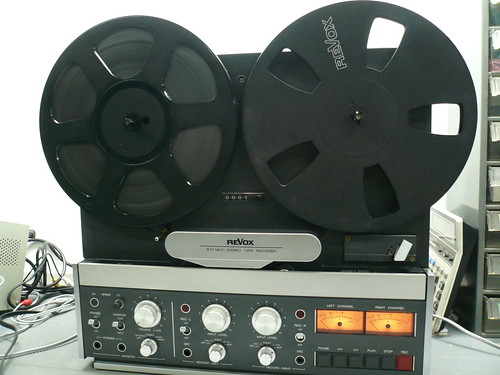
When I started off having an interest in DJing I went around to a a friend’s house whose older brother was into audio engineering. As well as having one of the first set of Technics 1200s I had ever seen he had a Revox B77 tape recorder. He used to record tracks on to the tape reels and then splice the tape to make tracks longer by extending breaks, or extend the breakdown or vocal hook of a track into staccato repetitions; which sounded like Max Headroom-esque stutters of vocal hook or ‘machine gun’ drum breaks.
Splicing tape took patience, practice and a modicum of skill to achieve. At the time however it was the Revox B77 tape machine itself that I fell in love with. These machines were made in Switzerland and felt like they were hewn from aluminum. Even the buttons were solid, giving positive feedback through a satisfying clunk when pushed and the VU meters glowed with a warm light and needles danced as the sound levels went up and down. As interfaces went, the analogue controls of the tape machine have yet to be beaten by anything that Apple has come up with. All of this belied the complex engineering that happened inside. All of this engineering expertise turned out machines that were about the best recorded sound that money could buy. Many artists today record digitally, transfer on to an analogue tape machine like the B77 and then master back to digital for CD manufacture and iTunes reproduction because of the way analogue treats sound.
Revox was a consumer facing brand of Swiss professional audio manufacturer Studer (now part of Harman International) and much of that professional engineering went into the Revox products. The Revox tape machines were professional ‘wolves’ in consumer electronics ‘sheep’s’ branding.
The B77 series of machines came out in 1979 and sported full logic controls (which made things smoother) and direct drive motors (which meant that everything got up to speed faster), but otherwise improved on the A77 of the late 1960s. The machine used 10 1/2 tape spools to make its recordings on with a tape throughput of 15 inches per second on most models which was the professional master recording standard and one could vary the speed up to over 20 inches per second if you wanted to – this operated a bit like pitch control on a Technics SL-1200 turntable.
The B77 series came in a number of guises:
The LS ran at low speeds for radio stations and call centres that needed to log everything that happened
The basic model which ran only at consumer speeds
The HS which ran at professional tape recording speeds
The PR99 (Mk I, II and III) which were designed to be more edit friendly and had less knob controls which could get in the way of the manual tape splicing process
All of this engineering came at a cost and the Revox B77 weighed a proverbial ton (actually closer to 20Kg for the machine itself plus whatever you carted it around in, like a studio rack or a flight case)
Quarter inch tape recording isn’t dead, the tape is still made around the world by Quantegy, RMGI, ATR Magnetics and Jai Electronic Industries. Otari Inc still makes an analogue studio master machine and Denon still sells a similar machine for broadcast purposes in Asia.
In addition, high end studios still use multi-track digital reel-to-reel machines when you want to record to 48 tracks as the time code technology and audio encoding technology used in them is superior to more modern computer-based solutions. More related content can be found here.
Ferdinand A. Porsche, 76, Dies – Designed Celebrated 911 – NYTimes.com – Butzi Porsche dead. Butzi Porsche came from a family of engineers. His grandfather led the original team behind the Volkswagen Beetle. His father had been part of that engineering team and went on to found what we now know as Porsche. However, Butzi Porsche wasn’t engineer but a designer with technical chops. After an infamous meeting of the Porsche family, no members were allowed to work at Porsche. Butzi Porsche didn’t get to do more after he designed the 911. Instead Butzi Porsche started Porsche Design. Butzi Porsche did product design for other companies. Porsche Design also came out with its own products with Butzi Porsche designing watches, glasses and more. Butzi Porsche resigned from Porsche Design in 2005 due to ill health.
Why Are So Many Americans Single? : The New Yorker – single living was not a social aberration but an inevitable outgrowth of mainstream liberal values. Supported by modern communications platforms and urban living infrastructure: coffee shops, laundrettes
Kraft break-up yields marketing shift: Warc.com – the break-up is ironic when you look at the trouble they went to, in order to buy Cadburys and then break their business down broadly into Cadburys + Jacobs Suchard vs Kraft US.
HK’s rich hesitate to have babies | SCMP.com – interesting takeaways: didn’t want the emotional commitment, time poverty, financial stability / too small a living space and concerned about the local environment not being suitable for children. It was interesting that the education system was given such a hard time, given that it’s better than the UK system (paywall)
agnès b. | VICE – great interview with French fashion designer agnés b
Marketing
Fueling the hunger for The Hunger Games – The New York Times – really interesting comment: …during the 1980s you bought the poster and once a year went to a convention and met your people for something like Star Trek (and Star Wars). It misses out the fact that you are likely to have had real-world friends that you would have talked about it with as well – marketers now seem blindsided to the real-world
I had delayed writing about this as I had a busy run-up to Easter and just about everyone of note in the Bay Area seems to have weighed in on the Facebook Yahoo legal case over patents. Fred Wilson (aka A VC) channeled the concern that the start-up community in general over wide-ranging patents being a tax on innovation.
The new, new thing
There is a certain amount of prejudice inbuilt against incumbents going on; Silicon Valley doesn’t make big money from existing large businesses but the new, new thing – for example:
IBM vs. Apple, VisiCalc, Oracle and countless Boston corridor enterprise technology brands before them
Beckman Instruments vs.the traitorous eight who went on to found just about every other semiconductor company from the late 1950s through to the early 1970s: Fairchild Semiconductor, Intel, Intersil, AMD, National Semiconductor, LSI Logic and venture capital firm Kleiner Perkins
Microsoft vs. Apple, Oracle, Sun Microsystems, the open source community
Google vs. Facebook and just about anybody else looking to make money from online advertising
Monomyth archetypes
I don’t necessarily hold this against them, it is the classic tale of David and Goliath that resonates at a deep level in the human psyche. It probably helped us move beyond being slightly smarter than the average ape and turn our use of tools into a decisive advantage with humans becoming the apex predator throughout the world.
What a lot of these arguments are failing to do is look at the underlying form in the Facebook Yahoo patent case:
Yes, the patent system is broken
Yes, Yahoo! has multiple business issues which would merit a series of posts in it’s own right
Yes, Yahoo! is unlikely to survive at least in its present form. Though for reasons that I have gone into previously I don’t think that Microsoft is a suitable suitor (just look at what has happened to its continued inability to match Yahoo!’s previous returns on search with Microsoft AdCenter) and more controversially I didn’t think that it was serious about its takeover bid first time around
Yes, Yahoo! is likely to be outmaneuvered by Facebook and be on a hiding to nothing
But for me, the story isn’t about Yahoo! or the inequitable nature of patent laws, but about Facebook and its business practices in relation to data.
Facebook Yahoo case similar to 1990s Microsoft practices
In the 1990s file formats: .doc, .xls, .ppt and others were used by Microsoft to leverage a competitive advantage. Competitor applications couldn’t open them; so your information was locked into using Microsoft Office software. This was one of the reasons why the web was so transformational; HTML opened up publishing of documents that had been previously locked into Microsoft Office – electronic versions of scientific papers, price lists etc.
Data portability is the document format of web 2.0 (or social web). During my time at Yahoo! we introduced the requirement to sign into Flickr using a Yahoo! ID, Stewart Butterfield and the team at Flickr worked hard to ensure that existing Flickr customers who didn’t want to have a Yahoo! ID could move their pictures off the service.
The idea was that the customer’s data was their property and allowing them to freely move was as American as apple pie, capitalism and the free market. Allowing customer’s data to be portable fitted in with the web being free as in speech ethic that had predominated up until then. Portable customer data kept you honest and encouraged you to innovate as losing a customer was only one export click away.
In the case of Facebook; the data that really matters is your address book. Whilst Facebook eventually allowed consumers to download their profile information (after it had gained hegemony in the US social network sector), it holds on fast to your address book. Om Malk over at GigaOM wrote a really good post on how Facebook leeched off Yahoo! user’s address book to build its business, but didn’t allow Yahoo! users to transfer data back the other way.
This had a detrimental effect Yahoo!’s already weakened business. It wasn’t only Yahoo!, Facebook did the same on Plaxo and has been in conflict with Google over the same issue. In the Yahoo! patent case; Yahoo! is in the position of shooter and patsy – but like the dreams of conspiracy theorists looking for a dark hand moving the pieces around the board – Facebook is responsible.
So consumers and some companies got screwed on their address book; but what the great and good of the start-up community who criticised Yahoo! forget is where Yahoo!, Plaxo and Google have gone before their start-ups could be tomorrow. The problem is the over-reliance on Facebook Connect as a federated ID and as a marketing tool using consumer news feeds in their word-of-mouth marketing campaign strategies.
Federated identities
Federated IDs are not a new concept, Microsoft tried to have their Passport technology adopted in a similar way some ten years ago and it was stymied because of early adopter and technology sector mistrust.
Like Facebook, the businesses adopting Facebook Connect usually rely on some sort of advertising-related business model, either for their revenue, or for garnering customers; yet with Facebook Connect – Facebook holds all the cards on targeting information that means:
Your advertising platform will always be worse than Facebook’s because they have a better customer view – as we’ve seen in search this is likely to turn into a zero-sum game
For more e-commerce-based businesses, Facebook data could be used by rivals to directly target your customers – because Facebook already has your customer list. By using Facebook Connect you already gave it to them and they could even infer a good estimate of customer engagement were by how often and how long they logged in
It has the potential to be digital equivalent of the way Standard Oil used its dominant position as a buyer of railroad transportation to screw over rivals. By supporting Facebook in the Yahoo! patents case; I believe that leading players within the start-up community inadvertently darkened their own futures.
What Microsoft was like back in the day
It is hard to imagine now, but in the mid-1990s Silicon Valley was genuinely afraid of Microsoft:
Another big factor was the fear of Microsoft. If anyone at Yahoo considered the idea that they should be a technology company, the next thought would have been that Microsoft would crush them.
It’s hard for anyone much younger than me to understand the fear Microsoft still inspired in 1995. Imagine a company with several times the power Google has now, but way meaner. It was perfectly reasonable to be afraid of them. Yahoo watched them crush the first hot Internet company, Netscape. It was reasonable to worry that if they tried to be the next Netscape, they’d suffer the same fate. How were they to know that Netscape would turn out to be Microsoft’s last victim?
That was Y Combinator’s Paul Graham on Microsoft back in the day and how fear of it partly sewed the seeds of failure at Yahoo! Great ideas couldn’t get funded if they where considered to fall anywhere near the purview of Microsoft – and Microsoft wanted everything, at that time the company mission statement was:
A computer on every desk and in every home running Microsoft software
Now the vision uses softer language that also takes into account technological change with Steve Ballmer describing it as:
…enabling people and businesses to realize their full potential
Microsoft still isn’t a cuddly business by any means. Let me show you: Some six years ago I spent a weekend in San Francisco on the dime of the agency I worked with at the time. The reason why I had a free weekend was that I was originally going out there to pitch an international brief for an enterprise technology company – and the weekend should have been very busy and productive in preparation fo the pitch early the following week.
The US folks had checked the substantial non-compete list that we had been provided with by Redmond and senior clients had been checked in with and they were ok with it.
Happy days, I was put on a Thursday flight from Heathrow to San Francisco with British Airways. I deplaned, got through immigration and got a taxi into town. I went to the hotel first; dropped by bags off and washed my face and then got a taxi to our San Francisco office down near the ball park.
As I walked in the door, I could see of the office general manager getting off the phone. Apparently my trip was a waste of time; someone at head office had a call with someone at Microsoft who asked us to withdraw at the last minute as the company operated in a space that Microsoft would like to enter in the next five years.
I ended up spending the Martin Luther King day weekend at the Hotel Monaco close to Union Square and spent much of the Saturday exploring the Asian Art Museum, the then Sony Metreon centre and shopping off Haight.
The point I am trying to make is that fear is relative, Microsoft is a changed but still fiercely ambitious and competitive business.
Facebook power
Facebook is much more than Microsoft. If we look at address books as an example; Facebook bought and closed down Malaysian start-up Octazen to close the door on others using their technology to import contact lists in February 2010.
Facebook is keenly competitive in the way that Microsoft has been, but it has learned from Microsoft’s mistakes; it has lawyered and lobbied-up much earlier in its development, so with Facebook there will be no humiliating Judge Jackson trial which gifted the start-up culture of Silicon Valley a second chance.
I believe that in the medium-to-long-term Facebook will have a neutron bomb effect on the Bay Area start-up finance community and at the moment they only have themselves to blame.
Although it may seem counter-intuitive to the start-up community at the moment, fueling Yahoo!’s patent duel with Facebook may make more sense in the long run.
Gore-Tex Under Siege from Waterproof Fabric Newcomers | OutsideOnline.com – interesting how Goretex waterproof fabric stranglehold mirrors Microsoft’s position in the technology sector. Goretex was historically under threat from a number of systems that had varying degrees of impact. Hipora is a silicon coating structure invented by Korean firm Kolon, Schoeller’s C change which has temperature dependent venting, SympaTex commonly used when you see ‘no brand’ 3-layer laminate, usually lower price products that would lose margin paying for Goretex licensing. Lowe Alpine’s ceramic coated triple point fabric, but managed Goretex to survive and Lowe Alpine didn’t. There are other competitor products including I suspect that the other fabrics will become niche pieces unless they sort their marketing out. Goretex is primarily a branding exercise, that sets minimum standards such as taped seals. Much of Goretex intellectual property has been voided or circumvented.
Marketing is where the Goretex difference lies now, but it is known for a confrontational relationship with partners.
Kwok brothers arrested by HK watchdog – FT.com – Sun Hung Kai is Hong Kong’s largest property company. Surprising that they are involved as the big firms there generally keep their noses clean (paywall)
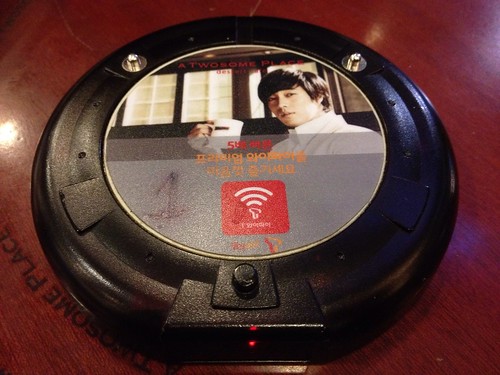
Coming from the UK, Korean customer service experience is amazing. Korea has a lower minimum wage than the UK, like China, when you pull into a filling station your fuel is pumped for you by an attendant. This means that Korean customer service often has a personal touch. However this doesn’t mean that you get table service in a coffee shop. Instead you buy your drinks and food, find a table and when your order is ready to collect a wi-fi pager usually shaped like a hockey puck starts flashing letting you know that you can collect your order.
Here’s an example of one of these Korean customer service pucks from A Twosome Place. This relies on a certain amount of social trust as you will have already put your bag down at your table may not want to take it with you to collect your order.
This would be a major flaw here in the UK where petty thieves and pickpockets are depressingly commonplace. I would imagine that that both bags and wi-fi pagers would disappear.
Generally, Korea is much safer in the UK so this isn’t too much of an issue. It an example of how technology has mediated a semi-table service experience.