Category: luxury | 奢華 | 사치 | 贅沢

Over the space of 20 years, luxury changed enormously. The Japanese had been a set of new consumers for luxury, but in terms of numbers they hadn’t eclipsed the US as the biggest market for luxury.

China’s ascent into the WTO (World Trade Organisation) made a lot of business people and politicians a lot richer. China challenged the US in terms of luxury market size. On their rise, Chinese consumers changed a lot in their sophistication as they educated themselves on luxury consumption.

These new consumers picked up new traits such as wine drinking. This also meant that luxury goods became new asset classes as Chinese money looked to acquire only the best. Chinese culture in turn impacted luxury design. Chinese new year became more important than Christmas.

Then there was the second generation money. Young rather than old consumers. Consumers who were looking for something less formal, either because they didn’t wear anything but streetwear or they worked in the creative classes rather than the traditional professions and high finance.

The industry had traditionally avoided rap artists and R&B singers, now Jay Z and Beyonce are the face of Tiffanys and Fendi had collaborated with Rihanna.

They no longer wanted to have to wear a jacket and tie to have afternoon tea at the Mandarin. They took an eclectic look more attuned to the Buffalo Collective than Vogue Italia.

You had hybridisation with the street to create a new category of luxe streetwear in a way that also owes a debt to football casual terrace wear and the pain.

Now you have Zegna badge engineering approach shoes from alpine brand La Sportiva and Prada has done a similar thing with adidas’ iconic Stan Smith tennis shoes. Balenciaga with their Speed Sock looks like a mix between Nike’s flyknit football boots and the Nike Footscape sole.

As I have written elsewhere on this blog:

Luxury has traditionally reflected status. Goods of a superior nature that the ‘wrong sort’ of people would never be able to afford. Luxury then became a symbol that you’d made it. In Asian markets, particularly China, luxury became a tool. People gifted luxury products to make relationships work better. It also signified that you are the kind of successful business person that partners could trust. You started to see factory managers with Gucci man bags and premium golfwear to signal their success. Then when the scions of these business people and figures in authority were adults, luxury has become about premium self expression.

  • Is there a luxury smartphone segment?

    There are luxury smartphones, but is there a meaningful luxury smartphone segment?

    From Apple’s iPhone price inflation to Huawei and Blackberry’s Porsche Design devices, manufacturers have looked to cater to a ‘luxury’ consumer.

    Prior to this is you had the Vertu phone with its concierge service and niche players like Goldvish catering for the the Gulf based clientele and Russian entrepreneurs. TAG Heuer tried launching its own phone.

    Pierre Cardin approach to licensing

    Prada and Bang & Olufsen had collaborations with Korean manufacturers. Even Dolce & Gabbana allowed their names to be used on a gold anodised Motorola RAZR. But these brand licensing deals rather like what Pierre Cardin were famous for in the 1970s and 80s.

    There was little input in the product beyond doing a launch.

    Luxury is an attachment

    Luxury brands have been smart enough to jump on the tech bandwagon in their product accessories. I used to have a Coach-made pouch for my Palm V courtesy of Sun Microsystems that I got given as part of a conference goody bag. (The dot-com era meant that money was thrown around willy-nilly).

    There were a variety slide in pouches from the likes of Louis Vuitton for Blackberry devices and Apple iPhones respectively. This then evolved into cases like Moschino’s famous ‘McDonald’s fries’ box.

    moschino

    Where’s the missing space?

    We know that China has become the workshop of the world. We know that Qualcomm’s reference designs, Google’s Android and Jolla’s Sailfish OS make smartphones easy (relatively speaking) to roll out.

    We also know that luxury firms are not afraid of:

    • Global supply chains and manufacturing in China
    • Attempting to step into complex manufacturing (like Louis Vuitton and Montblanc’s entry into watchmaking) or to do technology

    One only has to look at connected watches from the likes of Breitling or Louis Vuitton. Montblanc’s e-strap was way ahead of Sony’s WENA Wrist Pro Smart Watch Band.

    We know that luxury brands have moved away from the the stereotypical luxury buyer being an older western person of means to a younger Asian person with family money. That’s why we’ve seen the coalescence of streetwear and luxury brands.

    So where is the luxury smartphone? And why aren’t luxury brands embracing the space?

    Price elasticity

    I suspect that the issue is technology isn’t price elastic in the same way that luxury product categories are. Technology products by their nature are ephemeral. The benefits of technology products depends on network effects rather than exclusivity.

    In his blog post, Is the pace of technology adoption really speeding up? Nigel Scott put together evidence to show that price points and technology adoption are intrinsically linked. We are not in a state of constant acceleration of technology adoption, but instead only adopt it when the price is right.

    It would be reasonable to assume from this work that there is an inelasticity in technology pricing that makes luxury smartphones hard to sustain. It also explains why relatively low price accessories make more sense than ‘luxury’ smartphones. This seems to be a conclusion that Apple has some to (at least in China). It has rolled out discounts through third party channel members and made devices cheaper to purchase with zero interest financing.

    This makes the moves by Huawei and Samsung beyond Apple pricing with their latest phone launches a bit odd and a definite move to define a luxury smartphone segment. These must be halo effect handsets with no expectation of real profitable production; rather like Ford’s special cars like the GT-40. More luxury related posts here.

  • Legend of Old McLanden & things from last week

    BMW’s X7 advert about the Legend of Old McLanden has been cited as a piece of feminist advertising. I won’t spoil it for you watch the clip and you’ll see why.

    I think that its part of something different which has been less heralded: a return to craft in advertising. We’re starting to see a refocusing of marketing. Away from the shiny toys of ad tech and influencer networks back to advertising craft.

    The Legend of Old McLanden would fit comfortably with the golden age of TV adverts and I think that’s a good thing for brand building. Especially when we usually only see this kind of thing during the Super Bowl.

    I am a big fan of Visual Politik’s videos, but was unimpressed by this video on crypto currency. I get the attractiveness of a more decentralised internet, BUT I don’t buy into the cryptocurrency hype and believe that blockchain is at best a solution for niche problems.

    The video reminds me a lot about the techno-utopian opinions of the early web, P2P technologies etc. It has value, but it isn’t likely to be transformative in the way its implied.

    SK-II has a new instalment in its #changedestiny themed campaigns called ‘Meet Me Halfway’. This time they focused on the pressure that single Chinese women face during family gatherings for lunar new year.

    It follows on the SK-II marriage market makeover campaign done in 2016. More beauty related content here.

    Whilst many consumer brands have dashed into the influencer marketing space, it interesting that adidas have developed a contra-influencer content. It does

    Diesel’s ‘Be A Follower’ campaign took a similar line to this latest Adidas campaign.

  • Roland file trademarks + more things

    Roland Files Trademarks For 303 & 808 Designs In Germany – Magnetic Magazine – interesting reading, in particular patenting designs so long after they were manufactured. Roland files trademarks and patents aimed at trying to stop Behringer who are due to be releasing a near perfect copy of the 808 drum machine

    Why Jeff Bezos Went to Medium With His Message | NYTimes – evidence that blogging isn’t dead and social media isn’t everything

    Huawei Threatens Lawsuit Against Czech Republic After Security Warning | NYTimes.com – interesting that Huawei is trying to cow the government with legal force. Huawei’s interpretation of Chinese law seems to be different to legal experts

    An Honest Take on the Hits and Misses of SIHH 2019 | SJX WatchesBaume et Mercier’s abandoning of the silicon hairsprings that made their debut in the Baumatic of 2018. The elimination of the silicon hairspring has lowered the retail price of the watch by about €250, but that’s notable for the reason behind the retreat. According to several insiders, Baume & Mercier, and by extension its parent Richemont, was kindly asked to stop using silicon hairsprings because the intellectual property for them belongs to a consortium led by Swiss micro-engineering institute CSEM, which is in turn backed by Rolex, the Swatch Group and Patek Philippe

    Are Influencers Over? | The Daily | Gartner L2 – interesting read and contrasting approaches between Unilever and Diesel.

    5 Asian Trends for 2019 – TrendWatchingAfter decades of economic growth, rising numbers of Asians are no longer primarily focused on pursuing material wealth. On the contrary, the pressures of progress are catching up: overwork, mental health issues, apathy, and more. In 2019, many Asians comfortable with their economic status

    Meet the ‘godfather’ of China’s smartphone industry | SCMP – the founder of BBK which backs Oppo, Vivo, OnePlus, RealMe etc. More related content here.

    Cheatsheet: Snapchat is no longer adding more users (but it isn’t losing them, either) – Digiday – bots are loyal?

    WSJ City | As US and Germany draw up trade barriers, Germany fights back – makes sense

    WSJ City | Apple retail chief Angela Ahrendts leaving company – makes sense. Apple’s move into true luxury pricing has shown to be a fallacy if one looks at consumer reaction to iPhone sales and laptop pricing. A number of people I know downgraded in the range rather than follow through on MacBook Pro purchases. Also the retail presence has felt like straightening deck chairs rather than moving forwards

  • Apple and Jaguar Land Rover in China

    Apple and Jaguar Land Rover blamed the Chinese economy for their recent financial results. The truth is probably more complex. What factors are affecting affecting Apple and Jaguar Land Rover that aren’t directly related to the Chinese economy?

    The reality is that Apple and Jaguar Land Rover are being buffeted by very different forces, some of which are their own making.

    Apple

    China is a unique mobile environment and in some ways it mirrors the hopes (and fears) for the internet in the late 1990s. Oracle and Sun Microsystems spent a lot of time during the dot com boom developing technologies that would allow applications to run on the web. Enterprise software sudden had a user experience that could be accessed via a web browser. Java allowed applications to be downloaded and run as needed. Netscape had a vision of the internet replicating the operating system as a layer that would run applications. Microsoft also realised this which was why they developed Internet Explorer, integrated it into Windows and killed off Netscape. The Judge Jackson trial happened and that was the start of the modern tech sector allowing Google and Apple to rise.

    Move forwards two decades and most computing is now done on mobile devices. In China, WeChat have managed to achieve what Netscape envisioned. Their app as a gateway to as many services as a consumer would need including a plethora of mini applications. It doesn’t suffer the problems that native web apps have had in terms of sluggish user experiences. In addition, WeChat has invested in a range of high-performing start-ups to built a keiretsu of businesses from cab services, e-commerce, property companies and even robotics. In the meanwhile Tencent who own WeChat have a range of consumer and business services as well.

    What this means for Apple is that many of its advantages in other markets are negated in China. The OS or even performance of a smartphone doesn’t matter that much, so long as it can run WeChat and a couple of other apps. The look and feel of the app is pretty much the same regardless of the phone OS. Continuity: where the iPhone and a Mac hand-off seamlessly to each other doesn’t matter that much if many consumers use their smartphone for all their personal computing needs.

    This has been the case for a few years now in China – but Apple haven’t found a way around it.

    As for phone industrial design – Apple lifted the game in manufacturing capability by introducing new machines and new ideas. To make the iPhone 5, Apple helped its suppliers buy thousands of CNC machines. This grew the manufacturers capability to supply and the amount of pre-owned machines that eventually came on the marketplace. It meant that other manufacturers have managed to make much better phone designs much faster.

    That meant Chinese consumers can buy phones that are indistinguishable from an iPhone if you ignore the logo and function the same because of China’s app eco-system. Again this has been the same for a few years and has accelerated due to the nature of the dominant smartphone form factor. The second iteration of the iPhone X form factor is what really changed things. The phones were different to what has come before, but they weren’t demonstrably better. They were also more expensive.

    In the mean time Huawei and others have continued to make progress, particularly in product design and camera technology – the two areas where Apple led year-on-year. Huawei devices can be expensive for what they are, but they gave domestic manufacturers ‘brand permission’ in the eyes of many Chinese consumers to be as good as the foreigners.

    This wasn’t helped by Samsung’s missteps in the Chinese market that started with the global recall of the Samsung Galaxy Note7 battery recall. Samsung hasn’t managed to make that gap back up and seems to make marketing missteps regularly such as its recent tie-in with the ‘fake’ Supreme brand holder China. If you’re a Chinese consumer the additional value or status that you used to see in foreign handset brands is now diminished. This seems to be a wider theme as domestic brands are also making similar gains in market share compared to foreign FMCG brands. Although there are also exceptions like baby formula.

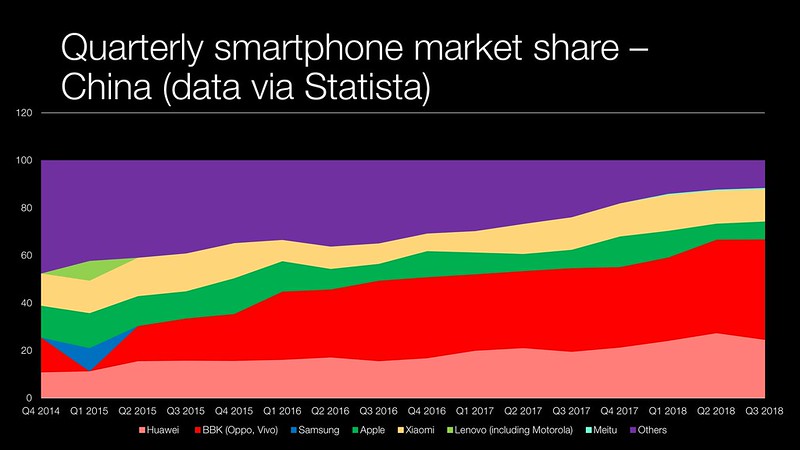
    Domestic brands have done a good job marketing themselves. BBK in particular are very interesting. Whilst Huawei makes lots of noise and bluster at how big they are, BBK creeps up. It has a number of brands in China and abroad OnePlus, Oppo, Vivo and RealMe going after particular segments. The brands are focused but run separately like companies in their own right. Apple’s marketing riffs on its global marketing (though it did a great Chinese New Year themed ad last year). This reinforces the perceived common view that foreign businesses are full of hubris and don’t sufficiently localise for China. Apple’s recent pricing strategy in a market where this is so little to show in value provided looks like the epitome of hubris.
    180120 - China smartphone market

    Finally, there has been a massive amount of consolidation of brands in the China smartphone market over the past four years. That provides for scale in terms of logistics, supply chain, design, component sourcing and marketing.

    Jaguar Land Rover

    If we move to the automotive sector and look at Jaguar Land Rover – their problems in China look self inflicted. China’s car market has declined for the first time in 20 years. But it seems to have mostly affected brands like Hyundai rather than prestige brands like Mercedes Benz or BMW. The reasons why aren’t immediately apparent. Yes diesel cars are less popular, but BMW, Audi and Mercedes make diesel cars.

    Jaguar Land Rover aren’t the only foreign brand suffering: Toyota has had problems in China since the last round of strong anti-Japanese sentiment exploded in 2012.

    More information

    Why Does WeChat Block Competitors, While Facebook Doesn’t? | Walk The Chat

    Apple’s China Problem | Stratechery

    Samsung recalls Galaxy Note 7 worldwide due to exploding battery fears | The Verge

    Samsung angers hypebeasts by partnering with fake Supreme brand in China | The Verge

    Fake News: Samsung China’s Deal With Supreme “Knock-off” Spurs Drama | Jing Daily

    Chinese car sales fall for first time in more than 20 years | World news | The Guardian

  • ICYMI | 당신이 그것을 놓친 경우

    Ogilvy consulting – the digital transformation arm of ad agency Ogilvy put together their annual trends presentation, which is worth going through. Ogilvy Consulting came out of Social@Ogilvy, Ogilvy Red and OgilvyOneMore related content here.

    About Placement asset customization on Facebook, Instagram and Audience Network | Facebook Ads Help Center – via James Whatley

    Evaluating the GCHQ Exceptional Access Proposal – Lawfare
    – great piece by Bruce Schneier and dangerous ideas. Once it can be done, it won’t be just the good guys that will be demanding it

    Jury awards T-Mobile $4.8M in trade-secrets case against Huawei | The Seattle Times – this has been going for years

    Navigating luxury in China: advice from the front line | Campaign Asia2018 was an interesting year for brands in China. It was the year of the WeChat pop-up mini program, and also the co-branded limited edition KOL collection. Standouts included collaborations between Mr Bags (the pseudonym of fashion blogger Tao Liang) with Tod’s—a collection that sold out in seven minutes—and Longchamp, for whom Liang made RMB 5 million [US$738,000] in two hours; and top KOL Fiona Xu’s collaboration with Roger & Gallet, which saw 500 limited edition pieces sell out online in minutes.

    Transformation | PMI – Philip Morris International – interesting regulatory push Philip Morris is making around smoke-free cigarettes

    Swiss Watchmakers Brace for Slowing Chinese Demand | BoF – they are are remarkably more resilient than I was expecting

    WSJ City | Poland tries to balance reliance on Huawei with spy fallout – just wait until they get into the water, electricity and railways….

    CES 2019: A Show Report – Learning By Shipping – Sit back and think for a minute that it actually got easier to turn off your lights in New York by tapping a button on smartphone and sending the off command into outer-fricking-space and back through a datacenter in Idaho than to simply send 4 bytes worth of infrared 12 feet across the room.