Category: media | 媒體 | 미디어 | メディア

It makes sense to start this category with warning. Marshall McLuhan was most famous for his insight – The medium is the message: it isn’t just the content of a media which matters, but the medium itself which most meaningfully changes the ways humans operate.

But McLuhan wasn’t an advocate of it, he saw dangers beneath the surface as this quote from his participation in the 1976 Canadian Forum shows.

“The violence that all electric media inflict in their users is that they are instantly invaded and deprived of their physical bodies and are merged in a network of extensions of their own nervous systems. As if this were not sufficient violence or invasion of individual rights, the elimination of the physical bodies of the electric media users also deprives them of the means of relating the program experience of their private, individual selves, even as instant involvement suppresses private identity. The loss of individual and personal meaning via the electronic media ensures a corresponding and reciprocal violence from those so deprived of their identities; for violence, whether spiritual or physical, is a quest for identity and the meaningful. The less identity, the more violence.”

McLuhan was concerned with the mass media, in particular the effect of television on society. Yet the content is atemporal. I am sure the warning would have fitted in with rock and roll singles during the 1950s or social media platforms today.

I am concerned not only changes in platforms and consumer behaviour but the interaction of those platforms with societal structures.

  • Ruining Oxygene

    I didn’t mean to write a post about ruining Oxygene by Jean-Michel Jarre. Instead I had hoped to write a post about the joy of having got my hands on one of Sony’s legendary D-Z555 Discman. That post will have to wait for another time.

    Jean-Michel Jarre - Oxygène (1976)
    Oxygene shot by luna715

    I had a 1980s vintage CD of Oxygene. Moving to Hong Kong had seen it go along with a lot of my other belongings. I had wanted to listen to it to hear the quality of the D-Z555. I got a new copy from Amazon. The Oxygene I remembered has highs and lows. It makes use of stereo spacing to move its sweeping sound around you. I paired it with a modern pair of Sony in-ear monitors (MDR-EX800ST) with custom Snugs ear moulds.

    This is wasn’t the Oxygene that I’d previously heard. The first thing that I noticed was the that the constant peak across frequencies on the on-board display. Then it stayed loud, when it doesn’t go quiet. So loud it made the hair stand up at the back of my neck and became uncomfortable to continue listening.

    I took the CD out and played E2 – E4 by Manuel Göttsching. But this sounded glorious and the onboard display was more what I expected. The highs, the lows. The space that allows all the instruments room to shine.

    Tried a new copy of Jean Michel Jarre’s album Magnetic Fields and had a similarly uncomfortable listening experience.

    So I went back to the Oxygene CD case. In the small writing it said that the album had been digitally remastered from the original analogue tapes. The same remastering company had also done the Magnetic Fields CD as well.

    This remastering process has been what was ruining Oxygene for me. Looking at reviews around the web, it was obvious that this process had been unpopular. Looking at the prices of Oxygene and Magnetics Fields CDs on Discogs showed that there was premium price on the original CD versions. This wasn’t just about rarity. Like Dire Straits and Sade albums, these were commonplace in CD collections.

    I delved into reading about the loudness war. I was aware of the loudness war and the effect that it had on pop music. But Jean Michel Jarre isn’t really radio play material. (Although Magnetics Fields had been used as a signature track for an Egyptian numbers station* in the past. His albums whilst popular are slow steady sellers.

    A lot of the music that I listen to didn’t need high dynamic range compression. I knew that sampled instruments and digitally synthesised instruments are naturally more compressed, lacking the peak transients of live performances. My friend Joe used to record dance music before building a property empire. His uncle was a long-time musician (ex-Mission, Pulp and Artery) who then left to record electronic music in New Mexico. I vicariously got some of my studio recording knowledge from him through Joe.

    Overall I hadn’t really been exposed to large amounts of high dynamic compression in music before. This practice of making loud music. This had started in earnest in the 1990s as digital signal processing put more tools in the hands of the mastering engineers.

    Historically compression techniques had been used creatively. Motown frequently pushed the limits of vinyl recordings, particularly 7 inch singles.

    Motown was notorious for cutting some of the hottest 45s in the industry

    Nashville mastering engineer Bob Olhsson

    Digital signal processing seems to have led to a dramatic acceleration in this evolution

    There’s a 12 to 14dB apparent loudness difference between Black Sabbath, produced in 1977 or so and transferred to compact disc in the early ’80s, and the Black Eyed Peas’ ‘Let’s Get It Started.

    Bob Katz, mastering engineer

    Both quotes were from an article written in 2005 and things seem to have got only worse. The reasons for this are myriad:

    • In-car listening and iPods were considered to blame. But the level of compression is far beyond that
    • The decline of consumers actively listening to music, using it as audio background
    • Inexperienced engineers who don’t know what good sounds like
    • Inexperienced artists think that overly compressed masters sound better

    Whilst record label A&R people were considered partly responsible for loud mixes on vinyl singles. By 2005, record labels weren’t considered to be pressuring mastering engineers for louder mixes.

    Ruining Oxygene seems to have occurred a few years later as streaming services built up steam. I remember how Yahoo! Music used to master their streams when I worked for Yahoo! Europe. They were ripped straight from CD on a desktop HP computer by whoever had time in the music team.

    All of my research into the process of ruining Oxygene seems to have been a vicious circle. Various pressures on compression lowered the bar on what was good and that went through several cycles.

    The morals contained the story for music listeners are

    • Progress doesn’t mean better
    • We have lost something with the move away from actively listening to music

    *Numbers stations are a rabbit hole that you can descend into on the internet. So rather than having to go there, here’s a potted explanation. Countries would have spies embedded abroad, often for years at a time. In order to give them instructions or information, it would be preferable to do it in a manner that didn’t involve directly interacting with the agent. Shortwave radio filled this breach. The signals carry over huge distances. The messages would be concealed in numbers, often read out using speech synthesis – which gives them an other worldly feel.
  • What consumers need + more

    What Consumers Need to Hear from You During the COVID Crisis – Harvard Business School Working Knowledge“NEARLY A QUARTER OF BRANDS HAVE GONE DARK, PAUSING ALL OF THEIR PAID MARKETING COMMUNICATIONS FOR THE FIRST AND SECOND QUARTER OF THE YEAR.” – their emphasis not mine. On the face of it that article is a good guide on what consumers need to hear most times; but I would have preferred to see that there was empirical research behind this. It relies on ‘common sense’ and smart people’s guess work / opinion to try and figure out what consumers need to hear from brands. What is undeniable is not that what consumers need to hear, but that consumers need to hear something. Media without advertising support will go under. Brands going silent are losing salience and brand consideration. Consumption still goes on. We communicate now, to influence post-COVID markets, that isn’t about what consumers need, but what brands need. More on related topics here.

    In the Battle Against the Machines, She’s Holding Her Ground – The New York Times – machine learning stuggles with things like multiple voices

    Chinese factories go to extremes to fend off second wave of coronavirus cases – The Washington Post – paywall. Interesting the kind of precautions Foxconn et al are taking to stop re-infection from decimating its workforce and shutting down their manufacturing lines

    Coronavirus Surveillance Helps, But the Programs Are Hard to Stop – Bloomberg – Two people taunted on social media for having an affair because the data showed they were at the same hotel at the same time turned out to have been there for a church gathering.

    UN’s partnership with Tencent at odds with its push for global unity – this is very dark, particularly when you take into account the hand China has played with compromising the WHO

    Thevintageknob.org • View topic – The web of japanese contractors – fascinating investigation into the complex web of sub contractors who supported the Japanese hi-fi industry

    TikTok Told Moderators: Suppress Posts by the “Ugly” and Poor – I presume this helped change the algorithms as well? It is a mirror of wider society

    Zoom admits user data ‘mistakenly’ routed through China | Financial Times – security has become a hot mess for Zoom

    What is Gen Z spending its money on? — Quartz – is it really that different?

    US prez Trump’s administration reportedly nears new rules banning ‘dual-use’ tech sales to China • The Register – ok this is going to get interesting

    Suspense – Single Episodes : Old Time Radio Researchers Group : Free Download, Borrow, and Streaming : Internet Archive“On September 30, 1962 a major milestone in radio drama came to an end with the final episode of the long running series, SUSPENSE. Ironically, the episode was titled “Devil Stone” and was the last dramatic radio play from a series that had its roots in the golden age of radio. What began as a “new series frankly dedicated to your horrification and entertainment” took on a life of its own mostly due to the talents of some outstanding producers and adaptations and original stories from the cream of mystery writers of the time. The golden age of radio was truly the golden age of SUSPENSE as show after show broadcast outstanding plays which were “calculated to intrigue…stir [the] nerves.” 911 radio plays from the 40s, 50s and 60s! SO MUCH STYLE! Honestly, I’ve listened to a few of these now and they are wonderful; great stories, great acting, and proper time travel – wonderful, and a perfect bedtime story if you’re in the market for such a thing. – via Matt Muir

    The life and timepieces of Ralph Lauren | How To Spend It – I love Lauren’s attitude to watches

    Gen Z. The Myth. The Reality. | GeometryI sometimes read out a excerpt from an article in Time Magazine to my colleagues when discussing Gen Z:“Deeply committed to the redemption of social imperfections, they have taken on a vast commitment towards a kinder, more equitable society; they are markedly saner and more unselfish than their elders.”Everyone nods respectfully, seeing images of Greta Thunberg in their mind.There’s One Phrase for the Aspirations of Gen Z that I Think is Oracular in an Interesting Way. The twist: it’s from a 1965 issue of the magazine. And they’re actually talking about Baby Boomers.

    Why Don’t We Just Ban Targeted Advertising? | WIRED – The most interesting thing is what this article misses – the questionable effectiveness of targeted advertising as opposed to smart mass advertising in the marketing mix a la Byron Sharp

    Porn platform poses as a snack delivery app on iOS – Porn is illegal in China, so one porn platform is hiding in plain sight | Abacus – interesting, how did this get through testing? Did they have a working snack delivery service up and running for testing; to get this through iOS testing in particular?

    Michel Lamunière: “Print is going to thrive in luxury and fashion” | Luxury SocietyI agree that print is being challenged in categories like news and general women’s lifestyle ­– I don’t see much of a future for those kinds of media. But with luxury, I think that, and I believe, that there will be less players in the future, and that the ones who do it right will really be able to continue to grow. So the product itself needs to be absolutely beautiful. There’s no room for average layouts and content. The content needs to be exclusive, unique, and super engaging

    Axios China – China’s v-shaped coronavirus recovery looks too good to be true – interesting PMI data that looks ‘too perfect’

    Can Taiwan Benefit From China’s Ouster of US Journalists? | The Diplomat – great opportunity for Taiwan

    Coronavirus gives China more reason to employ biometric tech – Nikkei Asian Review – (paywall)

    The Karen meme — TikTok escapism in a time of crisis | Financial TimesKarens are moms — pushy ones. They share corny inspirational quotes on Facebook, buy merchandise inscribed with “Live Laugh Love” and love to ruin teenage fun. What really marks out a Karen, however, is their capacity to complain and get their own way. If you ever worked in a shop or restaurant when you were younger, you will remember who the Karens were — they were the ones who asked to speak to your manager. – I must admit I am with the kids on this

  • Misleading ad metric + more news

    Facebook executives ‘knew for years’ about misleading ad metric | Financial TimesThe lawsuit claims that Facebook represents the potential reach metric as a measure of how many people a given marketer could reach with an advertisement. However, it actually indicates the total number of accounts that the marketer could reach — a figure that could include fake and duplicated accounts, according to the allegations. – Facebook’s misleading ad metric isn’t news in its own right. What’s interesting is that the FT article goes on to claim that potential audience size in some states were bigger than publicly available data and seemed nonsensical in comparison to say census data

    UK lays out plans for legal e-scooters, medical drones and more transportation innovation in test cities | TechCrunch – if electric scooters is going to be anything like what I saw in Paris, it’ll be carnage

    Xenophobia amid the coronavirus pandemic is hurting Chinese immigrant neighborhoods – Voxanti-Asian xenophobia and racism have become a bigger issue around the world as a result of Covid-19. As Nylah Burton reported for Vox, in major cities like Los Angeles, Seattle, and Toronto, East Asians have been targeted — from racist comments made by TSA agents to verbal street harassment. Meanwhile, Chinese restaurants across the globe say they are struggling for business because of widespread misconceptions about the “cleanliness” of their food – exceptionally dark reading

    Time Out rebrands to Time In as coronavirus ‘social distancing’ takes effect | The Drum – circumstance encouraged Time Out to rebrand, but the strong equity they have in their brand allowed them do so successfully, like Pizza Hut’s Pasta Hut or the Google Doodle

    Madison Avenue Insights | Creative agencies: winning the battle but losing the warCreative agencies have mastered the requirements of integrated campaigns, from TV to online video, websites, Facebook, Instagram, ad banners and e-mail marketing. It’s a pity, then, that this victory is being undermined by agency price-cutting strategies that leave agencies understaffed and underpaid. Senior agency executives need to create winning business practices – they’re losing the business war. – great read by Michael Farmer. I suspect the piece that’s missing is the devastation wrought by procurement

    Russian influence operations using netizens in Ghana to target African Americans – GrapfikaThe operation used authentic activists and users, fronted by an ostensible human rights NGO, to covertly propagate an influence campaign. It is not the first time such an attempt has been made, but the tactic is of concern. The unwitting individuals co-opted into the operation bear the risk of reputational or legal jeopardy; indeed, CNN reported that the Ghanaian operation was raided by law enforcement as a result of their online activities. For the human rights community, the risk is that genuine NGOs may be misidentified as being involved in influence operations by accident or malice, and there is also the danger of tarnishing the reputation of important work and organizations across the field – its a fascinating read – a mix of information ops, subterfuge and offshoring. The west African link is interesting

    The Public Interest and Personal Privacy in a Time of Crisis (Part II) – Google Docs – part two of an essay by a Chinese academic- l linked to part one in this post

    Between Privacy and Convenience: Facial Recognition Technology in the Eyes of Citizens in China, Germany, the UK and the US by Genia Kostka, Léa Steinacker, Miriam Meckel :: SSRN 

    Lao Dongyan, “Artificial Intelligence” – Reading the China Dream – piece on biometric recognition

  • Playlists and mixtapes

    Working as a remote team got me thinking about playlists and mixtapes. One of my colleagues started off a themed playlist on Spotify. The playlist creativity was based around a narrative. The narrative is driven by song title.

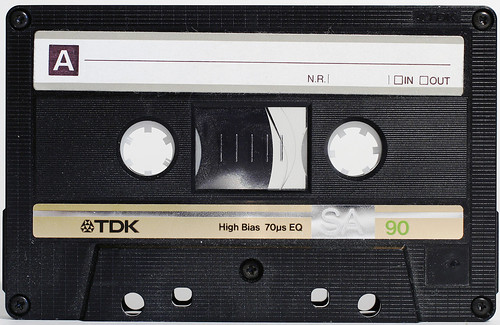
    cassette tape
    Thegreenj / CC BY-SA (http://creativecommons.org/licenses/by-sa/3.0/)

    Spotify made it easy to collaborate on putting more in there.

    Its a form of surface data, easy to see. Easy for machines to grasp.
    It is easy to analyse. Hence Spotify’s ad campaigns and pitch to advertisers based on data.

    Initially, I thought it was this data treasure trove that made me feel uneasy about music streaming services. Where other people felt Spotify’s ads were clever, I felt they were intrusive, even voyeuristic. It felt voyeuristic reading some of them.

    Music curation is a very personal thing. But in the end I realised it wasn’t the data that bothered me. Now I realise its the nature of curation and consumption on the platforms.

    Music is something that exists in everyone’s lives. For some people it was background wallpaper. It occasionally took on ‘sound track’ starring roles at important life moments. For instance, the track the bride and groom choose to dance to at their wedding. Or a one-hit wonder attached to holiday nightlife memories.

    For some people it moves beyond being a trigger. It stirs a passion. Myself and some friends have collections of records. Owning a thing has a power of its own. Digital services don’t really understand this drive.

    iTunes organisation

    iTunes in its day revolutionised digital music. It made music accessible in way that consumers wanted. But it wasn’t a perfect experience.

    For instance, someone like myself won’t necessarily follow an artist. Electronic music often sees artists change names as often as changing an overcoat.

    The producer or remixer becomes important. Tom Moulton back in the days of disco, Danny Krivit’s famous edits or London’s Nicolas Laugier (The Reflex). All of them have distinctive sounds that bring tracks to life.

    A record label becomes synonymous with a particular sound. Blue Note Records’ jazz, Strictly Rhythm’s New York tinged house music or the early rock of Sun Records. This is a mix of a curators ear, in house studios, producers and engineers.

    Yet in iTunes you could never search by remixer, or record label in the way that you could search for an artist or group name.
    Even the way iTunes treated DJ names indicated a lack of understanding. Someone like myself would treat DJ, the way rock fans would treat ‘The’ in a band name. So DJ Aladdin would come before The Beatles. But DJ Krush would come after.
    In iTunes, it ignores ‘The’ so The Beatles sit just behind The Beastie Boys. Both of them come before DJ Aladdin who is grouped with with all the other DJ names.

    Playlists and mixtapes

    iTunes introduced the concept of playlists with the iPod, but the marketing around it was creating lists for how they made you feel. Music to run by, a chillout list etc.

    In design, this was closer to a mixtape than a typical Spotify playlist. Apple worked on making them social. At one stage artists could share playlists of tracks that influenced them. Apple tried to create editorial content around it. It was an interesting idea, but discovery in iTunes was problematic.

    A mixtape is about careful curation. You take the listener on a journey, it is often meant to convey a feeling or an emotion. One of the few people that I’ve seen do this within Spotify has been Jed Hallam’s Love Will Save The Day selections. A non-verbal message.

    A mixtape was often time bounded by its medium.

    • Cutting your own vinyl record which was done on 78rpm discs might give you 2 minutes. Enough for a short voice mail home, if the record survived the postal system.
    • Reel to reel tape might give you up to 90 minutes at reasonable quality on a 10 1/2 inch reel of tape.
    • Cassette tapes were typically 30 or 45 minutes per side.
    • CDs could provide up to 80 minutes, depending on the disc. But the original ‘Red Book’ standard capacity was 74 minutes

    The playlist has no capacity considerations. No limitations that force choices or prioritisation.

    Consuming playlists and mixtapes

    A mixtape often brought a deeper experience to the listener. Whether it was an expression of love, passion or nerdiness. A playlist tends to operate much more at a surface level. This changes the dynamics of consumption. A playlist doesn’t require active listening. Its like drive-time radio. A backdrop to life.

    A playlist is often found, again rather like tuning into a radio station. It is usually a more passive consumption experience. The audience has less invested in it.

    Playlists and mixtapes business models

    This difference in attitude helps explains how music changed in fundamentally in business model. When you’re more passive, you don’t need to own your music.

    You don’t mind if tracks disappear due to licencing disputes. Music becomes a utility that you pay for each month. In this respect Spotify looks a lot like the post-war Rediffusion service.

    It’s an operating expense rather than a capital outlay for young consumers. It facilitates algorithm as taste maker which leads to a reductive path. Apple Music has tried to keep away from this. They’ve got specialist curators in niche genres. Want to hear the best of bluegrass and outlaw country? Apple Music likely covers you better than Spotify.

    If I am following your playlist, it opens up opportunities for payola. Artist brands become less important than a steady stream of releases in popular genres. Music plugging becomes an arbitrage play; streams versus promotional costs RoI. Traditional artist development no longer makes sense. Instead you end up with a model that looks closer to a fast-failure production line. More on media related topics here.

  • Attitudes to immigration + more

    Chinese attitudes to immigration. Some really interesting interviews done by Inkstone. Inkstone is part of South China Morning Post. Whilst the attitudes seem shocking, you do see them mirrored in other monocultural countries. The monocultural country has a very strong sense of self. In China this is exasperated by Han nationalism which explains Chinese attitudes to immigration. In Japan, despite a demographic crisis, attitudes to immigration has meant that the country has focused much more on robotics to solve the human labour deficit beyond manufacturing.

    Marketing in times of upheaval | LinkedIn – cites Beeston’s Law and then fulfils it

    The 1970 Osaka Expo: Looking back at the past to gauge where Japan sits in the present | The Japan Times – some of these pictures are fascinating

    SMS In Emergency Situations: SF COVID19 Updates Via SMS | Forrester Research – mature platforms work well

    Coronavirus Is A Headwind For Search Advertising, But The Outlook Remains Promising – not a terribly surprising analysis given Baidu’s recent financial performance in the Chinese New Year period

    Innovation of the Day | Heineken – alcohol free beer aimed at drivers without running the risk of drunk driving

    Augmented-Reality Startup Magic Leap Is Said to Weigh a Sale – Bloomberg – interesting that Johnson & Johnson are mulling an investment in Magic Leap

    Introducing Fluent Devices – System1 Group – is it fashion or is it a lack of effectiveness?

    cyberpunk « Adafruit Industries – Makers, hackers, artists, designers and engineers! – great series of posts on cyberpunk and its impact on culture

    Innovation of the Day | Time – letting exhiibition attendees get some sense of the experience involved in the 1963 civil rights march on Washington DC and experience Martin Luther King Jr’s ‘I have a dream speech’. VR’s real power to engage audiences is emotional experiences rather than storytelling in the way that we usually understand it. More related content here

    Persona Spotlight: Generation X – GlobalWebIndexWhile younger audiences are actively trying to regulate their digital activity – nearly 3 in 10 millennials and Gen Zs track their screen time each month – only 1 in 5 Gen Xers have done the same. Another possible reason is that, compared to Gen X, younger age groups are now using social media more passively. When on these sites, 4 in 10 Gen Zs fill up their spare time or search for funny content, while Gen Xers still flock to their social accounts with a greater emphasis on socializing. – this bit feels like they’re throwing hypotheses against the wall, planners pick your favourite

    In February Smartphone sales in China Crashed more than 50% – Patently Apple – not terribly surprising, Apple’s increase in iPad sales probably didn’t compensate for the drop

    The Public Interest and Personal Privacy in a Time of Crisis (Part I) – Google Docs – translation of a Chinese blog

    Is busy the new stupid? – hustle porn etc.

    SoftBank Vision Fund’s Rajeev Misra: 18 months will prove I’m right | CNBC – it will be interesting to see how this plays out

    Measure your distinctive brand assets | Ehrensberg-Bass Institute for Marketing Science – well worth downloading and reading (PDF)