Category: technology | 技術 | 기술 | テクノロジー

It’s hard to explain to someone who didn’t live through it how transformation technology has been. When I was a child a computer was something mysterious. My Dad has managed to work his way up from the shop floor of the shipyard where he worked and into the planning office.

One evening he broad home some computer paper. I was fascinated by the the way the paper hinged on perforations and had tear off side edges that allowed it to be pulled through the printer with plastic sprockets connecting through holes in the paper.

My Dad used to compile and print off work orders using an ICL mainframe computer that was timeshared by all the shipyards that were part of British Shipbuilders.

I used the paper for years for notes and my childhood drawings. It didn’t make me a computer whiz. I never had a computer when I was at school. My school didn’t have a computer lab. I got to use Windows machines a few times in a regional computer labs. I still use what I learned in Excel spreadsheets now.

My experience with computers started with work and eventually bought my own secondhand Mac. Cut and paste completely changed the way I wrote. I got to use internal email working for Corning and internet connectivity when I went to university. One of my friends had a CompuServe account and I was there when he first met his Mexican wife on an online chatroom, years before Tinder.

Leaving college I set up a Yahoo! email address. I only needed to check my email address once a week, which was fortunate as internet access was expensive. I used to go to Liverpool’s cyber cafe with a friend every Saturday and showed him how to use the internet. I would bring any messages that I needed to send pre-written on a floppy disk that also held my CV.

That is a world away from the technology we enjoy now, where we are enveloped by smartphones and constant connectivity. In some ways the rate of change feels as if it has slowed down compared to the last few decades.

  • Ten most popular posts of H1 2016

    In order of traffic volume, the ten most popular posts of H1 2016  on my blog (up to the beginning of June):

    1. What are the major reasons behind Yahoo!’s drastic decline – a Quora question inspired post. The reasons I highlight are a bit different to the popular media narrative around the Yahoo! business
    2. How the Panama Papers story broke online – a look at how the story broke across social media and traditional news with data
    3. What the IFTTT is going on? – IFTTT changed the way it approached development which left many service users such as me in the lurch. The key outtake is don’t trust services that you don’t pay for.
    4. Inside Virgin Atlantic’s online racism crisis – how the Chinese diaspora teamed up to highlight a racially motivated incident on a Virgin flight.
    5. On Writing – inspired by a similar post that Stephen Waddington did. We had a contrast of approaches and motivations
    6. The Trouble with Twitter – with growth stalled what does it mean for the social media platform?
    7. Yahoo! how did we get here? – similar post in many respects to to the top-ranking post that highlights missed opportunities
    8. Online advertising and technology data points – this is the April edition of a monthly (or as near monthly updates on statistics that I can do)
    9. The Smartphone Market and Huawei – analysis of Huawei’s consumer business. One can see the impact of smartphones on Huawei’s business. Huawei’s feature phone business was more successful than their smartphone business in terms of profit margin for a good while. Whilst Huawei has aspired to become progressively more  I updated it in a separate post when Huawei published its annual results at the beginning of April
    10. Everyday tools that are a part of my process part one – items that I use in my everyday workflow to create, curate content and brand strategy.
  • Google I/O 2016

    Google I/O 2016 happened on May, 18 – 20.  There had been a lot of pieces of coverage about the different products and services released. But I wanted to spend a bit of time reflecting on what Google I/O 2016 told us about their viewpoint on technology.

    Giving apps a second chance

    Google knows as well as anyone that the app moves towards a maturity model where consumers stick with the core apps that they want and then don’t go any further.
    apps
    Data shows that consumers use their top five apps 88 per cent of the time. So why would Google care when it knows that 60 percent of the top apps on the Android platform?

    The reasons for an expanded app usage include:

    • A proportion of Google’s advertising (like Facebook) is derived from the promotion of app downloads
    • Android devices are reaching market maturity in many markets, growth is likely to come from new uses – at least some of which will be derived from third party platforms
    • Google has staked its ambition in the PC sector on its Chrome operating system being able to run apps from the Android eco-system. In order for that to happen there needs to be a healthy community of developers
    • In the same way that DoubleClick’s ad network greatly expanded the inventory of Google’s advertising business, third party applications offer Google an additional source of usage for its own services. If you want to see the future of Google Apps look at the the way the likes of Baidu and Tencent allow third-party integration with their own tools

    Streaming or ‘instant’ apps is part of Google’s efforts to encourage consumer trial of new apps and enhance relationships with developers. Firebase, it’s new analytics platform for mobile developers helps them have a better relationship with their installed user base allowing them to use data to target notifications and campaigns.

    More faith in wider area networks (WANs) than personal area networks (PANs)

    Android Wear’s updates were interesting. Put simply Google has more faith in data being delivered in a timely manner over cellular or wi-fi networks than it does for inter device transfers over variants of Bluetooth. Both the Apple Watch and Android Wear products suffered from performance lags when the watch was a thin client of a phone. Having a cellular radio on board the phone presents challenges with battery life, but speeds up real world performance.

    The original design failure wasn’t down to network performance, but is likely to have implications for personal area network technology like Bluetooth in its different variants or ZigBee. These technologies are all about scale, lose a scale advantage and it poses a problem for future adoption by others. This can happen in a virtuous way. Apple’s adoption of USB benefited the standard greatly and drove interest in peripheral development for both Mac and PC. Apple’s abandonment of FireWire and the 3.5″ diskette marked their decline.

    Lots to be concerned about from a privacy point of view?

    Google Home moved yet another pair of Android powered ears into our environment. It was obvious from Google’s description of services that a paid marketing model to be the ‘car booking’ or equivalent service of Home could be very lucrative for the search giant. How this device could be used for market research, tracking brand mentions or government surveillance also poses some conundrums moving beyond smartphones to brown goods.

    Android N features file based encryption rather than treating the whole device as an encrypted disk. This raises questions around the comparative ease of access from a privacy perspective. Secondly, SafetyNet allows Google to reach into a phone to remove pre-existing applications without user permission. There is no explanation if they also have write privileges to the phone as well. If so, expect law enforcement and intellectual property owner interest. From the way it reads this would affect apps and content that have been side loaded as well as got from an app store.

    Android is giving the high ground to Apple on privacy presumably because it considers its own customers don’t care about it that much.

    Reference designs in VR to drive adoption and commoditisation 

    Google’s Daydream project looks to provide standardisation in hardware. By going down this route, Google hopes to spur on the sensor market required for improved AR experience and drive uptake. These will likely be a very different experience to the computer workstation powered Occulus Rift. Driving this technology into the smartphone market may combat the current stagnation in phone sales growth.

    More information
    Google I/O 2016 event page
    A16hz on Google I/O 2016
    Everything Google just announced at its I/O conference
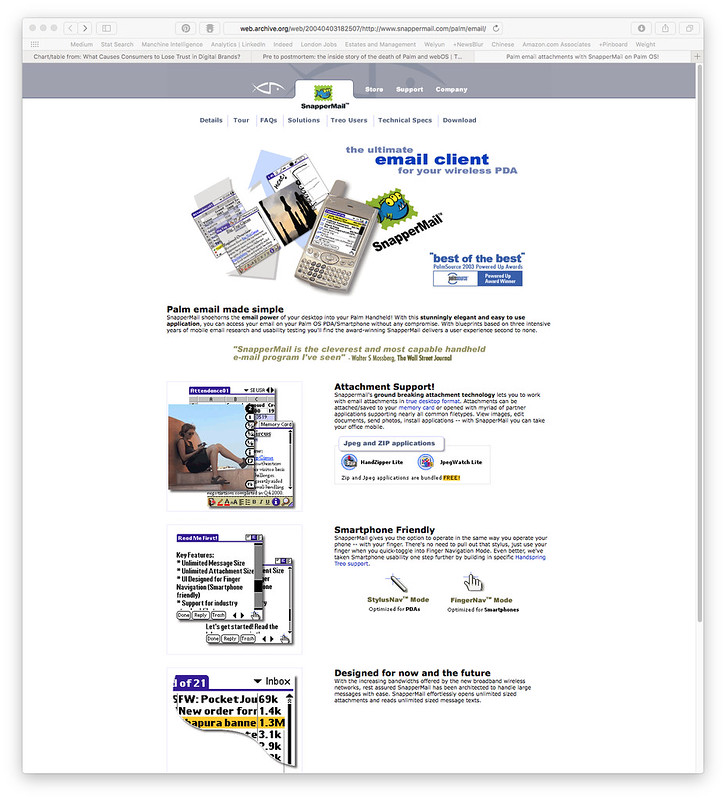
    Palm, Apple, Google and the whole mobile device thing
    The Limits of Google
    If Google’s right about AI, that’s a problem for Apple – Marco.org
    ISIS’s Mobile App Developers Are in Crisis Mode | Motherboard

  • Facebook most shared

    I managed to get hold of some data about the top 10 of Facebook most shared sites and it made some interesting graphs. From a media perspective Facebook has become less social.

    What does Facebook most shared content tell us?

    For the past year or so there has been a steady sustained decline in the amount of content shared. This even has a name internally at Facebook – context collapse.
    Facebook top ten content domains shared (june 2015 - april 2016)
    This is even more striking when I compared it with 12 months of data from January 2014 to January 2015. One can see that the trend of the graph has gone from a positive to a negative slope. Secondly, different media organisations have sailed in and out of this chart showing that even now after years of experience they don’t a consistent formula for success.

    The media landscape also started to change to more reactionary content with the rise of titles like the Conservative Tribune and Breitbart.

    What these graphs don’t explain that well is why the drop in sharing happened. Did our media consumption become much more fragmented?
    domains shared (January 2014 - January 2015)
    These trend lines partly explain media’s push into other channels like SnapChat, especially given that Twitter has hit a natural ceiling in its subscriber base.

    Perilous pivot to video

    Secondly there has been a big push into video content, particularly live video content. Video is more expensive to produce, yet monetisation is difficult. Viewability of video ads is lower than display ads. One has to wonder about the sustainability of all this video production? Especially since many of these media organisations don’t seem to have managed long term success at the top of Facebook’s eco-system.
    Viewability

    Ad fraud or ‘invalid traffic’ is higher on video advertising inventory solid via programmatic platforms – which are the hot new thing. Both of which are issues of concern to marketers and publishers alike.
    programmatic

    More on Facebook related topics here.

  • 2016 Mary Meeker presentation

    2016 Mary Meeker’s annual presentation on internet trends is a tradition within the technology sector that goes back more than two decades. Meeker used to be a sell side analyst during the dot com boom and was known as a cheerleader for the sector. Unlike Harry Blodget she didn’t come unstuck with the subsequent bust.

    More recently Meeker moved to Silicon Valley and took a job with a VC firm. Hence the reason why the 2016 Mary Meeker presentation is done in conjunction with KPCB (Kleiner Perkins Caufield Byers).

    The key themes explored in the presentation this year include:

    • Mobile – a favourite for a number of years, but with over half of all internet sessions being done on a smartphone or similar it was inevitable that it would take up a substantial amount of the presentation. Mobile is maturing which is shown in the decline in growth rate of the sector this year. Android is picking up market share due to its cheaper handsets but still lagging behind in share of profit
    • Declining global economic growth. Global debt has risen higher and faster than global GDP. Population growth is also slowing and ageing. Meeker thought that India may be the bright spot due to its demographics, but this assumes that it can get over its structural issues and take advantage of its young population. That is probably overly-optimistic because of rising hindu nationalism
    • Online advertising – efficacy still a serious issue to be dealt with. Consumers hate it hence ad blocking.
    • Social: Meeker saw the big factors being video, images and messaging
    • Voice: the rise of voice driven assistants in the home and on mobile devices. The decoupling of China versus the rest of the world is apparent in this new category.

    Here is the latest iteration for 2016

    More on Mary Meeker here.
  • June 2016 research slides

    Here is a copy of the slides that I pull together (when I have the time) of publicly available data that would be of use. This is the June 2016 research slides.

    Google search volumes

    This month I have some new data around search which came from disclosures at Google I/O in terms of search volumes. We talk about social as if search has gone out of style but its growth is still staggering. This is now driven by mobile device penetration and adoption as computing devices on the go. It also speaks to the wider number of questions that search now answers. It used to be that search answered with ‘facts’ found online. It then became more contextual with shortcuts that gave you the weather forecast or a foreign exchange rate. Mobile moved this on further to items like local recommendations.

    Partly through the search box, but also by more meta detail about the device doing the searching and its location to within a few metres due to GPS and cell tower triangulation. Voice interaction has also started to impact search volume. Image driven search still seems to be an area that could drive much more potential search volume, that would be valuable for commerce.
    Google global search volume
    Looking at global search revenue over time, Google’s monopoly position becomes immediately apparent. It is amazing how Bing and Yahoo! haven’t managed to grow market share but just transfer value from one to the other. In the Chinese market, Sohu has been obliterated with Baidu search. But one does have to wonder about the value of web search, when so much internet usage now happens in the WeChat eco-system.
    Global Search Revenues
    More details about me here.
    Slide20

    Full presentation

    Full presentation available for download as a PDF on Slideshare and you can find more research related posts here.