Category: technology | 技術 | 기술 | テクノロジー

It’s hard to explain to someone who didn’t live through it how transformation technology has been. When I was a child a computer was something mysterious. My Dad has managed to work his way up from the shop floor of the shipyard where he worked and into the planning office.

One evening he broad home some computer paper. I was fascinated by the the way the paper hinged on perforations and had tear off side edges that allowed it to be pulled through the printer with plastic sprockets connecting through holes in the paper.

My Dad used to compile and print off work orders using an ICL mainframe computer that was timeshared by all the shipyards that were part of British Shipbuilders.

I used the paper for years for notes and my childhood drawings. It didn’t make me a computer whiz. I never had a computer when I was at school. My school didn’t have a computer lab. I got to use Windows machines a few times in a regional computer labs. I still use what I learned in Excel spreadsheets now.

My experience with computers started with work and eventually bought my own secondhand Mac. Cut and paste completely changed the way I wrote. I got to use internal email working for Corning and internet connectivity when I went to university. One of my friends had a CompuServe account and I was there when he first met his Mexican wife on an online chatroom, years before Tinder.

Leaving college I set up a Yahoo! email address. I only needed to check my email address once a week, which was fortunate as internet access was expensive. I used to go to Liverpool’s cyber cafe with a friend every Saturday and showed him how to use the internet. I would bring any messages that I needed to send pre-written on a floppy disk that also held my CV.

That is a world away from the technology we enjoy now, where we are enveloped by smartphones and constant connectivity. In some ways the rate of change feels as if it has slowed down compared to the last few decades.

  • Perfect market on internet?

    Online perfect market introduction

    The train of thought on this blog post about online as a perfect market coalesced when I was re-reading Kevin Kelly’s New Rules for the New Economy for the first time in a decade. Kelly’s book built on the work done by fellow Wired contributor John Browning who pulled together The Encyclopedia of the New Economy which was published over a couple of issues of Wired magazine and as a compilation in a now out-of-print pamphlet that used to sold via the Wired web site.

    What is the new economy?

    Back in the 1990s when the internet started to move out research and academia into the commercial and consumer world lot’s of things were happening.

    The cold war had finished, television viewers had seen CNN revolutionise coverage of the Gulf War conflict and the Iraqi army had been routed largely due to technology (and overwhelming firepower). Proto-reality show The Real World was fresh, with David ‘Puck’ Rainey becoming the first reality TV villain to capture the public’s imagination. The M in MTV still stood for music; but also stood for ‘much innovative programming’; Gap had some of the coolest ads on TV and the record industry was making money like music sales were going out of style.

    Francis Fukuyama’s political philosophy tract The End of History (and the Last Man) seemed to catch the spirit of the time in terms of a utopian vision of the future, even if most of the people who name-dropped his work had never read it.

    People realised that the internet would change things, just in the same way that mobile phones had started to change everyday life (punctuality suddenly became passé, when you could phone ahead give your excuses and have a much more fluid schedule). It was going to change lots of industries perhaps creating a ‘new economy’ of online businesses. From a cultural point-of-view the new economy and the information superhighway was something to hitch one’s utopian hopes to with echoes of Roosevelt’s New Deal some 60 years earlier.

     The assumptions

    The new economy was thought to bring about what economists would call a perfect market. Consumers would have information available at their finger tips and be able to compare the price of products throughout the world to get the best deal. There were even those who thought that consumers would have software agents to do this on their behalf and companies would have their power reduced by consumers. All of this change would be brought about by connected information and the rise of hobbyist communities who often knew more about a company’s products than the company themselves. This was seen to be a logical extension based on what people knew of the power of networks.

    Consumer opportunities

    Many of the early e-commerce businesses were arbitrage plays. Boxman had complex software from IBM that bought CDs from the cheapest distributors across Europe, shipped to its warehouse in Belgium and then shipped to consumers with some of arbitrage gained reflected in their discounted price. CD-WOW.com sold CDs from Hong Kong and other markets to UK consumers at prices that were up to 25 per cent cheaper than other suppliers. In the end, Boxman was brought down by poor software performance due to IBM learning about e-commerce as they went along and eventually CD-WOW had to pay £41 million pounds damages due to a prosecution brought by the BPI under the Copyright, Designs and Patents Act of 1988.

    The ruling gave record companies a free hand to continue predation on UK consumers by supporting excessive prices on CDs compared to non-European markets. If it had been a bank instead of a record label, they would have been labeled loan sharks.

    I worked on agencyside on the launch of a comparison shopping service called Dealtime UK (it re-branded to Shopping.com and is now part of eBay) which showed the price of CDs, consumer electronics shops and compared them across a swathe of retailers. Eventually search became a big part of the comparison shopping play with Google having its product search function and Yahoo! buying Kelkoo and tapping into that expertise to roll-out Yahoo! Shopping functionality across the international Yahoo! network.

    Big Data

    The demise of the dot com era saw changes in media consumption that went hand-in-hand with the roughly 30 per cent decline in online advertising spend bottoming out in 2002. Consumers started to find their way around the web in a different manner. Instead of having there homepage of their browser  as a personalised melange of news, weather and horoscopes served up by a portal website like Yahoo!, Excite or MSN; there was instead a search box from Google, Baidu, Naver or Yandex depending where you lived in the world.

    As search engines tried to provide better results, they realised that context was important and that a record of what searches people did may make some sense of it. This data is immensely powerful. An example of how powerful it is was show by the AOL Search debacle. In August 2006, an AOL Research project put three month’s worth of search data for 650,000 users online. The data had been anonymised, but that didn’t stop the New York Times tracking down Thelma Arnold based on her search data. At the time I worked at Yahoo! we were gathering as much data each day from consumers as would be held in the US Library of Congress two times over.

    It wasn’t only search engines that had this inferred data inside it, other businesses like Amazon had been gathering information about consumer’s preferences towards different products. Netflix like AOL released anonymised consumer data into the public as part of a programme to crowd-source a better recommendation algorithm. Privacy concerns were raised following work done by the University of Texas and Netflix pulled the data set following an agreement with the FTC.

    Web 2.0 impact on the perfect market

    The web as a platform or web 2.0 came about out the ashes of the dot.com crash. The idea was that the web, had become a web of data that could be used through APIs to build new services and become more useful through mashing the data up. The key concepts that pioneers focused on was making the data usable and ensuring attribution of the data sets – (I’d recommend having a look at Tom Coates’ Native to a Web of Data presentation as a primer.)

    One of the key things about this was that a number of the pioneers in this area like Flickr’s founder Stewart Butterfield said that APIs gave consumers power over their data, they could back up their images or take it elsewhere. Their content was exportable and market forces kept all the players honest and competitive.

    However it could also be easily matched with existing data sets and much greater inferences derived from it.

    Secondly, over time the moral imperative changed in these businesses. Facebook developed its site as being a digital equivalent of the Hotel California where you data can enter, but never leave. So as a marketer you have never had so much consumer information between the big data, inferred data and the ability of blending in further data to refine the knowledge further moves the needle from consumer to marketer in terms of economic power.

    How could this be used to nullify a perfect market?

    • Targeted advertising – based on understanding of the consumer behaviour, consumer spending power, life-state information. If you want to know the power of this information, look at how US supermarket Target wants to get hold of consumers as they are ready to start a family.
    • Targeted offers – save your best offers for people who are most likely to act on them
    • Dynamic cross-selling and up-selling opportunities – one of the biggest problems that we as marketers faced when I worked at MBNA a number of years ago was the irate consumers who would reach out when they had been offered a superior deal by us via mail. This need never happen again, instead inventory could be used to target them with additional services from a trusted brand
    • Differentiated pricing – this is where things get interesting. For luxury brands you could deliberately use differentiated pricing as a barrier to the kind of consumers you don’t want. For insurance companies you could use a much wider set of data to make inferences about likely risks for everything from health to their likely driving-style

    The trust issue

    As the Edelman Trust Barometer has shown for the past decade or so trust is extremely important in consumer – organisation interactions and ongoing relationships and impacts on the perception of a perfect market. Or as Kelly puts it:

    With the decreased importance of productivity, relationships and their allies become the main economic event.

    He lists attributes of trust that shows how difficult it is to foster, and how fragile it can be to maintain:

    Trust is a peculiar quality. It can’t be bought. It can’t be downloaded. It can’t be instant

    So where does trust leave the information imbalance between consumers and the organisation that they interact with? It’s a big challenge, Kelly points out that for trust to work consumers have to know who has the knowledge and a full understanding of that they know.  The problem is that organisations aren’t ready to have that adult conversation and full disclosure, particularly about what they can infer from the data that they have access to. The benefit that the consumer gets in relational activity is much less than what the organisation derives from that data. This would be especially true for someone like Facebook:
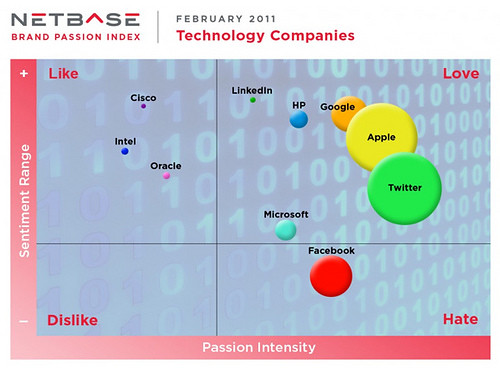
    netbase on Facebook
    Netbase looked at how consumers relate to brands, it indicates that many people feel that they have to be on Facebook rather than they want to be indicating that the consumer benefit is low, so the corresponding trust they are prepared to put into the social network regarding their privacy is low.

    Companies like Facebook and Path are treating privacy as an inconvenient hang-up of consumers that they must run an end game around rather than engendering trust. The less engagement these businesses have with their audience the lower the quality of the information and the consequent lower utility that they have for marketers. There is no perfect market in online advertising.

    In the same way that consumers have a reduced trust in the media following incidents at organisations like News International; there is likely to be an inciting incident at some point between consumers and the online advertising eco-system that is likely to bring trust to a head. The perfect market knowledge advantage then becomes mute.

    The internet becoming a too perfect market kills the golden goose being bad for consumers and bad for advertisers. The challenge is that the eco-system is a victim of its own success from 2002 to the end of 2011 the US online advertising market grew over four times to roughly 8 billion dollars a quarter. If someone steps back from the plate to take a more considered approach, someone else will rush in.

    A prime example of this is the use of facial recognition software which even Google’s chairman Eric Schmidt agrees is a step too far, Facebook has already implemented it and Google has rolled it out as an opt-in feature on Google+. The problem with the opt-in is that Google doesn’t spell out to the consumer the full ramifications of the technology – yet it was obviously concerned at the highest level in order for Schmidt to go on record about it at a conference.

    Looking at all this; it is counter-intuitive, but the market for consumer privacy should actually be with the brands that they are trying to engage them. How powerful would it be if a brand said: we can do all these things skulking around behind your back, pulling the strings but we aren’t going to and we don’t want to. We want to be a brand that you can address on your own terms.

    The clock is ticking for the brand that will make that leap and the advertising eco-system that won’t. It was the Cluetrain Manifesto accused PR people of being afraid of their publics; were now in a situation where the online advertising eco-system is afraid of being completely honest with its audiences and afraid of their advertisers.

    As Chuck D said:

    The easiest and the hardest word to say is NO

    More related content here.

    More information

    Here’s What Really Scares Eric Schmidt – Allthings D
    Google+ Introduces Automatic Face Recognition To Photo Tagging (But It’s Completely Opt-In) – TechCrunch

    Facial Recognition Technology: Facebook photo matching is just the start – PC World
    Netflix Cancels Contest After Concerns Are Raised About Privacy – New York Times
    CD Settlement forces prices up – BBC News
    Tom Coates famous ‘Native to a web of data’ presentation that he gave at Future of Web Apps back in 2006  and Simon Willison’s write up of the presentation
    How Companies Learn Your Secrets – NYTimes.com – How Target zeros in on consumers right around the birth of a child, when parents are exhausted and overwhelmed and their shopping patterns and brand loyalties are up for grabs
    Where’s the Market for Online Privacy? | The Precursor Blog by Scott Cleland

  • Samsung brand challenge

    One of the things that I had been thinking about for a while was the way the smartphone handset market; the Android eco-system had the value hollowed out of the business for the manufacturers including the Samsung brand. In some ways this process seemed to mirror what happened in the PC market through the 1990s and into the 2000s.

    Home computing

    But let’s go back to where it all began. Back at the end of the 1960s and into the early 1970s, home computing meant having a ‘dumb terminal’ connected to a mainframe or mini-computer at a large corporation or university via a telephone line. Due to the price of local calls in the US versus Europe; it was natural that should develop first in any meaningful way. Even then it was used by a very small number of early adopters. At this time Samsung was better known in Korea for fertiliser and started a partnership with Sanyo to learn about electronics.

    However there was a latent demand for personal computing, you had a few geeky counterculture types who had an old mini-computer in a building and provided terminals and accounts to members of the public and community groups free of charge. Outside San Francisco however this latent demand wasn’t being met. The Homebrew Computer Club that held most of their meetings in an auditorium attached to the Stanford Linear Accelerator had a different idea.

    In essence they looked to reinvent personal computing by using simpler less powerful hardware. This unleashed a wealth of innovation from the first spreadsheet to at-home stock-trading and eventually World of Warcraft.

    Mobile devices are a similar point of reset in personal computing. Many of the tasks that we do from word processing to entertainment don’t necessarily need the amount of computing power that we have. Secondly even this Mac that I am writing the post on probably has lots of unnecessary code that isn’t really required by me. For people who don’t create a lot of content mobile devices from tablets to smartphones are ideal for their needs in many respects.

    Beyond this moving forward through simplicity there is another aspect to the the rise of mobile devices that mirrors the PC world; like the Windows Intel eco-system before it – the Android ARM eco-system is becoming commoditised; defined by specification (processor, Android version and screen dimensions). This is what Nokia was afraid of when they decided not to go down the Android route; though the level of control that Microsoft has over Windows Phone hardware specification and and user experience could be argued make the lack of differentiation amongst Android competitors a mute point.

    HTC looks as if they have been trying to do something about this, in terms of hardware: purchasing a majority stake in fashion audio brand Beats Electronics LLC and S3 Graphics. This was matched by a similar effort in software with their HTC Sense interface skin with some productivity and communications applications.
    The problem with Android
    Technology marketers haven’t been doing themselves any favours with co-marketing budget type ads like these ones that I took a picture of last year for different Motorola phone models.
    Android marketing fail
    In reality, the HTC Sense interface isn’t the differentiator that one would have thought, they haven’t yet used the Beats audio brand in any meaningful way, nor has the S3 graphics come into the marketing mix. Sony Ericsson and Motorola have fared worse and Samsung has come out on top.

    Why has Samsung been successful?

    I think that this is down to a number of factors:

    • Samsung like Nokia has built up an extensive effective global logistics and channel network
    • An extension of this would be Samsung’s relationships with wireless carriers
    • Samsung can sweat the supply chain largely because it owns the supply chain: it makes LCD screens, memory, ARM procesors for instance. Thus allowing it to compete on price/performance points that many of the other players couldn’t match

    In this respect, Samsung’s operational efficiency and effectiveness is similar to Dell in it’s prime (the main difference is that Dell wasn’t a vertically-integrated component manufacturer). Samsung’s head marketer Younghee Lee wants to turn Samsung into an emotional brand rather than a rational one. Historically consumers have known Samsung as making reasonably good products; but many didn’t even realise that the company is Korean rather than Japanese.

    The company has a modicum of product design smarts that has allowed it to make in-roads in the television and brown goods markets at the expense of Panasonic and Sony – but it still isn’t operating at the same level of design acclaim as Apple.

    Ms Lee’s aspiration for people to feel something about the Samsung brand is at odds with the adverts that the company has been running in the US.

    (The embedded video is on Tudou, so will need patience whilst it loads).
    The adverts generally follow a pattern:

    • Attacking iPhone customers as foolish zealots
    • Demonstrate a Samsung | Android feature
    • Finish on a rational message

    It is the advertising equivalent of the Japanese phrase that ‘the nail that stands up must be hammered down‘. The problem for Samsung is that you don’t get a consumer to switch brands by berating or insulting them; those kind of motivators tend to only work as a line management technique in command-and-control companies (a la Apple).

    Secondly, the rational reason doesn’t give a reason to switch from Motorola or HTC to Samsung with the disdain of iPhone customers as a common bond.

    If Samsung wants to become a brand that consumers feel passion for, it won’t come through these attack adverts, but from the product design outwards in every part of the customer experience. In this respect Ms Lee’s hands are tied – as the product design and customer experience would need to be raised consistently across the Samsung product range; not just smartphones to make this happen effectively.

    It takes years to get this right in an organisation of the scale of Samsung, whilst that is happening Samsung can consider how it can do more appropriate consumer marketing and advertising – I’d suggest by thinking about how to encourage and empower existing Samsung customers to become passionate advocates of the brand.

    More information
    2012: just where is digital going?
    Things I’d like to see in 2012
    The demise of Palm | HP portable devices post
    The mobile and the PC market – an exploration in value
    Samsung’s Marketing Chief Aims to Stir Passion for Korea’s Electronics – AllThingsD
    EUROPA – Press Releases – Antitrust: Commission opens proceedings against Samsung
    Feature Phones Now More Profitable Than Mid-tier Smartphones – Forbes
    The mobile and the PC market – an exploration in value
    The folly of technology co-marketing budgets

  • Howard Stringer + more news

    Howard Stringer

    Sony confirms Kazuo Hirai as new President and CEO, replacing Howard Stringer — Engadget – this is huge, the pivot back from entertainment to engineering and technology is happening at Sony. Howard Stringer worked for three decades at CBS, which Sony bought during the go-go years of the 1980s. He started as junior on the Ed Sullivan show. Over the years Howard Stringer built his career as journalist, producer and executive. A subjourn at a media and telecoms funded start-up for two years saw Howard Stringer return to Sony. This pivot is important as it gives insight into Sony’s convergence strategy of the early noughties. The Sony share price fell 60 percent on the watch of Howard Stringer, part of this was due to force majeure of the great Tohoku earthquake. But it also didn’t help that Howard Stringer helped build up Samsung by providing a joint venture with Sony on its Bravia televisions

    Consumer behaviour

    Today’s Teens Better Behaved Than Their Parents – NYTimes.com – more socially conservative

    Design

    Boeing finds problem in tail section of 787 Dreamliners ‹ Japan Today – problem is with shims between the carbon fibre skin and supporting framework. Carbon fibre composite construction ins relatively new in the civil aircraft industry

    Old friend, new face, at Cathay Pacific’s flagship lounge | CNNGo.com

    Olympus OM-D E-M5 Camera Leaked Photos | Kineda – I love the way the design harks back to the classic Olympus OM film cameras

    Dezeen » Blog Archive » K01 by Marc Newson for Pentax

    Economics

    Beijing tells airlines not to pay EU carbon tax | SCMP.com – expect the EU to come off the worst with this Mexican stand-off

    China needs 200 years to achieve free market: economist|WantChinaTimes.com – what really constitutes a ‘truly free’ economy

    Chinese data suffer New Year hangover – FT.com – according to PMI index domestic demand weak, export demand strong

    Poverty trap for middle classes of Europe | Presseurop (English)

    The End Of Cheap China, Part III. How YOU Must Prepare For It. : China Law Blog

    Finance

    Private Equity: Fact, Fiction and What Lies in Between – Knowledge@Wharton

    Mortgage Tornado Warning, Unheeded – NYTimes.com – corruption and crime at the dark heart of the mortgage industry

    MasterCard reveals roadmap for our electronic payment future: EMV in, magnetic strips out — Engadget

    Hong Kong

    Hong Kong residents oppose opening roads to mainlanders|Want China Times

    Final curtains for cinema complex in Time Square | SCMP.com – one of my favourite haunts in Hong Kong (pay wall)

    Apple Daily Hong Kong runs ad against mainland “locusts”: Shanghaiist

    Hong Kong Finance Job Cuts Hit Samsung, Daiwa – WSJ

    How to

    LongReply to swissmiss – finding duplicate files

    Ideas

    Open the Future: The Future Isn’t What It Used to Be

    Study shows climate sensitivity to CO2 less than extreme projections

    Innovation

    Toyota Engineer Speaks on Advantages, Disadvantages of SiC Power Devices — Tech-On!

    Nokia reveals polarizing secrets of ClearBlack display — Engadget – would this work for televisions?

    Sony Global – Technology – SoRPlas Environmental Technology – interesting recycled plastic technology from Sony

    The Vintage Knob – Online vintage audio museum, forum and image bank – the superlative engineering involved in the products are amazing

    DARPA summons researchers to reinvent computing | ExtremeTech

    AMD’s CTO talks heterogeneous systems architecture

    A CEO’s guide to innovation in China – McKinsey Quarterly – interesting breakdown of Chinese innovation

    The death of CPU scaling: From one core to many — and why we’re still stuck | ExtremeTech – really interesting read on why computers don’t have the ‘wow’ factor that they did in the past

    Wanted: 3-D IC standards within six months

    Rebuilding America: Proposals emerge to fix ‘dysfunctional’ R&D tax credit

    Japan

    Panasonic, Fujitsu, Renesas eye chip merger ‹ Japan Today

    Japan’s current account surplus smallest in 15 years ‹ Japan Today

    Pachinko addiction a growing problem for Japanese women ‹ Japan Today

    Toyota Lets You Become A Sportscar  – brings out the inner 5-year old

    Trust in Japan – Sixty Second View – amazing destruction of trust

    Made Better in Japan – WSJ.com – interesting how attention to detail is causing a surge in low end | high price Japanese products

    The salaryman’s guide to Tokyo | The Guardian – made me laugh

    Labor ministry releases definition of ‘power harassment’ ‹ Japan Today

    Japan’s population to shrink two thirds by 2110 ‹ Japan Today

    Korea

    South Korea’s Pop Wave – Al Jazeera English – links to corruption and forced prostitution together with punishing schedules and unfair contracts blight reputation of K-pop

    Samsung’s Marketing Chief Aims to Stir Passion for Korea’s Electronics – Ina Fried – Mobile – AllThingsD

    Luxury

    French luxury giant buys into mainland firm | SCMP.com – first investment like this from LVMH. Ochirly is a mid-priced brand aimed at trendy female office workers (pay wall)

    Economic Slowdown May Fuel Maturation Of China’s Luxury Market « Jing Daily

    Bloomberg launches twice-yearly luxury lifestyle mag | Press Gazette – surprised that Bloomberg and Reuters hadn’t done this previously. There has been a magazine called Square Mile aimed at the city of London which occupies a similar niche.

    Marketing

    40 years of Super Bowl Commercials. | adland.tv

    Media

    Used MP3 Music Files Legal To Sell Says Federal Judge

    Themes from MIDEM – Mint Digital – interesting comments on Facebook

    Three Lessons for Social TV – Amy Jo Martin – Harvard Business Review

    News Corporation pushes tablet title: News from Warc.com – but is closing down the London based tablet experiment using entertainment and sports content from The Sun

    Reuters: News Corp clean-up squad has 100 staff reviewing emails, expense claims and phone records | Press Gazette – a hint of the Spanish Inquisition about it

    Why Some Book Buyers Are Increasingly Resistant To E-Readers | mocoNews

    Shoe on the other foot: RIAA wants to scrap anti-piracy OPEN Act

    Warner Music Group chairman loves Spotify, calls Google Music an “oxymoron” | VentureBeat

    Online

    Facebook says China still a major hurdle | Market-interactive.com – I am not certain that they would be able to beat domestic rivals

    New Registrations For Sina Weibo Appear To Have Fallen Off A Cliff | DigiCha – real-world ID requirements affects Weibo

    How OoVoo Became Teenagers’ Favorite Way To Video Chat – Forbes

    Retailing

    Facebook’s Payments Business Is Already 15% The Size Of PayPal — Sort Of – SplatF

    Tesco market share drops below 30% | Irish Examiner

    Amazon disappoints with dramatically lower profits for Q4 | VentureBeat

    Security

    Max Schrems: The Austrian Thorn In Facebook’s Side – Forbes

    Students voice privacy concerns with Facebook | ZDNet

    Black SMS Encrypts and Decrypts Your Text Messages – interesting application, wonder how robust the encryption actually is

    Satellite phone encryption cracked – Telegraph

    Where’s the Market for Online Privacy? – Forbes

    A fashion revolution? | FT.com – transparent fashion business

    Software

    Apple Requires Retina Screenshots From iOS Devs – this is good as reduces platform fragmentation

    An Ex-Zynga Engineer Is Ripping The Company Apart In Plain Sight – or why Zynga is crap to work for. Not particularly surprised by this

    Google Instant, Disabled For Slow Computers

    Windows Phone developer lead leaves for Amazon’s Kindle team | ZDNet

    Chinese Learning App, Mandarin Madness Launches on iOS and Android | TechNode

    Monocolumn – Presentations in PowerPoint – for and against [Monocle]

    Technology

    Samsung aims to sell 25 mil ‘smart TVs’ this year ‹ Japan Today

    Apple trademark may hint at processing improvement for next-gen A6 processor

    FOSS Patents: Apple removed products from German online store due to Motorola injunction based on FRAND patent – Motorola gets away with exploitation of FRAND patents, yet Samsung gets hauled in front of antitrust hearings?

    Canalys: Smartphone shipments surpassed PC shipments in 2011

    Ex-Apple engineer emits Zevo ZFS for Mac OS • The Register – good to see Sun’s ZFS getting new life. This will be important given the battering the cloud has taken

    Sharp to cut LCD production in Osaka plant by half – Engadget

    ITC judge throws out Barnes and Noble’s patent defense against Microsoft — Engadget

    Japan’s DeNa moves into Chinese smartphone game market in deal with Baidu | VentureBeat

    Telecoms

    UK Report Blames The Internet For Terrorism, Says ISPs Should Take Down Content | Techdirt – Jesus wept

    IPv6 upgrade to cost ISPs ‘hundreds of millions’ – Ixia

    Apple forcing IT shops to “adapt or die”

    Web of no web

    Siri to get Chinese, Russian and Japanese Support Next Month | gizchina.com

    Employers and Brands Use Gaming to Gauge Engagement – NYTimes.com

    Wireless

    Nokia on smartphone strategy: We don’t have a Plan B

    Apple and Samsung will continue dominating smartphone industry

    FOSS Patents: German appeals court upholds Galaxy Tab 10.1 injunction — but on different legal basis than Apple’s design right

    EUROPA – Press Releases – Antitrust: Commission opens proceedings against Samsung

    Feature Phones Now More Profitable Than Mid-tier Smartphones – Forbes

    DOCOMO, LAWSON and Radishbo-ya Agree on Business and Capital Alliances | NTT DOCOMO – interesting move into retail services by NTT

    DoCoMo demands Google’s help with signalling storm – Rethink Wireless

    In Europe, Some Lovers of the BlackBerry Now Seek A New Flavor – NYTimes.com

  • Sony Trinitron

    It is hard for anyone who can’t remember back to the original PlayStation, but back in the 1980s and the 1990s Sony was a technology company that held the kind of stature that Apple currently holds in consumer minds. Trinitron had the kind of gravitas that Apple’s iPhone or Samsung’s Galaxy have now.

    In fact, Sony used to do a fair bit of industrial and product design for Apple. The initial Apple PowerBook range was designed by Sony and the 3 1/2 floppy disk that was the hallmark of the original Mac was down to Sony engineers who collaborated with the Apple team to get the product ready in time. Steve Jobs self-imposed uniform of black mock-turtleneck jumpers and Levi 501s was inspired by a conversation he had with Akio Morita about the use of corporate uniforms inside Sony Japan which created corporate cohesion. (Sony had implemented these, because workers in post-war Japan struggled to afford clothes). Jobs cited  Sony, alongside Cuisinart and Braun as companies that he would like to emulate in terms of product design.

    Part of Sony’s pre-eminent position was down to their amazing electronic, electrical and mechanical engineering chops combined with great product design and an attention to detail which churned out a succession of small high-performance products including high-end personal tape cassette players (the Walkman), personal compact disc players (the Discman) and camcorders (Video8 and Hi-8).

    Often consumers couldn’t afford the high-end designs so the mid-and-low range products that they bought had the Sony quality and design ‘halo’ around these products.

    The second thing that supported Sony was the high quality of their televisions. This was due partly to the industrial design that Sony perfected – particularly in their portable television sets.
    Sony Trinitron TV
    The deal closer was Sony’s display technology called Trinitron.
    Trinitron logo
    Trinitron signified the technology that Sony had inside its screen, and the logo became a mark of quality. The story of Trinitron goes back the mid-1960s, Sony had bet the farm on a great display technology called Chromatron which it had licenced from a small American company. The problem with Chromatron was that it was really hard to make the displays commercially, Sony was getting about three good displays for every 1,000 they made on their production line. The televisions that the displays went into cost twice as much to make as Sony could sell them for. By 1966, Sony was facing financial ruin.

    So they took a look around at the other technologies pioneered by the likes of GE and RCA to try and work out how they could come up with a unique patentable product. In double quick time, Sony came up with a display with an electron gun at the back of the cathode ray tube with three electrodes (for the red, green and blue composite colours), permanent magnets to focus the electron stream and an aperture grill made up of tiny wires hung vertically connected by one or two tungsten stabilising wire going horizontally across them.

    This gave Trinitron displays a bright, high contrast, high-colour display with no gaps between the colour phosphor dots on the screen. I still use a Trinitron set to watch DVDs because it provides a superior colour and contrast to more modern LCD screens. Modern LCDs have to use a lot of power; up to 1,000 watts to try and match the contrast of the Trinitron set. In 1996 Sony’s patents ran out and technological change with copycat designs from Mitsubishi and ViewSonic; followed by LCD displays eroded Sony’s advantage in the market. Prior to bowing out of the market Sony made its WEGA sets which feature the best consumer Trinitron screens to date – and can be picked up on eBay for a song. In 2008, Sony stopped selling Trinitron televisions in the developed word (though WEGA sets continued to be sold in China).

    It still has a production line in Singapore making Trinitron displays for professional use, in particular video monitors. Sony’s television business is now bleeding cash as it no longer has a best-of-breed display technology advantage and so consumers will no longer pay a premium price because it’s a Sony. A Sony BRAVIA LCD television is a Sharp or Samsung panel display with Sony electronics and packaging.

    Efforts to commercialise OLED displays have so far proven to be unsuccessful so far; though Sony does offer a Trimaster branded version of these for high-end video monitoring. Presumably the Trimaster brand is allusion to the gold standard that Trinitron provided. More Sony related content here.

  • Tape pack

    Back in the day many computer games, audio books and language course used to come in a book sized moulded plastic sleeve lined with four or six cassette tapes called a tape pack. There would be a sleeve that would take a cover on the outside like a DVD film case (or a VHS film case before it). The boxes were pretty flimsy but they did better than the brittle plastic that went into cassette and CD album ‘jewel cases’.
    tape pack
    From the early 1990s through to the early noughties the tape pack took on a new cultural significance.

    Organisers of nightclub events quickly realised that consumers who couldn’t afford to attend every event could still be sold the evenings sound track on a series of tapes. Also people who had been often wanted to relive the night listening to the tapes on their Walkman, at home on the stereo, or as was usually the case on the car stereo. In the same way that I bought records by certain artists, remixers and record labels; club goers would by tape packs by their favourite DJs; given that a big name could play four sets on a Saturday night, they maybe chasing down £60 of tapes for that week.

    The boxes acted as a bill board for the club with flyer art on the front that parodied famous brands, were surreal or had fantastic themes with boasts of five or eight kilo-watt audio systems by TurboSound alongside details of the number of smoke machines and lasers in the club.

    DAT machines started appearing in the DJ booth. Even a wine bar that I played garage sets in on a Wednesday night had a HHb professional DAT recorder (that would have been at home in a recording studio as a tape machine for mastering albums) underneath the counter of the DJ booth.

    Tape packs were big money for club promoters and the independent record shops that supported the dance music scene at the time. tape packs jostled for shelf space behind the counter with racks of records. I am partly convinced that the C-90 cassette format was responsible for DJ’s working 90-minute slots at a club.  The tape pack started a long slow decline. The writing was on the wall with the rise of the super-club who looked to have a record label, alongside their fashion brand and club nights. DMC had shown the way with Mixmag Live – the first legal mix series.

    With the notable exception of the Ministry of Sound; the focus moved from the club franchise to the DJ; and DJ’s got their own production record deals with the dance imprints of major labels.

    Secondly, since recording a CD at first meant going into a studio, big name DJs used technologies like Digidesign’s Sound Tools and Pro Tools audio editing and production software to clean up their mixes, mould them and sound a lot better than they really were. These mixes has more in common with studio megamixes like Mirage’s Jack Mix series or and edit mixes a la Chris ‘Steinski’ Stein and Danny Krivits than DJing; but their superior flawless quality was more popular with consumers.

    The reason why this decline was slow was partly due to market forces; whilst the Discman replaced the Walkman as the personal stereo of choice; CD production took a long time to come down in costs to tape duplication and in-car audio still had a large installed base of cassette head units.

    In addition, early car CD units jumped and skipped tracks with every bump in the road and the cartridge units that held the CDs often scratched them. Fragmentation of dance music into different genres (and socio-economic classes of audiences if we’re honest about it) and in particular the reliance of happy hardcore and drum & bass relying on borrowing and shared sounds meant that tape packs lasted longest supporting these genres of music.

    Now these recordings are remastered by consumers into digital formats and shared or sold online. More culture related content can be found here.