Category: branding | 品牌推廣 | 브랜드 마케팅 | ブランディング

The dictionary definition of branding is the promotion of a particular product or company by means of advertising and distinctive design.

I have covered many different things in branding including:

  • Genesis – the luxury Korean automotive brand
  • Life Bread – the iconic Hong Kong bread brand that would be equivalent of wonder loaf in the US
  • Virgil Abloh and the brand collaborations that he was involved in
  • Luxury streetwear brands
  • Burger King campaigns with Crispin Porter Bogusky
  • Dettol #washtocare and ‘back to work’ campaigns
  • Volkswagen ‘see the unseen’ campaign for its Taureg off road vehicle
  • SAS Airline – What is truly Scandinavian?
  • Brand advertising during Chinese New Year (across China, Hong Kong, Singapore and Malaysia)
  • Lovemarks as a perspective on branding
  • BMW NEXTGen event and Legend of Old McLanden campaign
  • Procter & Gamble’s Gillette toxic masculinity ads
  • Kraft Mother’s Day campaign
  • Kraft Heinz brand destruction
  • Porsche Design in the smartphone space
  • Ermenegildo Zegna
  • Nike’s work with Colin Kaepernick
  • Counterfeit brands on Instagram, Alibaba and Amazon
  • Gaytime Indonesian ice cream
  • Western Digital
  • Louis Vuitton collaboration with Supreme
  • Nokia
  • Nike Korea’s ‘Be Heard’ campaign
  • Mercedes SLS coupe campaign
  • Brand collaborations in Hong Kong
  • Beats headphones
  • Apple
  • Henrion Ludlow Schmidt’s considerations of branding
  • Cathay Pacific
  • Bosch
  • Mitt Romney’s failed presidential bid
  • Microsoft Surface launch
  • Oreo Korean campaign
  • Chain coffee shop brands and branding
  • Samsung’s corporate brand
  • North Face’s brand overeach in South Korea
  • Mr Pizza Korean pizza restaurant and delivery service brand
  • Amoy Hong Kong food brand
  • Chevrolet Corvette ‘roar’ campaign promoting a build your own car service
  • The influence post

    Mark Ritson wrote an op-ed over at Marketing Week on influence and influencers. Whilst it lacked nuance on the subject area, a lot of what it said is true. Go over and have a read; I’ll be waiting for when you come back.

    Whilst I disagree on the finer points, what Ritson wrote needed to be said. There needed to be a turning of the tide on influencers from boundless optimism to a greater degree of sobriety and critical analysis of the influencer opportunity.

    I first noticed this boundless optimism when I attended the In2 Innovation Summit in May last year.  Heather Mitchell on a panel. Mitchell worked at the time in Unilever’s haircare division where she is director, head of global PR, digital engagement and entertainment marketing. I asked the panel discussing influencer marketing about the impact of zero-based budgeting (ZBB) and the answer was ducked. ZBB requires a particular ROI on activity, something that (even paid for) influence marketing still struggles to do well.

    This was surprising given the scrutiny that other marketing channels were coming under, I couldn’t understand how influencer marketing merited that leap of faith.

    This time last year I noted:

    Substitute ‘buzz marketing’ for ‘influencer marketing’ and this could be 15 years ago. Don’t get me wrong I had great fun doing things like hijacking Harry Potter book launches when I worked at Yahoo!, but no idea how it really impacted brand or delivered in terms of RoI. Influencer marketing seems to be in a similar place.

    Just five years ago we had managed to get past the hype bubble of social and senior executives were prepared to critically examine social’s worth. In the meantime we have had a decline in organic reach and massive inflation in both ad inventory and influencer costs. What had changed in the marketers mentality?

    Onward with Mark Ritson’s main points.

    Ritson’s Three Circles of Bullshit

    A very loose reference to Dante Alighieri’s Divine Comedy trilogy; but for modern marketers

    The First Circle of Bullshit: Are the followers real?

    • Are they bots?
    • Are they stolen accounts?
    • Are the user accounts active any more?
    • Has the account holder padded their account with bought followers and engagement. Disclosure – I ran an experiment on my Twitter account and still have a substantial amount of fake followers. More on this experiment here.

    The Second Circle of Bullshit: Are influencers trusted?

    • Ritson did an unscientific test that showed (some) influencers would post anything for a bit of money

    The Final Circle of Bullshit: Do they have influence?

    • Some influencers are genuinely authoritative; but this is a minority of influencers out there
    • Ritson alludes to the lack of organic reach amongst an ‘influencers’ followers which is likely to be 2% reach or less
    Trends in influence

    I looked at Google Trends to see what could be learned in the rate of change in searches over time. Consider Google Trends to be an inexact but accessible measure of changes in interest over time.

    Global interest in influencers have been accelerating
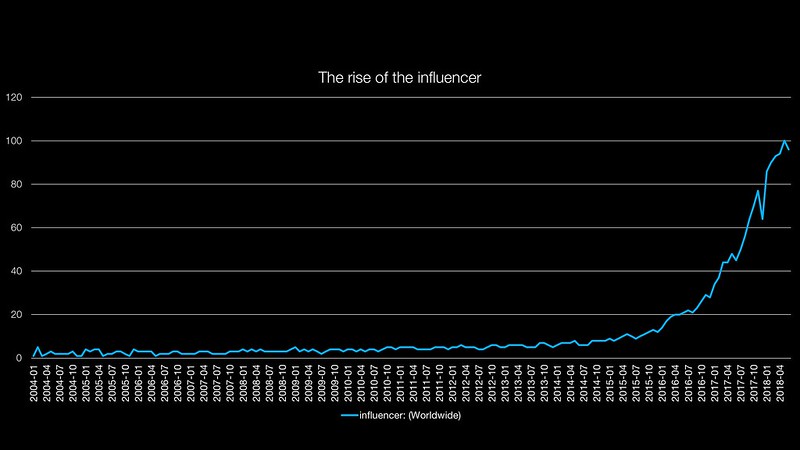
    Influence: Google Trends

    There has been a corresponding rises in interest around paid influencer marketing
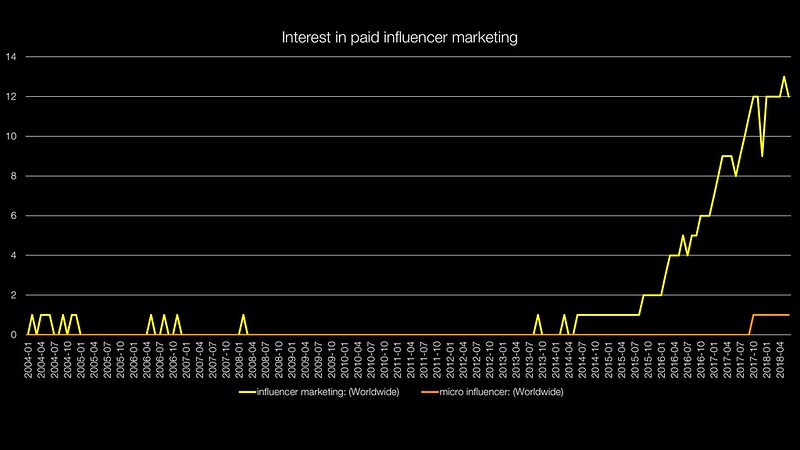
    Influence: Google Trends

    There hasn’t been the same interest peak in organic (PR-driven) influencer work
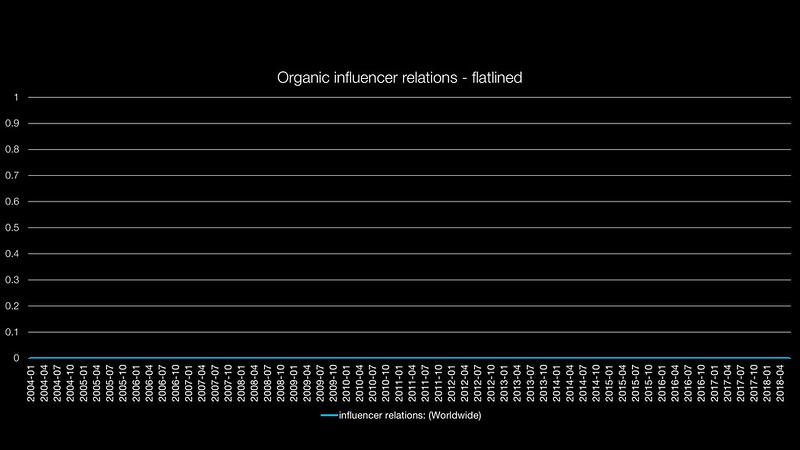
    Influence: Google Trends

    All of which supports the following hypotheses:

    • it’s become on-trend from the perspective of marketers, agencies and ‘influencers’
    • A significant amount of influencers are in it for the money – which brings into question their (long term authority and consumer trust)
    • A significant amount of influencers have an exceedingly good idea of their value (more likely overly-inflated)
    • Ego is less of a motivator for becoming an influencer than material gains
    What would influence look like?

    Propagation of the content by real people. Instagram, a particularly popular influencer channel, has made sharing posts difficult for followers historically. Re-gramming was a pain in the arse for the average Instagram user.
    Slide4

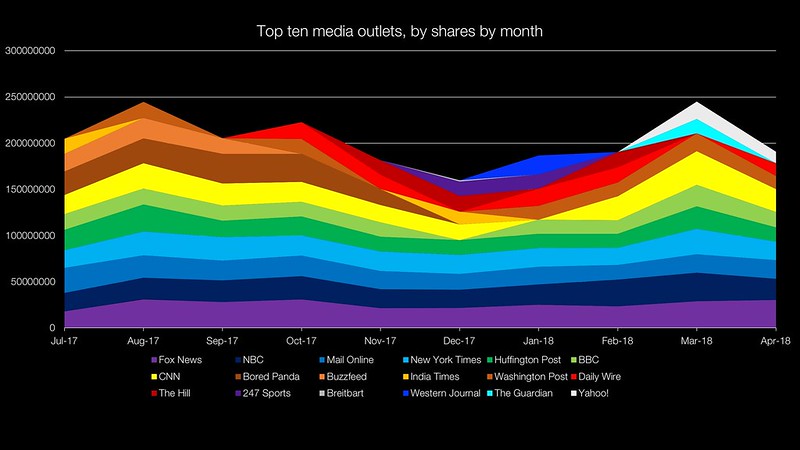
    If we look at the mainstream media and how it is shared on Facebook we see that only five media brands are consistently in the top ten most shared media properties. ‘Traditional’ influencer status isn’t necessarily a garrantor of consistent successful propagation either, if Newship’s data is to be believed.

    Attributed sales. Some luxury brands in China have had success collaborating with influencers and selling through their channels; the post child being Mr Bags collaboration with Longchamps.

    How is the best way to use influencers in marketing?

    Assuming that you are using influencers in the widest possible sense at the moment.

    Treat the majority of influencers as yet another advertising format

    That means that reach, the way the brand is presented, and repetition are all important – smart mass marketing following the playbook of Byron Sharp.

    • Viewing your influencer mention in that prism, it means estimating what the real reach would be (lets say 2% of the follower number as an estimate) and paying no more on a CPM rate than you would pay for a display advertising advert
    • Ensure that the brand is covered in the way that you want. Some luxury brands have managed to get around this by keeping control of the content; a good example of this is De Grisogono – a family-run high jewellery and luxury watch brand. They work with fashion bloggers that meet their high standards and invite them to events. De Grisogono provides them with high-quality photography of its pieces and the event. They get the  high standard of brand presentation which raises the quality of the placement
    • Get repetition with the audience by repeating the placement with other content that delivers the same message with the same high standard of production

    All of this might work for a luxury brand, IF you found that the amount of agency time and creative work made commercial sense. It is less likely to work for normal FMCG brands. What self-respecting influencer is going to be bossed around by a breakfast cereal?

    Thinking about micro influencers, probably the area that has had the most interest from marketers recently due to them appearing to be better value than macro influencers.

    Brown & Fiorella (2013) explanation of micro-influencers:

    Adequately identifying prospective customers, and further segmenting them based on situations and situational factors enables us to identify the people and businesses – or technologies an channels that are closest to them in each scenario. We call these micro-influencers and see them as the business’s opportunity to exert true influence over the customer’s decision-making process as opposed to macro-influencers who simply broadcast to a wider, more general audience.

    Brown & Fiorella focus on formal prospect detail capture and conversion.

    This approach is more likely to work in certain circumstances; where there is low friction to conversion (e-tailing for discretionary value items).

    It starts to fall apart when you deploy their approach to:

    • Consumer marketing
    • Mature product sectors
    • Mature brands

    You would also struggle with many B2B segments where social provides a small reach and little social interaction.

    Work with real influencers on long term collaborations
    • There is more likelihood of having audience trust if they can see and understand the long term relationship between a brand and its influencers
    • Better brand placement easier, with an influencer that ‘gets’ the brand
    • You’ve got a better chance of being able to get access and fully understand the underlying analytics of their accounts (which should be a prerequisite for long term relationship)
    • You can look at collaborations and attribution payment models that raise all boats
    • You can lock out rivals out of relationships
    More information

    Mark Ritson: How ‘influencers’ made my arse a work of art | Marketing Week
    Edelman Digital Trends Report – (PDF) makes some interesting reading
    Instagram Marketing: Does Influencer Size Matter? | Markerly Blog
    Influence Marketing: How to Create, Manage and Measure Brand Influencers in Social Media Marketing by Danny Brown & Sam Fiorella ISBN-13: 978-0789751041 (2013)
    Facebook Zero: Considering Life After the Demise of Organic Reach
    Quantifying the Invisible Audience in Social Networks – Stanford University and Facebook Data Science
    PLOS ONE: Detecting Emotional Contagion in Massive Social Networks by Lorenzo Coviello,Yunkyu Sohn, Adam D. I. Kramer,Cameron Marlow, Massimo Franceschetti, Nicholas A. Christakis, James H. Fowler
    Senior Execs Not Convinced About Social’s Worth | Marketing Charts
    Measuring User Influence in Twitter: The Million Follower Fallacy – Cha et al (2010) – (PDF)
    Visualizing Media Bias through Twitter. Jisun An. University of Cambridge. Meeyoung Cha. KAIST. Krishna P. Gummadi. MPI-SWS et al – (PDF)
    Mr. Bags x Longchamp: How to Make 5 Million RMB in Just Two Hours | Jing Daily
    It’s time that we talk about micro-influencers

  • German nuclear plant + more things

    German nuclear plant infected with computer viruses, operator says | Reuters – So Sarbannes Oxley meant that a lot of corporates disabled USB ports. Technology company Huawei used to have ‘dirty machines’ and clean machines. Neither of which were connected by a network. The same was true in many agencies where I worked. Yet a German nuclear plant allows easy access via USB. Secondly, why do the USB chargers on airplane cockpits have any intelligence at all that would store a virus and allow it propagate? I would be very paranoid about using any USB chargers in coffee shops or an aircraft seat moving forwards. This is the problem when everything from light bulbs and doorbells now contain a Linux server. More security related content here.

    Ogilvy’s rebrand reveals an ad industry in confusion | Thomas Barta – an inhouse marketers perspective on things. If you substituted the word advertising for PR in this as a discipline it could be an analysis of all agencies.

    iPhone maker Foxconn is churning out “Foxbots” to replace its human workers — Quartz – I am not convinced that they will be that successful. This is partly down to some of the manual dexterity required being similar to a watchmaker in some parts of the assembly. And that is down to Apple driving an industry race to squeeze phones into tighter factors for the guts. The process is repeatable, but hard to deliver. Back in the day Japanese consumer electronics manufacturers used to use pick-and-place machines for a lot of consumer electronics. It is why Japan went more towards micro-chips faster than players like Philips. Japan did a lot of component standardisation in terms of sizing and connectivity to the board. The boards were relatively simply designed and gave a bit of latitude to allow for a lack of precision from the machines. That meant slightly larger goods. More expensive devices like Sony’s Walkman  Pro, were handmade because they crammed so much technology inside them .

    [Publish] Facebook Profiles can no longer be connected to Buffer Publish – Buffer FAQ – well that’s a bit of a bummer. But you can still publish content via more expensive systems like Percolate. Is this Facebook trying to discourage organic content from anyone but brands (that spend advertising money?)

  • Three and Superdrug + more

    Three and Superdrug launch new UK MVNO | total telecom – the MVNO deal with Three and Superdrug is a natural deal. Three and Superdrug are both owned by CK Hutchinson Holdings. The interesting bit is the cross business CRM where Three and Superdrug have got together to Superdrug drive loyalty card adoption. More retail related content here.

    THE LONG AND THE SHORT OF IT needs THE WRONG AND THE SHIT OF IT – BBH – interesting essay. The challenge is where do you get ‘crap’ campaign data from and how well will it be documented?

    Meet Kakao: How Korea’s Largest Mobile Giant Is Embracing Blockchain – CoinDesk – some smart critical thinking

    The Canard About Falling Incomes – WSJ – not an argument that I agree with, but Kessler argues that increasing digital features (like ABS on cars) compensate for the hollowing out of the middle classes (paywall)

    Tesla Model 3 Gets CR Recommendation After Braking Update – Consumer Reports – Teslas inspire a ‘true believer’ type following. I am leery of their ‘always in beta’ car software approach because its a car. So I am more concerned rather than delighted the that company managed to bring its braking distance closer to standard using an other-the-air software update

    Right Media, Creators of the First Ad Exchange | NYMag.com – the rise and fall of Right Media

    Chinese firms pile in to sponsor World Cup 2018 amid Fifa fallout-Sino-US“Chinese companies get two things from sponsoring the World Cup. The first is access to western audiences that they will sooner or later be trying to win over, as their companies expand. The other is a cosmopolitan veneer to their brands, which they hope will resonate with their sizeable domestic markets.” – interesting that BBK’s youth brand Vivo rather than Huawei is the smartphone sponsor

    Grace Dent: ‘The processed food debate is MSG-sprinkled class war’ | Life and style | The Guardian – I would align it more with a Neo Victorian patrician attitude towards the working class

    Cross border insights finder – handy Facebook ad tool

    ‘I make £45k a month buying clothes for other people’ – The FT catches up with diagou 15 years after everyone else. China’s changes in luxury tax, increased travel of consumers, restrictions on capital flight, clampdown on corruption and e-tailing has had its toll on diagou

    Smart bulbs turn dumb: Lights out for Philips as Hue API goes dark • The Register – I get the benefits of technology but why does heating, lighting or other smart home controls have to be mediated through the cloud?

    Holiday Rentals, Homes, Experiences & Places – Airbnb – AirBnB launches stories which seems to be a continuation of its magazines

    What is a smartphone? | ASSA – really nice essay on smartphones and consumer behaviour

    Shenzhen’s tech innovation hothouse overheats – it’s been going on for the decade or so that I have travelled there. The unaffordability, maker spaces which are a real estate ruse to suck government grants and a grinding life pace. Financial services and design have already moved in. Your in less need of maker spaces when workshops can build working prototypes for you

  • Video ads + more news

    Sources say Adidas has paused its video ads on Facebook while it reviews their efficacy – Digiday – From my perspective it really depends what the video ads are supposed to do.  What kind of job that they want Facebook video ads to do in the customer journey? More adidas marketing content here.

    Armed with better perspective, Sir Martin Sorrell vows to ‘start again’ | Marketing Interactive – this is interesting, particularly as a number of clients put WPP on review after he left. I am not sure that he will be able to build another WPP; but he could build a great consultancy for procurement departments at major brands. I hope that he doesn’t go digital only, or go and work for a platform like Google or Facebook; selling Facebook video advertising

    James Murdoch Won’t Move to Disney if Fox Deal Closes – WSJ – makes sense given his time at Rawkus Records, there is probably an itch to scratch getting out and doing his own thing

    Facebook will not be accepting referendum related ads from advertisers based outside of Ireland – issues with international pro-life groups

    The United States of Japan | The New Yorker – interesting analysis

    Microsoft wants serious, non-gaming developers to make more money • The Register – this will put pressure on Apple’s services revenue in particular the Mac store

    Ray Ozzie’s Encryption Backdoor – Schneier on Security – Scheier nails it. The sad thing is that Ozzie has been one of the few universally respected technologists over the years

    The Netflix generation doesn’t do compromise | The Times – a few things about the media consumption in this. There are still shared experiences: landmark shows like Sherlock, McMafia, Game of Thrones, Stranger Things, or Black Mirror. Fragmentation of audiences didn’t start with Netflix but with video cassette recorders, multiplex cinemas, Channel 4 and cable and satellite TV. There was a certain delicious irony reading about how media plurality is ‘bad’ in a paper owned by the Murdoch media empire. I committed a greater sin than the Netflix millennials and opted out of watching TV quite happily for seven years until I was gifted a Sony Trinitron TV set by a friend who was getting a flat screen –  which would probably count as even more ill tempered. The comments on online discussion are natural. Do Times readers invite objectionable opinions around to dinner parties in the name of diverse thinking? I would imagine not that often unless there are other ties (like familial links). (Paywall)

    SenseTime: The billion-dollar, Alibaba-backed AI company that’s quietly watching everyone in China — Quartz

    Report: Chinese government is behind a decade of hacks on software companies | Ars Technica

  • ZFS + more things

    A ZFS developer’s analysis of the good and bad in Apple’s new APFS file system | Ars Technica – this is a good guide by Adam Levanthal. The thing that puzzles me is this. Apple had a working implementation of ZFS running on early beta versions of OS X and then decided not to implement it. Apple adoption of ZFS would be a major boost (it is already supported on Linux and Solaris). It takes about a decade for a file system to mature sufficiently; ZFS has that maturity and is still bleeding edge tech. Apple has a good relationship with Oracle so that wouldn’t be a problem, Larry Ellison is still the shot-caller over there and he still hates Microsoft and Google. Instead they build their own version, which has nice encryption facilities but lacks the data integrity features that ZFS has. It doesn’t seem to be about squeezing the footprint of ZFS for mobile devices either. Apple just decided to go it alone for reasons that aren’t readily apparent at the moment with APFS.

    Huawei sees building alternative to Android as insurance amid US-China trade tensions | SCMP – not a big leap from an OS point of view. The big jump would be the app store since both Google and Amazon’s app stores would be out of reach if Huawei were found guilty. A way around this would be the likes of SailfishOS which would also deal with lingering security concerns about Huawei handsets. More Huawei related content here.

    Someone might’ve hacked the company that can hack any iPhone – BGR – another reason why backdoors are bad

    Mobile advertising represents 91% of Facebook’s ad revenue | Marketing Interactive – I suspect that there is a lot of wasted ads here. Linking through to sites that aren’t mobile friendly or things that don’t work on mobile for instance

    Kraft Heinz works with JKR to introduces quirky new biscuit brand JIF JAF | Marketing Interactive – Kraft Heinz launching product in China going head to head with Mondelez; that spun out of Kraft….

    British adults using Facebook less to communicate with friends | Technology | The Guardian – according to Ofcom there is also a wealth divide in how Britons use the internet, with poorer individuals more likely to rely solely on a smartphone to get online and have “lower levels of online confidence and critical understanding”.

    APAC markets exceed global benchmarks for viewability, brand safety | Digital | Campaign Asia – fraud rates for campaigns that optimised against fraud remained relatively flat, showing optimisation efforts are paying off by keeping fraud rates low. Singapore and Hong Kong had higher fraud risk at 20.7% and 14.0% respectively, because ad fraudsters tend to follow where the digital spend goes and where CPMs are higher.

    Can This System of Unlocking Phones Crack the Crypto War? | WIRED – this sounds dodgy AF. If the US gets access, every country gets access

    Facebook beats in Q1 and boosts daily user growth to 1.45B amidst backlash | TechCrunch – basically people don’t care if Facebook invades their privacy or usurps their government. All of that is a mere bagatelle

    AMD earnings confirm it’s biting into Intel’s market share | VentureBeat – it likely won’t be permanent

    Addressing Recent Claims of “Manipulated” Blog Posts in the Wayback Machine | Internet Archive Blogs – interesting hack that should be in the tool bag of reputation managers

    U.S. DoJ probing Huawei for possible Iran sanctions violations: WSJ – interesting that they are getting dinged for similar things to ZTE. Stopping US vendors from selling to Huawei would be a bit less impactful than on ZTE. But it would retarget the Huawei R&D budget away from innovation to replacing American component technology and engineering services currently provided by the likes of Ciena or Qualcomm. This actually fits neatly with Mr Xi’s China 2025 manufacturing initiative that is designed to free the country from relying on international suppliers.

    Amazon is releasing a new Alexa gadget specifically geared toward kids – Recode – but what about the privacy settings?

    Meet John Hennessy and Dave Patterson, Silicon Valley’s first disruptors | Recode – great read about when Silicon Valley actually made silicon and solved ‘hard’ innovation problems, rather than sociopathic web services. You couldn’t have your modern computer or your smartphone without Hennessy & Patterson

    Nike’s Converse Loses Chief Marketer to Supreme | BoF – not that Supreme really needs marketing with its over-subscribed drops. Unless they are changing direction to become more mass affluent?

    A French billionaire is being investigated for bribing African officials for lucrative contracts | Quartz – this surprised me. France has used businesses like Total and Elf with the likes of Jacques Foccart to keep a relationship and control in the Francophone. Why are they turning on Bollore now? Especially odd when you think about how China is pushing western interests out of the continent

    Electric Autos – Long life – I think it’s more complex, depending on vehicle range and driving patterns will factor into demand. Of course the shit is really going to hit the fan when lithium ion technology fails to provide for transport needs like long distance heavy goods vehicles, becomes too expensive and essential materials become too rare. There is likely to be a pivot to hydrogen combustion engines or hydrogen fuel cells due to superior energy density. The economics around risk, infrastructure and other capital costs will change.