One of the things that I had been thinking about for a while was the way the smartphone handset market; the Android eco-system had the value hollowed out of the business for the manufacturers including the Samsung brand. In some ways this process seemed to mirror what happened in the PC market through the 1990s and into the 2000s.
Home computing
But let’s go back to where it all began. Back at the end of the 1960s and into the early 1970s, home computing meant having a ‘dumb terminal’ connected to a mainframe or mini-computer at a large corporation or university via a telephone line. Due to the price of local calls in the US versus Europe; it was natural that should develop first in any meaningful way. Even then it was used by a very small number of early adopters. At this time Samsung was better known in Korea for fertiliser and started a partnership with Sanyo to learn about electronics.
However there was a latent demand for personal computing, you had a few geeky counterculture types who had an old mini-computer in a building and provided terminals and accounts to members of the public and community groups free of charge. Outside San Francisco however this latent demand wasn’t being met. The Homebrew Computer Club that held most of their meetings in an auditorium attached to the Stanford Linear Accelerator had a different idea.
In essence they looked to reinvent personal computing by using simpler less powerful hardware. This unleashed a wealth of innovation from the first spreadsheet to at-home stock-trading and eventually World of Warcraft.
Mobile devices are a similar point of reset in personal computing. Many of the tasks that we do from word processing to entertainment don’t necessarily need the amount of computing power that we have. Secondly even this Mac that I am writing the post on probably has lots of unnecessary code that isn’t really required by me. For people who don’t create a lot of content mobile devices from tablets to smartphones are ideal for their needs in many respects.
Beyond this moving forward through simplicity there is another aspect to the the rise of mobile devices that mirrors the PC world; like the Windows Intel eco-system before it – the Android ARM eco-system is becoming commoditised; defined by specification (processor, Android version and screen dimensions). This is what Nokia was afraid of when they decided not to go down the Android route; though the level of control that Microsoft has over Windows Phone hardware specification and and user experience could be argued make the lack of differentiation amongst Android competitors a mute point.
HTC looks as if they have been trying to do something about this, in terms of hardware: purchasing a majority stake in fashion audio brand Beats Electronics LLC and S3 Graphics. This was matched by a similar effort in software with their HTC Sense interface skin with some productivity and communications applications.
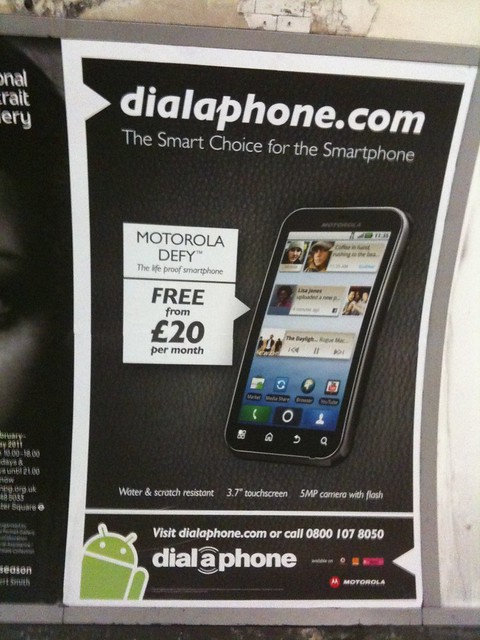
Technology marketers haven’t been doing themselves any favours with co-marketing budget type ads like these ones that I took a picture of last year for different Motorola phone models.

In reality, the HTC Sense interface isn’t the differentiator that one would have thought, they haven’t yet used the Beats audio brand in any meaningful way, nor has the S3 graphics come into the marketing mix. Sony Ericsson and Motorola have fared worse and Samsung has come out on top.
Why has Samsung been successful?
I think that this is down to a number of factors:
- Samsung like Nokia has built up an extensive effective global logistics and channel network
- An extension of this would be Samsung’s relationships with wireless carriers
- Samsung can sweat the supply chain largely because it owns the supply chain: it makes LCD screens, memory, ARM procesors for instance. Thus allowing it to compete on price/performance points that many of the other players couldn’t match
In this respect, Samsung’s operational efficiency and effectiveness is similar to Dell in it’s prime (the main difference is that Dell wasn’t a vertically-integrated component manufacturer). Samsung’s head marketer Younghee Lee wants to turn Samsung into an emotional brand rather than a rational one. Historically consumers have known Samsung as making reasonably good products; but many didn’t even realise that the company is Korean rather than Japanese.
The company has a modicum of product design smarts that has allowed it to make in-roads in the television and brown goods markets at the expense of Panasonic and Sony – but it still isn’t operating at the same level of design acclaim as Apple.
Ms Lee’s aspiration for people to feel something about the Samsung brand is at odds with the adverts that the company has been running in the US.
(The embedded video is on Tudou, so will need patience whilst it loads).
The adverts generally follow a pattern:
- Attacking iPhone customers as foolish zealots
- Demonstrate a Samsung | Android feature
- Finish on a rational message
It is the advertising equivalent of the Japanese phrase that ‘the nail that stands up must be hammered down‘. The problem for Samsung is that you don’t get a consumer to switch brands by berating or insulting them; those kind of motivators tend to only work as a line management technique in command-and-control companies (a la Apple).
Secondly, the rational reason doesn’t give a reason to switch from Motorola or HTC to Samsung with the disdain of iPhone customers as a common bond.
If Samsung wants to become a brand that consumers feel passion for, it won’t come through these attack adverts, but from the product design outwards in every part of the customer experience. In this respect Ms Lee’s hands are tied – as the product design and customer experience would need to be raised consistently across the Samsung product range; not just smartphones to make this happen effectively.
It takes years to get this right in an organisation of the scale of Samsung, whilst that is happening Samsung can consider how it can do more appropriate consumer marketing and advertising – I’d suggest by thinking about how to encourage and empower existing Samsung customers to become passionate advocates of the brand.
More information
2012: just where is digital going?
Things I’d like to see in 2012
The demise of Palm | HP portable devices post
The mobile and the PC market – an exploration in value
Samsung’s Marketing Chief Aims to Stir Passion for Korea’s Electronics – AllThingsD
EUROPA – Press Releases – Antitrust: Commission opens proceedings against Samsung
Feature Phones Now More Profitable Than Mid-tier Smartphones – Forbes
The mobile and the PC market – an exploration in value
The folly of technology co-marketing budgets