Ni hao – this category features any blog posts that relate to the People’s Republic of China, the Chinese communist party, Chinese citizens, consumer behaviour, business, and Chinese business abroad.
It is likely the post will also in other categories too. For example a post about Tong Ren Tang might end up in the business section as well. Inevitably everything is inherently political in nature. At the moment, I don’t take suggestions for subject areas or comments on content for this category, it just isn’t worth the hassle.
Why have posts on China? I have been involved in projects there and had Chinese clients. China has some interesting things happening in art, advertising, architecture, design and manufacturing. I have managed to experience some great and not so great aspects of the country and its businesses.
Opinions have been managed by the omnipresent party and this has affected consumer behaviour. Lotte was boycotted and harassed out of the country. Toyota and Honda cars occasionally go through damage by consumer action during particularly high tensions with Japan.
I put stuff here to allow readers to make up their own minds about the PRC. The size of the place makes things complicated and the only constants are change, death, taxes and the party. Things get even more complicated on the global stage.
The unique nature of the Chinese internet and sheltered business sectors means that interesting Galapagos syndrome type things happen.
I have separate sections for Taiwan and Hong Kong, for posts that are specific to them.
Whilst I won’t be dashing out and getting myself one of the Microsoft | Sharp Kin phones. I did like the Kin logo. The logo seems to be completely unrelated to the devices. It’s an atemporal brand design it would be easy to produce on screen, as an app icon or in print and also looks as if it draws heavily on Asian influence.
You wouldn’t need to be able to read the characters to at least recognise the brand. With that in mind it would work in markets around the world.
All of that is makes for a really challenging design brief and the work done on the Kin logo is very impressive.
I’d go as far as to say that the Kin brand and products are unworthy of the Kin logo design
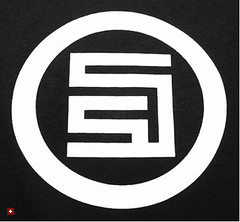
There is a noticeable stylistic similarity to the S|Double Studio logo from Shawn Stussy’s new clothing label.
And the S|Double logo reminds me of Asian seal designs used to sign documents and mark the ownership of artworks.
This is roughly what my given name would look like on a seal or chop in Chinese characters.
There is also a resemblance to Chinese design motifs in Chinese new year and wedding decorations. The one that immediately comes to mind for me is the double happiness character set that is incorporated into designs.
Such motifs are used in a repeated pattern across fabric weave, interior design prints and carvings. There is a certain irony in that the Kin logo: one of the most modern of graphic design assignments going back designs and principles that are millennia old.
I am curious to know if the Kin logo harking back to those designs was intentional, based on design research, or if it was happenstance. Both are probable likelihoods for this project.
Google has finally left the Chinese market for search, so I thought I would try the alternative, hence an unscientific assessment of Baidu. My trial is unscientific in nature and not particularly rigorous. I did what most consumers would have done and searched for myself.
I was quite open-minded about this, on the one hand Google has been killing the search market in Europe, nothing can touch it in the EU and they have made moderately successful forays into other sectors as well. I also know that Google is not all conquering. In fact the wheels start to come off the Google search wagon when you venture into areas with non-Roman languages such as Russian, Korean, Japanese and Chinese.
On the other hand, Robin Li over at Baidu is no slouch. Baidu is famous for is huge index and its continued appetite to crawl content whenever and wherever it can find it.
Baidu like its Korean counterpart Naver has also managed a successful social search product running a question-and-answer service like a better version of Yahoo! Answers – largely free of spam and a more middle-class range of participants provide highly relevant quality content.
It is also blatantly obvious that Baidu doesn’t care whether it attracts a potential English-speaking audience as the entire site apart from investor relations is in Chinese.
I was expecting some divergence between Google and Baidu search engine results pages for a number of reasons. Google crawls an estimated 15 per cent of the total web, and Baidu is likely to crawl a slightly larger amount. That means that their search indexes are likely to be slightly different. Secondly, both will have started with slightly different algorithms and these will change over time with a experience of what users want. Finally, the results are usually ‘flavoured’ according to local market preferences such as language and local content.
I was a bit surprised at the level of divergence between Google and Baidu, which was great than I had seen between Google and Yahoo! in the past.
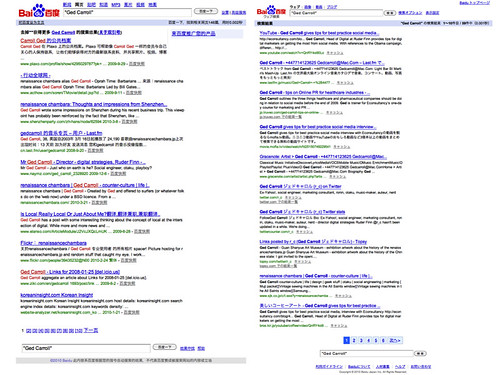
First of all flavouring. A comparison between the Japanese and Chinese versions of Baidu show a high degree of variance between the two versions of the Baidu search engine.
Part of the reason for the difference may be due to Chinese regulations around permitted services, for instance an educational video of me by Econsultancy on YouTube is the top result on the Japanese site and a couple of twitter related hits come in at six and seven. The Japanese site skews much more toward video services than the Chinese site which picked up profile services Plaxo and Naymz.
Interestingly, the Chinese site picked up the re-direct URI for my blog (renaissancechambara.com), whereas neither the Japanese or the Chinese versions picked up my proper domain (renaissancechambara.jp) at all. Even when I clicked a few pages down.
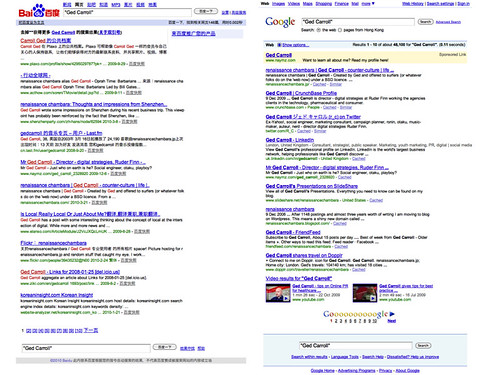
Plotting Baidu China against Google Hong Kong produced an interesting diversity of the results.
Their one point of correlation, my profile on Naymz. Again part of this may be because of my presence on services that don’t do business in China for instance YouTube and Twitter. Google rightly puts more weight and a consequently higher ranking on my Crunchbase and LinkedIn profiles than Plaxo which appears a couple of pages down on Google.
Baidu obviously puts much more emphasis on a historic redirect URI I have for my blog than the ‘real’ one and doesn’t seem to crawl the site in any great depth. I am guessing that this is because of its largely English language content.
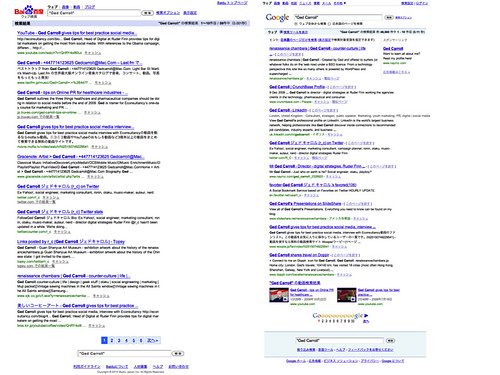
In Japan, the Baidu | Google comparison told a similar story. The Google flavouring between Hong Kong and Japanese versions wasn’t that great only showing differences at position five and lower on the page. Baidu Japan managed to pick up my last.fm profile and twitter profile, but didn’t pick up my blog or any professional information on the first page.
In conclusion, my unscientific assessment of Baidu has shown provides a great search experience for consumers. But I am uncertain how valuable it would be for people in a professional context, for instance researching foreigners with whom they may be doing business or finding foreign presentations. I can understand why Chinese scientific audiences would be concerned by the departure of Google.
I also suspect that optimising content to make it searchable on Baidu is different to the process that I would go through for Google or Yahoo!, but that would merit far more investigation before I could blog with any confidence about it. More Baidu related posts here.
Former CEO of Fujitsu Nozoe Kuniaki (野副州旦) – blackmail forced his resignation | Japan: Stippy – interesting story of boardroom intrigue. Nozoe Kuniaki was originally said to have resigned due to ill health. The FT reported that Nozoe Kuniaki was really forced to resign by Fujitsu. Apparently Nozoe Kuniaki was forced to resign over links to a company of “unfavourable reputation”. The FT hints the roots of this palace putsch: apparently Nozoe Kuniaki was opposed by colleagues due to his drive to refocus the group on IT services at the expense of unprofitable electronics divisions, including its hard disk drive business.
Op-Ed Contributor – Microsoft’s Creative Destruction – NYTimes.com – “Microsoft has become a clumsy, uncompetitive innovator. Its products are lampooned, often unfairly but sometimes with good reason. Its image has never recovered from the antitrust prosecution of the 1990s. Its marketing has been inept for years; remember the 2008 ad in which Bill Gates was somehow persuaded to literally wiggle his behind at the camera?” and “Microsoft’s huge profits — $6.7 billion for the past quarter — come almost entirely from Windows and Office programs first developed decades ago. Like G.M. with its trucks and S.U.V.’s, Microsoft can’t count on these venerable products to sustain it forever.”
When I discovered the idea of the naked official I was pondering the similarity that the Chinese have with the Irish. In both cases immigration is part of their psyche. Reading an article in Sina.com, I was reminded of one particular tranche of Chinese immigration. The immigration that happened prior to, and after the handover of Hong Kong. A number of rich and middle class families chose to move to Canada and other countries. The families lived in places with large existing Chinese communities like Vancouver and the patriarch would often commute to do business back in Hong Kong. These commuters were nicknamed astronauts because they spent so much time in the air.
A trend for the families of Chinese officials to conduct a similar kind of transplanted lifestyle has spawned a new term of naked official. A number of officials whose families had emigrated abroad (presumably beyond the reach of the state) were subsequently convicted of charges relating to them abusing their position. Naked officials are considered to be suspicious of preparing a bolt-hole abroad. Although moving abroad is a widely held middle class Chinese aspiration.
I’ve put together a list of things I learned the hard way that I have called a China hack. Your mileage my vary. Rules change constantly in China. What would have been a China hack for me might be not possible for you. Real ID is being extended to all phone SIMs – you might not be able to get a PAYG phone SIM like I did.
Do get a Starbucks card if you are here for any length of time. It doesn’t charge like it does in the west and Hong Kong, instead it costs you 100 Yuan, but does provide you with vouchers and a discount on your order and they have free wi-fi in many of their coffee shops
Bring a SIM-free mobile phone with you. There isn’t that much of a price differentiation between legitimate phones in China and the West – bringing one from home means that you will have English language instructions
Do get a local PAYG SIM card. Many things in China are arranged over the phone. Having a local SIM card reduces the amount you will spend. I have a China Mobile SIM which gives me a Hong Kong number and a Chinese number. International calls on the card are from 1 yuan-a-minute
If you are going to buy DVDs here, don’t buy off the street. The best ones are usually found in the markets. They tend not to be openly sold on stalls. Personally, I’d advise against it, its just not worth the risk given the low prices that Amazon usually have on if you shop carefully. If you are looking for local films I can recommend DDDHouse.com – which has a wide selection of legal Chinese and Hong Kong films with English subtitles
Always carry a pack of tissues with you, it comes in handy if you have go to the toilet. Whilst facilities are generally clean; a number expect you to bring your own supplies. The reason for this is the army of middle aged men and women who steal toilet roll, liquid soap and anything else that isn’t screwed down
Do bring a laptop or an external hard drive with you to take advantage of the free (legitimate) music downloads available though Google Music China
In the same way that you tend to find dodgy diet Coke allegedly made in former Russian republics from small shops in London. Buying your groceries in a smaller shop in China poses similar risks. Good places to shop include Jasco and Walmart
Do bring index cards with you. Get a Chinese friend to write any address you are going to on the front and be sure to label the back of them. They are invaluable for working with taxi drivers