Category: economics | 經濟學 | 경제학 | 経済

Economics or the dismal science was something I felt that I needed to include as it provides the context for business and consumption.

Prior to the 20th century, economics was the pursuit of gentleman scholars. The foundation of it is considered to be Adam Smith when he published is work An Inquiry into the Nature and Causes of the Wealth of Nations. Smith outlined one of the core tenets of classical economics: each individual is driven by self-interest and can exert only a negligible influence on prices. And it was the start of assumptions that economists model around that don’t mirror real life all the time.

What really is a rational decision maker? Do consumers always make rational decisions? Do they make decisions that maximise their economic benefit?

The problem is that they might do actions that are rational to them:

  • Reducing choice when they are overwhelmed
  • Looking for a little luxury to comfort them over time. Which was the sales of Cadbury chocolate and Revlon lipstick were known to rise in a recession
  • Luxury goods in general make little sense from a ration decision point of view until you realise the value of what they signal
  • Having a smartphone yet buying watches. Japanese consumers were known to still buy watches to show that they care about the time to employers when they could easily check their smartphone screen

All of which makes the subject area of high interest to me as a marketer. It also explains the amount of focus now being done by economists on the behavioural aspect of things.

  • The basics

    The current economic climate will help re-define the basics for many people.

    Since I was a child supermarkets and shopping experiences have been richer and presented consumers with progressively more choice. During the last recession of the early 1990s supermarkets created own brand products that offered cheaper alternatives with the exact same quality as own brand products.

    No Frills

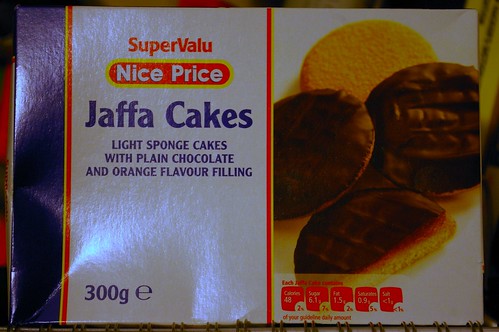
    A second own-brand phenomena was own brand products that fulfilled basic needs but did away with superfluous packaging and were best seen as ‘fit for purpose’: the No Frills supermarket own brand pioneered by Kwik Save is a classic example of this category. Sainsbury has their version called Sainsbury Basics. So by the time the economy picked up again choice had been increased even further. These brands moved away from, or redefined the bare essentials, for instance recently in Sainsbury’s I have noticed basics including filter coffee and Jaffa Cakes.

    SuperValu Nice Price Jaffa Cakes

    When I left university in the late 1990s, I got a jump on other candidates that worked for the same temping agency as me by having an alphanumeric pager that allowed me to be more responsive to the agency – getting better roles because it was easier for them to find me. Over the next ten years mobile phones became ubiquitous to the point where even homeless people and crack addicts have one.

    It is pretty much the same story with internet access. I used to go over to a cyber cafe in Liverpool near James Street station to check the email in my Yahoo! account every Saturday. Although I had bought shareware Mac software online via Kagi whilst at university, I made my first modern e-commerce purchases via Boxman during my lunch break in the office when I moved down to London. It is hard to imagine that prior to Freeserve in the UK, even dial-up home internet access was largely the preserve of the middle classes in the UK. In contrast, now fixed and mobile broadband has become ubiquitous with mobile broadband connections costing as little as 5GBP a month at the time of writing.

    I get the sense that we have reached a golden age of what basics means, and that golden age will last an uncertain amount of time as environmental and resource concerns kick in. Resources as diverse as food products, oil, copper and water are all under pressure; together with rise of a huge middle class in the developing world basics are going to be more expensive and some items will come off the list as compromises are made. Globalisation will no longer just be about competition to supply products and services, but also about consumer competition to demand goods.

    What does the basics look like to you? How will it change by economics, increasing awareness of personal carbon footprint and environmental impact? More retailing related content can be found here

  • Bijin tokei + more news

    Bijin tokei

    bijin-tokei(美人時計)official website – bijin tokei is a relatively simple creative idea, really well executed. In bijin tokei pretty Japanese ladies were photographed holding a board with the time on it. This was then turned into a clock. It is a website and an iPhone app.

    Consumer behaviour

    Value Is the New Green – WSJ.com

    BBC NEWS – From Our Own Correspondent | The mechanics of tipping US-style

    Design

    ‘Focus Shifted from Gadgets to QOL,’ National Semi CEO Says — Tech-On! – new trend is consumer electronics designed to enhance quality of life (QOL)

    Good design: The ten commandments of Dieter Rams

    Economics

    Barbie in the land of Chairman Mao | GlobalPost

    Will China Buy The World? The Beijing Debate – Deal Journal

    How to

    Hive Five: Best Home Server Software – interesting this came out with purely OSS solutions

    Japan

    AppleInsider | Japanese “hate” for iPhone all a big mistake – Wired gets hit again on editorial integrity

    The Japanese are iPhone haters… or are they? – Ars Technica – Wired article debate runs on and on, interesting issues on editorial fact checking raised

    Media

    Baseball’s New MLB.TV Player Launches, Looks Good – Silverlight swapped out as Flash provides better experience

    TeliaSonera: European Carrier to Enter CDN Space — Seeking Alpha

    The ten publishing principles for BBC online – great advice here

    Lord Carter confirms his plans for a digital rights agency

    Online

    Video Viewing Strong on All Screens – eMarketer

    Official Google Blog: Tipping points

    Security

    Who Hid the Hash Key? | Yellow Swordfish – forgot that this is difficult for switchers

    Software

    Amazon Launches Kindle App for the iPhone

    I, Cringely » The Neokast Mystery

    Style

    YOHO.CN 年轻人的城市 – interesting Chinese style magazine, similar to Milk

    Telecoms

    Total Telecom – Hutchison Telecom up on HK, Macau spinoff plan

    Web of no web

    Slashdot | The Real Reason For Microsoft’s TomTom Lawsuit – all that experience in court on the receiving end of patent suits has taught MS a thing or two

    Wireless

    Digital Evangelist: Economist view on MWC09 – its all about the ARPU

    Nokia Plans LTE Devices for 2010

    Why We Need Fat Mobile Pipes

  • The Writing On The Wall China And The West In The 21st Century by Will Hutton

    Before we get into The Writing On The Wall I thought it would be best to talk about how I got into reading books like this. I didn’t start reading economics for fun until I read Will Hutton’s The State We’re In when I was in college. I was interested to find out what Hutton thought about China and the west in his new book The Writing On The Wall. China has a history of technological and legal progression going back three millenia and made an unprecedented move back to the forefront of the global economy.

    IMGP0256.JPG

    The Writing On The Wall China And The West In The 21st Century by Will Hutton writes in a narrative style that would be familar to readers of The State We’re In. Hutton covers how the teachings of Confucius led to a ‘modern society’ in China when my ancestors were building Brú na Bóinne.

    How the western colonial powers (notably the UK, France, Germany and the US) managed to embarrass and humble the celestial kingdom? The hard choices which the communist party had to make and the hard road that the country has walked to gain its present status and the challenges that the party faces in maintaining an even keel.

    Whilst Hutton is critical of some Chinese measures, he points out were the west has made similar mistakes and the lessons learned from them. Some readers may feel mis-sold as Hutton discusses the global politics of energy and protectionism by the US. However the world is connected and I feel his discussion of the intertwined fates of the US and China is a valid one. More on China here.

  • Cyprus notes

    I spoke earlier this week at an eTourism Forum in Cyprus. It was my first time on the island. It is an interesting mix of contrasts:

    • The main language is Greek, but everyone speaks English
    • Everyone drives on the leftside of the road and the even the road signs look British
    • The island has a series of micro-climates with snow on the mountains when I was there and a pleasant 20 celsius down nearer the sea

    I spoke and participated in panel discussions over two days. You can find my presentation on Online Reputation Management and the Personalised Web. It was good opportunity to catch up with some old friends and make some new ones including: John Horsley founder of the Marzar social network, Gerd Leonhard media futurist, Richard Sedley of cScape, Andrew Gordon,  Theodoris Koumelis of Travel Daily News and Dr. Natasa Christodoulidou of UNLV. The conference was enthusiastically hosted by Petros Mavros of Avantless on behalf of The Cyprus Tourism Organisation.

    The audience were enthusiastic and eager to learn about what online marketing techniques could do for their businesses. It struck me that there was more demand than there was the local web and design talent to address it, though some of the attendees seemed to already have a sophisticated understanding of search marketing techniques.

    What became apparent was the unequal nature of market power. The local businesses needed to reset the balance between themselves and the large tour groups that had traditionally brought travellers to the island.

    Large tour groups immense market power was used to screw these businesses into the ground on price. Cyprus even needs to import its own drinking water, so a downturn in the economy would be disastrous.

    Whilst I had been there on a professional basis, I wouldn’t mind going back during the winter or spring as a tourist to sample some of its more cultural aspects. More related content can be found here.

  • Industrial Action

    The recession has brought industrial action that we haven’t seen since the 1970s as union members blame foreign workers for taking British jobs. The flashpoint has been at Lindsey refinery operated by Total. Lindsey sits at the mouth of the Humber river. The inciting incident involved an Italian subcontractor doing maintenance on the refinery who brought in Italian and Portuguese workers, which there was high unemployment in the area. The underlying nationalism is the populist dark side of the globalisation boom.

    My parents came to the UK when my Dad came over to work in the shipbuilding industry in the mid-1960s. Most of my friends have worked abroad: engineering in the Middle East, construction in Germany, web development and PR in North America and Asia Pacific.

    Newsnight highlighted two things of interest to me in the strike.

    First of all is the conflicted politics around the strike. Traditional left-wing allies of the strikers like the Socialist Workers Party  are between a rock and a hard place as they can’t allign themselves with worker solidarity and a doctrine of protectionism that smacks of racism. Secondly this gives the far right yet another opportunity to get a hook into the angry disenfranchised white working-class. There is a large amount of government money already going into community engagement programmes to try and deal with this problem and other organisations have ongoing efforts to deal with the BNP head on, however the industrial action is like putting petrol on a fire. I could see this feeding into a broader anti-globalisation right wing populist fuelled reactionary politics focused on Euro-skepticism.

    The second thing is the way worker politics has been extended and expanded via web 2.0 platforms. British Wildcats is a WordPress-based blog which seems to have far-right sympathies. It presents a professional looking face (even if the copy is hackneyed) to the movement using Google Maps integration, downloadable leaflets and blog posts to spread its message.

    British jobs for British workers Facebook group

    Over on Facebook I found 487 groups relating to British jobs for British workers. The top-ranked group: British Jobs for British Workers has 27,094 members. It used to be that the printing press and the xerox machine were tools of subversives. The CIA used to smuggle photocopiers into the Soviet Union for that very reason. Now it’s blogs and social networks.

    More related content can be found here.