Category: gadget | 小工具 | 가제트 | ガジェット

What constitutes a gadget? The dictionary definition would be a small mechanical or electronic device or tool, especially an ingenious or novel one.

When I started writing this blog the gadget section focused on personal digital assistants such as the Palm PDA and Sony’s Clie devices. Or the Anoto digital pen that allowed you to record digitally what had been written on a specially marked out paper page, giving the best of both experiences.

Some of the ideas I shared weren’t so small like a Panasonic sleeping room for sleep starved, but well heeled Japanese.

When cutting edge technology failed me, I periodically went back to older technology such as the Nokia 8850 cellphone or my love of the Nokia E90 Communicator.

I also started looking back to discontinued products like the Sony Walkman WM-D6C Pro, one of the best cassette decks ever made of any size. I knew people who used it in their hi-fi systems as well as for portable audio.

Some of the technology that I looked at were products that marked a particular point in my life such as my college days with the Apple StyleWriter II. While my college peers were worried about getting on laser printers to submit assignments, I had a stack of cartridges cotton buds and isopropyl alcohol to deal with any non catastrophic printer issues and so could print during the evening in the comfort of my lodgings.

Alongside the demise in prominence of the gadget, there has been a rise in the trend of everyday carry or EDC.

  • Convenience store + more things

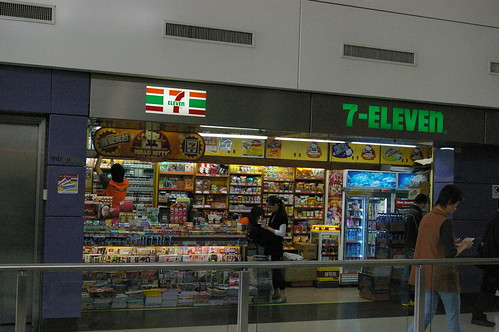
    CivicScience | Convenience Store Food Taking Aim at Fast Food – god this brings back memories of fishballs and curry sauce in the 7-Eleven convenience store common in Hong Kong. More stories on retailing here

    7-Eleven at Tung Chung (Lantau Island) MTR station
    7-Eleven convenience store in Tung Chung (Lantau Island) MTR station circa 2006

    TBWA HK offers service pack to help brands through “financial winter” | Advertising | Campaign Asia – sales over brand building. More on this later

    What the Heck Does Luxury Mean Now? | GQa new and enticing definition of the word emerged with flawless-diamond clarity: big European houses hired a swath of truly cool designers who rewrote the rules of exclusivity and quality, breaking brands free from its tiresome cliches about who and what was indulgent, beautiful, and elegant. Figures like A$AP Rocky and Frank Ocean became the new doyennes of style and taste; Alessandro Michele, Virgil Abloh, and Kim Jones became worldwide superstars; and Supreme convinced a new generation that you could make inexpensive stuff with the rigorous sensibility of a fashion house. Things that were once secret became matters of global pop-cultural importance—a lot of people now follow the haute couture and menswear shows like others follow football

    PopSockets, Sonos, and Tile Ask Congress to Rein in Big Tech | WIREDit wasn’t until PopSockets agreed to spend $2 million on retail marketing that Amazon finally clamped down on the fakes and knockoffs. Amazon denies this, and says that worked “with PopSockets to address our shared concerns about counterfeit.”But there were still other problems: Barnett says Amazon frequently lowered the price of PopSockets products, and then expected his company to make up the difference—even though that was never part of their contract. Amazon would “dress up requests as demands, using language that a parent uses with a child, or more generally, that someone in a position of power uses with someone of inferior power,” Barnett wrote in testimony sent to Congress. Am I shocked that Amazon is playing hard ball in the way that everyone from Tesco to Wal-Mart have done? No. But the problem isn’t the tactics per se, but the scale at which Amazon operates. Also Tesco and Wal-Mart might try and tear your face off with look-a-like private label products, but they won’t intentionally cross the line into selling counterfeit products

    Twitter picks 2019’s most creative brand campaigns – Some interesting tactics, all of which look like PR and are run of the mill in nature

    How China’s state-owned enterprises milk listed subsidiaries – Nikkei Asian Review – no surprise in this report but nice to see it explicitly stated

    Facebook apologises after Xi Jinping name translated as an obscenity – While China does not allow its citizens to access Facebook freely, the country is the company’s largest source of revenue after the US. Facebook is setting up an engineering team at its Asia-Pacific office in Singapore to focus on the lucrative Chinese advertising market, Reuters reported this month.

    How Britain’s big retailers missed their online moment – most traditional retailers still operated separate pools of stock, often in different warehouses, for stores and online. This really surprised me

    Old Masters, New Clothes: Highsnobiety’s Latest Streetwear Collab | Sotheby’s – STFU – this is just taking the michael. Years from now, I might look back on this as the peak of the current premium streetwear bubble

  • Sega MegaDrive Akira game + more

    A gorgeous unreleased adaption of Akira for the Sega MegaDrive. I presume that these visuals are designed to move the game play from level to level.

    At the time the Sega MegaDrive was innovative. Both in terms of the Sega MegaDrive technology and the marketing that went to support the games console. Sega brought a huge heritage in arcade gaming to the Sega MegaDrive. The neon noir vibes of Akira was a perfect pairing for the console

    As technology has improved computer graphics has become more prosaic. You no longer see the kind of surreal computer graphics visuals that you enjoyed from the late 1970s to late 1990s. VintageCG has archived a lot of early CG demos on YouTube.

    The Witcher was the must watch show on Netflix at the end of last year. It was inevitable that the memeable power ballad Throw A Coin To The Witcher gets the inevitable remixes. Amongst the best is this remix by Whitestone.

    https://soundcloud.com/whiteestonee/the-witcher-toss-a-coin-to-your-witcher-whitestone-remix

    Donald Knuth features in Robert X Cringely’s history of computing from post-World War II to the rise of the personal computer. While Knuth never made a fortune, his ideas facilitated a lot of modern computing. Here’s a great interview with Knuth that will make you appreciate the computing power in the power of your hand today.

    Its hard to to appreciate today the great leaps forward that have been made in semi-conductors. Programmes were once written in 4KB of memory, an app icon might now be 130KB of memory.

    Strange Parts did an amazing video on how lithium polymer ion batteries are made during a recent trip to Shenzhen, China. What immediately becomes apparent for me is the challenge of doing this process in reverse to recycle these batteries once they have reached their end of life.

    Strange Parts at the Pisen Group battery factory
  • Machines for emoting

    Machines for emoting

    Machines for emoting, is the problem of our internet in the palm of our hands? Over the past few years the sentiment towards the internet has changed dramatically.

    iPhone

    Before the internet

    Going back to the 1960s, my parents told me about the ‘No Blacks, No Irish, No Dogs’ signs. These were found in many British towns at the same time that hippies were advocating peace and love. And when Enoch Powell made his rivers of blood speech; 70 percent of British people surveyed agreed with him.

    Real world media and underground subcultures traded blows over racism at a slower pace. Though many of those blows were real.

    Is it the internet?

    This is no longer the information superhighway of Al Gore. The reasons for the changes aren’t obvious. One popular narrative is that algorithms are to blame. It is common to hear that narrative in news media.

    But academic research suggests that it isn’t ‘radicalisation’ by algorithms isn’t true.

    Is it the devices we use?

    There were smartphones before the iPhone. They were made by numerous companies including Nokia, Palm, SonyEricsson, Panasonic and even Microsoft (who partnered with a number of manufacturers). In Japan, NTT DoCoMo put the ‘smart’ in the network through iMode rather than building a mini-PC in the phone itself.

    Smartphones had initially started with business users and gradually broadened its base. Quite early on, phones focused on social functions, a classic example would be Danger’s Sidekick model which was designed for messaging. Nokia first popularised the app store and security signed apps that Apple and Google built upon.

    The move to the ‘pictures under glass’ interface that we now know from Android and iPhone devices coincided with a surge on social.

    Social media existed before 2010, but not as we now know it. Few of us had smartphones in 2009. Facebook’s active user base has grown sevenfold over the past 10 years, and there simply aren’t enough people for that to happen again. Instagram and WhatsApp were both launched about a decade ago, and swiftly absorbed into the mother of all social networks. As for Twitter, let me simply note that Donald Trump only started tweeting in earnest in 2011.

    Tim Hartford in the FT

    Did the pictures under glass metaphor and apps designed to utilise it make social too easy to share? It allows people to emote. From mild emotions usually expressed with emoticons or GIFs to visceral anger that seems to flood Twitter – there seems to be evidence of correlation if not causality. So how can design slow the hose pipe down to encourage more considered responses?

    If that’s the case then user experience design has to play a part in resolving some of the worst issues online, given that people can’t seem to be able to respond appropriately by moderating their behaviour.

  • Open source 5G + more things

    Pentagon wants open-source 5G plan in campaign against Huawei – ok in theory only. Open source 5G including OpenRAN doesn’t provide the flexibility in installation that vendor solutions do. More related content here.

    It Seemed Like a Popular Chat App. It’s Secretly a Spy Tool. – The New York Times – Emirati’s do with Totok what the Chinese have been doing for years with WeChat TOMS/Skype etc. Totok is apparently popular in Qatar as it allows VoIP without a VPN – so expat workers use it to connect with their families at home.

    Totok messenger

    Made in America – On US staffed hacking team in UAE. Interesting investigation by Reuters

    The decade of the drop: why do we still stand in line? | How To Spend It – experience. It’s diametrically opposite to one stop shopping

    Apple Captures 66% of the Smartphone Industry’s Profits in Q3 leaving all of their Competitors Combined in the Dust – Patently Appleit is becoming a challenge for Chinese smartphone brands to increase their smartphone ASPs and margins due to a combination of longer consumer holding periods and Apple lowering pricing on some key SKUs, which has limited the headroom that Chinese vendors had used to increase their ASPs – in the long term Huawei having to be vertically integrated all the way up the stack could be to their benefit

    Nike’s Jordan brand just had its first billion-dollar quarter — Quartz – interesting that it has taken over 30 years to get to a billion dollar quarter, yet Jordan is at least ten years past its cultural peak

    In Focus: Pet Shop Boys 6th December 2019 | Listen on NTS – amazing delve into their career

    Reality TV stars auditioned to ‘promote’ poison diet drink on Instagram – BBC News – Oh my gosh, this is as good as watching re-runs of Brass Eye

    Pig Irons at the ‘Plex | Margins – essay on consulting firms well worth reading

    Gildo Zegna: tailoring masculinity for changing tastes | Financial Timesluxury goods industry is feeling the heat of technological disruption, social upheaval and identity politics. Furthermore, within the high end fashion industry few items of clothing are facing more pressure from falling consumer demand than the one that made the Zegna family rich: the traditional men’s suit. “The big challenge we face is a rethinking of masculinity,” he says. – I think streetwear is interesting because of the reassurance it provides on masculinity. The basics of streetwear go back to the mid-century sports basics. The hooded top, jeans, t-shirts, plaid shirts, Letterman jacket, track jacket etc

    Facebook awaits EU opinion in privacy case | Financial Times – interesting how wide the impact of this case could be in terms of things like credit card transaction data etc. (paywall)

    Aito.ai – Introducing a new database category – the predictive database – hmmm

    A Surveillance Net Blankets China’s Cities, Giving Police Vast Powers – The New York TimesChinese authorities are knitting together old and state-of-the-art technologies — phone scanners, facial-recognition cameras, face and fingerprint databases and many others — into sweeping tools for authoritarian control, according to police and private databases examined by The New York Times. Once combined and fully operational, the tools can help police grab the identities of people as they walk down the street, find out who they are meeting with and identify who does and doesn’t belong to the Communist Party. The United States and other countries use some of the same techniques to track terrorists or drug lords. Chinese cities want to use them to track everybody.

    Is LVMH’s Digital Transformation Working? | Luxury Society“Over the last few years our market has become highly fragmented,” it added. “Customer journeys and purchasing habits have become more complex. Now, in addition to magazines and other traditional media, our customers – especially young people – use a range of digital options to stay informed, communicate with friends and shop. Brand awareness and customer engagement are built on these many different touchpoints.”

  • Snowden revelations + more things

    Looking back at the Snowden revelations – A Few Thoughts on Cryptographic EngineeringThe brilliant thing about the Snowden leaks was that he didn’t tell us much of anything. He showed us. Most of the revelations came in the form of a Powerpoint slide deck, the misery of which somehow made it all more real. And despite all the revelation fatigue, the things he showed us were remarkable – this is such a good read. I suspect that the level of surprise expressed is mostly a US thing. I was disappointed, but not shocked by it all. Back in the day the NSA used to publish one of the best guides to ‘hardening’ macOS – documents that they no longer seem to host online. The Snowden revelations were nothing new. I grew up in Europe when:

    • GCHQ were tapping all of Ireland’s overseas telecoms and data traffic via the Capenhurst tower. Having lived in the neighbourhood of Capenhurst during the 1980s and 1990s, this was well known but only confirmed in the media in 1999
    • The ECHELON network was hoovering up microwave, fax, satellite and telephone calls

    After Duncan Campbell’s lifetime of work, the Snowden revelations are part of a decades long pattern of behaviour. Admittedly the US’ rivals will be up to the same things and worse.

    Luxury watch maker Patek Philippe and Leagas Delaney launch new Generations campaign – Marketing Communication News – the most interesting aspect of this to me is the way its looking to address a younger audience. Secondly, if you look at the background with the plants and rain its moved the look and feel to more tropical than their previous campaigns that were northern European in feel. (It was actually shot in Italy). Because? My guess, China. Younger rich people due to second generation wealth. Two children reflecting the recent law changes around family size in the country

    Is the era of the $100+ graphing calculator coming to an end? | The Hustledon’t feel too sorry for Texas Instruments: over a 20-year period, TI set out to manufacture demand by making its calculators mandated classroom tools. The company established partnerships with big textbook companies that integrated TI-specific exercises (complete with screenshots of buttons) into classroom curricula. It sought approval for standardized test use from administrators like the College Board. And every time a competing tech innovation came along, it lobbied to maintain its perch atop the parabola. According to Open Secrets and ProPublica data, Texas Instruments paid lobbyists to hound the Department of Education every year from 2005 to 2009 — right around the time when mobile technology and apps were becoming more of a threat. The company campaigned against devices with touchscreens, internet connection, and QWERTY keyboards” – hate the game, not the player etc. etc.

    Snap Detailed Facebook’s Aggressive Tactics in ‘Project Voldemort’ Dossier – WSJ – which is being used in an antitrust investigation. No real surprises for anyone who has followed Facebook over the years. This negates Facebook’s main defence of ‘if it wasn’t us, it would be China’

    The Dark Side of Techno-Utopianism | The New Yorker – the sub heading ‘Big technological shifts have always empowered reformers. They have also empowered bigots, hucksters and propagandists

    New York in 1984 was the time, and the place, dance music became a culture – Features – Mixmag – great write up, the only thing missing is a name check for the Latin Rascals, Cutting Records and the Freestyle scene

    Jason Dill HYPEBEAST Magazine Interview | HYPEBEAST – great interview, partly due to the car crash of journalist interviewing technique

    Parenting’s New Frontier: What Happens When Your 11-Year-Old Says No to a Smartphone? – Voguemy son had decided three things about smartphones. 1. They’re infantilizing, a set of digital apron strings meant to attach you to your mother. (He was onto something there.) 2. They compromise a boy’s resourcefulness because kids come to rely on the GPS instead of learning Scout skills. 3. They make people trivial. This final observation bugs me the most, because he still expresses it whenever he sees me jabbing at my own device: “Texty texty! Emoji emoji!” And when I play my word games, he shouts, “GAMER!” That hurts. In short, my son says, he doesn’t want a phone because he wants to be free