Category: gadget | 小工具 | 가제트 | ガジェット

What constitutes a gadget? The dictionary definition would be a small mechanical or electronic device or tool, especially an ingenious or novel one.

When I started writing this blog the gadget section focused on personal digital assistants such as the Palm PDA and Sony’s Clie devices. Or the Anoto digital pen that allowed you to record digitally what had been written on a specially marked out paper page, giving the best of both experiences.

Some of the ideas I shared weren’t so small like a Panasonic sleeping room for sleep starved, but well heeled Japanese.

When cutting edge technology failed me, I periodically went back to older technology such as the Nokia 8850 cellphone or my love of the Nokia E90 Communicator.

I also started looking back to discontinued products like the Sony Walkman WM-D6C Pro, one of the best cassette decks ever made of any size. I knew people who used it in their hi-fi systems as well as for portable audio.

Some of the technology that I looked at were products that marked a particular point in my life such as my college days with the Apple StyleWriter II. While my college peers were worried about getting on laser printers to submit assignments, I had a stack of cartridges cotton buds and isopropyl alcohol to deal with any non catastrophic printer issues and so could print during the evening in the comfort of my lodgings.

Alongside the demise in prominence of the gadget, there has been a rise in the trend of everyday carry or EDC.

  • A laser cut record & things that made last week

    Laser cut record

    A frickin’ laser-cut record. How awesome is this? Back in the day there were efforts to use laser pick-ups to read vinyl records in a way that wouldn’t affect the records over time. Dragging a diamond tipped needle through a groove was viewed as destructive. The first prototype was demonstrated publicly in 1977.

    An American company called Finial demonstrated a commercial product. But its business no longer made sense and eventually the intellectual property was picked up by Japanese company ELP Japan. ELP Japan build laser turntables to order. The laser cut record turns this philosophy on its head. The record is no longer a valuable artefact, but something that can be replicated over and over again.

    A simple but delightful Japanese Vine. Simple but amazingly cute gerbil with a priceless reaction when its human stops stroking it. I remember petting the dog that I owned at the time and eliciting a similar reaction of why stop. This seems to be a reaction that’s hardwired in; a sudden stop in grooming by another might indicate that they sense danger and consequently I should be on alert.

    A totally awesome Japanese game for the Sony PlayStation featuring Godzilla and all manner of kaiju. The odd thing about this Bandai Namco game is that it is for the PS3 rather than the PS4 which is gaining the lions share of console sales. One can only guess that this was a project that massively overshot its initial launch date?

    A smooth jazz version of Van Halen’s Running With The Devil, which seems to use studio stems of this rock classic. It works amazingly well, which says a lot about Van Halen’s songwriting and general musicianship

    Finally a video of park life in Beijing. It is hard to emphasise the amount of smoking that happens in China, so this video shows you instead. More related content here.

  • On wearing a smart watch

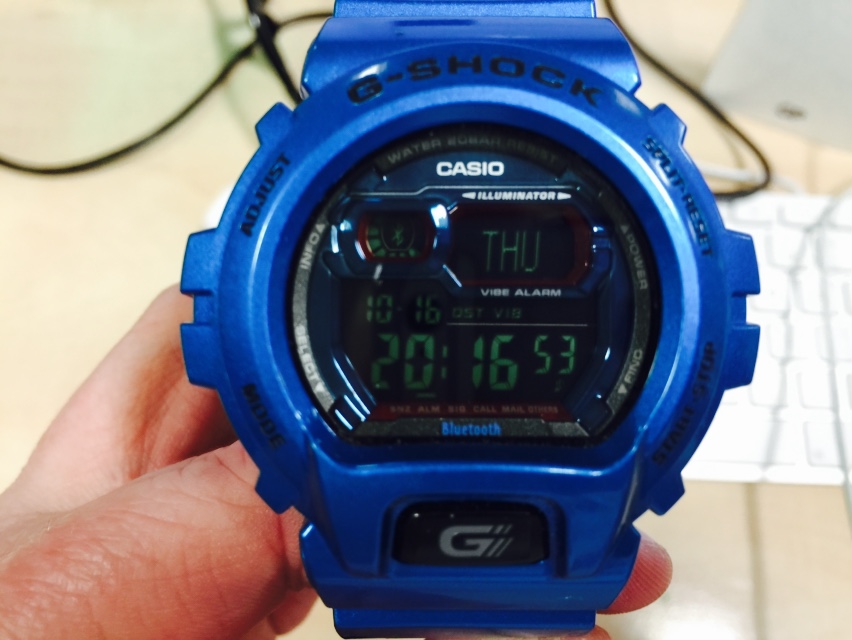
    At the beginning of the month I took the plunge and decided to buy a Casio G-Shock connected watch. After a week or of wearing a smart watch, I have a pretty good sense of the pros and cons of using it.
    Casio G-Shock Bluetooth

    The connection with the iPhone makes a major leap forward in the G-Shock experience. Using a G-Shock is rather like using an old computer system like a DEC VAX minicomputer, the experience is modal. Everything revolves around combinations of button pushes to get to the functionality of the watch. Realistically you can’t navigate this process while wearing a smart watch.  The manual is a quarter of an inch thick and the commands not exactly memorable. If you have clumsy fingers or are not paying attention you have to cycle through the complete set of button commands again
    g-shock modal nature
    The G+ iPhone application deals with every setting on the watch bar setting the time and date itself (which still requires a bit of button juggling).
    Untitled
    The achilles heel is battery life. Most of the facilities about the watch are about husbanding a relatively meagre lithium ion battery. What Casio’s engineers managed to achieve is imperfect but impressive. The battery life is the silent hand that ruled all aspects of the product design. In order to have a sealed in battery that lasted more than a day, Casio had to go with an old school battery. Out went modern G-Shock features such as the GPS module and atomic clock radio units used to provide accurate time based on location.

    Out too went the solar power option. Alerts seem to be polled every quarter of an hour for things like email. But then in this connected age, having a message to let me know that I don’t have email would be more noteworthy.

    This all had a number of effects:

    • The watch didn’t alert me to everything – that isn’t a bad thing. I do want my alerts to be consistent, so I shut down alerts from everything but Twitter, calendar and calls. I would have loved to have alerts for WeChat, SMS / iMessage messages, FaceTime and Skype calls but they aren’t on the programme (so far)
    • The watch did cure ‘phantom’ rings. I got to ignore ringtones out in public and at home unless my wrist shook. It also worked well when I couldn’t feel my phone vibrating in my Carhartt jacket
    • I remembered to take my phone with me on more occasions, the watch would vibrate if the Bluetooth link was broken

    The best bit of the phone for me was that it was still a G-Shock, it could be worn in the gym, the shower, whilst shaving, washing dishes or swimming. It is a watch for living rather than a Bluetooth-enabled human leash.

    More information
    On smart watches, I’ve decided to take the plunge

  • DJ equipment + more stuff

    Pioneer To Sell DJ Equipment Business For More Than Half A Billion Dollars » Synthtopia – interesting move, particularly with the launch of the new turntable. Pioneer’s DJ equipment business gave them a fill up as hi-fi revenue dropped. Pioneer CDJs managed to replace Technics as the industry standard in DJ equipment for many clubs. What will happen with things like IP?

    Fareed Zakaria Never Stopped Plagiarizing: How Dozens Of Episodes Of His CNN Show Ripped Others Off | Our Bad Media – looks like a potential new media storm-in-a-teacup. If he plagiarises, he has good taste with the material he takes

    Daring Fireball: Apple Watch: Initial Thoughts and Observations – a key point missing here is that you don’t buy a watch when you pay for a luxury watch; you buy into the support network behind it which will keep it running at a price decades from now.

    Foreign firms should not control so much of the Chinese economy | WantChinaTimes – explains antitrust crackdowns

    This Chennai startup thinks the first click for an e-commerce purchase will soon be on a camera – reminds me of the virtual Homeplus (Tesco) stores in Korea

    Daring Fireball: Promotional Images That Hide the iPhone 6 Camera Bulge – interesting that John Gruber has called it a mistake

    Using app-specific passwords | Apple – Apple’s way around dealing with recent hacking scandals

    Facebook partners with Google, Twitter, others to launch ‘TODO’ – Inside Facebook – interesting move and interesting omissions in the participants

    The Apple Watch Won’t Kill the Swiss Watch Industry | The NextWeb – it makes sense that TAG Heuer would make a smart watch being the most feminine of the brands in LVMH’s roster of serious watch brands

    Are Agencies Killing Their Programmatic Golden Goose? | WSJ – opaque practices and pricing models of some of these agency groups have recently led marketers to question how their money is being spent, and in some cases to shun the groups completely in favor of building their in-house alternatives. More related content here.

    The single, buried statistic that explains China’s slowdown – Quartz – implication that construction is down

    DisplayPort 1.3 announced w/ support for upcoming 5K displays, enhanced 4K performance | 9to5Mac – 5k displays already

  • Ghost in the Shell

    Masamune Shirow’s Ghost In The Shell is a three-volume manga series (volumes 1, 1.5 and 2) that is based on a Japanese security service team who try and solve cyber-crime related issues.

    The stories deal with a future where technology is embedded into human beings and augment them. It is also based around a world where the internet of things is an everyday occurrence. Shirow’s future is believable. Unlike Star Trek, he recognised that the future is built in layers on the past. So you see this in the architecture in the background of picture cells.

    You also see that layers in terms of everything from clothing and personal effects to vehicles of the protagonists.

    The author obvioiusly goes deeply into the story as a thought experiment with copious side notes explaining either technological developments or why he has made certain decisions. The stuff that he incorporated was cutting edge scientific research at the time. Whilst I love the anime adaptions, this insight into Shirow’s thinking makes the books invaluable.

    The books seem to have been remarkably prescient about hacking and the risks of technology. In previous literature, hackers were generally on the side of good or libertarians. In Ghost In The Shell you have cyber warfare and cyber crime similar to our own reality today. A crumbling healthcare system, organised crime, private military entities and shadowy state actors.

    Unfortunately, the designers of smart televisions and refrigerators didn’t pay much attention to these books, otherwise they would not have left these products so open to being hacked. Come for the sci-fi stay the course of the books for the underlying ideas. More book reviews here.

  • Jim Yurchenco & other things this week

    Before IDEO was better known for corporate workshops and collaborative sessions; it did really good product design. This great interview / video by IDEO of veteran mechanical engineer and industrial designer Jim Yurchenco. Yurchenco is a throwback to when IDEO designed things.

    Yurchenco worked on the design of the original Apple mouse, in the video he discusses his approach to design. It is also great to see him actually using real tools, rather than just tapping away at a work station. Yurchenco was retiring last week and leaves IDEO with some 80 patents to his name. Alongside the original Apple mouse Yurchenco also worked on the Palm V, in his own words:

    That was a really important product for us, and the industry, Yurchenco says. “It was one of the first cases where the physical design—the feel and touch points—were considered to be as important as the performance

    You can read more on Yurchenco’s work here. I worked on the marketing of the Palm V and Vx. The exterior of the devices set the standard for the smartphones we got a decade later. The problem with the V and Vx is that they were held together with hot glue. Yurchenco made an object of beauty, but one that was very difficult to repair.

    The PDA launched with a lithium ion rechargeable battery around about the time that the Ericsson T28 came on the market. The T28 was the first phone with a lithium ion battery. This allowed Ericsson to make a really small clamshell phone. The Yurchenco design completely encapsulated the battery, rather like the first iPhone years later.

    Subtraction.com did a great job of collating the user interface (UI) designs done by Territory Studios for Guardians Of The Galaxy.

    In the same way that Star Trek, Ghost In The Shell and Star Wars have influenced engineers, who is to say that Territory’s work won’t be the creative DNA of new interfaces in the future?

    In the earlier days of the web, interactive content had a distinctly trippy feel, from site design to ‘Mind’s Eye’ videos and The Shamen’s generative screen saver.  Japanese group BRDG (Bridge) have gone back to that psychedelic feel with this brilliant discordant video:

    Twitter cards are something that is interesting me at work at the moment and I was particularly taken by this interactive one from Acura – the upmarket brand of Honda.

    Pizza Hut Japan, have managed come up with marketing gold by creating an interactive YouTube series based around the grand opening of a pizza restaurant run by cats. Japan is obsessed with cats, which explains the prominence of felines. I am just surprised that Jonathan Hopkins and Nando’s hadn’t done it much earlier…