Category: ideas | 想法 | 생각 | 考える

Ideas were at the at the heart of why I started this blog. One of the first posts that I wrote there being a sweet spot in the complexity of products based on the ideas of Dan Greer. I wrote about the first online election fought by Howard Dean, which now looks like a precursor to the Obama and Trump presidential bids.

I articulated a belief I still have in the benefits of USB thumb drives as the Thumb Drive Gospel. The odd rant about IT, a reflection on the power of loose social networks, thoughts on internet freedom – an idea that that I have come back to touch on numerous times over the years as the online environment has changed.

Many of the ideas that I discussed came from books like Kim and Mauborgne’s Blue Ocean Strategy.

I was able to provide an insider perspective on Brad Garlinghouse’s infamous Peanut Butter-gate debacle. It says a lot about the lack of leadership that Garlinghouse didn’t get fired for what was a power play. Garlinghouse has gone on to become CEO of Ripple.

I built on initial thoughts by Stephen Davies on the intersection between online and public relations with a particular focus on definition to try and come up with unifying ideas.

Or why thought leadership is a less useful idea than demonstrating authority of a particular subject.

I touched on various retailing ideas including the massive expansion in private label products with grades of ‘premiumness’.

I’ve also spent a good deal of time thinking about the role of technology to separate us from the hoi polloi. But this was about active choice rather than an algorithmic filter bubble.


  • A content desert?

    I started thinking about the idea of a content desert for a few reasons:

    Experian Marketing Services put out a really nice whitepaper out in June as part of their ConsumerSpeak series called Millennials come of age. One graph stood out to me; the split across generations between traditional and digital media consumption.
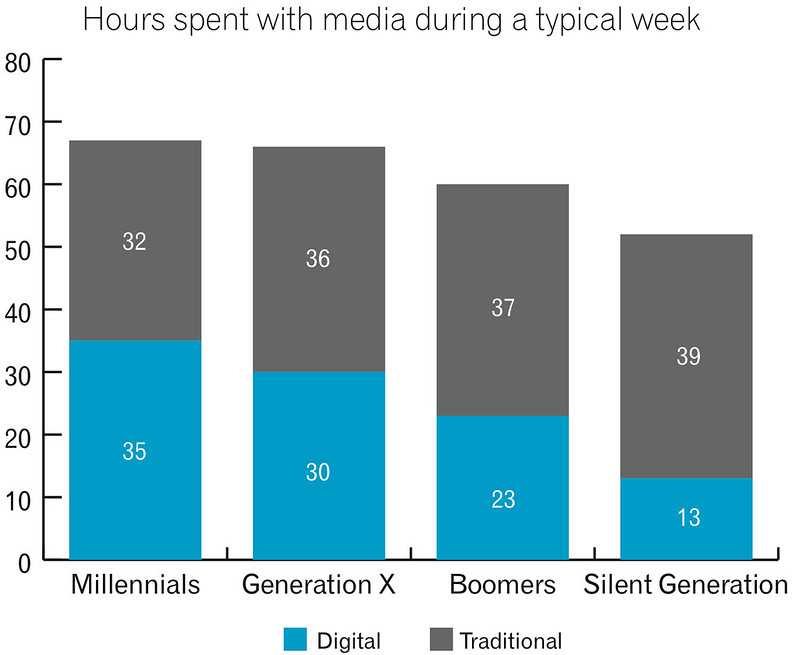
    media diet
    On the face of it, two things struck me, consumption of online media increased between millenials and generation X – but not in a way that makes them radically different – . There was also a marginal increase in overall consumption between generation Y and generation X. Is this due to media literacy, less commitments or they were having to work harder to get a similar amount of value from their media consumption?

    We had a focus group in the office looking at the personal media consumption habits of 18 – 24 year olds with an interest in sport. One of the things that came out of this was that they would only buy a magazine about their favourite sport if they were getting on a long plane journey. They thought it was ‘too expensive’ to spend £4 on a magazine. A colleague who sits near me loves the magazine and gets a lot out of the long form articles published in it. He uses these articles as social currency, in the office and with friends. However the panelists that we met felt that they could get everything they needed from sources that they perceived to be of equal quality via free online media.

    This stuck with me for a few days, then I realised why I kept churning it around in my mind. It reminded me of the kind of dialogue and decision-making process that was made by poorer people around food and nutrition. A mix of skewed value systems and economics brought a food desert into these areas.

    I wonder if we aren’t seeing the same thing in the media industry, whilst we know that Buzzfeed and their ilk provide easily-consumed low-quality content usually about first world problems or childhood nostalgia – are generation Y merely getting the media that they deserve? Will there be a content desert? How would a content desert impact brands and perceptions of value?

    A few things give me hope that there may not be; Vice Media is building the global news network that is defining the 2010s in the same way that Aljazeera defined the post-9/11 world and CNN defined the end of the cold war. Although you could argue that with Vice the bill is paid by branded entertainment on behalf of sponsors like Nike and Intel.

    Television has entered a new golden era in dramas; will media companies take the opportunity to reinvigorate factual programming? More related content here.

  • Makimotos wave

    Makimotos wave is named after Dr Tsugio Makimoto. Dr Makimoto is a technologist who has worked at Sony and Hitachi. He co-authored Digital Nomad with David Manners which was published in 1997 and seems to have been influential to executives in the semiconductor industry. Makimotos wave named is a twenty-year cycle between custom design components and general components.

    While GPUs could be argued as general components based on their usage in machine learning and cryptocurrency mining.

    We’re definitely in an era of custom design components at the moment in personal computing, with PCs moving to bespoke processors based on the ARM architecture.

    At the moment in mobile we are in the custom part of the cycle with the kind of silicon being created for smartphones like Apple’s and Samsung’s respective chips and we are due to see a swing to general purpose components from 2017 or so.

    General purpose components may be very different to what we have been used to before. New processes will allow new functions to be built on the chips, though this seems to be happening at a slower rate with people like Intel making chipsets. Multiple pieces of silicon in a single chip package. 

    Makimotos wave helps us understand these transitions. 

    Like Moore’s Law, Makimotos law is used as a heuristic to try and understand what is happening within the industry. Dr Makimoto discusses it in this video below.  

    More similar content here.

  • Google Glass & things this week

    Google Glass and IBM

    An IBM video from 2000 did a pretty good use case and flaws of Google Glass. Good work (I presume by Ogilvy & Mather, but I maybe wrong). Looking on the bright side of things for Google Glass, this probably protects them from IP court cases, given the ad could be cited as prior art. All of this makes me wonder why companies like Google when working on Google Glass aren’t doing desk research looking for content like this through to science fiction and the challenges flagged up or unanswered questions. More related content here.

    Five years ago I would have wanted to watch this because Oakley was some kind of engineering wonderland, now I watch it curious to know how Kevin Spacey’s voice over would clash with the conservative designs currently coming out of Oakley post-Luxxotica takeover. Funnily enough the voiceover would have worked almost as well with his appearance in Call of Duty: Advanced Warfare.

    My colleague Phee went for a Gorkana briefing with the Wall Street Journal, as a Storify embed.

    Apple made a really nice 30-second spot to promote the MacBook Air range. The ad plays on how consumers personalise their computers as an analog for love. I started modifying the shell of my laptop as an anti-theft measure. Prior Apple laptops becoming so popular my customisations were limited to the software layer. Organising my desktop and having a desktop wallpaper of my own.

    One day a client tried to walk off with my laptop (they actually had a Lenovo), I managed to stop them, but then decided to customise it so there was no question of who’s laptop it was. Less about love, more about basic survival. For many of my geekier friends, a laptop lid, like a t-shirt is a billboard sharing their advocacy of a development language or the Open Source movement.

    There is something WestWorld-esque about the faceless robots in this film about K-league baseball team Hanwha Eagles and their devoted supporters. The film also makes an interesting point about how fandom and participation have changed with online participation mediated though the robots. It’s a fascinating approach and a next stage in consumer behaviour.

  • Apple and IBM and other things

    Apple and IBM

    IBM and Apple just not that big a deal – I, Cringely – probably the most level-headed analysis of the Apple and IBM deal that I have seen so far

    IBM and Apple: Catharsis | Asymco – Horace on the long view of the Apple and IBM deal

    Apple and IBM team up to conquer the enterprise market, and crush Microsoft, Blackberry, and Android – I am less convinced of the Apple and IBM deal given Global Services trouble in meeting SLAs, would I want them providing AppleCare?

    Business

    Huawei Announces 2014 H1 Operating Performance – Huawei Press Center – interesting that smart devices were given such a prominent placement. Smart devices could also cover mobile broadband and there is no indication of contribution to profit of smartphones

    GE has no business being in retail finance so it’s making a steady exit | Quartz – it makes sense to offload consumer debt

    Internal memo: Microsoft to cut off all ‘external staff’ after 18 months, imposing mandatory 6-month break – GeekWire – this is an interesting move. I wonder how might it affect PR and marketing agencies?

    Mini-Microsoft: 18,000 Microsoft Jobs Gone… Eventually? – a perspective from inside Microsoft

    Yahoo’s Mayer: ‘We are not satisfied with our Q2 results’ – Media news – Media Week display advertising business fell 8% last quarter, to $436 million (£436 million), compared with the same quarter a year ago, as it continues to lose ground to the market leaders Google and Facebook.

    Overall, Yahoo’s revenue fell 4% last quarter, year on year, to $1.08 billion, operating income dropped 72% to $38 million (£22 million), largely attributed to one-off restructuring costs, and net earnings for the second quarter were down 19%, to $270 million (£158 million) – I have a lot of love for the Big Purple, but in the internet world lightning doesn’t strike twice

    Consumer behaviour

    Air Force research: How to use social media to control people like drones | Ars Technica – you’re all sheep

    Single Mom Used OKCupid To Make Friends | Social Networking Watch – interesting move and interesting trust dynamics

    How I stay informed… — Product Club — Medium – Tom Coates on how he stays informed

    Economics

    Welcome to the Everything Boom, or Maybe the Everything Bubble – NYTimes.com – so potentially we have a bubble in all countries in all classes of assets, what happens when it goes pop? Or is this a devaluation of currency across the global and if so why isn’t this seen as inflation?

    Ideas

    Rethinking Cold War America: An Interview with Fred Turner | Henry Jenkins – well worth a read

    Marketing

    Microsoft Will Climb Past Yahoo In Digital Ad Share | WSJ – blame Carol Bartz and Carl Icahn, they fucked it up when they didn’t give Jerry Yang a chance to do it right and didn’t manage to sell the business outright

    Why Do We Treat PR Like a Pink Ghetto? – The Cut – interesting US perspective on things. Interesting that diversity doesn’t make it into the article at all

    Two Rail Operators Selling Rights to Advertise on Bullet Trains – Caixin – great ambient advertising opportunity

    Edelman confirms Rui Chenggang held shares in Pegasus while at CCTV – ahh, this could get messy. Bill Bishop in his Sinocism newsletter pointed out that Rui flamed Starbucks Forbidden City branch on CCTV while Starbucks was an Edelman client. Edelman then bought Pegasus where Rui was a shareholder. The question is will China make this coincidence into an issue making 2=2=5? Will the backwash from all this hit Starbucks or other Edelman clients as well?

    Is a PR Crisis Brewing For Edelman in China? – Advertising Age – so they may not be compliant at the moment. What does this mean for other large agencies in China and will this delve into some of the more interesting media buying strategies out there?

    Online

    WeChat first: a new frontier in China beyond Android and iOS – interesting how WeChat’s app constellation is fostering new start-ups, the question is will WeChat kill them the way Facebook turned the screw on its own ecosystem

    Baidu launches search engine for Brazil | PCWorld – interesting expansion by Baidu

    Taiwan

    HTC ‘selfie phone’ to be launched in Q4: report – only a good 18 months after the Huawei Ascend P6 and probably several other handsets that I can’t remember

    Web of no web

    Future Drama – IBM anticipates Google Glass(holes), from 2000 – interesting thought experiment by IBM which nails some of the issues with Google Glass. More related content here.

    Wireless

    Messaging, Notifications, and Mobile – AVC – mobile OS have real power through control of notification

    Qualcomm to face strong competition in China’s 4G chip market | WantChinaTimes – which explains why Qualcomm is trying to play nice with the government

    MediaTek No. 3 global supplier of smartphone chips in Q1|WantChinaTimes.com – 1. Qualcomm 2. Apple 3. MediaTek 4. Samsung 5. Spreadtrum

    New MediaTek Chip Aimed at High-End Phones | Re/code – LTE, 2K video, 64-bit

  • Smartphone value system

    Benedict Evans in his post Unbundling innovation: Samsung, PCs and China compared the value system of smartphone industry to the PC industry where value began to be hollowed out and the market became commoditised.

    Evans claims that this hollowing out of the value system is already happening to Samsung. Part of the challenge is that so much of the design of the hardware layer in phones comes from reference designs by component manufacturers like Qualcomm and reference design work done by manufacturers like Foxconn. Globalisation outsourced hardware design innovation, a plus side of this is that there is a whole eco-system in southern China that can support anyone who wants to make a branded handset building on experience gained working with major technology brands. The downside that there is little room to add to the value system beyond brand marketing.

    As he quite rightly points out some businesses are looking to take control of their business by building beyond hardware and into the service stack to try and move up the value system.

    A number of manufacturers put their own UI over Android like HTC’s Sense UI and Huawei’s Emotion UI. Whilst these contributed to a handset personality, they didn’t provide true value system  differentiation. Facebook even tried to get in on the act with Facebook Home, but the user experience left something to be desired according to reviewers.

    Manufacturers tried to add applications in their phones, which competed with Google’s own application stack. At the present time, no Android manufacturer has come up with a killer application for their brand of phone, mainly because they replicated Google’s efforts and with the exception of Samsung, the application wouldn’t be sufficiently ubiquitous – particularly if it was some sort of communications platform like say Whatsapp.

    Meanwhile, Google hasn’t been sitting quietly on the sidelines but has been using its power within the community to exasperate commoditisation by combatting manufacturers efforts at software customisation. This process has been rolled further into the Android efforts with strict guidance on Android Wear devices. All of this may feel quite similar to Microsoft Windows around about the time of their dispute with Netscape.
    The ultimate budget phone shootout: Xiaomi Redmi vs Huawei Honor 3C vs Motorola G.
    Deeper innovation requires a fork in the Android OS and a break with some if not all of the services. This break has been forced on Chinese manufacturers anyway as consumers wouldn’t be able to access Google’s maps, email or search. Which is the reason why Xiaomi’s MIUI, Jolla’s Sailfish OS and CyanogenMod have an opportunity to work with phone manufacturers.
    Charles' Jolla phone
    However, the ironic aspect of this is that any of these platforms became too successful they would wield as much power as Google does at the moment.

    A sweet spot for hardware manufacturers would be a hetreogenuous OS environment, all of which will run Android-compliant applications. In order for this to work, you would need an equivalent of POSIX compliance for Unix-type operating systems for these mobile OS’ and a way of ensuring that platform innovation didn’t ossify either the OS or the internet services supporting it.

    Where does Apple fit into all this?
    DSCF6958
    Could the HTC One have been built without manufacturers having invested in milling machines after the introduction of the iPhone 5 aluminium monocoque chassis? Apple’s process innovations / popularisation of production techniques opens up opportunities for the wider Android community. This is because of Apple’s focus on materials innovation as well full integration of the services and software stack.

    This lends weight to a viewpoint that Apple has in some respects has become a ‘fashion brand’ as one of my colleagues put it, think a watchmaker rather than say a fashion house like Louis Vuitton and the analogy has a certain amount of merit. This also implies that when thinking about the iPhone the value decision lifts itself out of the economic rational actor. However there are also shifting costs. You don’t buy a DSLR camera, you buy into a system since the camera needs lens in order to work. Applications (particularly paid for applications) play a similar role, as do services.  There is an inherent switching cost away from iPhone, this is lower when switching platform from Andrioid to iPhone and practically none existent for many users upgrading their Android handsets.

    So in many respects Apple sits apart from this in the same way that the Mac sat within, yet apart from the PC industry.

    More information
    Unbundling innovation: Samsung, PCs and China
    Android and differentiation | renaissance chambara
    Messaging’s middleware moment | renaissance chambara
    The folly of technology co-marketing budgets | renaissance chambara
    HTC One – gsmarena