Ideas were at the at the heart of why I started this blog. One of the first posts that I wrote there being a sweet spot in the complexity of products based on the ideas of Dan Greer. I wrote about the first online election fought by Howard Dean, which now looks like a precursor to the Obama and Trump presidential bids.
I articulated a belief I still have in the benefits of USB thumb drives as the Thumb Drive Gospel. The odd rant about IT, a reflection on the power of loose social networks, thoughts on internet freedom – an idea that that I have come back to touch on numerous times over the years as the online environment has changed.
Many of the ideas that I discussed came from books like Kim and Mauborgne’s Blue Ocean Strategy.
I was able to provide an insider perspective on Brad Garlinghouse’s infamous Peanut Butter-gate debacle. It says a lot about the lack of leadership that Garlinghouse didn’t get fired for what was a power play. Garlinghouse has gone on to become CEO of Ripple.
I built on initial thoughts by Stephen Davies on the intersection between online and public relations with a particular focus on definition to try and come up with unifying ideas.
Or why thought leadership is a less useful idea than demonstrating authority of a particular subject.
I touched on various retailing ideas including the massive expansion in private label products with grades of ‘premiumness’.
I’ve also spent a good deal of time thinking about the role of technology to separate us from the hoi polloi. But this was about active choice rather than an algorithmic filter bubble.
Jeremy Deller is famous for examining 1980s events from the MIner’s strike to rave culture. Most notably his work Acid Brass, working with the William Fairey Brass Band on cover versions of early house and techno music. In this documentary he walks a group of sixth formers through the context that rave culture began in.
Jeremy Deller has hosted a reenactment of the Battle Of Orgreave and made an inflatable version of Stonehenge in a piece called Sacrilege.
Jacobs cream crackers
As a child, I would have eaten several cream crackers manufactured on this line. In more recent times the production of Jacobs products were moved abroad for cost cutting reasons. There is something mesmerising about watching the process of production.
Cyberpunk
Quinn’s Ideas exploration of Neuromancer pointed out some links that I hadn’t realised in the formation of cyberpunk as a genre and cultural force.
LA Noir
Why film noir happened when it did, and why it is so synonymous with the city of Los Angeles is explained in this documentary which features an interview with author James Eilroy.
EDC
Everyday Carry (EDC) – whilst having evolved as an online cultural phenomenon has been around for as along as men and boys have had pockets. My childhood friend Nigel was obsessing about Swiss Army knives and really small Leica binoculars back when I was in primary school. His Dad was a well-to-do dentist and Nigel fulfilled his EDC goals before coming a teen. It was only natural that it eventually became a thing when the internet came around. Kevin Kelly had been talking about cool tools on the the web for the past quarter of a century; Drop.com when it was founded over 12 years ago covered products that would be considered EDC today.
All of which leaves me more puzzled why EDC has sudden become the focus of media attention in the quality newspapers.
You’re still reading? Great! Welcome to my November 2023 newsletter which marks my 4th issue.
I am not excessively superstitious – but living in Hong Kong rubbed off a bit on me.
I developed a love of milk tea, found the ‘hit women’ cathartic and am still leery of the number 4.
The number 4 is considered unlucky. In Hong Kong buildings, there is no fourth floor – in a similar way to their being no 13th floor in the UK high rise and office blocks. So I hope that this fourth issue doesn’t bring misfortune.
The clocks have gone back and the sun rises reluctantly over the horizon every morning, disappearing earlier each afternoon, but that doesn’t mean that inspiration stops. And it will be Christmas before you know it.
New reader?
If is your first time reading, welcome to my November 2023 newsletter! You can find my regular writings here and more about me here.
Things I’ve written.
Dimensions of Luxury based on a mix of stuff that I have read from Sense Worldwide, Horizon Catalyst and books on luxury trends.
Every wondered why its dot com rather than full-stop com? So did I.
Analysis on IPSOS research on the value to brands of reputation.
MCN – multi-channel networks. A business type popular in China and Japan is taking a record label approach to a stable of influencers.
Material World: A Substantial Story of Our Past and Future by Ed Conway. Prior to working in advertising, I had a background in manufacturing and consider myself reasonably well read, but some of the material in Conway’s book was completely new to me. Its narrative approach reminds me of the vintage TV documentary series Connections presented by James Burke, that can be found on YouTube.
Beyond Disruption by W. Chan Kim and Renée Mauborgne. This book looked at non-disruptive innovation. This is diametrically opposed to the way innovation is discussed in Silicon Valley and the mainstream media. More on my view of it here.
The New Working Class by Claire Ainsley. In the advertising industry, we have an acute perception that we might not understand life outside the M25 as we think we do. I thankfully have friends and family in the North to keep me somewhat grounded from the metropolitan elite lifestyle that I lead. Until I read this book, I didn’t realise how grounded the advertising industry was compared to our counterparts in national politics. That this book had to be written is a damning indictment of how out of touch politicos actually are.
Things I have been inspired by.
Project Gutenberg Open Audiobook project – Microsoft, and MIT have worked together to create thousands of free and open audiobooks using text-to-speech technology and Project Gutenberg’s open-access collection of e-books. Via Matt’s Webcurios newsletter.
IPSOS research video seminar on Unlocking The Value of Reputation. This is the closest I have seen to making the case for earned media activities. The full whitepaper is available here. Thanks to Stuart Bruce for the link!
My friend Ian recommended the Honest Brokernewsletter to me and I have found it to be a great read alongside my long time subscription to Bill Bishop’s Sinocism.
DDB Remedy’s meta analysis of marketing science work and academic scientific research on how emotion work for effective campaigns. How The Unexpected and Emotion Work to Influence Behaviour Change – focuses on how surprise when paired with emotion led creative had an increased impact. It all makes sense when you think about the power of salience and distinctiveness in communications; but it’s great to see that someone has drawn the multi-disciplinary research together in a cogent argument.
SEMRush have published a report for 2024 trends in social media platforms: The Vision in a Social Era that is worth downloading and pillaging for ideas that can be sold into clients.
I don’t know if inspired was the right term to use but I noticed 2023 Girlguiding Girl’s Attitudes survey thanks to a former colleague of mine from the start of my agency career. This is a survey that the Girlguiding movement has run over 15 years. Having freelanced on Dove’s ‘Real Beauty‘ campaign back in the day, this one statistic stood out to me.
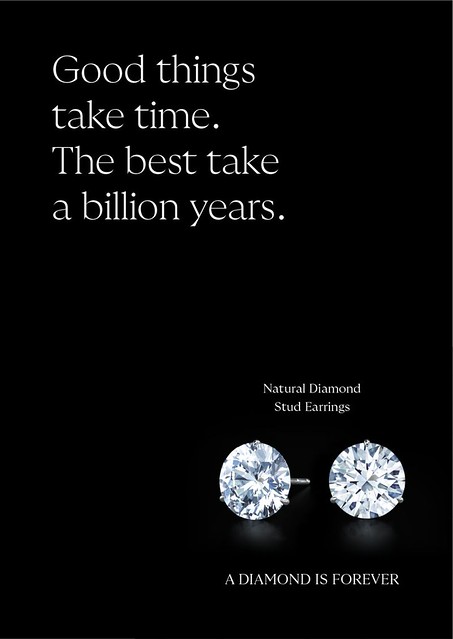
DeBeers is returning to its ‘A Diamond Is Forever’ campaign. The print campaign image is beautiful with a great use of negative space. DeBeers is spending 20 million dollars on media in the US in China. In the US, I think this makes total sense.
DeBeers
I don’t know how well it will work in China? There isn’t the mental model built up in west over decades around the campaign theme. While the wealthy in China realise that diamonds are recognised as a store of wealth – the guo chao mindset may see gold (and possibly jade) jewellery favoured by at least some younger consumers.
This has been exacerbated by a decline in the number of marriages by just under 11% and a trend to prefer gold has an 18% reduction in diamonds sold in China over the past 12 months. In the meantime the sale of gold has risen by 12%.
I look forward to seeing how the campaign goes.
According to Numerator, online retail platforms will be the big winners from Christmas shopping. The news for the food and beverage services sector isn’t so great.
Finally ‘Knowledge is Power with Kidney Disease took me back to 1988. Rob Base has remade It Takes Two for Bohringer Ingelheim in the US to highlight the linkage between kidney disease and type two diabetes. The message is poignant as Base’s creative partner DJ EZ Rock died in 2014 and suffered from diabetes.
Producer DJ EZ Rock was responsible for the hype backing track based around Lynn Collins ‘Think (about it)’ and backing vocals from Rhonda Parris. (Parris has a short-lived recording career, releasing just one solo single No, No Love – a bit of a proto-House banger heavily influenced by freestyle if you like that kind of thing). Those that knew also had the Derek B remix of It Takes Two, with a heavy kick drum underpinning from a Roland TR-808 drum machine.
Things I have watched.
It’s cold and dark and I make no apology for my films being unapologetically escapist and and entertaining to try and counterweight the drab conditions. I do have some standards through and got material for this November 2023 newsletter.
Zerozerozero – follows a single drug deal between the Mexican cartel and the ’Ndrangheta. However things don’t go according to plan, so as the conspiracy unfolds we get a walk through the international drug trafficking trade across Latin America, Africa and Europe. This was done as a limited series, but I watched it as a boxset. It is directed by Stefano Sollima who did the Sicariofilms and Subarra.
Novembre – A French fictional dramatisation of the government response to coordinated terrorist attacks in Paris at Stade de France and the Bataclan concert venue through to the Saint Dennis raid that resulted in the death of police dog Diesel, which trended on social media with the #jesuisdiesel hashtag. Jean Dujardin shows the range of his ability as an actor from the comedy of his OSS117film series, to the deadly seriousness of this film.
Diva – I originally watched Diva as part of the Moviedrome series of curated films introduced by Alex Cox. At the time Cox personally disliked the film due to it being ‘a film of style’ rather than narrative. I loved it and revisited it on Blu-Ray. It was sharper and I got to appreciate the Vladimir Cosma soundtrack with its mix of opera, classical music and avant-garde compositions.
Alex Cox’s introduction to Diva for the much missed Moviedrome film seasons that used to run on BBC 2.
The Continental – Amazon Prime Video has some great tentpole content and The Continental adds to this. It’s a prequel of sorts to the John Wick universe and starts with a beautifully made feature length pilot. The action would find it hard to live up to the John Wick films, but the impeccable soundtrack manages to surpass them. The alternative past New York of the film has similar vibes to shows like Pennyworth and Gotham.
Useful tools
Better Miro, Mural or Figjam alternative
I have started using Milanote as an alternative to Miro for personal projects. Like Miro it has a mix of templates to get you started. There is an iPhone app and a native Mac app, so you don’t have to rely on running resource hungry pages in your internet browser of choice. It might even replace Omnigraffle in my personal software stack for some of the tasks that I do.
The sales pitch.
It was great to collaborate this month with my Hong Kong and Shanghai-based friends at Craft Associates on a prospective exciting new project. Now taking bookings for strategic engagements or discussions on permanent roles. Contact me here.
The End.
Ok this is the end of my November 2023 newsletter, I hope to see you all back here again in a month. Be excellent to each other. Let me know what you think or if you have any recommendations to be featured in forthcoming issues.
The value of reputation is something that various disciplines especially the public relations industry discuss ad infinitum. IPSOS have put together some interesting research and thinking that helps to quantify and shape the value of reputation. Previous discussions on reputation value that I have seen, haven’t had the same rigour behind them. The presenter calls out the assertions of former Unilever Paul Pollman as misleading.
Unlocking the value of reputation key takeaways
Shareholder value and reputation don’t necessarily correlate contrary to the assertions of Unilever’s former CEO Paul Pollman.
A better reputation means that advertising becomes more effective: more believable and more memorable.
A better reputation means that consumers are more likely to pay a premium for a product (however this is relative within category).
The value of reputation varies by region. It’s stronger in Latin America than the UK, Europe or many Asian markets, but weaker in Africa and the Middle East.
The value of reputation parleys into brand trust and brand resilience. A personal example of this for me was the wayUK consumers were much more supportive of the BP than American consumers during the Deepwater Horizon disaster.
Thanks to Stuart Bruce, I managed to get the full white paper that can be found here.
This is Financial Advice
This is Financial Advice is one of the best films that I have seen about the GameStop short squeeze.
Studio Ghibli music
While Japanese production company Studio Ghibli is recognised for its animation, the specially composed music is a key part of its ambience. It also happens to be great music for listening to while working. There’s a 120 hours of Ghibli related musical playlists here.
https://youtu.be/Cdp2qXHD96U?si=eaiL43V2J7K08Atv
Metal morphosis. Made Untamed
Toyota Australia were promoting the Toyota GR Corolla. This is the Corolla version of a GR Yaris. Same mechanicals, but five doors and a larger body shell. The Yaris was not made available in some markets such as the US and Australia, instead they got the larger car.
The creative is a mix of animation relying on precise high speed driving and a set course reminiscent of the late Ken Block’s Gymkhana series of films. The gymkhana series was in turn influenced by skate videos. Prior to being a rally driver, Block had co-founded Droors and DC Shoes prior to running his car culture brand Hoonigan and driving professionally.
The Humane AI pin has been hyped for a while. Now it’s been launched as a product with what seems to be a small initial batch based on a waiting list and drop type distribution model. I thought I would wait a bit to post on the Humane AI pin and let the dust settle.
The Humane AI pin is an interesting take on a personal device. particularly with its ‘AI experience’ switching – picking the right smarts for the right task. This seem to fulfil the kind of vision that the likes of Kevin Kelly have outlined in the past. It also seems to access communications services like messaging services and the audio design in the product seems interesting. There is also a projected interface of sorts on the Humane AI pin. It’s an interesting alternative direction to the spatial computing vision of Apple’s Vision Pro.
The Humane AI device falls down in being such a network-centric device. Although it has onboard machine learning technology, its reliance on a relationship with T-Mobile US’ cellular network is problematic. Cellular connectivity is not ubiquitous. It is one of several device visions that have been articulated over the years, but what I still don’t understand is the ‘why?’
What’s going to be more interesting is what the Humane AI pin does next?
US law firms rethink China future amid economic woes, data crackdown | Reuters – Of the 73 largest U.S. law firms with a presence in China, 32 shrank their attorney presence in the last decade, according to a Reuters review of data from Leopard Solutions, which tracks law firm hiring. In Beijing, 26 of the 48 largest U.S. law firms drew down their presence since 2018. Worthwhile reading with: US consultancy Gallup withdraws from China | FT – market research was sensitive when I worked in China. Gallup’s business was closer to consulting than a pollster to get around these challenges. Interesting that they can no longer thread the needle in China
China’s family-run businesses face succession challenges – Nikkei Asia – more than 80% of China’s 1 billion private enterprises are family-owned, with about 29% of these businesses in traditional manufacturing. From 2017 to 2022, around three-quarters of China’s family businesses are in the midst of a generational leadership transition
Post-pandemic party’s over as Americans shun cognac | FT – Half of all cognac in the US is drunk by African Americans, a demographic that has been disproportionately affected by the cost of living crisis, according to analysis by Bernstein. The skew to African American consumers is in part due to the fact that French spirits producers ignored the segregation mandated by America’s Jim Crow laws and “cultivated the African American market segment in ways that other producers did not,” said David Crockett, professor of marketing at the University of Illinois Chicago. French spirits producers at the time marketed to Black-owned and targeted publications. As early as the 1970s the advertisements conveyed a message of upward socio-economic mobility, said Naa Oyo Kwate, a sociologist at Rutgers University
Wong wanted to enter the U.S. consulate. The diplomats told him that only the rooms in the St. John’s Building were on offer, and that the office tower did not offer the protection of a diplomatic compound. In Washington, Ngo took the matter up with one of Hawley’s policy advisers, reasoning that the ultra-Trumpian senator might have the president’s ear. Responding at 1 a.m., Hawley’s staffer promised to pass the message on to his boss, but nothing changed. On July 1, the national-security law passed. The diplomats’ positions were the same: Wong couldn’t enter the consulate and couldn’t apply for asylum from outside the United States. Wong and Ngo knew the rules. But they were asking for the same pathway to haven that had been granted to Fang and Chen…
The focus in Washington has moved on from Hong Kong to Taiwan. The island is under constant military threat from Beijing, which claims the territory as its own, even though the Chinese Communist Party has never controlled it. But for those in Taiwan who cherish their democracy, Hong Kong’s story offers a cautionary tale. The United States gave Hong Kong’s cause its vocal backing, then abandoned the city in its time of greatest need.
Asia is much more important to U.S. interests than the Middle East | Noahpinion – East Asian cities like Tokyo, Seoul, Singapore, and until recently, Hong Kong are arguably the world’s most magnificent — hyper-dense and efficient and bustling with life and creativity and personal freedom, but also extremely safe. East Asia is a wealthy region with high quality of life across the board, rivaled only by North Europe and parts of the Anglosphere. Maciej Cegłowski called them “Zeroth World”, and I think that is an apt description. – the burn for Hong Kong on this is real
Ideas
The challenges of sustainable societies and solar punk.
The one where Chandler Bing’s impenetrable job defined a generation | FT – André Spicer, Executive Dean of Bayes Business School, suggests a new category altogether: a “Chandler Bing job”, one indifferent to finding meaning, “low on existential rewards but relatively high on extrinsic rewards, like pay and promotion”. Chandler’s stoicism more broadly reflects Gen X’s tacit acceptance of their lot: the forgotten latchkey kids squished between the Baby Boomers and the Millennials. Jennifer Dunn, author of Friends: A Cultural History, says he “showed that we might not all find fulfilment in the first, or even the longest lasting job we will ever have.” Compared to today’s employers who are increasingly concerned about making their younger colleagues happy, few cared about Gen X’s work-life balance.
The New Working Class by Claire Ainsley is unashamedly wonkish in nature. Ainsley comes from the left of the political establishment. She is an executive director of the Joseph Rowntree Foundation. She had previously worked for Unite and as a government advisor.
Ainsley posits that the Labour Party is out of touch of who the working class are and what they care about. Deindustrialisaton and immigration has changed the nature of what working class means. They might have lower middle class incomes working in the services sector. Traditional blue collar roles declined to represent about 14 percent of the British population.
Ainsley’s The New Working Class is a testimony to how out of touch policy makers and advisers with the society that they claim to represent. This also makes wonder about the usefulness, and or, the attention paid to polling and research done by political parties in the UK. The Conservatives understanding of hard-working families shows at least some understanding at a high level of who the new working class are.
What struck me about the book is that much of the ‘new’ working class isn’t actually that new at all. The struggle to make ends meet is one that Orwell would have recognised the best part of a century earlier. The challenge of unemployment is one that haunted much of the 1970s and 1980s.
Family is still important and while society is secular, working class communities have been more socially conservative. That doesn’t mean that they hate gays or immigrants, they take a common sense approach to fairness but they will be concerned about family. The rate of change in society and the desire for working opportunities has been more of a driver over immigration than outright racism back to the rise of Enoch Powell.
I had thought I would gain new consumer insights in the same way that I have had in the past, reading books by like likes of American pollster Mark Penn, but this wasn’t the case with Ms Ainsley’s book. Ms Ainsley has clearly written for a different audience. Instead of the ‘new new’ insight, her work is a 101 guide for politicos to the society that the profess to live in and represent. That scared the hell out of me. More on the book here. You can find more book reviews here.