Ideas were at the at the heart of why I started this blog. One of the first posts that I wrote there being a sweet spot in the complexity of products based on the ideas of Dan Greer. I wrote about the first online election fought by Howard Dean, which now looks like a precursor to the Obama and Trump presidential bids.
I articulated a belief I still have in the benefits of USB thumb drives as the Thumb Drive Gospel. The odd rant about IT, a reflection on the power of loose social networks, thoughts on internet freedom – an idea that that I have come back to touch on numerous times over the years as the online environment has changed.
Many of the ideas that I discussed came from books like Kim and Mauborgne’s Blue Ocean Strategy.
I was able to provide an insider perspective on Brad Garlinghouse’s infamous Peanut Butter-gate debacle. It says a lot about the lack of leadership that Garlinghouse didn’t get fired for what was a power play. Garlinghouse has gone on to become CEO of Ripple.
I built on initial thoughts by Stephen Davies on the intersection between online and public relations with a particular focus on definition to try and come up with unifying ideas.
Or why thought leadership is a less useful idea than demonstrating authority of a particular subject.
I touched on various retailing ideas including the massive expansion in private label products with grades of ‘premiumness’.
I’ve also spent a good deal of time thinking about the role of technology to separate us from the hoi polloi. But this was about active choice rather than an algorithmic filter bubble.
Creative Culture ran a roundtable that provided with Japanese insights across brands and consumers. Well worth a watch.
Key outtakes
Kawaii or cute occurs in areas that you wouldn’t expect it. From Hello Kitty airlines and maternity wards to Miffy being used to sell mortgage services.
Imagine 2060, more than 40% of Japan’s population will be 65 and older. This changes what market segments look like; no point chasing the latest generation. It will change what marketing will look like and what products will be sold. It would be an exciting time for product designers, creatives and strategists working with local clients who are willing to embrace the opportunity.
Couple by Norimutsu Nogami
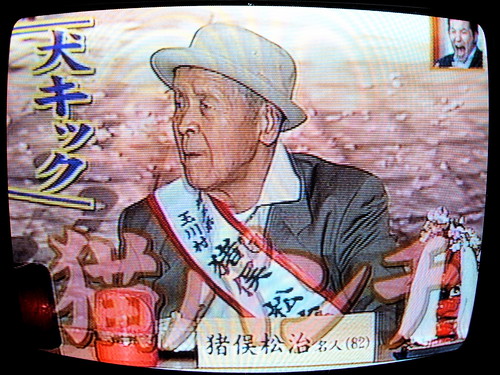
Newsprint and television are still popular media in Japan (and more popular than marketers are willing to admit outside Japan). These media still have a strong influence on consumers and are represented more strongly in the media mix by Japanese companies. In terms of Japanese insights for brand marketers this means that brand building should be less of a challenge from a media investment point of view than it would be in in some western markets or China.
Japanese television by buck82
Consumers shop daily or every other day. This is because they don’t have enough space to keep their groceries. So there are convenience stories in every neighbourhood. Retailers want to keep minimum inventory, so they receive frequent, small deliveries almost daily. Since there is a rapid turnover this in turn allows innovation around product innovation. Special edition Kit-Kats are the example most familiar to consumers. But you can see different products in the convenience store at different times of the day.
Family Mart Convenience Store, Harajuku, Tokyo by MD111
Moving from Japanese insights to Chinese strategy, the Center for Strategic & International Studies discusses what is needed for the west to have a better China strategy.
Technology
The Computer History Museum in Silicon Valley, took the opportunity to interview Mark Markkula. Markkula was an engineer and product marketer involved at Fairchild and Intel during the early days. He put in seed capital into Apple and sat on the board until 1997.
If you watch nothing else on this post, watch this discussion between Stephen King and Jeremy Bullmore at J Walter Thompson. Bullmore ended up as chairman of J Walter Thompson, eventually retiring in 1987. King established the first account planning department in the advertising industry at J Walter Thompson in 1968.
May of the problems outlined are similar to problems today.
How Lee Dunne challenged the depiction of working-class mothers | RTÉ – I originally didn’t know Lee Dunne as a novelist. Instead he was part of my childhood. Lunchtime listening when I wasn’t at school was Harbour Hotel, a radio soap opera written by Lee Dunne that gave a good sense of everyday life. The graininess of listening to the show on medium wave added to the experience. Dunne wrote each episode a bit like Roshomon, with each character talking about an event (like an argument) from their perspective. RTÉ’s obituary also focuses on Dunne’s social commentary literature that was banned by the Irish government in the 1960s through to the mid-1970s. Lee Dunne like James Plunkett wrote about the everyman. Plunkett’s work differed from Lee Dunne in that it had more of a socialist tenor to the content. Lee Dunne had particular success with his 1969 novel Goodbye To The Hill, more Ireland related content here.
Beauty
Shu Uemura to Exit Korean Market | BoF – Shu Uemura, a Japanese beauty brand owned by L’Oréal, is exiting the South Korean market in September after 16 years. While some speculate this is due to Korean consumer boycotts of Japanese products that began in 2019, L’Oréal states the withdrawal is part of a strategy to optimise its brand portfolio and respond to local market demand. Another contributing factor is likely the intense competition within the Korean beauty market. Shu Uemura currently operates over 70 outlets in the country.
NewNew™ on the App Store – god this dark. In th sage words of Matt Muir – how else do you describe a new app, with significant VC funding, whose main purpose seems to be to allow ‘creators’ (we’ll come back to that word) to earn money from their ‘fans’ in exchange for letting said ‘fans’ determine the course of their life, in some sort of modern, ersatz version of The Diceman?
How China’s online hate campaigns work – Protocol — The people, power and politics of tech – In today’s China, a nationalist campaign involves something far more complex than paying people to post scripted messages parroting Beijing’s line. The government has mastered the craft of influencing people’s genuine emotions and having these ordinary users do the trolling and doxxing — for free. Oftentimes, this means appealing to misogyny or chauvinism, something that virtually guarantees more clicks. Many videos and articles attacking Xu have tried to paint her personal life as promiscuous and delinquent. Web users have frequently called Xu a “female Han traitor,” a dog whistle that conflates concepts of chastity and national loyalty
How China structures loans to become Africa’s “preferred” lender — Quartz Africa – Chinese contracts contain broad confidentiality clauses that stop borrowers from sharing details about the contracts, or sometimes even the fact that they exist. And with a confidentiality clause in every contract in the dataset since 2014, the contracts had become more secretive over time. Most of the clauses commit the borrowing countries not to disclose any of the contract terms or related information, unless required by law.
Hong Kong’s elites should think about an exit strategy – Nikkei Asia – The most serious concern for Hong Kong’s elites is the impact on their interests if China’s economic integration plan is fully implemented. Hong Kong’s tycoons may see this plan as a great opportunity and believe that their connections on the mainland will help them. But they may be in for a rude shock. Beijing wants to integrate Hong Kong’s economy not to enrich its tycoons, but to make the city’s economic future even more dependent on the motherland. In this process, Beijing would understandably give preference to mainland players, in particular state-owned enterprises, at the expense of Hong Kong’s businesses. – this covers all the reasons why I think Jardine’s pivot to Indonesia is smarter than Swire doubling down on mainland China
The great British retail reopening | Vogue Business – The 12 April reopening of all physical stores in the UK is an occasion for optimism, but it’s heavily laced with caution. “The big question is how much of the massive increase in total share of spend will online retain?” says Richard Hyman, veteran UK retail analyst. His rough estimate, he says, is about 85 per cent. “If online hangs on to a material portion of spend, then the cost of selling something in a shop will have gone up significantly.”
Job search | Amazon.jobs – interesting job ads. Amazon is looking for a lot of product designers and software engineers to work on visual search and augmented reality as part of the ‘next generation of shopping innovation’ – I found this via the ex-Yahoo! employees groups on LinkedIn. Yahoo! had a large contingent of people working in areas such as image and video search that would be of interest to Amazon now. The team is based just down the road from Sunnyvale in Palo Alto
Bill Bishop in his excellent newsletter Sinocism (paywall) asked some interesting questions about platforms and information war as part of an opinion piece covering a wider range of issues. It was a particular question that he posed about platforms and information war that got my attention.
…if you believe that the PRC is engaged in a coordinated global information war to control the narrative about China and delegitimize the US and the West, should the US and other governments targeted in this campaign pay more attention to the use of social media platforms like Youtube, Facebook and Twitter in those efforts? If so how?
Bill Bishop, Sinocism – Weekly Open Thread 2021 #10: Gratitude; Narrative control; Xinjiang and social media (April 2, 2021)
I replied to Bill’s question; in his thread and thought I would publish my thoughts here in an expanded and hopefully better written way.
In my response I decided to deal with the online / social platforms and information war head on. It is a problem that western countries have been wrestling with for a good while. Whether its:
State actors like China, North Korea or Russia
Political extremists on the right and the left including populism
Non-state actors: jihadist groups, ‘spontaneous’ Chinese Han nationalists
On platforms
The main platforms of concern are:
Alphabet (Google search, YouTube)
Facebook (Facebook, WhatsApp, Instagram)
Twitter
Bytedance (TikTok)
For sake of convenience I am going to refer to Alphabet / Facebook / Twitter / Bytedance as AFTB for the rest of the article.
All of the platforms are controlled by algorithms, but what does that really mean? The algorithms are created by technologists to:
Surface content that the audience will want to engage with and make less visible content that is less interesting. Rather like an editor selecting articles in magazine. Algorithms are also used to select and match advertising with content. The algorithms incorporate feedback loops. Whilst they are created by technologists, they are in turn altered by audience behaviour over time. Descriptors like deep learning, reinforcement learning, machine learning and artificial intelligence are often used to describe the technologies supporting algorithmic selection. Popular media would conjure up images of sentient intelligent computers, but that isn’t really helpful.
Instead I would like to draw on geography as a metaphor to describe what’s going on. Imagine a fissure in the earth opens up in the side of a lake. The water follows a natural path downhill, over time the water carves out a gulley, that becomes a river. It removes the top soil, taking it down to sea. Stones are tumbled and rubbed together by the flow of the river. They become smooth and lozenge shaped. The landscape directs the flow of the water and is acted upon by the water. The water’s effect becomes more pronounced over time.
So it is with algorithms. They are created, they interact with the audience. Over time, their behaviour becomes affected by audience behaviour patterns that it experiences over and over again. The reality is that AFTB have power, but are also influenced by audience behaviours.
Is the audience real?
Algorithms automate advertising. Online advertising was estimated to be worth 319 billion dollars in 2019 and expected to be 1,089 billion dollars by 2027. To give a frame of reference, in 2019 global advertising spend was roughly equivalent to the GDP of Singapore. By 2027 it will be greater than the GDP of Indonesia, the country with the world’s fourth highest population and largest muslim population. All of that money attracts serious efforts to defraud advertisers and platforms. Statista estimates that advertising fraud will be worth 44 billion dollars by 2022. A lot of that will be created by technology driven ‘fake’ audiences or bots.
One of the main questions that platforms ask themselves is are their audience members real. A lot of efforts have gone into counteracting fake advertising audiences. Some of these efforts have also taken platforms and information war in the form of fake commenters and automated social accounts.
This has given rise to mass organised real commenters, from influencers in WhatsApp groups arranging to like and comment on each others posts, to troll farms and self organised groups. State actors like Russia and China are known to have have both troll farms and self organised groups of the politically faithful working for them. A lot of the time, their comments aren’t designed to persuade other people on social media, but distract, drown them out or intimidate others. Their role is also designed to shape the algorithms that surface content.
YouTuber talks about how his posts are commented on, demonetised and flagged for take down
Platforms also use algorithms and audience participation as a first line of defence against inappropriate content. Chinese respondents have compiled a great deal of expertise in successfully flagging content for removal or demonetisation. Demonetising a video soon after it has been posted is particularly harmful for video creators as this is when they have their most views and greatest opportunity for ad revenues. Video views over time from posting have a a curve that steeply declines over time. Video channel view distribution roughly follows the long tail model with a a small amount of popular channels having an outsized audience and the bulk of the advertising anyway. This puts demonetised creators in a very precarious situation. It puts aggressors at an advantage in terms of platforms and information war.
Creators dealing with this process will find the process very wearing even if they are one of the lucky few who has a creator account manager. The platforms can’t fix that without spending a large amount of money on real people, which would impact profitability.
The exception to the rule would be TikTok which has more aggressive algorithms similar to what would be used on Chinese social platforms and actively filter controversial content. TikTok focuses on light entertainment and a good deal about this approach is because of its Chinese ownership. Douyin, the China-only version of TikTok is even stricter. The algorithms are supplemented by an army of a human censors. The other platforms have a wider remit.
Content that works
There have been leaps forward in understanding how to make more effective content and what app designs worked. The secret sauce is variable rewards. An example of this would be content associated with the QAnon conspiracy, each instalment is known as a Q drop. Some Q drops were big claims, others relatively small details.
Nir Eyal’s Hooked is a book that covers this and is one of the more accessible of the of the advertising / marketing / product design-industrial complex works on this area.
The difficulty changing platforms
It is really hard to get platforms to do more than what they’re already doing through non-policy related means. A case in point would be studying Facebook’s recent history. The reason why Facebook was able to withstand large brand boycotts in 2020 was because they make their money from small companies around the world. A good deal of the business is small D2C (direct to consumer), gaming and major brands. Many of which are Chinese. Examples would be
wish.com
shein.com
Oasis games
Xiaomi
Vivo and OPPO (part of BBK)
This layer of immunity is likely to be less pronounced but similar on Google advertising as well. As I write this, I can see that Air China is running Google advertising campaigns. They are in both English and simplified Chinese against a range of search terms.
Secondly, social media platform changes wouldn’t be solved by policy alone. You’d need a reorientation of priorities in the boardroom, call it a higher purpose or patriotism in the broadest terms that hasn’t been seen in the US since the Eisenhower administration.
You would need a mammoth tech revamp inside the platforms; a huge increase in human account management and intervention. For instance, it would mean YouTube having to shake up the pro-China (or Q-Anon) rabbit holes that are instrumental in attitudinal change.
Deplatforming
You would need to deplatform domestic advocates who are either paid, or are fellow travellers with groups using platforms for information warfare. I would imagine that you would have a lot of people baulking at that. In order to inoculate local populations of Russians or Chinese against use of their favoured platforms for information warfare, you would need to completely rebuild their native language media within western countries. In the case of Chinese immigrants and students, you would need to start filtering content on WeChat. That would be a major undertaking for any security service. WeChat could make that job a lot harder if they integrated encryption into the app for overseas users.
You would need to deplatform foreign media organisations such as Russia Today, Global Times and CGTN.
Finally, there would need to be eye-watering punitive damage done to corporates who acts as apologists for these countries. This would need to be multilateral. So the US should be prepared to blow up Facebook and Goldman Sachs, the UK HSBC and Germany Daimler-Benz or Deutsche Bank. They would need to pick a side.
Given the heavy involvement of large corporates in setting policy, that’s quite a conundrum. More related posts here.
I wrote a blog post back in February 2014 that highlighted 40 blogs that inspired me, revisiting this post I decided to write about 2021 blogs that inspire me. But first how did the original list hold up in 2021?
Original list in 2021
Name / Category
Description
Analysis
Wall Street Journal Corporate Intelligence blog
No longer exists, the link defaults to the Wall Street Journal front page.
Edge Perspectives with John Hagel
– No longer exists
Monocle Monocolumn
Monocle has kept the archive online, but the Monocolumn is no longer updated. It has been abandoned in favour of the Monocle Minute
The Asia Society have a blog which alternates between amazing photography from the region and analysis pieces with an academic / think tank type feel. It is still maintained
Still sporadically posted to by Robert Kelly a Korean-based professor of international relations, it has some interesting posts analyzing the complex relationships across APAC. In 2017, became better known when his children gatecrashed a television interview he was doing via Skype with the BBC
Bytes of China
No longer available
China Real Time
The blog has disappeared and now diverts to the WSJ’s Asian news section.
A ‘best of ‘ website that looks at different technology categories
What surprised me about the 2012 list is how many blogs covering different aspects of China in terms of the technology scene, culture and online life have disappeared or stopped being updated. Despite the fact that now, more than ever, they are needed.
Major media outlets have walked back from building blogs based on interest areas or personalities ( like a traditional newspaper columnist).
By comparison, I have a compiled an exemplar list of inspirational 2021 blogs. I look at more but that would be ludicrously long to compile.
Asian Sentinel is edited by a couple of veteran Asia based journalists. The content comes from a number of experts in the region in specialisms such as finance, economics and policy.
English language blog that collates Hong Kong celebrity news from Cantonese language media. It is was important for me to keep an eye on this when working in Hong Kong. It is also a good way to track the slow death of the Hong Kong domestic media industry.
English language version of a Japanese news site that focuses on ‘fun, weird, and intriguing news from Asia, particularly Japan’. It has some great Japanese consumer insight content including retail experiences
The South China Morning Post historically was the paper of record for Hong Kong. It’s medium-to-long term usefulness looks in question with the National Security Act and the Chinese government pressure for Jack Ma to divest media ownership
Colossal in their own words – “an international platform for contemporary art and visual expression that explores a vast range of creative disciplines.”
George Tannenbaum is a 40 year creative veteran in the advertising industry. His blog is a mix of smart thinking and ranting about ageism and other isms in the ad industry (there’s a lot of them to rant about)
France Telecom has a blog about the bleeding edge of technology. Alongside the usual 5G flag waving you’d expect from a major mobile network operator there’s some thoughtful content
Despite the name, covers technology and does some interesting business analysis. I really like the way everything is delivered in succinct bullet points
YouTuber Tom Scott delves into the marketing industry and laws that force influencers to declare ads. It is worthwhile watching regardless of how involved you are in marketing. Scott points out what he considers to be inconsistencies in the principles of when to declare ads. In particular, he focuses on the role of product placement in film and TV programmes and the way that is handled.
Future of
Wired contributor and author of What Technology Wants, Kevin Kelly has spent the COVID lockdown putting together some great talks on YouTube on the future of different aspects of technological progress.
Kelly’s opinions are usually well thought out and the videos are better than sitting through a few conferences; especially TED conferences.
SolarWinds
World Affairs put together a great panel to discuss the recent SolarWinds hack and the impact it has had across both enterprises and governments.
Celebrity Zoom Bombing
I was listening to a podcast about a University of Sydney research paper on Zoom based culture building. TL;DR – it doesn’t work unless participation is truly voluntary. Most of them are painful. Lights and Shadows were commissioned to help help promote fun in a company corporate culture. Usually did creative events, but for COVID-19 they had to get creative in Zoom.
Somehow they managed to get celebrities, or convincing deep fakes to bomb existing Zoom calls.
Strong Enemy
The strong enemy is Chinese Communist Party-speak for the United States. China increasingly sees its relationship with the US to lead to eventual war. Xi Jingping has been talking more about the strong enemy in speeches aimed at the PLA to get them ready for inevitable conflict with the US. Sinocism has this great essay on it all.