Category: ideas | 想法 | 생각 | 考える

Ideas were at the at the heart of why I started this blog. One of the first posts that I wrote there being a sweet spot in the complexity of products based on the ideas of Dan Greer. I wrote about the first online election fought by Howard Dean, which now looks like a precursor to the Obama and Trump presidential bids.

I articulated a belief I still have in the benefits of USB thumb drives as the Thumb Drive Gospel. The odd rant about IT, a reflection on the power of loose social networks, thoughts on internet freedom – an idea that that I have come back to touch on numerous times over the years as the online environment has changed.

Many of the ideas that I discussed came from books like Kim and Mauborgne’s Blue Ocean Strategy.

I was able to provide an insider perspective on Brad Garlinghouse’s infamous Peanut Butter-gate debacle. It says a lot about the lack of leadership that Garlinghouse didn’t get fired for what was a power play. Garlinghouse has gone on to become CEO of Ripple.

I built on initial thoughts by Stephen Davies on the intersection between online and public relations with a particular focus on definition to try and come up with unifying ideas.

Or why thought leadership is a less useful idea than demonstrating authority of a particular subject.

I touched on various retailing ideas including the massive expansion in private label products with grades of ‘premiumness’.

I’ve also spent a good deal of time thinking about the role of technology to separate us from the hoi polloi. But this was about active choice rather than an algorithmic filter bubble.


  • Hydrogen fuel cells + more news

    Hydrogen fuel cells

    Hyundai and Ineos team up to develop hydrogen future | CAR Magazine  BMW details fuel cell plans | EE News – I think that this move to hydrogen fuel cells makes more sense than lithium ion batteries. Hydrogen fuel cells are well understood, having been used by NASA during the Apollo space mission, the main challenge as been the cost of the cell. Hydrogen fuel cells don’t induce range anxiety and don’t have the environmental problems that you get recycling lithium ion batteries.

    Panasonic finally looks at European battery gigafactory – but this is happening with hydrogen fuel cells being in a more effective decision. Elon Musk is down on hydrogen fuel cells, but ignores the issues with lithium ion batteries compared to hydrogen fuel cells. Lithium ion batteries have their own dangers. Hydrogen fuel cells don’t have the same recycling issues that spent lithium ion batteries have. Given the strategic hold over lithium mining by China; hydrogen fuel cells offer a better option to reduce dependence. The hydrogen lobby does a better job to combat the Tesla showmanship.

    China

    EU braces for battle despite new faces in White House | Financial Times“ There will be a number of easy wins and enhanced co-operation on climate, the pandemic and remedying some of the offences of the past four years,” said Kristine Berzina, a senior fellow at the German Marshall Fund of the United States. “But there are real dangers that disagreements on issues like data privacy and digital taxation will make it more difficult to get agreements on other issues that are very important for both the US and Europe — particularly China

    Germany frets over its corporate dependency on China | Financial TimesRobust Chinese demand has helped Germany’s auto manufacturers and their suppliers to offset weaker European and US markets still afflicted by the pandemic. But it has also revived concerns that German industry is too dependent on China. And it has raised questions about whether Berlin will be willing to respond to growing pressure in the EU for a stronger line towards Beijing and to embrace a new transatlantic partnership on China under a Biden administration. – you can see this in the split between Merkel and her party over China engagement – Daimler, which has two large Chinese shareholders, sells nearly 30 per cent of its Mercedes cars in China. It accounts for about 11 per cent of group revenues. For several companies in the Dax 30 index, China represents at least a fifth of sales including BMW, chipmaker Infineon and plastics manufacturer Covestro. Likewise, Volkswagen is estimated to generate a similar proportion of its sales in the country last year, selling nearly 40 per cent of its vehicles there. All of this leaves you vulnerable to the Australian situation: China sends a message with Australian crackdown | Financial TimesThe message is clear. If your media is overly critical, if your think-tanks produce negative reports, if your MPs persist in criticism, if you probe Communist party influence in your community and politics and if you don’t allow Chinese state and private companies into your market, and so on, you will be vulnerable to Beijing’s retribution as well

    Red Convergence | China Media Project – media policy in China – with implications domestically and internationally. It outlines how the Chinese Communist Party intends to leverage transformations in global communication, both at home and abroad (though the latter is more implied), to sustain the regime and increase its influence internationally.

    Lessons from China’s decision to halt Ant Group’s giant IPO | Financial Times – interesting points from WeBank about a sweet spot from Rmb 8,000 – 200,000 were debtors do not have an incentive to run away or speculate. SMEs are focused on having a good credit record

    Q&A: Gareth Richardson – Western Brands No Longer Have an Easy Ride in Asia | Branding in Asia MagazineIn China, there’s no access to Google and Facebook but consumers are immersed in WeChat. This is a playground where western brands have no inherent advantage. In fact, many Chinese consumers don’t know or much care about where the brand originated (save for a few specific categories such as Infant Milk Powder). In western culture individuals are heroes and this is reflected in the approach to brand storytelling. However, in Asia, the culture is more collectivist and storytelling celebrates multiple heroes. Asian brands should celebrate their cultural values. Examples include brands built on traditional values of Asian hospitality, such as Mandarin Oriental. There’s a paradox though. Asian culture is collectivist and yet Asian businesses are very hierarchical. There’s often a significant power gap between the C-suite and the frontline staff. This makes branding more challenging to implement even when its value is properly understood by the leadership – this also happens within agencies. True story: I was asked to go and present to the Chinese subsidiary of a US multinational. The global digital lead had gone in there previously with the global client ambassador and made a mess that couldn’t be cleared up. Firstly, they hadn’t recognised the great firewall. Twitter doesn’t matter in China. Secondly, they thought that democratic political campaigning experience was an example of great marketing. At the time, the person who was the global data lead had also worked on the first Obama presidential campaign. All of them had come from a political background and were clueless about brand marketing. Finally, they’d unintentionally priced a measurement solution ludicrously low. It was a shit show. We had lost the client already, but the client lead had held out hope that hanging on in there churning out a monthly report with no actionable insight would somehow provide a way back in. But at least I got to Guangzhou for the first time.

    Consumer behaviour

    Right-wing populism with Chinese characteristics? Identity, otherness and global imaginaries in debating world politics online – Chenchen Zhang, 2020The past few years have seen an emerging discourse on Chinese social media that combines the claims, vocabulary and style of right-wing populisms in Europe and North America with previous forms of nationalism and racism in Chinese cyberspace. In other words, it provokes a similar hostility towards immigrants, Muslims, feminism, the so-called ‘liberal elites’ and progressive values in general. This article examines how, in debating global political events such as the European refugee crisis and the American presidential election, well-educated and well-informed Chinese Internet users appropriate the rhetoric of ‘Western-style’ right-wing populism to paradoxically criticise Western hegemony and discursively construct China’s ethno-racial and political identities. Through qualitative analysis of 1038 postings retrieved from a popular social media website, this research shows that by criticising Western ‘liberal elites’, the discourse constructs China’s ethno-racial identity against the ‘inferior’ non-Western other, exemplified by non-white immigrants and Muslims, with racial nationalism on the one hand; and formulates China’s political identity against the ‘declining’ Western other with realist authoritarianism on the other. The popular narratives of global order protest against Western hegemony while reinforcing a state-centric and hierarchical imaginary of global racial and civilisational order. We conclude by suggesting that the discourse embodies the logics of anti-Western Eurocentrism and anti-hegemonic hegemonies. – This is interesting especially when the Communist Party of China is adopting a more Han nationalist stance (and in some respects reaching back into historic integration of Mongol and Manchu rulers). Secondly, Communist Party academics and legal academics from Beijing University have been drawing heavily on the work of Carl Schmitt. As have far right organisations and Russian nationalists. Schmitt was Nazi Germany’s leading legal theorist. He was known to be hostile to parliamentary democracy and supported the power of an authoritarian leader to decide the law. Schmitt’s rejection of attempts to take politics out of the operation of the law or economic policy implementation – have appeals to diverse audiences.

    Design

    Top 3 reasons why Nokia N97 failed: The “iPhone killer” that actually killed Nokia – Gizchina.comNokia N97 has a slide-out design with a three-line QWERTY keyboard displayed below the display. That was an advantage at the time, but it was just another manifestation of Nokia’s outdated ideas. With the improvement of input methods, touch screen keyboards have become more accurate and soon eclipsed physical keyboards. – the keyboard was very poor compared to the Nokia E90 Communicator that I used to use. I also remember that the address book feature used to crash the phone if you loaded more than 999 contacts into it. Even their ‘E’ series business handsets like my E90 Communicator and the later E71 devices. I moved to the iPhone because I wanted an address book that worked. If the iPhone ever came in a Nokia Communicator type format, I would be ecstatic. More gadget related content here.

    Ideas

    I have been watching more David Hoffman films recently, looking back to the past to try and understand the present. What becomes apparent was that there was a schism of values in the late 1960s America. What’s less apparent was how, or even if; that schism was eventually healed.

    Online

    China tightens grip on booming livestreaming sector | Financial Times – this needs to be viewed in the wider aspect of reining in internet companies

    Style

    Good Collaborations Are Art, Great Ones Are Kitsch | Highsnobiety“You know it’s art when the check clears,” said Andy Warhol. With Roy Lichtenstein and Robert Indiana, Warhol made his way into museums by turning the mundane world into works of art by enriching it with pop references, connotations and associations. Warhol’s art is commercial and his commercials are art (a Warhol ad launched Absolut vodka in 1986)

    Technology

    A little automation goes a long way in distracting drivers | INPUT – technology creating more problems than it solves in the car driving experience.
  • Things that caught my eye this week

    This project among older Irish people in the UK caught my eye Dementia and Music | Comhaltas in Britain.

    Comhaltas Ceoltóirí Éireann (to give it its proper name) is an Irish based organisation with international branches that promotes Irish traditional music. It puts on grass roots sessions in local communities, trains young musicians and organises touring parties of musicians from Ireland around the world.

    As a young child the Comhaltas tour of Britain meant a night out in the then packed Irish centre. There was the stress of getting ready; seeing my parents getting into their Sunday best (which has become less formal over the years) and my Mum never being able to find the shoes she wanted.

    I would be wearing scratchy formal wear listening to Irish comedian / MC, mournful sean-nós singing and the lively céilí music with the occasional puirt à beul accompaniment.

    A YouTube video with classic Irish tunes like these take me back playing records on my Granny’s turntable as a child; or my Uncle, Granny and I dancing like dervishes around the Marley tiled farmhouse floor as we whooped and clapped.

    So the fit with Comhaltas and dementia made a lot of sense given the long term memories that would be likely accessed. And its amazing that something like this is specifically developed for the Irish community in the twilight of their years. Other organisations have looked to build something similar, such as Boots’ multi-sensory box. But this lacked the same degree of cultural relevance.

    I loved Akira from the first time I saw it at an arthouse cinema in Liverpool in the early 1990s. It mirrored the cyberpunk culture I had loved since I originally watched Blade Runner. Akira had a quality and visual style way beyond what I had ever seen before. I’ve watched it many times since. But this video by an animator, going through a small section frame by frame was a revelation to me. The clever hacks that the animators did were amazing.

    https://youtu.be/2ltgr21jMag

    While we’re back in the 1990s, here’s Public Enemy live at Brixton Academy. Yet in 2020, Chuck D’s monologues feel even more relevant now than they did in 1990.

    https://soundcloud.com/flip-the-script/public-enemy-live-at-brixton

    TikTok could be used for more than repeatable dance moves like BlackPink’s Samsung #danceawesome routine collaboration or Dettol India’s hand washing meme. This is a great video on publishing ‘serious content’ based on the experience of the World Economic Forum.

    Google has launched a new workflow tool in the US. It looks interesting, here’s a YouTube walkthrough of it.

  • Internet of Bodies

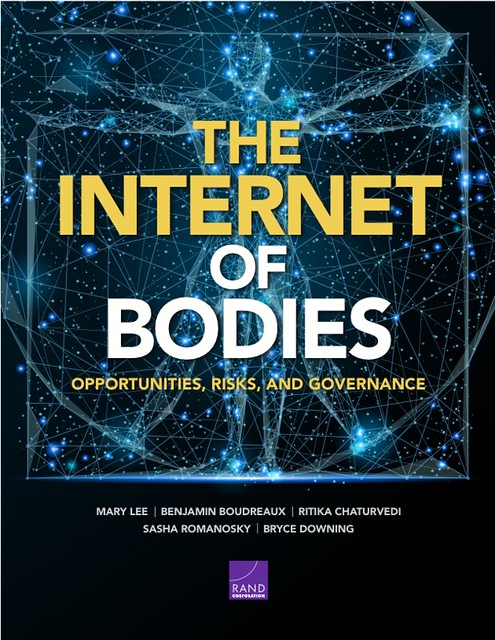
    Internet of bodies or IoB is a term that I first heard as The Internet of Bodies – a RAND Corporation report into internet connected devices that

    …monitor the human body and transmit the data collected via the internet. This development, which some have called the Internet of Bodies (IoB), includes an expanding array of devices that combine software, hardware, and communication capabilities to track personal health data, provide vital medical treatment, or enhance bodily comfort, function, health, or well-being.

    RAND Corporation
    The Internet of Bodies

    RAND Corporation were interested in the internet of bodies because of the complexity of the area. There are benefits which are well documented by others. However there are also ethical considerations around:

    • Data use by commercial organisations (advertising, health insurance, pharmaceutical industry)
    • Misleading product claims around product efficacy
    • Privacy risks
    • Data security risks
    • Underdeveloped and complex regulatory environment

    What the Internet of Bodies covers includes:

    • Fitness trackers
    • Fitness software running on smartwatches or smartphones and device sensors
    • Connected health devices: insulin pumps, pacemakers
    • Patient adherence apps on smartphones
    • Patient diaries about their condition

    The report came to a number of conclusions including:

    • As 5G, Wi-Fi 6, and satellite internet standards are rolled out, the US government conduct research projects to better understand any potential issues that might emerge
      There is a challenge that needs to be addressed to replace earlier generation devices and services with poor information security practices. The issue of cybersecurity needs to have more attention paid to it, right from the beginning of IoB product development
    • Device makers should test products and services for vulnerabilities often, and devise methods for users to patch software.
    • Data transparency and protection regulations need to be revisited to take account of materials received from the IoB
    • As with any new sector, a tighter regulation is required to prevent false or misleading product claims

    More jargon related posts here.

  • US political reporting

    Like most people at the moment I have been following the US presidential election. What struck me was the state of US political reporting I was watching on US network ABC and foreign media coverage.

    Polling station
    Polling station sign

    Polls

    Something seems to have gone wrong with polling methodologies. There are a variety of explanations for this but the impact is felt on US political reporting.

    • There is a lack of polling coverage in areas that are more likely to vote Republican: white working class, working people in rural areas
    • Conversely the models tend to skew more towards urban and suburban based voters
    • The very nature of polling questions is usually done out of context

    Qualitative data

    What becomes apparent is the there are huge swathes of the country that there is no longer qualitative research from. There are no longer local newspapers in a number of areas and ‘local’ TV networks are often an agglomeration of several former stations. This impacts on the granularity of the US political reporting. The greatest impact of this is felt in areas that are also ‘under-polled’.

    Disintermediation of the media

    The campaign for incumbent president Donald Trump seems to have been organising under the radar on social media and seems to have focused on getting more people who share their world view to get out and vote rather than reach ‘new constituencies’. This aspect of the campaign seems to have been missed by media pundits.

    In many respects it resembles the UK leave referendum grassroots campaigners and supporters of Nigel Farage’s various reactionary political efforts. What they lack in absolute numbers, they try and make up for in commitment to getting out their base.

    This resulted in Republican supporters creating convoys of cars and pickup trucks in their neighbourhoods to show their visibility, creating a form of social proof.

    Opinions

    Instead of data, the US political reporting seems to be based on the opinions of pundits affiliated to both major parties. This allowed networks and audiences to ‘drink their own kool-aid’.

    While the Democrat presidential candidate Joe Biden’s campaign strategy was to try and build interest across the spectrum – there wasn’t a manifesto the way we’d understand it in Europe.

    Instead there was an exchange of negative character messages about each candidate bolstering this wider battle of opinions over substance. This hasn’t been questioned in the US political reporting that I’ve seen, which surprised me.

    More media related content here.

  • Things that caught my eye this week

    Positive Brand Friction is a report that looks at the impact of customer experience on brand and how to get the best benefit out of it in the long term. The report was launched by the Institute of Practitioners in Advertising (IPA) at the Effworks Global Conference.

    Positive Brand Friction identifies a number of factors that increase the complexity in customer experience:

    • CX is usually designed around business functions rather than the customer
    • Ownership (but not necessarily responsiblity) falls under different business functions. Collaboration and swift decision making become even more important
    • The conflict between identifiable efficiency gains through cost reductions versus more variable returns through effectiveness and value-growth focus
    • Investment differences between operating expenditure (OPEX) and capital expenditure (CAPEX). This can make it harder for marketing to deliver long term value where OPEX is reduced

    Positive Brand Friction identifies four areas of focus for organisations and their agencies:

    • Experience intelligence / measurement. Measurement, insights and reporting system to discovers places where the experience can be improved
    • Collaboration rather than individual ownership of the experience. This also results in a customer focused culture
    • Evolving to get the right balance of positive brand friction without impacting on customer effort
    • Marketing growing into its role as the experience leader and influencer balancing customer and business value

    More here.

    Kazakhstan gets their reputation work in to balance the new Borat film on Amazon Prime Video. Rather than righteous indignation, they’ve respun Borat’s catch phrase and put together a number of short spots that challenge viewers expectations of Kazakhstan.

    Big Daddy Kane is one of the unsung heroes of hip-hop, Micro-Chip put together this great essay on him. Take out 15 minutes and give it a read: Big Daddy Kane’s Voice is an Instrument – Micro-Chop

    I happened to come across this Doug DeMuro video reviewing the BMW X5 M Competition. I haven’t suddenly turned into a car nut, but I found DeMuro’s dive into the unusual aspects of the driver experience was fascinating. What becomes apparent is how much digital has become part of the car. Look at the remote finger-twirling gesture control to alter audio volume at 7:00 in. It all feels very laboured compared to other digital products and too feature heavy.

    More on design related content here.