Category: ideas | 想法 | 생각 | 考える

Ideas were at the at the heart of why I started this blog. One of the first posts that I wrote there being a sweet spot in the complexity of products based on the ideas of Dan Greer. I wrote about the first online election fought by Howard Dean, which now looks like a precursor to the Obama and Trump presidential bids.

I articulated a belief I still have in the benefits of USB thumb drives as the Thumb Drive Gospel. The odd rant about IT, a reflection on the power of loose social networks, thoughts on internet freedom – an idea that that I have come back to touch on numerous times over the years as the online environment has changed.

Many of the ideas that I discussed came from books like Kim and Mauborgne’s Blue Ocean Strategy.

I was able to provide an insider perspective on Brad Garlinghouse’s infamous Peanut Butter-gate debacle. It says a lot about the lack of leadership that Garlinghouse didn’t get fired for what was a power play. Garlinghouse has gone on to become CEO of Ripple.

I built on initial thoughts by Stephen Davies on the intersection between online and public relations with a particular focus on definition to try and come up with unifying ideas.

Or why thought leadership is a less useful idea than demonstrating authority of a particular subject.

I touched on various retailing ideas including the massive expansion in private label products with grades of ‘premiumness’.

I’ve also spent a good deal of time thinking about the role of technology to separate us from the hoi polloi. But this was about active choice rather than an algorithmic filter bubble.


  • Hasan Minhaj and other things that caught my attention this week

    Supreme by Hasan Minhaj. I hadn’t watched much of Patriot Act mainly because there is more content that grabs my attention on Netflix. This clip is a great dive into hype culture by Hasan Minhaj – often the best humour is that with uncomfortable truths in it.

    Amazon playbook on Amazon Vine. Gartner L2 made this useful clip on the effective use of Amazon’s Vine programme.

    Key take-outs (my observations in italics):

    • Amazon don’t allow vendors any editorial controls over reviews and look to keep them honest and authentic
    • Vine seems to be really good in the process of accelerating product launches for vendors
    • Use Vine BEFORE Amazon’s sponsored products and sponsored brands advertising function; by the sounds of it pretty similar to the way you’d have previously used PR in a product launch marketing campaign
    • L2 recommends ensuring the efficacy of the product; but Vine COULD be used as the last gate in the innovation process before you go gangbusters. Lots of negative reviews could still save you on a massive production run and huge advertising spend

    Sophie Cope (Electronic Frontier Foundation) on digital privacy and the surveillance state. Great video on the World Affairs channel – interesting how this has become such a big issue amongst ‘wonkish’ audiences. More privacy related content here.

    Lynx (Axe for non UK audiences) have latched on to the ASMR meme that has been popular for a couple of years. It feels weird to watch, I am not sure what the strategic insight(s) were for this work beyond the fact that beards are sticking around for a good while yet.

    https://youtu.be/x9T7BJ-jf6o

    The last thing is the positive experience I had with American Express this week when I lost my card. I spoke to a real person on a decent phone line who quickly canceled my old card sent me out a new one that arrived in 48 hours.

  • Pioneer Axe + more things

    Pioneer Axe was an old-time US manufacturing company. The company used skilled labour and machine tools to manufacture axes. The Pioneer Axe plant didn’t seem to have been invested in during the 20th century and globalisation was starting to make itself felt in light industrial areas. This documentary film about their manufacturing process was made just prior to the the business closing. I’m a sucker for these kind of films that show case processes. There is something poetic about them. The processes have likely evolved from an initial plan over time organically to enhance productivity.

    This is one of a series of ads done for RACV Pet Insurance in Australia. It’s the kind of work you’d be proud of doing. I love some of the customised rigs that the disabled dogs have been given to enable to keep being good dogs.

    Naomi Wu demonstrates a bin that heat seals its bags. At first I thought it was frivolous; but then thinking about the kind of summer we had last year I can understand the appeal to reduce smells and the opportunities for insects to take up home in your bin content. The bin is positioned as a smart device; but it isn’t really.

    Water Margin Podcast: Outlaws of the Marsh – my favourite general interest podcast to fill the gap after Cocaine and Rhinestones. It is a podcast that explains in relatable terms the Chinese classic. This makes a lot of sense as the number of characters starts to expand a lot.

    I ended up working out of Somerset House for some of this week and shot this Thameside time lapse video. It is amazing how much river traffic there is on the Thames in central London. Despite the congestion charge and outrageous parking charges, the car is still very popular. More London related content here.

  • To kill the truth by Sam Bourne

    To kill the truth is very much a book of our time. It explores the power of historical records, the alt-right and technology. The plot opens with a very current battle between ‘woke’ academia meets the polo-shirted, tiki torch-bearing far right. A former academic has gone to court in order to dispute our understanding of the slave trade and create a revisionist history.

    Historical records and accounts were picked apart to cast sufficient doubt on them. By using this legal standard record-by-record the mass of evidence is ignored. The truth becomes lies, rather like social political discussions over Brexit and Trump’s election.

    Untitled

    Then key establishments of historical record start to burn down around the world. Online repositories from websites to Google are brought to their knees by hackers. Into this mess steps a smart wonkish protagonist Maggie Costello. Maggie is tired of the political machine and gets pulled back in. Soon she suffers from online identity theft.

    Taking one side Costello’s gender for a moment. Costello feels familiar. This is partly because she is so similar to Dan Brown’s Robert Langdon and Tom Clancy’s Jack Ryan. Smart bookish heros who could see what the establishment couldn’t.

    The second parallel to Clancy’s work is that characters are secondary to the big ideas and technical wonders. And here lies the book’s achilles heel. Costello has obviously beeen developed as a smart vulnerable ‘woke’ hero. But she feels like a cardboard cut-out rather than a believable character. The androgynous nom-de-plume Sam Bourne hides the identity of Guardian journalist Jonathan Freedland. His wonkish credentials created a great high concept, but he hasn’t managed to create a character that we can root for.

    Enjoy the exploration of big contemporary issues, just keep our expectations low on the character development.

  • 3 year phone contracts + more things

    Paying for Keeps | CC Insight – 3-year phone contracts will suppress smartphone market even further, that includes 5G handsets (the why 5G in a handset is a whole other question). 3-year phone contracts will also likely encourage SIM only shopping. More wireless related content here.

    MOFT – World’s First Invisible Laptop Stand – of course early laptops had more opportunity to do ergonomic design which isn’t available when you fallow Apple’s ‘size zero’ design ethos. My first laptop an Apple PowerBook 165 had small rotatable legs. I am surprised that class action suits aren’t a thing due to RSI and carpal tunnel syndrome on modern laptops. The ergonomic information required to make the case for MOFT has been available for decades

    Uncover Harassers – rage as a plug-in. Surprised that there isn’t a UK version for gammons and remoaners respectively. Download this plug-in to optimise you’re being triggered. I get where they coming from but I can also see the downside of it as well

    The Facts About Facebook – WSJ – Zuckerberg’s op-ed falls flat with WSJ subscribers. A lot of people have written out how this back end binding of the services is as much about fending off coming regulation as anything else. Think Internet Explorer and Windows when Microsoft were taken to task. Read also Opinion | Mark Zuckerberg, Let Me Be Your Ghost Writer – The New York Times – funny but true, love the VCR analogy (paywall)

    I Bought a Fake Canada Goose Jacket on Amazon – The Atlantic – Amazon is full of fake stuff. There doesn’t seem to be a vendor quality control facility on Amazon Marketplace

    Global mobile ad spend set to tip TV in 2019 thanks to programmatic boom, and 5G boost – a 5G boost really?

    Huawei/Edelman Relationship Ends Before It Starts | Holmes Report – very interesting reading and the optics are pretty bad for Huawei.

    Xiaomi Mijia laser 4K projection TV goes on sale for 14999 Yuan ($2210) – Gizchina.com – who has clear space for a 100 inch screen to be thrown up on a wall?

    China has a special passport for its elites—like Huawei’s detained executive — Quartz – the smoking gun that connects Huawei to the government in the way that the company has always denied. I was really surprised that more hasn’t been made of this story. A P series or ‘Public Affairs’ passport is a non-diplomatic, but otherwise VIP passport for party officials and others who are very tightly involved with the Chinese government. It is the smoking gun that links Huawei and the Chinese government in a way that hasn’t been previously done and shreds a lot of Huawei’s counter arguments

    Tencent, NetEase Shut Out Again in New Batch of Games OK’d by China – Variety“Given the current speed of new game approval, the backlog of games waiting for licensing, and the government’s stricter control over game content, we estimate it could take two to three years before the Chinese games industry stabilizes,”

    ‘They need the scale’: DTC brands like Peloton and Chewy are buying more TV ads | Digiday – because TV advertising still works

    WSJ City | Russia accuses Facebook Twitter of failing to comply with data laws – surprised more countries aren’t Balkanising personal data storage

  • Apple and Jaguar Land Rover in China

    Apple and Jaguar Land Rover blamed the Chinese economy for their recent financial results. The truth is probably more complex. What factors are affecting affecting Apple and Jaguar Land Rover that aren’t directly related to the Chinese economy?

    The reality is that Apple and Jaguar Land Rover are being buffeted by very different forces, some of which are their own making.

    Apple

    China is a unique mobile environment and in some ways it mirrors the hopes (and fears) for the internet in the late 1990s. Oracle and Sun Microsystems spent a lot of time during the dot com boom developing technologies that would allow applications to run on the web. Enterprise software sudden had a user experience that could be accessed via a web browser. Java allowed applications to be downloaded and run as needed. Netscape had a vision of the internet replicating the operating system as a layer that would run applications. Microsoft also realised this which was why they developed Internet Explorer, integrated it into Windows and killed off Netscape. The Judge Jackson trial happened and that was the start of the modern tech sector allowing Google and Apple to rise.

    Move forwards two decades and most computing is now done on mobile devices. In China, WeChat have managed to achieve what Netscape envisioned. Their app as a gateway to as many services as a consumer would need including a plethora of mini applications. It doesn’t suffer the problems that native web apps have had in terms of sluggish user experiences. In addition, WeChat has invested in a range of high-performing start-ups to built a keiretsu of businesses from cab services, e-commerce, property companies and even robotics. In the meanwhile Tencent who own WeChat have a range of consumer and business services as well.

    What this means for Apple is that many of its advantages in other markets are negated in China. The OS or even performance of a smartphone doesn’t matter that much, so long as it can run WeChat and a couple of other apps. The look and feel of the app is pretty much the same regardless of the phone OS. Continuity: where the iPhone and a Mac hand-off seamlessly to each other doesn’t matter that much if many consumers use their smartphone for all their personal computing needs.

    This has been the case for a few years now in China – but Apple haven’t found a way around it.

    As for phone industrial design – Apple lifted the game in manufacturing capability by introducing new machines and new ideas. To make the iPhone 5, Apple helped its suppliers buy thousands of CNC machines. This grew the manufacturers capability to supply and the amount of pre-owned machines that eventually came on the marketplace. It meant that other manufacturers have managed to make much better phone designs much faster.

    That meant Chinese consumers can buy phones that are indistinguishable from an iPhone if you ignore the logo and function the same because of China’s app eco-system. Again this has been the same for a few years and has accelerated due to the nature of the dominant smartphone form factor. The second iteration of the iPhone X form factor is what really changed things. The phones were different to what has come before, but they weren’t demonstrably better. They were also more expensive.

    In the mean time Huawei and others have continued to make progress, particularly in product design and camera technology – the two areas where Apple led year-on-year. Huawei devices can be expensive for what they are, but they gave domestic manufacturers ‘brand permission’ in the eyes of many Chinese consumers to be as good as the foreigners.

    This wasn’t helped by Samsung’s missteps in the Chinese market that started with the global recall of the Samsung Galaxy Note7 battery recall. Samsung hasn’t managed to make that gap back up and seems to make marketing missteps regularly such as its recent tie-in with the ‘fake’ Supreme brand holder China. If you’re a Chinese consumer the additional value or status that you used to see in foreign handset brands is now diminished. This seems to be a wider theme as domestic brands are also making similar gains in market share compared to foreign FMCG brands. Although there are also exceptions like baby formula.

    Domestic brands have done a good job marketing themselves. BBK in particular are very interesting. Whilst Huawei makes lots of noise and bluster at how big they are, BBK creeps up. It has a number of brands in China and abroad OnePlus, Oppo, Vivo and RealMe going after particular segments. The brands are focused but run separately like companies in their own right. Apple’s marketing riffs on its global marketing (though it did a great Chinese New Year themed ad last year). This reinforces the perceived common view that foreign businesses are full of hubris and don’t sufficiently localise for China. Apple’s recent pricing strategy in a market where this is so little to show in value provided looks like the epitome of hubris.
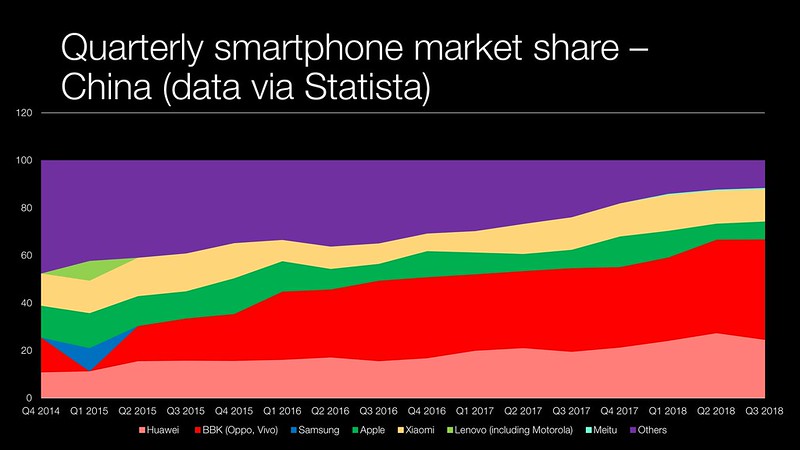
    180120 - China smartphone market

    Finally, there has been a massive amount of consolidation of brands in the China smartphone market over the past four years. That provides for scale in terms of logistics, supply chain, design, component sourcing and marketing.

    Jaguar Land Rover

    If we move to the automotive sector and look at Jaguar Land Rover – their problems in China look self inflicted. China’s car market has declined for the first time in 20 years. But it seems to have mostly affected brands like Hyundai rather than prestige brands like Mercedes Benz or BMW. The reasons why aren’t immediately apparent. Yes diesel cars are less popular, but BMW, Audi and Mercedes make diesel cars.

    Jaguar Land Rover aren’t the only foreign brand suffering: Toyota has had problems in China since the last round of strong anti-Japanese sentiment exploded in 2012.

    More information

    Why Does WeChat Block Competitors, While Facebook Doesn’t? | Walk The Chat

    Apple’s China Problem | Stratechery

    Samsung recalls Galaxy Note 7 worldwide due to exploding battery fears | The Verge

    Samsung angers hypebeasts by partnering with fake Supreme brand in China | The Verge

    Fake News: Samsung China’s Deal With Supreme “Knock-off” Spurs Drama | Jing Daily

    Chinese car sales fall for first time in more than 20 years | World news | The Guardian