Ideas were at the at the heart of why I started this blog. One of the first posts that I wrote there being a sweet spot in the complexity of products based on the ideas of Dan Greer. I wrote about the first online election fought by Howard Dean, which now looks like a precursor to the Obama and Trump presidential bids.
I articulated a belief I still have in the benefits of USB thumb drives as the Thumb Drive Gospel. The odd rant about IT, a reflection on the power of loose social networks, thoughts on internet freedom – an idea that that I have come back to touch on numerous times over the years as the online environment has changed.
Many of the ideas that I discussed came from books like Kim and Mauborgne’s Blue Ocean Strategy.
I was able to provide an insider perspective on Brad Garlinghouse’s infamous Peanut Butter-gate debacle. It says a lot about the lack of leadership that Garlinghouse didn’t get fired for what was a power play. Garlinghouse has gone on to become CEO of Ripple.
I built on initial thoughts by Stephen Davies on the intersection between online and public relations with a particular focus on definition to try and come up with unifying ideas.
Or why thought leadership is a less useful idea than demonstrating authority of a particular subject.
I touched on various retailing ideas including the massive expansion in private label products with grades of ‘premiumness’.
I’ve also spent a good deal of time thinking about the role of technology to separate us from the hoi polloi. But this was about active choice rather than an algorithmic filter bubble.
Quantum computing explained for different skill levels. The explanations of quantum computing are amazing. The simplicity of the quantum computing explanations should be must watch content.
A video on Sony‘s old school copy protection for the original PlayStation. It is the height of ingenuity. I had a couple of CDs with black faces like a PlayStation disc. They were a Sisters of Mercy Japanese import disc and a limited edition disc by Yello that I picked up secondhand. I have got no idea where they are now.
The black coating was a ruse from a copy protection point of view; except that it may have concealed the real copy protection system (if you had a microscope good enough to see it). The technology is down to the way wavy data lines were put down on the PlayStation disks rather than a copy management style encryption.
Mark Ritson wrote an op-ed over at Marketing Week on influence and influencers. Whilst it lacked nuance on the subject area, a lot of what it said is true. Go over and have a read; I’ll be waiting for when you come back.
Whilst I disagree on the finer points, what Ritson wrote needed to be said. There needed to be a turning of the tide on influencers from boundless optimism to a greater degree of sobriety and critical analysis of the influencer opportunity.
I first noticed this boundless optimism when I attended the In2 Innovation Summit in May last year. Heather Mitchell on a panel. Mitchell worked at the time in Unilever’s haircare division where she is director, head of global PR, digital engagement and entertainment marketing. I asked the panel discussing influencer marketing about the impact of zero-based budgeting (ZBB) and the answer was ducked. ZBB requires a particular ROI on activity, something that (even paid for) influence marketing still struggles to do well.
This was surprising given the scrutiny that other marketing channels were coming under, I couldn’t understand how influencer marketing merited that leap of faith.
Substitute ‘buzz marketing’ for ‘influencer marketing’ and this could be 15 years ago. Don’t get me wrong I had great fun doing things like hijacking Harry Potter book launches when I worked at Yahoo!, but no idea how it really impacted brand or delivered in terms of RoI. Influencer marketing seems to be in a similar place.
Just five years ago we had managed to get past the hype bubble of social and senior executives were prepared to critically examine social’s worth. In the meantime we have had a decline in organic reach and massive inflation in both ad inventory and influencer costs. What had changed in the marketers mentality?
Onward with Mark Ritson’s main points.
Ritson’s Three Circles of Bullshit
A very loose reference to Dante Alighieri’s Divine Comedy trilogy; but for modern marketers
The First Circle of Bullshit: Are the followers real?
Are they bots?
Are they stolen accounts?
Are the user accounts active any more?
Has the account holder padded their account with bought followers and engagement. Disclosure – I ran an experiment on my Twitter account and still have a substantial amount of fake followers. More on this experiment here.
The Second Circle of Bullshit: Are influencers trusted?
Ritson did an unscientific test that showed (some) influencers would post anything for a bit of money
The Final Circle of Bullshit: Do they have influence?
Some influencers are genuinely authoritative; but this is a minority of influencers out there
Ritson alludes to the lack of organic reach amongst an ‘influencers’ followers which is likely to be 2% reach or less
Trends in influence
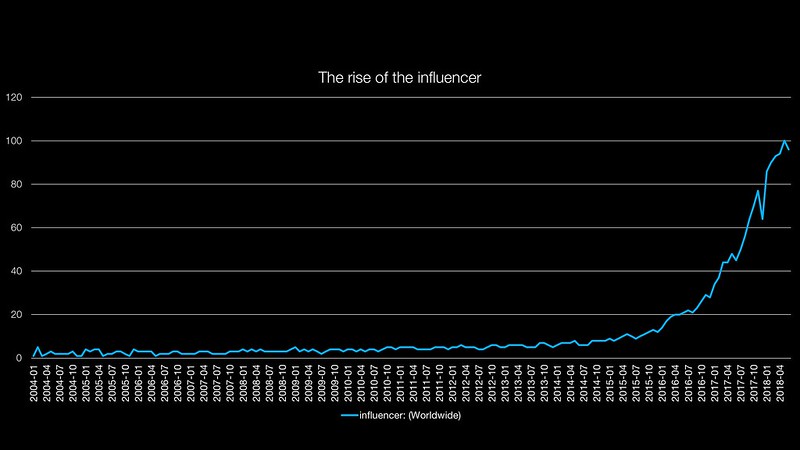
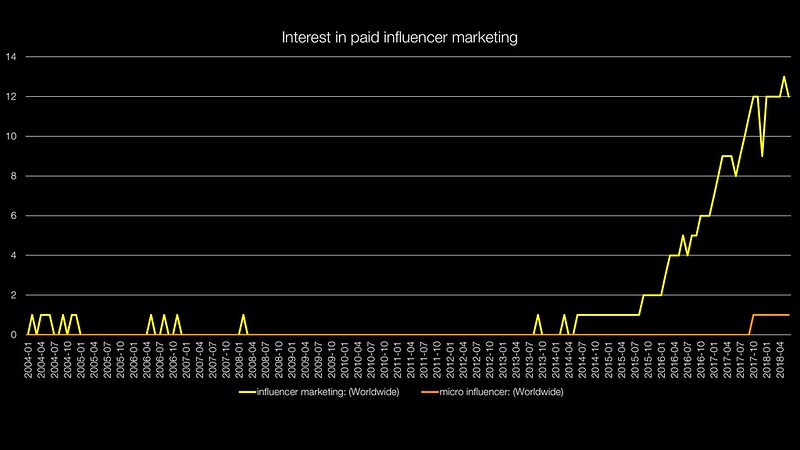
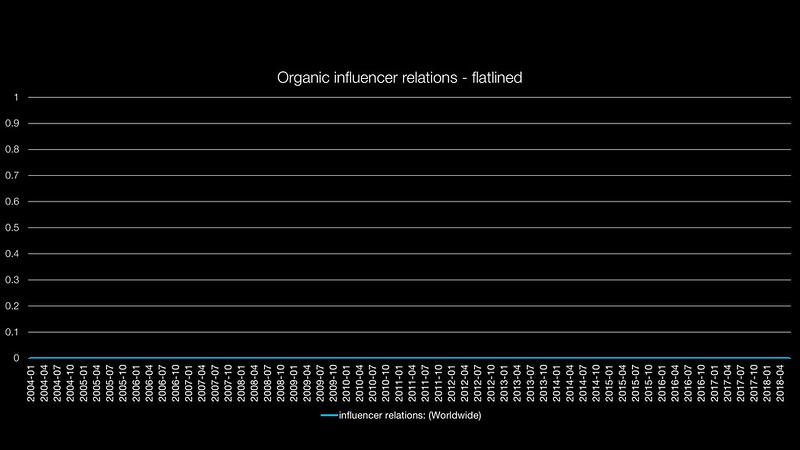
I looked at Google Trends to see what could be learned in the rate of change in searches over time. Consider Google Trends to be an inexact but accessible measure of changes in interest over time.
Global interest in influencers have been accelerating
There has been a corresponding rises in interest around paid influencer marketing
There hasn’t been the same interest peak in organic (PR-driven) influencer work
All of which supports the following hypotheses:
it’s become on-trend from the perspective of marketers, agencies and ‘influencers’
A significant amount of influencers are in it for the money – which brings into question their (long term authority and consumer trust)
A significant amount of influencers have an exceedingly good idea of their value (more likely overly-inflated)
Ego is less of a motivator for becoming an influencer than material gains
What would influence look like?
Propagation of the content by real people. Instagram, a particularly popular influencer channel, has made sharing posts difficult for followers historically. Re-gramming was a pain in the arse for the average Instagram user.
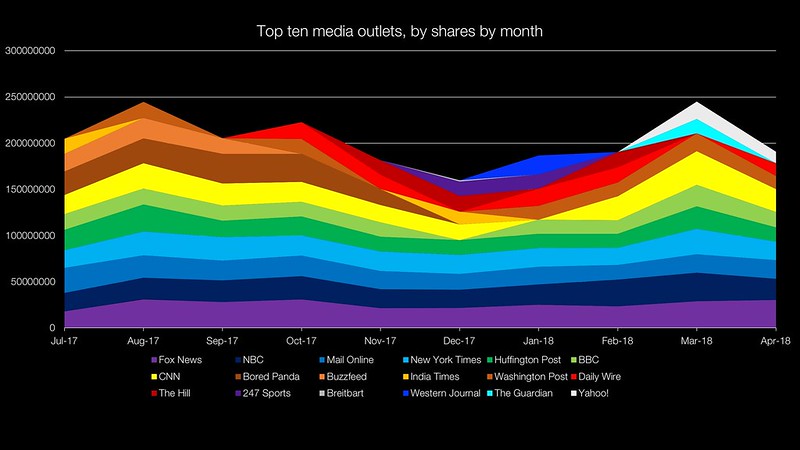
If we look at the mainstream media and how it is shared on Facebook we see that only five media brands are consistently in the top ten most shared media properties. ‘Traditional’ influencer status isn’t necessarily a garrantor of consistent successful propagation either, if Newship’s data is to be believed.
Attributed sales. Some luxury brands in China have had success collaborating with influencers and selling through their channels; the post child being Mr Bags collaboration with Longchamps.
How is the best way to use influencers in marketing?
Assuming that you are using influencers in the widest possible sense at the moment.
Treat the majority of influencers as yet another advertising format
That means that reach, the way the brand is presented, and repetition are all important – smart mass marketing following the playbook of Byron Sharp.
Viewing your influencer mention in that prism, it means estimating what the real reach would be (lets say 2% of the follower number as an estimate) and paying no more on a CPM rate than you would pay for a display advertising advert
Ensure that the brand is covered in the way that you want. Some luxury brands have managed to get around this by keeping control of the content; a good example of this is De Grisogono – a family-run high jewellery and luxury watch brand. They work with fashion bloggers that meet their high standards and invite them to events. De Grisogono provides them with high-quality photography of its pieces and the event. They get the high standard of brand presentation which raises the quality of the placement
Get repetition with the audience by repeating the placement with other content that delivers the same message with the same high standard of production
All of this might work for a luxury brand, IF you found that the amount of agency time and creative work made commercial sense. It is less likely to work for normal FMCG brands. What self-respecting influencer is going to be bossed around by a breakfast cereal?
Thinking about micro influencers, probably the area that has had the most interest from marketers recently due to them appearing to be better value than macro influencers.
Brown & Fiorella (2013) explanation of micro-influencers:
Adequately identifying prospective customers, and further segmenting them based on situations and situational factors enables us to identify the people and businesses – or technologies an channels that are closest to them in each scenario. We call these micro-influencers and see them as the business’s opportunity to exert true influence over the customer’s decision-making process as opposed to macro-influencers who simply broadcast to a wider, more general audience.
Brown & Fiorella focus on formal prospect detail capture and conversion.
This approach is more likely to work in certain circumstances; where there is low friction to conversion (e-tailing for discretionary value items).
It starts to fall apart when you deploy their approach to:
Consumer marketing
Mature product sectors
Mature brands
You would also struggle with many B2B segments where social provides a small reach and little social interaction.
Work with real influencers on long term collaborations
There is more likelihood of having audience trust if they can see and understand the long term relationship between a brand and its influencers
Better brand placement easier, with an influencer that ‘gets’ the brand
You’ve got a better chance of being able to get access and fully understand the underlying analytics of their accounts (which should be a prerequisite for long term relationship)
You can look at collaborations and attribution payment models that raise all boats
How Batteries Went From Primitive Power to Global Domination – Bloomberg – but has the technology moved on at a pace to really justify this upsurge? The chemistry in lithium ion batteries was developed back in the 1970s and commercialised by Sony and Asahi Kansei, with the first batteries appearing in 1991.
Beans – pretty sure that this isn’t an ad, but nicely played. It looks and feels more like a creative calling card that are usually sent to agencies. In this case the video effects house that created this animation. You have a mix of computer animation, green screen backdrop for the moon and . More related content here.
Fifa threatens action against BeoutQ for infringement of broadcast rights | The Drum – this is interesting. beoutQ is a pirate pay television broadcaster serving Saudi Arabia. Established in 2017, the service primarily simulcasts the programming of Qatar-based broadcaster beIN Sports, with beoutQ on-air logos overlaid over the original ones. beoutQ has similarly taken content from other broadcasters, and its set-top boxes also contain access to various IPTV services carrying other forms of live channels and entertainment content. The service launched shortly after beIN was forced to stop selling its services in Saudi Arabia, due to the then-ongoing diplomatic crisis between Qatar and other Arab countries over alleged government support of terrorist groups. beoutQ set-top boxes and subscriptions have since become widely available in Saudi Arabia. The owners of beoutQ aren’t known. It is suspected that they may have a connection to the Saudi government as it was considered to be a way of attacking Qatar-owned media that come under the gulf states stand off with Qatar.
I took a little bit of time to reflect on the content that I have been writing, what can I learn from it and how I can reuse these learnings? Specifically what are people finding of interest? This couldn’t happen without people actually reading the content, so thank you for reading; feel free to come back on a regular basis. Over the past six months readers like you have found the following articles of most interest. In reverse order
Reuse, Re-edit, Remix and Recycle – if you read the industry publications we here about personalised ad creative driven by ad targeting. But often the core creative and is created unnecessarily. Instead, what’s the minimum viable creative tweak that can be used? How do we extend the smart processes of reuse, re-edit, remix and recycling into this world?
“If you do not know where you come from, then you don’t know where you are, and if you don’t know where you are, then you don’t know where you’re going. And if you don’t know where you’re going, you’re probably going wrong.”
So it was time for reflection in order to get a perspective as the regulators and media discovered Facebook, Google and Amazon where not models of virtuous conduct.
This supports a hypothesis of slowing market growth and solidifying market dynamics at a macro level. Strategic acquisitions start to make less sense compared to improving efficiences and effectiveness.
Throwback Gadget: Bose Wave System – usually my gadget reviews tend to be some of the better performing content. The Bose Wave review was the only one that appears this time around.
Mercedes China Syndrome – Chinese netizens are jumping the Great Firewall to vilify western brands who reflect views that ‘offend the Chinese people’ – even when this content is aimed at non-Chinese audiences. Mercedes’ offence was an Instagram image with one of their cars and a quote from the exiled Dalai Lama
Personal online brand – at a time when we’re seeing social media turning into walled gardens. David Gallagher asked the Twitterverse if he should have his own site?
Twitterverse: @wadds says I need a proper blog. I say I can do it on LinkedIn or Facebook. What say you? Build my own?
I weighed in on why he should and how I manage the process.
Chinese smartphone eco-system for beginners – Winston Sterzel did a good video for the average bystander on the Chinese smartphone eco-system. I thought it was a good film to share with marketers – with a bit more background information answering some of the ‘why’ in terms of market dynamics.
App constellations 2018 research – I built on work that I had done in 2014 and 2016, comparing the rate of growth across different companies apps based on Fred Wilson’s definition of app constellations. This was also the post that took me the longest to research!
Troublesome advanced engines for Boeing, Airbus jets have disrupted airlines and shaken travelers | The Seattle Times – this isn’t like the new engine in your car. The advanced engines in a jet engine are exposed to more heat and pressure than you can imagine. When you’re working on advanced engines for aircraft; you’re operating at the bleeding edge of materials and engineering. New metal alloys, titanium, engineering ceramics and carbon fibre all started in advanced engines for aircraft. What’s interesting is the way the problems have assailed multiple engine builders at the the same time. Almost as if there is a roadblock in the technium for advanced engines
Lost Liverpool #13: The Beat of Bold Street Part 2, the Mardi Gras and G-Love – Getintothis – wow I read this and it brought back a lot of memories. G-Love was the closest thing to the legendary Shoom vibe in Liverpool. It was a different kind of crowd to what you saw at the Quadrant Park or even Garlands. G-Love at the Mardi Gras is what I’ve measured every club experience against since and most of them have been miserable failures by comparison. Early Cream felt austere and corporate with its ‘no jeans’ dress code. G-Love was part 1960s love-in and part rave. It was Ibiza without even knowing where the Balearic islands were.