Yōkoso – welcome to the Japan category of this blog. This blog was inspired by my love of Japanese culture and their consumer trends. I was introduced to chambara films thanks to being a fan of Sergio Leone’s dollars trilogy. A Fistful of Dollars was heavily influenced by Akira Kurosawa’s Yojimbo.
Getting to watch Akira and Ghost In The Shell for the first time were seminal moments in my life. I was fortunate to have lived in Liverpool when the 051 was an arthouse cinema and later on going to the BFI in London on a regular basis.
Today this is where I share anything that relates to Japan, business issues, the Japanese people or culture. Often posts that appear in this category will appear in other categories as well. So if Lawson launched a new brand collaboration with Nissan to sell a special edition Nissan Skyline GT-R. And that I thought was particularly interesting or noteworthy, that might appear in branding as well as Japan.
There is a lot of Japan-related content here. Japanese culture was one of odd the original inspirations for this blog hence my reference to chambara films in the blog name.
I don’t tend to comment on local politics because I don’t understand it that well, but I am interested when it intersects with business. An example of this would be legal issues affecting the media sector for instance.
If there are any Japanese related subjects that you think would fit with this blog, feel free to let me know by leaving a comment in the ‘Get in touch’ section of this blog here.
London 2012 brought into sharp focus the high cost and low benefit of hosting the Olympics. The Olympics has a low to negative economic impact. London 2012 was a way of seizing land for redevelopment that benefited a few investors. To do this the organising committee of London 2012 closed down a plethora of small businesses and a previously affordable London neighbourhood was priced out of the reach of many Londoners.
So, you thought London 2012 was for spectators? Wrong | guardian.co.uk – In 2005 the International Olympic Committee passed a 109-page document to the British Games organisers in which they described, in mind-bending detail, how Lord Coe and his colleagues at the London Organising Committee of the Olympic Games (Locog) should run the media strategy for London 2012. “The preparation period is likely to be the most difficult for Locog in terms of communications,” it explains. “Popular support may decline … soft targets should be identified … Meanwhile, there will be an enormous range of milestones that can be taken advantage of to demonstrate positive progress.” We are now well into what the document calls the operational readiness phase, during which every celebrity “honoured” to carry the Olympic torch has helped Locog satisfy their requirement to show “positive progress” with the Games. The torch run is a truly inspired PR tool. Alas, the hourly stories of its ponderous progress have not yet drowned out all coverage of those “soft target” stories which, with equally ponderous regularity, are beginning to reveal who may stand to benefit most from the Olympics – the corporate sponsors and the IOC themselves. – Not terribly surprising, just emphasises how huge a mistake of having the London 2012 Olympics was. However The Guardian misses the big picture. The Olympics sees the city captured by a non-governmental body that answers to elites of a criminal or authoritarian nature. They dictate media laws, traffic laws and planning laws. They provide a detailed guide on media manipulation like the example quoted above for London 2012.
Dazed Digital | East London 2012: Is It Dead? – to give an idea of how London 2012 is facilitating a real estate ponzi scheme: Reuters reported that Shoreditch was on course to become a “mini Bond Street” that would welcome luxury retailers eager to capitalise on Shoreditch’s “edgy image”. Property values in areas such as gallery-strewn Redchurch Street have doubled in the past decade, and have the potential to do so again in the next five years as the retail giants move in. For those stores that chose east London as a cheaper, dirtier alternative to the Royal Borough of Kensington and Chelsea, the unthinkable has happened – the east is now mimicking the west
Why I left Google – Spencer Tipping – probably getting more attention than its worth at the moment, but an interesting point-of-view none the less. Interesting how Google’s engineering culture in some ways conflicts with trying to build a social application / platform
Ellen Pao, the protagonist in the Kleiner Perkins law suit doesn’t sound like the typical kind of person one would think of in terms of coercion and harassment. She is the child of middle class Taiwanese immigrants to the US. Ellen Pao has an educational background in law and technology topped with an MBA – so a high achieving executive. All were from Ivy League schools. According to the egalitarian myth of Silicon Valley Ellen Pao should have been an insider. Pao had worked in legal and strategy at various blue chip Silicon Valley firms before she started at Kleiner Perkins. Instead Ellen Pao was past over for roles and dragged through the mud for a relationship that she was coerced into continuing by Ajit Nazre.
Spotlight turns on Hong Kong graft agency – FT.com – (paywall) the ICAC is the jewel in the crown of Hong Kong. It is unfortunate that there isn’t a similarly robust service to fight corruption and graft in other countries like the UK and Ireland – we wouldn’t have needed the Mahon and Leveson investigations
Why Microsoft Killed Windows Live – It’s basically admitting that “Windows Live” branded products cannot compete with Facebook, Twitter and other successful online services. (So why did Microsoft launch a new social network this month, named So.cl? Yes, exactly…)
Google+ wants to be your new Flickr | VentureBeat not likely to happen whilst I have 1000s of photos on Flickr, use it for my blog image hosting service and Google+ doesn’t offer similar things cheaper. Also Flickr’s APIs continue to enjoy developer usage
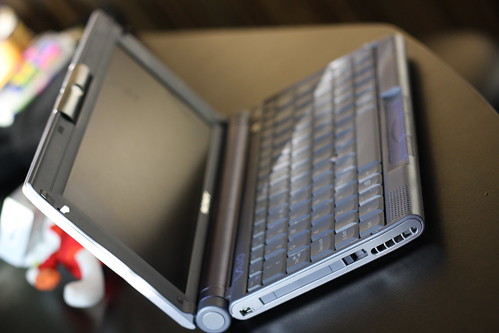
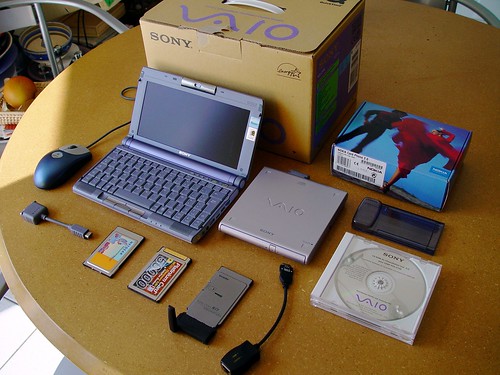
I’m an unusual choice to write about the Sony Vaio PCG C1. I’ve only had PC envy with a couple of devices during my twenty something years at a Mac user:
In common with the 701, the Sony Vaio PCG C1 impressed me with its product design. In a pioneering design for 1998, the Sony Vaio PCG C1 included a built in web camera above the screen that could be rotated to try and ensure an optimum camera position.
Sony made a small modular computer. What was important was what they had left out in their device case and instead relied on a set of outboard peripherals so the user could bring or configure their computer set-up to suit their needs. The PCMCIA (Personal Computer Memory Card International Association) slot was equivalent of the USB socket today and used to connect a wide range of devices including both fixed-line and GSM wireless modems.
The beauty extended on to the inside of the devices with some of the range using a Transmeta Crusoe processor. The Crusoe was the Intel Atom almost a decade before the Atom; it used a combination of software techniques and hardware innovations to reduce heat output and improve power consumption. This had some benefit in terms of battery improvement, but battery life relies on a combination factors such as screen power, hard drive power and other parts on the circuit board.
This device is even more remarkable when you realise that the Vaio PCG C1 was launched some seven years before Steve Jobs went on stage at Apple’s Worldwide Development Conference in 2005 to announce the move to Intel processors because of a new focus on computer power per Watt. You could consider the MacBook Air that I am typing this post out on as a spiritual successor to the Vaio C1. More Sony posts here.
Ferdinand A. Porsche, 76, Dies – Designed Celebrated 911 – NYTimes.com – Butzi Porsche dead. Butzi Porsche came from a family of engineers. His grandfather led the original team behind the Volkswagen Beetle. His father had been part of that engineering team and went on to found what we now know as Porsche. However, Butzi Porsche wasn’t engineer but a designer with technical chops. After an infamous meeting of the Porsche family, no members were allowed to work at Porsche. Butzi Porsche didn’t get to do more after he designed the 911. Instead Butzi Porsche started Porsche Design. Butzi Porsche did product design for other companies. Porsche Design also came out with its own products with Butzi Porsche designing watches, glasses and more. Butzi Porsche resigned from Porsche Design in 2005 due to ill health.
Why Are So Many Americans Single? : The New Yorker – single living was not a social aberration but an inevitable outgrowth of mainstream liberal values. Supported by modern communications platforms and urban living infrastructure: coffee shops, laundrettes
Kraft break-up yields marketing shift: Warc.com – the break-up is ironic when you look at the trouble they went to, in order to buy Cadburys and then break their business down broadly into Cadburys + Jacobs Suchard vs Kraft US.
HK’s rich hesitate to have babies | SCMP.com – interesting takeaways: didn’t want the emotional commitment, time poverty, financial stability / too small a living space and concerned about the local environment not being suitable for children. It was interesting that the education system was given such a hard time, given that it’s better than the UK system (paywall)
agnès b. | VICE – great interview with French fashion designer agnés b
Marketing
Fueling the hunger for The Hunger Games – The New York Times – really interesting comment: …during the 1980s you bought the poster and once a year went to a convention and met your people for something like Star Trek (and Star Wars). It misses out the fact that you are likely to have had real-world friends that you would have talked about it with as well – marketers now seem blindsided to the real-world
Gore-Tex Under Siege from Waterproof Fabric Newcomers | OutsideOnline.com – interesting how Goretex waterproof fabric stranglehold mirrors Microsoft’s position in the technology sector. Goretex was historically under threat from a number of systems that had varying degrees of impact. Hipora is a silicon coating structure invented by Korean firm Kolon, Schoeller’s C change which has temperature dependent venting, SympaTex commonly used when you see ‘no brand’ 3-layer laminate, usually lower price products that would lose margin paying for Goretex licensing. Lowe Alpine’s ceramic coated triple point fabric, but managed Goretex to survive and Lowe Alpine didn’t. There are other competitor products including I suspect that the other fabrics will become niche pieces unless they sort their marketing out. Goretex is primarily a branding exercise, that sets minimum standards such as taped seals. Much of Goretex intellectual property has been voided or circumvented.
Marketing is where the Goretex difference lies now, but it is known for a confrontational relationship with partners.
Kwok brothers arrested by HK watchdog – FT.com – Sun Hung Kai is Hong Kong’s largest property company. Surprising that they are involved as the big firms there generally keep their noses clean (paywall)