Category: jargon watch | 術語定義 | 용어의 정의 | 用語の定義

Jargon watch as an idea was something that came from my time reading Wired magazine. I found that in my work terms would quickly spring up and just as quickly disappear. So it made sense to capture them in the moment.

The best way of illustrating jargon watch is by example. I came across the term black technology through mainland Chinese friends. One of the key things that Chinese consumers think about technology products is the idea of ‘black technology’. This makes no sense to your average western reader. It equates to cool and innovative.

The term itself comes from a superior technology featured in a Japanese manga series plot. As an aside the relationship between Chinese and popular Japanese culture is becoming increasingly attenuated due to Chinese nationalism.

What might be black technology this year might be humdrum in six months as the companies quickly catch up. Black technology is a constant moving target, but generally its sophisticated and likely has a cyberpunk feeling to it.

I keep an eye out for jargon like this all the time, hence jargon watch. I find this content in my professional reading and in the sources that I follow online. What makes something worthwhile to appear here is purely subjective based about how I feel about it and how much I think it resonates with my ideas or grabs my attention. A lot of British youth culture doesn’t make it because it doesn’t have that much of an impact any more beyond the UK.

  • Smartphone zombies

    Digital engagement

    Hong Kong was the first place that I had every been where on the mass transit system specifically warns you to not look over intently at your phone and pay sufficient attention to riding the escalator. So it makes sense that I first read about smartphone zombies in the South China Morning Post.

    Over 80 per cent of Hongkongers between the ages of 15 and 34 own a smartphone; so South China Morning Post‘s article about the perils of smartphone zombies roaming around seemed appropriate. Add to the ownership, the excellent reception that you can get in most part of Hong Kong compared to Europe and the you can see why it happens. 

    The term describes someone cocooned in their own world of mobile social updates, email or games who  is distracted in walking or travelling on public transport. You don’t tend to see these people using voice services though in this cocooned state with their devices.

    The devices are used all hours of the day and the night, it wasn’t unusual to get messages from colleagues after midnight most days on WhatsApp. The zombie impression is probably magnified by the bleary eyed Hong Kongers on a morning commute.  

    The Cantonese for the phenomenon is dai tau juk or ‘head down tribe’.  It would be wrong to portray this as a purely a Hong Kong phenomena, with articles covering it in China, the US and Japan over the past year alone.

    The US talked about it in terms of an addiction, whereas coverage of China, Japan and Hong Kong looked at it as being broadly anti-social behaviour. More jargon related posts here.

    More information
    Beware the smartphone zombies blindly wandering around Hong Kong | SCMP (paywall)
    Japan’s smartphone ‘zombies’ turn urban areas into human pinball | Japan Times
    Putting Smartphone Zombies In Their Place | TechCrunch
    How your smartphone is turning you into a zombie | The Tennessean

  • Chinadroid

    The modern mobile eco-system was built in the factories of China, in particular Shenzhen. But two mobile eco-systems exist: China and the rest of the world, hence Chinadroid.
    Downtown Shenzhen
    Chinadroid: These are phones that use the Android Operating System but have not gone through official channels for compatibility (CTS) or do not have a Google Mobile Services (GMS) license.

    A couple of scenarios are playing out to drive Chinadroid handsets:

    • Virtually no Android handset in China has access to Google services including the app store. Baidu estimates that are over 386 million active Android handsets in China, using different app stores and web services.  Some of these have a very different look-and-feel like Cyanogen or MIUI – Xiaomi’s flavour of Android
    • A second scenario is where smaller manufacturers don’t get Google to play ball and get them onboard with a GMS licence for those handsets that they do sell outside China. Google historically hasn’t bothered to scale to address the international aspirations of these tier two and tier three handset makers. Their product is probably being used across the developing world, from the Nigerian merchants with their suitcases of phones flown from Hong Kong to the virgin mobile markets of Burma or Laos. The big challenge with these secondary players is that they are market makers and not having them registered means that Google doesn’t get the full benefit of being able to onboard these people on to the internet and hooked into the Google eco-system
    • Will the Chinadroid situation drive a completely new OS system (like SailfishOS) with Chinese characteristics? Doing their own operating system has a lot of technical challenges, but it may be done for security reasons

    More information
    The Shenzhen Market Mini-Guide | Medium
    China now has 386 million active Android users | Techinasia
    The rise of the Shenzhen eco-system
    The smartphone value system
    Google I/O: who is Google trying to disrupt?

  • iPods cultural impact + more things

    On Death and iPods: A Requiem | WIRED – on the cultural impact of iPods. Each medium including iPods, CDs and vinyl before it defined and shaped the public. The design was a media in and off itself that was affected by the heritage that went before. iPods were very much in this mould of media.  I miss the time when we were still defined by our music. When our music was still our music. I miss being younger, with a head full of subversive ideas; white cables snaking down my neck, stolen songs in my pocket. There will never be an app for that. More on consumer behaviour here.

    As Phones Expand, So Does the Word ‘Phablet – WSJ – the etymology of the word phablet – originally from GSMA and first mentioned in print by TelecomTV

    Grandparents Accidentally Tag Themselves As Grandmaster Flash | NPR – genius.

    IBM News room | IBM and Yonyou to Accelerate Big Data and Analytics Adoption – interesting Chinese partner on big data

    Apple Watch ‘too feminine and looks like it was designed by students’, says LVMH executive – Telegraph – ok a bit over-exaggerated coming from the man who heads up TAG Heuer, but beneath the comments lies a deep truth about the watches that I agree with

    Huawei In Bad PR Move With Anti-Corruption Campaign | Young’s China Business Blog – interesting analysis of Huawei’s corruption drive

    China May Be Heading for a Japanese-Style Economic Crisis | TIME – the Chinese have a lot more levers to pull and a stable government (rather than a new prime minister every year like Japan); both of which are in China’s favour. On the downside China has bigger internal security issues than Japan

    阿里美国IPO首场路演的38张PPT(全) – Alibaba IPO deck

    Microsoft is found in contempt of court for refusing to hand over user emails | The Inquirer – Microsoft has to go to the line on this as it is likely to affect future international cloud services businesses

    China Misses Out on First Wave of New iPhone Releases | Re/code – I wouldn’t be surprised if the government is holding it up deliberately rather like the FCC did with H-silicon-powered Huawei phones

    A Watch Guy’s Thoughts On The Apple Watch After Seeing It In The Metal (Tons Of Live Photos) — HODINKEE – some interesting observations, kudos for their industrial design and manufacturing but some really good questions

    For Alibaba’s Small Business Army, a Narrowing Path | Foreign Policy – TaoBao needs to fix its model for smaller merchants

  • Nearables

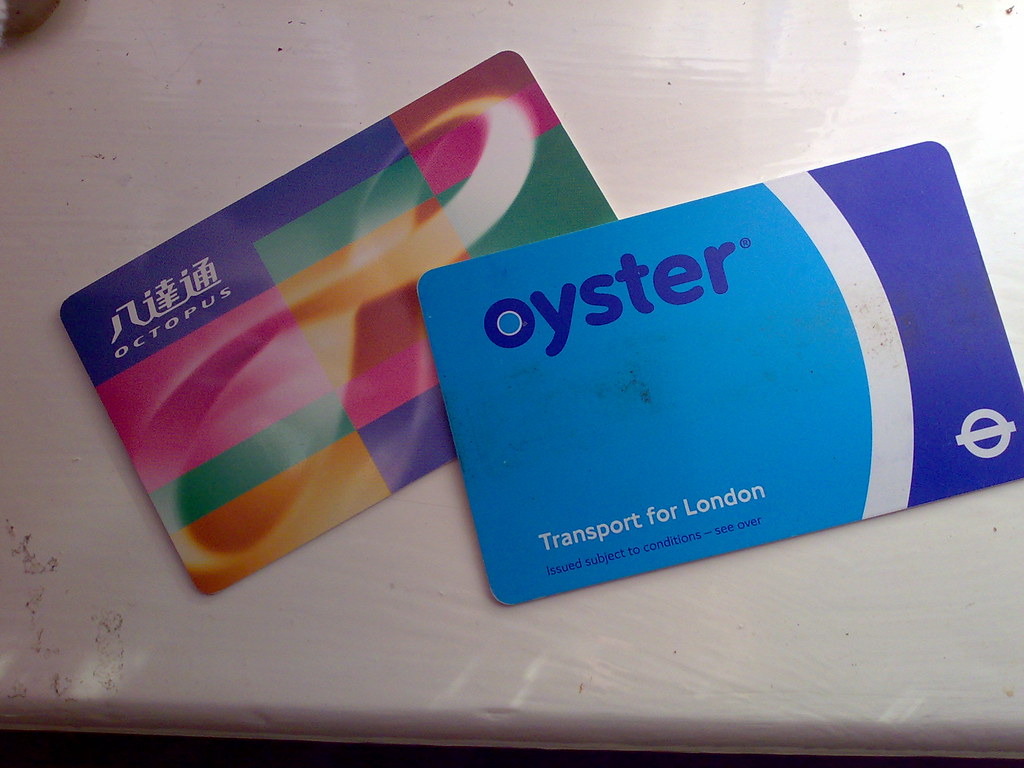
    Before we think about nearables; lets go back a few years. Back in the day shops and businesses where digitised using RFID tags that covered everything from lose prevention in shops and libraries (shop lifting to you and I) to providing payment systems like the Octopus and Oystercard. RFID tags are passive devices with a small amount of information on them; electromagnetic waves from a reader ‘powered’ them allowing the data to be read. In essence RFID is rather like the magnetic strip that used to be on the back of credit cards, bank deposit books and on some passports.
    My Oyster card for LDN & my Octopus card for HKG
    Estimote’s Wearables product takes the RFID tag and asks what could be done if the tag became active, self-powered. It is compliant with Apple’s iBeacon standard using low-powered Bluetooth LE radio transmissions to interact with a smartphone.

    Estimote defines the nearables as:

    … a smart, connected object that broadcasts data about its location, motion and temperature.

    The information that nearables can provide can be dynamic, based on simple sensors included in the electronics package. At the moment nearables in sticker form cost some $33/unit and a default battery life for three years.

    This initial version of nearables might be of interest for high value package tracking, like a consignment of vintage wine, fragile museum pieces or high end cigars.

    Although this seems like limited technology at the moment, imagine what improvements could be brought in over future evolutions of it. If I had been told about this in my 20s, I would have thought that nearables came out of the wild imaginings of a James Bond film or similar. Now its aimed at high end supply chain management and logistics.

    More related content here.

    More information
    Nearables are here, introducing Estimote stickers | Estimote Blog

  • Makimotos wave

    Makimotos wave is named after Dr Tsugio Makimoto. Dr Makimoto is a technologist who has worked at Sony and Hitachi. He co-authored Digital Nomad with David Manners which was published in 1997 and seems to have been influential to executives in the semiconductor industry. Makimotos wave named is a twenty-year cycle between custom design components and general components.

    While GPUs could be argued as general components based on their usage in machine learning and cryptocurrency mining.

    We’re definitely in an era of custom design components at the moment in personal computing, with PCs moving to bespoke processors based on the ARM architecture.

    At the moment in mobile we are in the custom part of the cycle with the kind of silicon being created for smartphones like Apple’s and Samsung’s respective chips and we are due to see a swing to general purpose components from 2017 or so.

    General purpose components may be very different to what we have been used to before. New processes will allow new functions to be built on the chips, though this seems to be happening at a slower rate with people like Intel making chipsets. Multiple pieces of silicon in a single chip package. 

    Makimotos wave helps us understand these transitions. 

    Like Moore’s Law, Makimotos law is used as a heuristic to try and understand what is happening within the industry. Dr Makimoto discusses it in this video below.  

    More similar content here.