Category: marketing | 營銷 | 마케팅 | マーケティング

According to the AMA – Marketing is the activity, set of institutions, and processes for creating, communicating, delivering, and exchanging offerings that have value for customers, clients, partners, and society at large. This has contained a wide range of content as a section over the years including

  • Super Bowl advertising
  • Spanx
  • Content marketing
  • Fake product reviews on Amazon
  • Fear of finding out
  • Genesis the Korean luxury car brand
  • Guo chao – Chinese national pride
  • Harmony Korine’s creative work for 7-Eleven
  • Advertising legend Bill Bernbach
  • Japanese consumer insights
  • Chinese New Year adverts from China, Hong Kong, Malaysia and Singapore
  • Doughnutism
  • Consumer Electronics Show (CES)
  • Influencer promotions
  • A media diary
  • Luxe streetwear
  • Consumerology by marketing behaviour expert Phil Graves
  • Payola
  • Dettol’s back to work advertising campaign
  • Eat Your Greens edited by Wiemer Snijders
  • Dove #washtocare advertising campaign
  • The fallacy of generations such as gen-z
  • Cultural marketing with Stüssy
  • How Brands Grow Part 2 by Jenni Romaniuk and Byron Sharp
  • Facebook’s misleading ad metrics
  • The role of salience in advertising
  • SAS – What is truly Scandinavian? advertising campaign
  • Brand winter
  • Treasure hunt as defined by NPD is the process of consumers bargain hunting
  • Lovemarks
  • How Louis Vuitton has re-engineered its business to handle the modern luxury consumer’s needs and tastes
  • Korean TV shopping celebrity Choi Hyun woo
  • qCPM
  • Planning and communications
  • The Jeremy Renner store
  • Cashierless stores
  • BMW NEXTGen
  • Creativity in data event that I spoke at
  • Beauty marketing trends
  • Kraft Mothers Day marketing
  • RESIST – counter disinformation tool
  • Facebook pivots to WeChat’s business model
  • Smartphone launches
  • Ad blockers

    If you work in the advertising or media sectors, the elephant in the room will be the problem ad blockers. Specially developed software designed to stop ad tracking and ad vending online.
    ad blocker
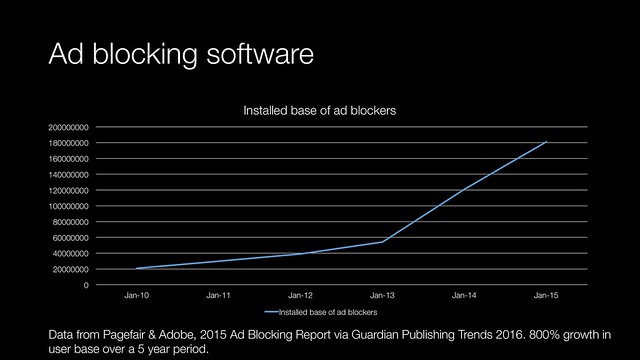
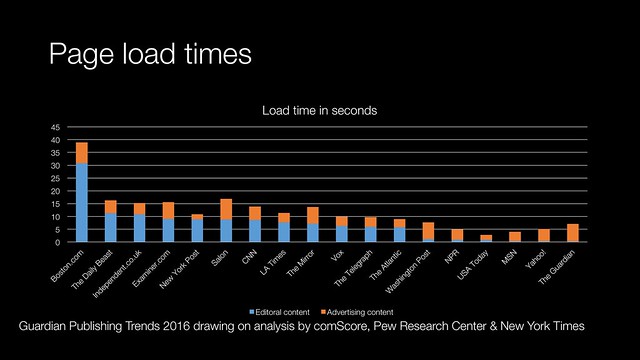
    Over five years from 2010 to 2015 the installed base of ad blockers has increased eight-fold. The root problem is a that of a poor web experience. It is a well known heuristic since the late 1990s that page load time and the likelihood of a consumer to click away to another page have inverse relationship with each other.
    page load times

    Can it be the ads themselves?

    Display ads have been around almost as long as the commercial web.

    Secondly, Google research found that 56.1 per cent of display ads vended in a trial were not viewable by the audience.

    But that number is a problem for advertising customers as they want to get greater efficiency and effectiveness in their marketing campaigns.

    Unilever’s CMO Keith Weed went on record last year demanding 100% viewability for digital advertising. In order to support this, there needs to be tracking technology deployed to monitor the advertising experience.

    This is on top of tracking technology that is used to conduct retargeting and aid programmatic selling of advertising. All of this slows page load times as information is conveyed to a plethora tracking servers, which then controls which ads are served.

    Retargeting is a tool that is particularly crudely used, audiences aren’t that impressed by brands stalking them throughout their online journey. More media related content can be found here.

    More information

    IAB: 100% Viewability of Digital Ads Is ‘Not Yet Possible’ | Advertising Age
    5 Factors of Display Visibility | Think With Google (US)
    The Future of Viewability | 360i
    CPM is dead: a guide to viewability in online advertising | Econsultancy GooglePlus account
    Measuring Ad Viewability | Think With Google
    Why viewability will become one of the key issues in digital advertising in 2016 | The Drum
    State of Viewability Transaction 2015 | iab
    Unilever’s Keith Weed: ‘Digital ads must be 100% viewable’ | Marketing Week
    Ad Blockers and the Next Chapter of the Internet | HBR – retargeting blamed (hat tip Daniel Appelquist)

  • MWC 2016 as a case study on talkability, brand mentions and brand performance

    Mobile World Congress (or in industry parlance MWC 2016) is where the telecoms industry goes to set out its stand. It has gradually changed from being a conference where the big issues of the day are hashed out, to more of a trade show a la CES or CeBIT.

    From a brand point of view, it was of interest to me for two reasons:

    • It offers largely culture neutral brand discussions, many of which occur online
    • I have an interest, having worked on a few mobile brands during my agency career (Palm, Ericsson, Verizon Wireless, Samsung, Qualcomm, Telenor Myanmar and Huawei)

    I pulled this slide ware together for a talk I am giving at an internal event at an agency.

    The first data that I have put together is looking at the amount of mentions that occurred regardless of the channel. It is a relatively easy data point to pull out of monitoring systems very quickly.

    Obviously the value of mentions will depend on how many people view them, what is the context that the mention appears in. What was the content around it? Who said it, are they expert or trustworthy? So looking purely at the number of mentions would be crude, offering little value apart from nice PowerPoint slides.

    Breaking the mentions down by platform gives an idea of relative marketing communications competencies of brands. So looking at Huawei and Xiaomi shows contrasting approach to building talkability and conversations. Huawei focuses on traditional media channels where as Xiaomi focuses on social.

    By comparison LG and Samsung seem to have a more holistic approach.

    I then moved on beyond the mention data to try and look at relative authority of whoever mentioned the brand and looking at the relative distribution by brand and channel.

    I had done some initial analysis on the event in general here. These numbers showed how well brands had built high authority communities and the discussions around them.

    What was quite surprising was the polarised authority of mainstream media sources. Newswire syndication had destroyed authority of many online traditional media channels. A second cross brand observation was the relatively low authority of the blogosphere.

    These slides only start to delve into understanding talkability and are time consuming to create in comparison to looking at raw mention numbers, but offer superior strategic insight for both earned and paid media approaches for future launches.

    I did some broad profiling of online conversations around MWC here.

  • Come to Singapore + more

    Come to Singapore

    Come to Singapore! The Sights (And Branding) Are Lovely | WIRED – it feels very Monocle-esque in terms of editorial style. Come to Singpore! is very different to the Conde Naste Traveller type editorial. Singapore is aiming at developing a start-up culture so targetingWired (US) readers make a good deal of sense. More Singapore related posts here.

    Decline of cyberspace

    William Gibson on the decline of cyberspace. It is fascinating in terms of how Gibson’s inspiration has evolved over time. He was reacting against genres that he didn’t want to write as much as ideas he wanted to convey. The ability to say no, is a very interesting creative process and it reminds me of an interview I saw with an Apple executive talking about why the iPod didn’t have an FM radio.

    Renault Alpine Vision

    Interesting to see Renault going back to Alpine’s sports roots with the Vision sports coupe. It is made to a similar formula to the original 1960s cars that made Alpine famous. A light, small car, a rear-mid engine placement with a highly tuned small capacity engine. Performance is viewed by the Alpine team in much more holistically with an equal focus on handling and breaking.

    Tesla Model X

    I am a sucker for well done manufacturing and process films. The first one up is from Tesla, highlighting robots working in a manufacturing cell on their X model vehicle. Tesla has had problems around areas like panel fit. I am not sure if they have resolved those quality issues, but robots should provide them with a very consistent process and higher throughput.

  • Fitness apps + more things

    Fitness apps

    Adidas, Asics, Under Armour Spend $1 Billion on Fitness Apps | Business of Fashion – interesting how sports apparel brands are making the front running in fitness apps. Fitness apps look like one of the key use cases for wearables and I expect technology firms to try and muscle in. Fitness apps would fit in with Google and Facebook’s broader health ambitions, advertising ambitions and subscription offerings.

    China

    HOW TO: Shenzhen Spring Festival/Chinese New Year | Dangerous Prototypes – great write-up that nails how Shenzhen feels over Chinese new year. One thing that people forget is that Shenzhen is a town of immigrants from other parts of China. That becomes apparent during the Chinese new year in Shenzhen. More on China here.

    Consumer behaviour

    Coming of Age: Millennials – Pornhub Insights – more about millennials than you probably ever want to know – more about millennials than you probably ever want to know

    Ethics

    Daring Fireball: Was Pew’s Polling Question on the Apple FBI Debate Misleading? – yes. The debate is based on emotive logical fallacy. More security related posts here.

    Finance

    Samsung Pay to enter China tomorrow, is probably screwed | Techinasia – yep, headline about sums it up

    WeChat had more mobile transactions over just Chinese New Year than PayPal had during 2015 | The Drum – a lot of this is down to the relative attractiveness of electronic payments. The largest denomination Chinese bank note is worth about £9. So Chinese money is more inconvenient hard currency in other countries. In the west credit and debit cards are well established by comparison to their Chinese counterparts.

    Marketing

    Facebook for Business Influencers – Edelman

    Media

    Yahoo Has a Surprise New Suitor | Vanity Fair – quite why Time Inc would want to buy Yahoo! after parting with Aol is beyond me given that the businesses were similar in many respects (email, messaging, vertical news content, international presence)

    Retailing

    Powa Technologies: from UK tech darling to administration – FT.com – TechCity is more fragile than many people care to admit

    Security

    Daring Fireball: New York Times Publishes Report on iPhone Security and China – irony of Dept of Justice and State Department being at cross purposes is an interesting dynamic

    Singapore

    Helpers of Singapore – interesting tumblr account, surprised that is such long form content. Well worth checking out

    Software

    Microsoft to phase out Skype Qik video chat app as of March 24 | ZDNet – I didn’t know Qik was still maintained by Microsoft

    Web of no web

    Facebook creates ‘social virtual reality’ team – FT.com – all your cyberspace dreams coming true?

    Samsung, LG improve smartphone cameras, turn to virtual reality – Shanghai Daily – there is a definite lull in innovation

    Wireless

    MateBook a surprise move for Huawei – Kantar – really?

  • What does ZBB mean for agencies?

    After talking with a friend I pulled together a brief presentation for them which explained what Zero Based Budgeting (ZBB) practices at a client were likely to mean for an agency.

    The key takeout for me are is one of attitude. ZBB isn’t about cost cutting but about spending the money in the most effective way,  where it matters the most. ZBB has benefits that can applied outside marketing on complex projects. 

    And there in lies the problem with the way ZBB has been adapted by some consumer brands. Looking from the outside in at 3G Capital and its work at Kraft and Heinz brands, it seems that ZBB is being used for short term cost cutting, rather than resource allocation. 

    Whilst this might be justified in terms of Jack Welsh-style shareholder value. The reality is short term pay-offs robbing long term potential. This is what happens when you let finance focused MBA graduates a la Scrooge McDuck attempt to do a brand marketers job. What looks good on their spreadsheet looks retarded when viewed through the lens of marketing science

    For agencies, ZBB means that the client is making an active effort to keep marketing thinking fresh. It means a pragmatic approach to innovation based on benefit rather than running around screaming innovation. 

    It also means knowing when you’re not the right agency for the job and having partners that you can work with. Which is why we’ve seen ad agencies like Mullen Lowe bulk up on digital and earned media chops. Finally if you see that your client is using ZBB just to cut, cut, cut. Plan for another client because at least one of two things are happening:

    • You aren’t coming up with ideas that meet the needs of the business, so ZBB dictates that investment will be moved away from your programmes
    • The client has a short-termist mindset in using ZBB. You might not be in danger of losing your business, but they might be in danger of losing theirs to the competition