We think of the meme now as the lowest form of culture of a standard trope that is used to explain a situation by shorthand, but the reality is more complex.
The text book definition of a meme would be an idea, behaviour, or style that spreads by means of imitation from person to person within a culture and often carries symbolic meaning representing a particular phenomenon or theme. Richard Dawkin coined the word meme in his book The Selfish Gene, I have also heard the concept articulated as an idea virus.
So that would bring in things in everyday life that you take for granted like the way we tie up shoelaces. People who have been in the military tend to use a ‘ladder approach’ versus going criss-cross.
Its what can bind tribal affiliations together. Many people support the same sports team as the people around them such as neighbours, peers or friends and family. The initial choice about the team to support is memetic in nature.
Memes have moved beyond being an analogy to being a badge of belonging and even the lingua franc itself. If one looks at 4Chan’s /b/ channel mostly consists of anonymous users bombarding memes at each other. Occasionally there will be a request to customise a meme image from a user and the community piles in.
Memetics became a formal field of academic study in the 1990s. The nucleus for it as a field of study was Dawkins books and a series of columns that started appearing in the Scientific American during the early 1980s by Douglas Hofstadter and Media Virus by Douglas Rushkoff.
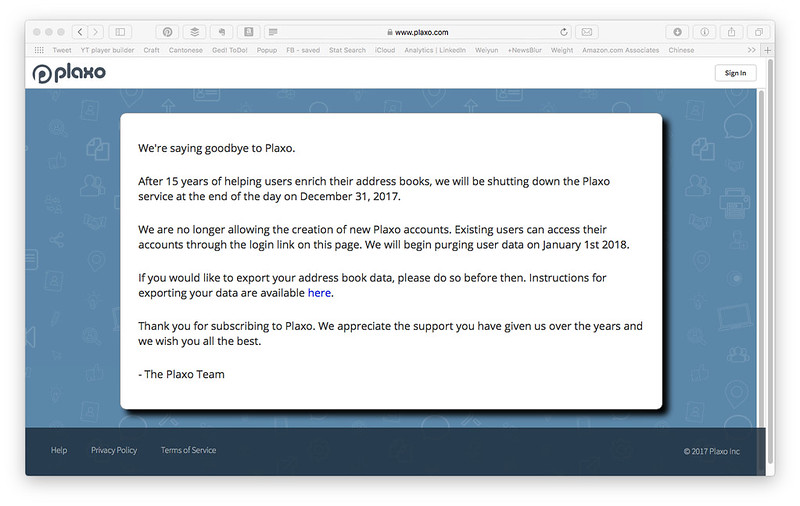
I don’t know if I hadn’t been paying attention or if it hadn’t been put out there in the media about Plaxo closing down. Prior to Plaxo closing down, it provided a valuable service by syncing your address book to people’s profile cards which they changed if they moved jobs, changed their cell phone number or email address. It was clunky but the data in and out was more useful than LinkedIn or Facebook has been since. I gave up on it when it started to have issues with LinkedIn connections. Comcast had been running it quietly for a number of years but have evidently given up on it. It’s main legacy for me now is knowing the real birthdays of many contacts as this was before the web got quite as crime laden as it is now. Plaxo closing down is about the the decline of web 2.0 data portability and
Culture
This week I have been listening to Pleasure – the new single from Luxxury and this fantastic play list from Chicago legend Mike Dunn of the tracks which most inspired him.
Dunn isn’t as famous as Frankie Knuckles or Steve ‘Silk’ Hurley but has production credits on Sterling Void’s ‘Don’t Wanna Go‘, Julian ‘Jumpin’ Perez’ ‘Relight My Fire‘ and as an artist in his own right with the likes of ‘God Made Me Phunky‘.
By the time that you read this I will be too engrossed in watching The Punisher on Netflix to care
I have grown tired of a ridiculous statistic being used so frequently that it becomes marketing truth. It’s regurgitated in articles, blog posts, social media and presentations. The problem with it is that affects the way marketers view the world and conduct both planning and strategy. The picture below is a goldfish, his name is Diego. If you’ve managed to read this you aren’t Diego.
I realise that sounds a little dramatic, but check out this piece by Mark Jackson, who leads the Hong Kong and Shenzhen offices of Racepoint Global. It’s a good piece on the different elements that represent a good story (predominantly within a PR setting). And it is right that attention in a fragmented media eco-system will be contested more fiercely. But it starts with:
Over the course of the last 20 years, the average attention span has fallen to around eight seconds; a goldfish has an attention span of nine! The challenge for companies – established and new – is to figure out how to get even a small slice of that attention span when so many other companies are competing for it.
Mark’s piece is just the latest of a long line of marketing ‘thought leadership’ pieces that repeat this as gospel. The problem is this ‘truth’ is bollocks.
It fails the common sense test. Given that binge watching of shows like Game of Thrones or sports matches is commonplace, book sales are still happening, they would have to be balanced out with millisecond experiences for this 8-second value to make any sense as an average. The goldfish claim is like something out of a vintage Brass Eye episode.
To quote DJ Neil ‘Doctor’ Fox:
Now that is a scientific fact! There’s no real evidence for it; but it is scientific fact
Let’s say your common sense gets the better of your desire for a pithy soundbite and you decide to delve into the goldfish claim a bit deeper. If one took a little bit of time to Google around it would become apparent that the goldfish ‘fact’ is dubious. It originally came from research commissioned by Microsoft’s Advertising arm ‘How does digital affect Canadian attention spans?‘. The original link to the research now defaults to the home page of Microsoft Advertising. Once you start digging into it, the goldfish wasn’t actually part of the research, but was supporting desk research and thats when its provenance gets murky.
PolicyViz in a 2016 blog post The Attention Span Statistic Fallacy called it out and provided links to the research that they did into the the goldfish ‘fact’ in 2016 – go over and check their article out. The BBC did similar detective work a year later and even went and asked an expert:
“I don’t think that’s true at all,” says Dr Gemma Briggs, a psychology lecturer at the Open University.
“Simply because I don’t think that that’s something that psychologists or people interested in attention would try and measure and quantify in that way.”
She studies attention in drivers and witnesses to crime and says the idea of an “average attention span” is pretty meaningless. “It’s very much task-dependent. How much attention we apply to a task will vary depending on what the task demand is.”
There are some studies out there that look at specific tasks, like listening to a lecture.
But the idea that there’s a typical length of time for which people can pay attention to even that one task has also been debunked.
“How we apply our attention to different tasks depends very much about what the individual brings to that situation,” explains Dr Briggs.
“We’ve got a wealth of information in our heads about what normally happens in given situations, what we can expect. And those expectations and our experience directly mould what we see and how we process information in any given time.”
But don’t feel too bad, publications like Time and the Daily Telegraph were punked by this story back in 2015. The BBC use the ‘fact’ back in 2002, but don’t cite the source. Fake news doesn’t just win elections, it also makes a fool of marketers.
This whole thing feels like some marketer (or PR) did as poor a job as many journalists in terms of sourcing claims and this ‘truth’ gradually became reinforcing. Let’s start taking the goldfish out of marketing.
Not Just A Crock: The Viral Word-Of-Mouth Success Of Instant Pot : The Salt : NPR – The instant pot of the title is what was called a slow cooker back when my parents bought one in the mid-1980s. It was a ceramic dish with a lid in a metal holder with a heating plate. They used to use the instant pot to make porridge for breakfast and lentil soup. I am expecting to see the instant pot as a case study in ‘value of earned media’ decks moving forward
WSJ City – CPI Hits Two-Year High – UK price inflation due to currency devaluation is going to put a pre-Brexit squeeze on the economy prior to the post-Brexit tumble
Qualcomm: FTC Alleges Special Deal with Apple – Tech Trader Daily – Barrons.com – Extracted exclusivity from Apple in exchange for reduced patent royalties. Qualcomm precluded Apple from sourcing baseband processors from Qualcomm’s competitors from 2011 to 2016. Qualcomm recognized that any competitor that won Apple’s business would become stronger, and used exclusivity to prevent Apple from working with and improving the effectiveness of Qualcomm’s competitors.
Why do diplomats use this alien WhatsApp emoji for Vladimir Putin? | Technology | The Guardian – its hardly diplomatic to carry on this in this way even if it is referring to Vladimir Putin. Secondly, I am pretty confident that Vladimir Putin and his team have a good insight into it. Finally I’d still want to be using Signal rather than giving Facebook indirect oversight of messaging. Given the ubiquity of WhatsApp, I would have thought that the security services that report into President Vladimir Putin would have found a way to crack WhatsApp
Microsoft Is Looking Like the New Apple | MIT Technology Review – this isn’t the headline Apple want. Its kind of like the immediate aftermath of Windows 95. I think Apple’s interface design call is right but its marketing, product design and pricing is fucked. If they had put 32GB RAM in the machine, hadn’t upped the pricing and messed with the ports as badly this wouldn’t be a problem. It’s execution which is failing them
Brandon Li put his short film Hong Kong Strong on Vimeo last week. The video sprang up all over my Facebook feed as proud Hong Kongers shared the video. There were a number of things happening. The Hong Kong Tourist Board was having its strategy and spend challenged by some of the public and Wan Chai was shut down as a senior Chinese official arrived in the city for a three-day inspection.
Why does Li’s Hong Kong Strong work? Its a beautiful piece of film in its own right and its cleverly edited. But you can see films with similar production values to Hong Kong Strong all over YouTube and Vimeo.
I think that the answer lies in the strong sense of place that it provides the viewer. In this respect it reminded me of Hollywood director John Ford’s The Quiet Man. Ford’s real name was Feeney and he was a first generation Irish American. His parents were from the west of Ireland (Galway and the Arran Islands respectively).
As with great art Ford poured some of himself and his sense of place into the mawkish comedy. That lack of irony and love the old country saw the film become a touchstone for many Irish Americans.
Hong Kong is a largely thriving city but the sense of itself is under attack as the city state is absorbed by mainland China, that process has caused a dissonance in Hong Kongers which is why a film with a strong sense of place resonated so much. Hong Kong Strong captures not only what Hong Kong looks like, but also the energy and vitality of what Hong Kong is.
Brandon accompanied the video with a description of how it was made. The film was boiled down from over 1.7TB of rushes.