Category: meme | 模因 | 밈 | ミーム

We think of the meme now as the lowest form of culture of a standard trope that is used to explain a situation by shorthand, but the reality is more complex.

The text book definition of a meme would be an idea, behaviour, or style that spreads by means of imitation from person to person within a culture and often carries symbolic meaning representing a particular phenomenon or theme. Richard Dawkin coined the word meme in his book The Selfish Gene, I have also heard the concept articulated as an idea virus.

So that would bring in things in everyday life that you take for granted like the way we tie up shoelaces. People who have been in the military tend to use a ‘ladder approach’ versus going criss-cross.

Its what can bind tribal affiliations together. Many people support the same sports team as the people around them such as neighbours, peers or friends and family. The initial choice about the team to support is memetic in nature.

Memes have moved beyond being an analogy to being a badge of belonging and even the lingua franc itself. If one looks at 4Chan’s /b/ channel mostly consists of anonymous users bombarding memes at each other. Occasionally there will be a request to customise a meme image from a user and the community piles in.

Memetics became a formal field of academic study in the 1990s. The nucleus for it as a field of study was Dawkins books and a series of columns that started appearing in the Scientific American during the early 1980s by Douglas Hofstadter and Media Virus by Douglas Rushkoff.

  • On Writing

    This post was prompted by reading A Time To Write by Wadds, open it in a new tab on your browser and give it a read.
    Cover on my old book
    Given Wadds’ post I thought I would reflect briefly on my own process.

    Why I write?

    Wadds describes his writing as a kind of mindfulness.  For me writing serves a number of purposes:

    • It cements things in my memory, a bit like revision at school
    • It helps me work out ideas and my stance on them
    • Its a good platform for experiments. I started off my blogging to work out how it could help clients that I couldn’t get media coverage for. This was back before social media was a thing. At the moment I am using this blog  as part of an experiment on LinkedIn Pulse as a source of traffic. More on that when I have a decent set of data
    • Occasionally decent conversations spark of these posts, some of my good friends are online
    • There is a more talented fighter than I, also called Ged Carroll. I like to have a clear differentiator from him
    • My blog is also a marketing calling card, I have got jobs from it over the years.

    Wadds talks about why people don’t write, he describes it as effort and bravery. I suspect its a bit more complex. Yes life does get in the way for many people, but many of my friends have their own creative outlets: painting, photography, the art of social conversation, mastering video games to name but three.  For me writing extends out of curiosity, it is a natural progression – otherwise ideas would vanish into the ether.

    In terms of bravery, Wadds talks about the willingness to share private or personal subjects. I generally don’t, the reason is quite simple. Growing up in an Irish household, my time was predominantly spent in the UK during The Troubles, I grew up with the idea of the pervasive, invasive surveillance state. I grew up with a personal perception of what could be called ‘operational security’ (Op-Sec). The future has finally caught up.

    Workflow

    You can break my workflow down into four sections:

    • Ideation.  Ideas broadly come from reading something or the world around me. If it is something on the world around me, I will make some bullets in the notes application of my iPhone.  If it is a talk I will have likely recorded it using Olympus’ free dictation app for the iPhone. If it is from reading a book, I am likely to put post-it notes on the relevant pages with some notes and then flick back through this as I write a post. I have aversion to writing on the books themselves. I have found that I don’t get much out of reading on a Kindle, so only use that for leisure reading now. If  I am inspired by something I have seen, there will be a picture on Flickr, which also serves as the image hosting platform for this blog. I have about 46 GB of images in my Flickr account – it would take a major tectonic event to persuade me to move to another platform like 500px. I have a Twitter account with a set of lists that provide inspiration and use Newsblur as an RSS reader as well. Newsblur is invaluable. I am currently trying Breaking News, an app recommended by Richard Edelman and occasionally dip into Apple’s own News app. When I have online content that has spurred a writing idea I will notate it in my bookmark service pinboard.in
    • Writing. My writing method varies based on two criteria; the regularity of the post and the length of the post. If you’ve read my blog for a length of time you will see that there are repeating themes. Every two days is a collection of interesting links from around the web. These posts are based on content that I bookmark. There is a post on Friday for interesting creative or useful things, again this pretty much writes itself based on my bookmarks as I ingest the web. At the moment I am publishing slides of data that I have collected on a monthly basis, I usually write a bit of analysis on the some of the data that I have surfaced. This just flows out easily. For short irregular posts they are often a stream of consciousness with minimal editing directly into WordPress. Longer posts are often mind-mapped onto engineering squared paper and then written into Hemingway
    • Editing. Unlike Wadds, I don’t have an editor. I use Hemingway app as a machine-based editor. My fact-checking happens before words are committed to the posts in my reading around
    • Syndication. I syndicate my content using plumbing that I have put int place using IFTTT and WordPress’ own JetPack plug-in. When I syndicate to Medium and LinkedIn this is done manually.

    Wadds’ talks about mindfulness in writing. I don’t necessarily think that its the same for me.  That feeling of being in the zone is something I get more from DJ’ing ironically, or focusing on a mundane task. Writing is more about making fleeting ideas permanent. It is also written with at least half an eye on my work.

    More information
    Olympus Dictation app
    Flickr
    Newsblur
    Twitter lists
    pinboard.in
    Breaking News app
    IFTTT
    JetPack
    Medium
  • How the Panama Papers story broke online

    The Panama Papers are 2.6 TB worth of documents provided to German paper Sueddeutsche Zeitung by an anonymous source in August 2015. The documents cover 40 years of work by a Panamanian corporate law firm Mossack Fonseca on behalf of clients around the world.

    The documents detail corporate services provided to the rich and powerful around the world. The first stories from the data trove were published on April 3, 2016 with more expected by early May 2016.

    Many of the stories within the trove of information is likely to be never told. This is due to the vast volume of data provided. It would still need to be interpreted and mapped out into a story. That story would then need to go through legal review at a media outlet.
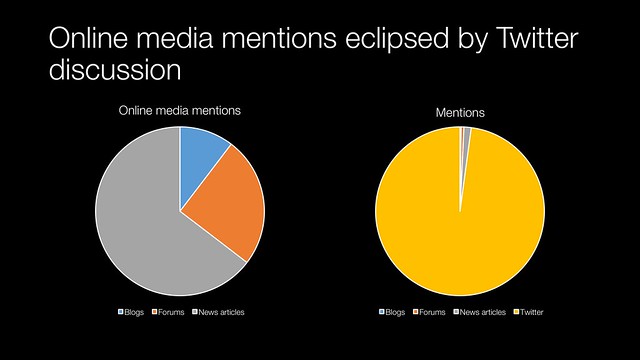
    Mentions by medium
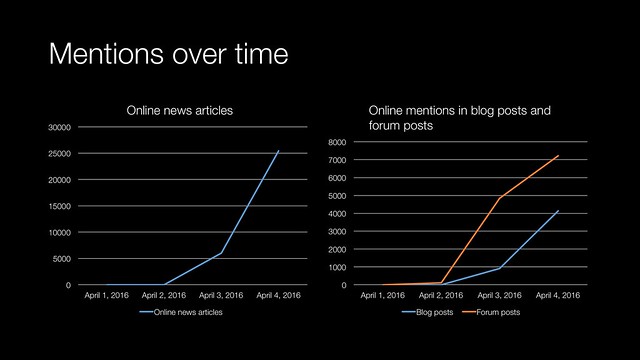
    Looking at social media listening services we can see how the story rolled out online.

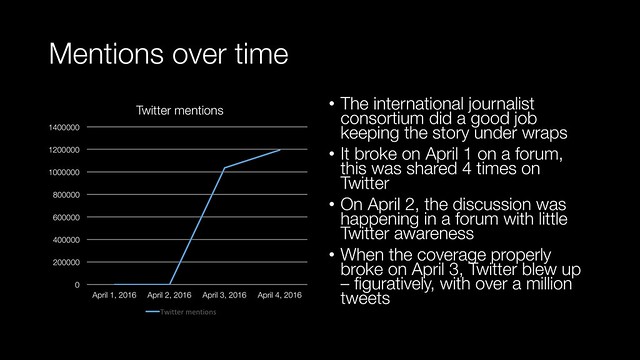
    Forums gave an early ‘canary in the coal mine’ for the story, a day before the story broke.  But it was Twitter that provided a massive accelerant. Twitter’s audience belies the platforms size versus Facebook. It is one of the few platforms that provides data like this for a price.

    The challenge for Twitter is monetising the power that they have in a way that will satisfy shareholders.
    Mentions over time
    Mentions over time

    It was clear that the mainstream media was needed as a catalyst to drive the story. Both the mainstream media and Twitter share the same monetisation problem.

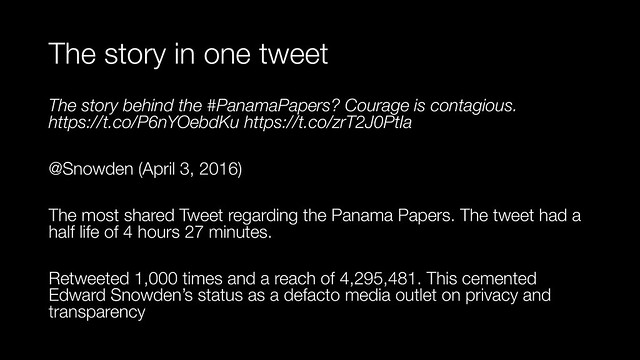
    A secondary effect of the Panama Papers story was the way the story cemented Edward Snowden’s place as a media brand. His media brand specialises in privacy and transparency – he was the most retweeted commentator in the first 24 hours of the story being out there.
    The story in one tweet
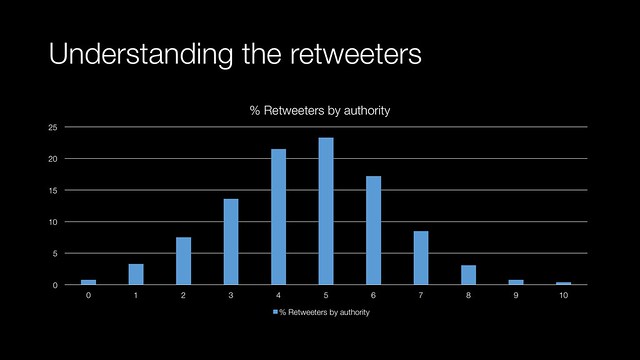
    Understanding the retweeters
    About me
    More on Slideshare. I also analysed the VS250 crisis and got some lessons from the data.

  • VS250 online racism crisis

    VS250

    Virgin Atlantic flight VS250 had a tough finish to the week as Chinese social media users and their overseas counterparts united to hit the airline hard. The problem had percolated for the previous two weeks on Chinese social media as netizens fumed at the way cabin staff had allegedly treated a Chinese woman traveller.

    Chinese social media users are known for their direct co-ordinated action such as the ‘human flesh engine’ in a way that is similar to Anonymous or Reddit readers – but at a greater scale.

    Looking at the VS250 related social data we can see that there were two concerted pushes on social media. The first one happened on Twitter at 4am – 5am and then hours later it landed on Facebook. Interesting that the open nature of Twitter was the first place Chinese netizens went. Presumably because it was more visible and likely to get picked up. A second reason might be the superficial similarity with Weibo made it their first choice.

    The surge post volume would be enough to stress even the largest and most sophisticated customer services team.

    Key lessons for brands:

    1. A Chinese market problem has the potential to be an international one. The Virgin Atlantic team had a good two weeks to either shutdown the protest through a quick resolution or prepare for the Chinese netizen onslaught. They didn’t seem to do either
    2. The Great Firewall will not keep the protest isolated. In fact through benign neglect the Chinese government has encouraged patriots to jump the firewall on issues like Taiwan
    3. Expect a more co-ordinated approach if the protest jumps the firewall. It can be diagnosed by looking at realtime data
    4. Chinese netizens can effectively drive international media coverage, despite western scepticism or possible concerns of state collusion. (They often give the Chinese Communist Party too much credit, and not enough credit to the effective adhocracy Chinese netizens create)
    5. Sentiment analysis doesn’t seem to be a good trigger / escalation vector in this incident as the tweets mostly seemed to register as neutral based on the analysis tools that I used. On their own it wouldn’t indicate anything untoward – which negates some of the pretty command dashboards you see

    Here’s a similar analysis that I did on the Panama Papers.

    More information

    Trail of conversations on Sina Weibo – you need an account to log-in and see the content
    Virgin Atlantic targeted after racism accusations | Global Times
    Woman Was Called “Chinese Pig” on Flight by Passenger, Only to be Threatened by Crew to Leave the Plane in Mid-air | People’s Daily – probably the best write up of the incident by Chinese government’s paper of record
    Virgin Atlantic investigates abuse case as story goes viral | China Daily – London bureau breaks the western social media debacle for English language readers
    Chinese woman claims flight attendants ignored her after man called her ‘Chinese pig’ | asiaone – asiaone is a Singaporean news aggregator owned by SPH who own The Straits Times
    Richard Branson sends apologetic tweet after woman claims she was called a ‘f****** Chinese pig’ on Virgin flight by fellow white passenger… but cabin crew threatened to kick HER off the plane | Mail Online – the Mail Online piece is particularly importance as it validates the story for western audiences and other media such as The Metro
    Richard Branson apologises to woman called ‘Chinese pig’ on Virgin flight | Metro.co.uk

  • Revisiting The X-Files twenty years later

    I discovered The X-Files at college. I had just purchased a Casio TV with a screen the size of a postage stamp from a pawn shop in Huddersfield. I bought a power block from Argos to save on batteries. The internet was only available for me during college time, so destination TV was a thing. I would tune in without-fail to watch the show.
    I want to believe
    The X-Files was of a time and a place. The Berlin Wall had just come down and the military industrial complex still existed. It existed without a wider purpose. The Thatcher years seemed petty with aspirations for authoritarianism at the time; in the way that Teresa May does now. Area 51  was the home of stealth planes, and so wrapped in mystery. Nuclear annihilation was as much a part of society as terrorism is now.

    The six episode relaunch caused me to revisit the show. It was interesting to see who it felt current and still had changed. Mulder and Scully used mobile phones, email, the internet and databases. From a technical point-of-view it feels current. Although Mulder and Scully should count their blessings for not living in our always-on connected world. Japanese technological skill now feels off-key. Whilst Japan is still very technically advanced, it doesn’t feel like the technological titan it seemed to represent in the 1980s.

    China was still in the early stages of opening up and had yet been let into the WTO. The latest gadgetry was instead being made in Malaysia, Singapore, Taiwan and Japan.

    The use of optical media was interesting. I still prefer the quality of audio CDs over streamed music or MP3 downloads.

    The authors understanding of technology and the online world is much more muddied. AOL would have been a thing in the US. Al Gore and Bill Gates would have talked about the information superhighway and cyberpunk had made a huge impact on culture. Series 7 episode First Person Shooter muddles online computer gaming, virtual worlds and reality and feels like it was written by William Gibson whilst extremely drunk.

    The storytelling definitely hit a low in series 6. Series 7 saw some interesting series mash-ups and changes:

    • Lance Henriksen from Chris Carter show Millennium appears in one episode as a plot crossover
    • There is a special episode of COPS (X-Cops) where the show format changes to ‘reality TV’
    • The Smoking Man becomes a trickster character like Loki than the sinister hand of the military industrial complex

    The Lone Gunmen seem quite niave and childish in their quest for the truth. There was a failed effort to crack a Las Vegas convention where banal details of black ops were discussed over poker. It would be interesting to see what they would look like in a post-Snowden world.

    Series 8 seems to be a self conscious effort to re-inject tension into the franchise. Robert Patrick joins as a by-the-book FBI agent dealing with shape-shifting bounty  hunter aliens. This is an interesting juxtaposition as he was previously best known for his role as the liquid metal policeman T-1000 from Terminator 2: Judgement Day. In this series it was Mulder’s turn to get abducted by aliens.

    Series 9 loses something in the awkward working threesome of Scully, Reyes and Doggett. There is something fitting about the final episode which features black helicopters and the smoking man.

    The Truth Is Out There was the oft-repeated mission statement in the show. Now it really is out in public and profoundly depressing. Despite this, I found re-watching the first five series of The X-Files very rewarding.

  • McRefugees

    McDonalds and McRefugees

    McDonalds Restaurants in Hong Kong is famous to Economist readers for consistently providing the best value in the publication’s ‘tongue-in-cheek’ ‘Big Mac Index’. But it is also increasingly becoming a cheap source of social housing for what has become known as McRefugees. McDonalds Chinese sign

    The restaurants are ubiquitous, offering cheap consistent food. And many of them remain open 24 hours a day, which contributes to Hong Kong’s ‘up all night’ lifestyle alongside the ubiquitous convenience stores. They are a neighbourhood haven to office workers, students and those on shifts. Their relative low costs mean that they prove attractive to homeless people. McSleepers and McRefugees were the interchangeable labels given to the homeless people sleeping in McDonalds to escape the oppressive heat of summer or the cold around lunar new year. It became a thing in the media last year when a woman lay dead in a restaurant for 24 hours before being discovered. The tragedy masks the unintentional social role McDonalds is playing for the poorest in Hong Kong society. More Hong Kong related posts here.

    More information

    Hong Kong ‘McRefugees’ up sharply, study shows – Hong Kong Economic Journal Insights

    Save our McRefugees: Woman’s lonely unnoticed death in Hong Kong McDonald’s highlights need to help homeless | SCMP

    Hong’s Kong’s lack of affordable housing fuels ‘McSleeper’ trend, where the homeless sleep at McDonald’s | SCMP Homeless woman found dead at Hong Kong McDonald’s 24 hours after she sat down as unaware customers ate | SCMP

    ‘McRefugee’ reunites with son in Singapore through media report on Hong Kong’s McDonald’s sleepers | SCMP

    The lonely life of the McSleepers, the poor who call McDonald’s home | SCMP