Category: retailing | 零售 | 소매업 | 小売業

Looking back to when I started this blog, it would have been reasonable to expect an inevitable march of retailing from offline to online. Amazon was on a tear and search advertising volumes were increasing year on year. By the time I was at Yahoo! search advertising (focused on online retailing) counted for about half of all revenue for the company.

At that time Yahoo! had a Spotify-like subscription streaming music service that was viewed as a threat to Apple’s iTunes download only offering. When I worked there Yahoo Music was the number one online music site in terms of audience reach and total time spent by consumers on the site. Also display advertising was much bigger for brands than it is today and Yahoo! was guaranteed a good share of the online marketing spend from any movie launch at the time.

The reality of online retailing, was slower than our expectations. While COVID drove an increase in online retailing there has also been corresponding innovations in retailing as well.

Amongst the pioneers in this change have been luxury brands like Burberry and Nike, who brought digital into their stores to provide a superior customer experience.

Adidas brought manufacturing into its stores with its speedfactory experiment, allowing for fast time to market and customisation.

Supreme changed the cadence of retailing with the Thursday morning ‘drop’  which saw queues outside stores. Every Thursday became a launch day as far as their customers where concerned. The queue has moved from Apple’s annual cadence, to every week.

  • Easy growth trap + more things

    Luxury Brands Must Avoid This Easy Growth Trap | Jing DailyChina has been reporting significant growth rates in the luxury sector recently, and many global luxury brands have been counting on China to be their silver lining. However, this recent growth has, to a large extent, been driven by repatriation (meaning sales that customers would otherwise have made during overseas travels). With travel routes to Europe and the US closed, Chinese luxury customers have been shopping domestically, which has driven the luxury demand inside Mainland China. Yet, this strong increase in demand in China could not offset the drastic decline in demand in both Europe and the US, at least during the second quarter of 2020. As such, many brands across categories like luxury cars, high-end jewelry, watches, and luxury fashion are sitting on enormous inventories and are looking at empty stores – Jing Daily were warning of the easy growth trap in discounting but their description of the market at the moment is very interesting. I suspect that the luxury sector is already well aware of this. The have seen department stores fall into the easy growth trap. Luxury brands have historically gone to extreme lengths to avoid the easy growth trap. Reputedly, during the last recession Rolex is alleged to have bought excess products from its dealers and the grey market to recycle, rather than discount. More on luxury and retailing.

    AI in Marketing: Myths vs. Reality – Techerati – Johnny Bentwood articulates a more reasonable assessment of AI. Badging everything ‘AI’ wonder technology is the easy growth trap of the tech sector. We’ve been here before

    Teens are turning themselves into Gucci models on TikTok | DazedLuxury is interesting because here brands really have meaning. The Gucci brand has history and meaning that comes from their behaviours and their products – rather than merely from how they have spent their ad budget in the past. Their Northern Soul homage in 2017 is just one example of the brand’s authenticity, energy and creative eye. For Gucci, it’s vital their brand continues to be culturally relevant, so they need to participate in TikTok. First, their #AccidentalInfluencer Grans in fur coats (with 8m views) showed they understood the grammar of TikTok and then the #GucciModel Challenge invites – no, demands – people play along. As Gucci makes fun of themselves they convey strong messages and have 26m views already. One thing I particularly like is how they use the audio by Lachlan Watson, star of the Netflix hit ‘Chilling Adventures of Sabrina’. This is the antithesis of the glossy spreads Gucci and others place in the top magazines and balances their marketing with authenticity which suits TikTok so well – Simon over at Great TikTok creative

    ‘It’s Ridiculous.’ Underfunded FTC and DOJ Can’t Keep Fighting the Tech Giants Like This – Big Technology 

    China’s middle-class dream of a second home in Malaysia dashed by coronavirus and geopolitical tensions | South China Morning Post“Most of these Chinese individual investors are not prepared – financially or psychologically – for the risks of overseas investment,” Zhao said. “They have experienced only economic growth and a booming property market on the mainland for decades, and they lack the funds and risk awareness to deal with the downside [of the economic cycle].” – the belt and road initiative isn’t all plain sailing

    ‘Funnel juggling’ is the answer to marketing effectiveness – Marketing WeekFor the long work, in most Uber countries there are a series of brand campaigns that push the emotional benefits of travel. Inevitably and rather cleverly the focus is on the top of the benefit ladder; or, in Uber’s case, the end of the journey, when it delivers you to your destination and the emotional benefit that awaits. In the US, for example, the brand uses TV, outdoor and digital media to associate Uber with these moments. It’s mass-market, it’s emotional, it’s brand-focused and it asks nothing of the consumer other than to see Uber as more than a ride-sharing service. 

    I have no idea what the split in Uber’s marketing spend actually is but I will bet about half of the money in any country also goes on the short of it.

    Gucci’s Gaming Garments | Gartner for Marketing – Chinese princelings….

    Cinnabon in the Oven | Gartner for Marketers – processed foods are the new eating out

    Public Image Decline of South Korean Churches – The PeninsulaThe PeninsulaPastors in South Korea claim that church-linked COVID-19 outbreaks have tainted the public image of churches in the country. Most recently, a church in Seoul emerged as the source of the country’s second largest infection cluster following a spike in cases associated with a religious sect in Daegu earlier this year. A 2015 Gallup Korea poll finds that more South Koreans, particularly those in their twenties and thirties, are moving away from religion.

    Hallyu Con 2020 | KCCUK – virtual festival on October 4th

    Ageism Is Not Just A Disease—It Is The New Business Model For Top Ad Agenciesthe original statement inadvertently let the cat out of the bag about agencies’ cost cutting at the expense of clients: they are now inhabited by junior talent, inexpensive and inexperienced. And this is the main reasons for the decline of the advertising industry. The holding companies like WPP were formed in the eighties, and they started consolidating the industry by gobbling up independent agencies. To do so, they needed to issue debt and the industry mortgaged itself to bankers. Madison Avenue went from focusing on the clients’ business to focusing on their balance sheet. And that meant getting rid of “cost”: talented experienced people in their forties and fifties and replacing them with cheaper labor.

    GBA hurt by Cold War, pandemic and protests EJINSIGHT – ejinsight.com – Greater Bay Area (cities and Hong Kong around the Pearl River delta) that China envisages as kind of like Judge Dredd’s Mega City One

    Video encoders using Huawei chips have backdoors and bad bugs – and Chinese giant says it’s not to blame • The Register 

    Hard to pardon: why Tenet’s muffled dialogue is a very modern problem | Tenet | The Guardian“Think about it: the first few Star Wars [films], we heard them all. We heard all the lines. Listen to Apocalypse Now – you hear everything.” Price agrees: “If you watch old movies, you might hear some sound effects here and there but now they go nuts: somebody’s walking across the room in a leather jacket, you hear the zippers clink and the creak of the leather and every footstep is right in your face.” When television became commonplace in the mid-20th century and challenged cinema’s dominion, cinema needed to distinguish itself; it needed to prove that it could justify people leaving the comfort of their homes. It did so partly by becoming bigger and louder. In an era – and a pandemic – in which home streaming dominates, cinema may be forced to pull out the stops once more. “I think we’re bombarded,” Paul Markey, a projectionist at the Irish Film Institute, says of modern films. “The more expensive movies have got, the more of a bombardment they become on your senses.”

    ‘The Devil All The Time’ Costume Designer On Its Style | Esquire – the world has never fallen out of love with American workwear; no split, no wandering eye. The only thing that has changed is who wears it. The plaid-clad men of The Devil All The Time wear clothes that are as tough and hardscrabble as their lives. Their ancestors still flock to the same brands – think Dickies, Levi’s and Carhartt – only now it’s because they’ve collaborated with Off-White. Still, context is context, but the fact that these classics still work is testament to their longevity, both in design and build – the timelessness of American workwear
  • Dark stores and coercive diplomacy

    I came across a couple of interesting terms recently: dark stores and coercive diplomacy.

    Dark stores

    Gartner for Marketing (formerly L2 Inc.) were talking about a new development at Amazon’s Whole Foods subsidiary. It was what Gartner called digital dark stores. The first one has been established in Industry City to serve much of Brooklyn, New York.

    Amazon themselves called it a ‘permanent online-only store‘ on their blog.

    So whats the difference between dark stores and the ‘last mile’ warehouses that Amazon uses for fulfilment in places like London?

    • Looking at the limited amount of photos available, this doesn’t feel warehouse-like. There wasn’t obvious automation in the pictures. Instead it feels like a supermarket that’s well stocked, but lacking price tags and shopper marketing accoutrements. Gartner describe it as ‘technically a grocery store’, which implies that there might be zoning or planning regulations that they might be working around
    • It is only for the Whole Foods brand; rather than fulfilling Amazon Fresh and Amazon Prime Now items

    This isn’t just an Amazon thing. Gartner points out that American supermarket brands Kroger and Giant Eagle have also embraced the order-only store model. More at Gartner for Marketing here.

    Coercive diplomacy

    The Australian Strategic Policy Institute published a report on September 1, 2020 called The Chinese Communist Party’s coercive diplomacy. It was written by Fergus Hanson, Emilia Currey and Tracy Beattie. Hanson, Currey and Beattie analysed ten years of Chinese government diplomacy. In there words:

    The Chinese Communist Party (CCP) is increasingly deploying coercive diplomacy against foreign governments and companies. Coercive diplomacy isn’t well understood, and countries and companies have struggled to develop an effective toolkit to push back against and resist it.

    The Chinese Communist Party (CCP) is increasingly deploying coercive diplomacy against foreign governments and companies. Coercive diplomacy isn’t well understood, and countries and companies have struggled to develop an effective toolkit to push back against and resist it.

    This report tracks the CCP’s use of coercive diplomacy over the past 10 years, recording 152 cases of coercive diplomacy affecting 27 countries as well as the European Union. The data shows that there’s been a sharp escalation in these tactics since 2018. The regions and countries that recorded the most instances of coercive diplomacy over the last decade include Europe, North America, Australia, New Zealand and East Asia.

    There seems to be an escalation of economic and non-economic measures deployed. Economic measures would include:

    • Trade sanctions – such as the recent ban on German pork products. This was rolled out just a few days in advance of a trade negotiation meeting between China and the European Union
    • Investment restrictions in strategic industries such as the ‘agreement‘ that Yahoo!, Softbank and Alibaba had over Alipay (which included what would now be Ant Group). Strategic industries like state security is notoriously (and deliberately) ill-defined in China
    • Tourism bans
    • Popular boycotts such as Korean corporate Lotte being driven out of China and the 2012 anti-Japan protests where the public smashed Japanese stores, attacked factories and burned Japanese cars

    Coercive pressure is also applied at below state level on businesses. It may also be applied on individuals, based on the data leak provided from Zhenhua Data seems to imply.

    Non economic measures include:

    • Arbitrary detention. The best example of this would be Michael Kovrig and Michael Spavor detained as part of China’s dispute with Canada. Another example might be Australian citizen Karm Gilespie. China didn’t admit it had detained him for over six years, until they announced his death sentence in the summer
    • Restrictions on official travel
    • State-issued threats which are usually issued on a regular basis as part of wolf warrior diplomacy. (Wolf Warrior is a set of two films with a Chinese action hero, a la Rambo – but with less humour).

    Some of the imputus for coercive diplomacy might come from the Chinese Communist Party’s continued rancour over Qing dynasty-era unequal treaties. More China related content here and more on retailing here.

  • Chinese State Security + more things

    When Chinese State Security police knocked on ABC journalist Bill Birtles’ door, he realised he was no longer safe in China – ABC News – interesting how business and finance reporting has been hard for the past few years. Which is one of the reasons why scandals like Luckin Coffee happen. Chinese state security is incompatible with the kind of transparency needed for good business reporting. More on Luckin Coffee here.

    Mulan’s official Chinese poster advances a nationalist agenda — Quartztweaked its posters, fascinating run through he symbolism

    Minitel: The Online World France Built Before the Web – IEEE SpectrumFor a generation of French citizens, Minitel wasn’t about hardware, switches, or software. It was about the people they chatted with, the services they used, the games they played, and the advertisements for these services they saw in newspapers and on billboards. Many of the services that we associate with the Web had predecessors in Minitel. Before there was Peapod, there was 3615 TMK (Tele-Market), a service that enabled Parisians to order groceries for same-day delivery. Before there was Cortana or Siri, there were Claire and Sophie, services that provided personalized information using natural-language interfaces. Before there was Ticketmaster, there was Billetel. And before there was telebanking, there was Minitel banking

    Brand Equity May Be Auto Industry’s Biggest AI Risk | CLS StrategiesThe AI Risk Index reflects a substantial gap between what is intended and what is perceived by critical stakeholders. The results are stark—especially in the context of substantial investment and many more years of public scrutiny as AI is improved—and reveal a growing crisis of trust. Though an average of 62% of Americans are familiar with companies in the transportation industry, only 35% have a positive opinion of them (compared to 43% for non-automotive manufacturing and 41% for retail companies) and only 37% trust them (compared to 44% for manufacturing and retail companies). Even more concerning is that the transportation companies most heavily involved in AI technology drive this sense of distrust, more so than traditional carmakers. That may explain why only three out of eight transportation companies analyzed during the third quarter of 2018 mentioned advancements in AI at all—indicating that auto companies are either communicating poorly or not communicating at all.

    Amazon’s profits, AWS and advertising — Benedict Evans – interesting analysis of where Amazon makes it’s money

    Strategic Management: Evaluation and Execution – Table of Contents – great book available in the creative commons

    BlackBerry Is Planning a Comeback. For Some, It Never Left | WIRED – a bit like me and Nokia feature phones LOL. On a more serious note you see this kind of loyalty on lots of diminished, but distinctive brands. SAAB would be the classic poster child

    2007 forever – The Magic iPod – resurrecting AplusD type mashup culture

    Facebook May Be Ordered to Change Data Practices in Europe | New York TimesFacebook is facing the prospect of not being able to move data about its European users to the United States, after European regulators raised concerns that such transfers do not adequately protect the information from American government surveillance. – this comes under the Irish data commissioner. More here – Facebook Fights Irish Privacy Watchdog’s Data-Transfer Curbs – Bloomberg 

    Human values: understanding psychological needs in a digital age – BBC R&D – really interesting work done by BBC Research and Development that could be applied to site and app design

    Douyin, China’s TikTok, permanently bans live-streamer who verbally harassed young women on the streets | South China Morning Post 

  • Things that caught my eye this week

    Indonesia is a fascinating place in and of itself and comes up with all kinds of cultural nuggets. The latest one that I came across was the Vespa Extreme moped sub-culture. Vespa scooters are plentiful in Indonesia, as is the desire to invent. Car tuning culture is big amongst the middle class. But for those who need something more affordable Vespa Extreme builds are a site to behold. The South China Morning Post put together this great documentary film on the Vespa Extreme culture and its riders.

    Like car culture there are meet-ups, cruises and even festivals organised.

    Vespa Extreme Culture.

    About half of the mobile game developers on iOS are based in China, the country’s universities turn out more programmers each year than anywhere else (including India). Yet China has still lagged behind other countries games in terms of incorporating technology and art. That’s where Black Myth: Wukong is supposed to come in. Sun Wukong is one of the names of the Monkey King in the Chinese literary classic Journey To The West. This has been a staple of Chinese animation and film for years.

    Black Myth: Wukong

    Could it be popular in China? It’s hard to tell from this pre-Alpha release footage. The biggest issues are likely to come from Chinese regulators. But hopefully the game won’t have to undergo the lengthy rewrites and changes foreign games have to do to comply. Instead the Chinese developers should be able to bake compliance in from the start. However, its China; so nothing is guaranteed.

    German software giant SAP created a Tinder-like internal matching app to connect isolated employees for virtual lunches during remote work – its an interesting approach to things I guess. Home working lacks serendipity of working in an office. There is no water cooler moments. Social interactions are limited and Zoom analogues (Microsoft Teams, GoTo Meeting etc) burden the user with a heavy cognitive load. I just hope that this is opt-in at SAP, rather than ‘enforced’ or ‘serious fun’.

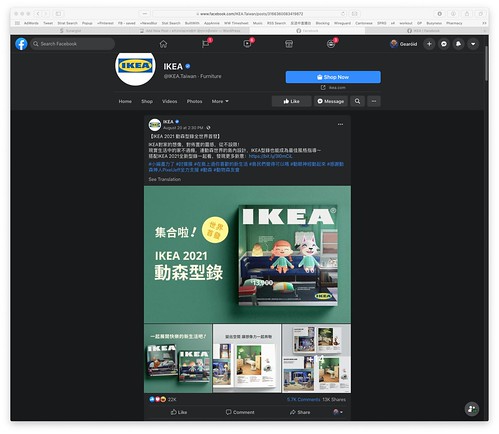
    The Ikea Taiwan Facebook page faithfully created looks from their catalogue on Animal Crossing, much to the delight of their Taiwanese and Hong Kong based followers. The original post is here.

    Ikea Taiwan Animal Crossing
    The original Facebook post
    Ikea Taiwan Animal Crossing
    Front cover with Animal Crossing characters, but on Ikea furniture
    Ikea Taiwan Animal Crossing
    Side-by-side comparison between the original catalogue and a recreation using sets dressed in Animal Crossing
    Ikea Taiwan Animal Crossing
    Another example, all prices are in Taiwan dollars rather than Animal Crossing belles

    More Ikea related content here.

    Spotify is already encouraging media planners to start thinking about audio adverts for their client Christmas campaigns. More here; Spotify’s Christmas in Summer: Hear the Cheer 

  • Memes as protest tactics + more

    Why Protest Tactics Spread Like Memes – The New York Timesoften, she noted, the images’ similarity was unwitting. In their spread, their simultaneity and their indirect influence on each other, the protest videos had all the characteristics of memes, those units of culture and behavior that spread rapidly online. The same cultural transfer that gives us uncanny cake-slicing memes and viral challenges also advances the language of protest. “We live in this world of attention dynamics so it makes sense that tactics start to converge,” Ms. Mina said. She called the images’ tendency to build on each other “memetic piggybacking,” and noted that everyday items that are subverted into objects of protest are “inherently charismatic.” – protest groups tactics as memes. Memes are a transmissible idea; whether its knowledge, humour or even cat gifs. Memes are something learnable and easily repeatable. The Hunger Games three finger salute or the LIHKG are deliberately chosen memes. Reciting lines from films or TV programmes like The Office are memes. Similarly protest slogans like “Liberate Hong Kong, Revolution Of Our Time’, ‘Five Demands, Not One Less’ (FDNOL) are memes. Other memes evolve due to pragmatism, such as the use of umbrellas during the 2014 protests. More meme related content here.

    Hong Kong Protests 2019
    Hong Kong Protests 2019 by Jonathan van Smit

    German oil refinery to build 30 MW hydrogen electrolysis plant – Reuters – great news. I think hydrogen fuel cells should be a more important part of the energy mix

    Apple Faces $1.4 Billion Lawsuit by Chinese AI Firm in Siri Patent Fight – WSJ – Conflicts over intellectual property, technology and trade are driving bilateral relations between the U.S. and China to their lowest point in decades. Last Friday, President Trump threatened to ban Chinese short-video app TikTok on national-security grounds. U.S. officials have been involved in talks over a potential sale of TikTok’s American business to Microsoft Corp.

    Google to invest $450M in smart home security solutions provider ADT | TechCrunch – tech eats the old economy due to obscenely high share prices

    7-Eleven owner is buying Marathon Petroleum’s Speedway gas stations for $21 billion – CNN – it’s a good deal for Marathon; but looks expensive for Seven and I (7-Eleven’s owner). 7-Eleven would need to get $175,000 net profit a year out of each gas station to make it worthwhile at the current purchase price

    Op-Ed: Never Trust Mark Zuckerberg Again- PingWest – a few things in this. 1/ Facebook probably didn’t get anything out of its reprochment with China. Yes China could stop advertising on Facebook, but A/ Chinese state owned companies not advertising on Facebook would be immaterial and probably benefit Facebook politically B/ Chinese private sector companies don’t have a lot of choice, so China would see a good deal of SME job destruction. 2/ The US government have more leverage. In this respect its like the embarrassing HSBC kowtowing in reverse. The Chinese author now realises how lame it looks when you’re on the other side of it

    Pompeo the Maoist – SettimanaNewsBorrowing from the logic used by Mao Zedong in his On Contradiction, Pompeo tried to prove that CCP didn’t represent the Chinese people, and that actually the party is the enemy of the Chinese people. This point is fundamental because, as Mao put it, the crucial political element is to know who is with us and who is the enemy, and the party should always represent the people. Pompeo stated: “We must start by changing how our people and our partners perceive the Chinese Communist Party. We have to tell the truth.” What is the truth, according to the US secretary of state? It is that: “We know … that doing business with a CCP-backed company is not the same as doing business with, say, a Canadian company. They don’t answer to independent boards, and many of them are state-sponsored and so have no need to pursue profits… We know too that if our companies invest in China, they may wittingly or unwittingly support the Communist Party’s gross human rights violations… We know too too that not all Chinese students and employees are just normal students and workers that are coming here to make a little bit of money and to garner themselves some knowledge. Too many of them come here to steal our intellectual property and to take this back to their country.” Therefore, he argues that the US should de facto work as a new revolutionary party: “We must also engage and empower the Chinese people—a dynamic, freedom-loving people who are completely distinct from the Chinese Communist Party.”

    Breaking Off TikTok Will Be Hard to Do — The Information – basically China still has control despite the window dressing. Given the structural, development, infrastructure and control aspects on this; how can Microsoft negotiate and engineer a clean break in the limited time that they have for TikTok versus Douyin? Some interesting analysis at the FT: The challenges Microsoft faces in buying TikTok’s US arm

    ARM China Asks Beijing to Intervene in Row With U.K. Parent – Caixin Global – It is interesting that the ARM CEO thinks he has the political juice to go against Hopu and its head Fang Fenglei. Is there more than meets the eye going on here? More from Sina.com’s tech channel (via Google Translate): Sina.com Technology Channel ARM China debaclethe intention of Hopu Investment , which represents 36% of the investors of the central state-owned enterprise financial institution in the joint venture, to join hands with foreign shareholders this time? Hopu and Arm recently appointed Hopu Investment’s Teck Sien Lau (Singaporean) as Chairman of Amou China, and Arm President Graham Budd (British) as Vice Chairman. In addition, Arm and Hopu previously appointed two co-CEOs (one Singaporean and one Chinese) on the disputed board of directors, and the board dispute is currently being resolved in legal proceedings. It seems that Hopu hopes to help Arm replace the existing management team and actually control the operation of the joint venture company through this operation. However, under the premise that HOPU violated the Chinese party’s agreement to act in concert and joined hands with Arm, such an organizational structure obviously did not represent China’s national interests. In addition, can they lead the technical team to realize the original intention of the joint venture company and truly realize the vision of autonomous and controllable core technology that China needs? More on ARM here.

    How to Keep Your Skin Healthy While Wearing a Mask | Vogue Hong Kong 

    Facebook Employee Leaks Show Betrayal By Company Leadership – “hurting people at scale” is a brutal header on the article

    Upfield targets block butters with vegan Flora Plant range | News | The Grocer – repackaging to remove the negative connotations of margarine by creating ‘vegan butter’ in salted and unsalted variants. *Disclosure, I worked with Mullen Lowe and Phd to develop ‘Family Brands’ global digital strategy, prior to Flora et al being sold off to Upfield. My work covered Blue Band, Bonella, Country Crock, Doriana, Dorina, Flora, Imperial, La Perfecta, Maizena, Milda, Mirasol, Planta, Planta Fin, Primavera, Rama, Sana, Stork, Tulipan, and Vitam

    Tymbals : Bytedance and the hypergrowth delusion – Nigel Scott explaining the importance of context when there is yet another hyperbolic growth story in the tech sector

    Slack Files EU Competition Complaint Against Microsoft | The Official Slack Blog – feels a bit Netscape all over again

    Influencer Marketing Panel – some useful primers here from the CIPR, in particular about UK regulations

    Imint is the Swedish firm that gives Chinese smartphones an edge in video production | TechCrunchThe hyper-competitive nature of Chinese phone makers means they are easily sold on new technology that can help them stand out. The flipside is the intensity that comes with competition. The Chinese tech industry is both well-respected — and notorious — for its fast pace. Slow movers can be crushed in a matter of a few months. “In some aspects, it’s very U.S.-like. It’s very straight to the point and very opportunistic,” Lifvendahl reflected on his experience with Chinese clients. “You can get an offer even in the first or second meeting, like, ‘Okay, this is interesting, if you can show that this works in our next product launch, which is due in three months. Would you set up a contract now?’” “That’s a good side,” he continued. “The drawback for a Swedish company is the demand they have on suppliers. They want us to go on-site and offer support, and that’s hard for a small Swedish company. So we need to be really efficient, making good tools and have good support systems.” – Ok a few things. 1/ The hyper competition is a very Chinese phenomenon. Like when in someplace like the UK Chinese restaurant opens in a neighbourhood, another will move in next door. In China, you end up with clusters of barber shops, tea shops and restaurants right next to each other in; actively competing. It’s about rapid small iterative steps of innovation, or what Huawei used call ‘customer focus’. It’s not paradigm shifting stuff. 2/ Its interesting that Imint have taken the German middelstadt model to software. Historically, German companies have managed to focus on a niche and do it really well. There is a long-term focus, continuity, independence, flexibility innovation and customer focus. They are nimble by nature and design with lean hierarchies and a family-like corporate structure.

    Google in Talks to Take Over More Search Tasks on Samsung Phones – Bloomberg – Samsung would be giving up more user experience control and by implication, becoming more commoditised. To be fair a lot of Android skins and bundled apps haven’t been great. What happens with Google’s Pixel brand devices?

    Aaron Toponce : The Physics of Brute Force – Why you should use encryption and why Moore’s Law’s limitations and physics indicate an optimal key size when using it against non-quantum computing.

    Europe and AI: Leading, Lagging Behind, or Carving Its Own Way? – Carnegie Endowment for International PeaceEurope, meanwhile, despite having certain advantages such as a strong industrial base and leading AI research and talent, is punching far below its weight. This state of affairs is especially due to the fragmentation of the EU’s digital market, difficulties in attracting human capital and external investment, and the lack of commercial competitiveness. Fortunately, in recent years, European leaders have recognized the importance of not lagging behind on AI and have sought to raise their ambitions. Leaders such as German Chancellor Angela Merkel and French President Emmanuel Macron have stressed the need for Europe to become a leading global player on AI, and the new European Commission has made AI a top priority for the next five years. By declaring AI a major strategic priority, several member states and EU institutions are taking steps to advance the continent’s ambitions for AI leadership

    COVID-19 and biopharma in China | McKinsey – fascinating read. In particular the growth of health insurance. Up to now, one of the reasons why Chinese consumption is so low the high amount of savings to cover health costs. (Yes, I know property and parent care are also huge areas for savings). But that is why Chinese people are generally lower in credit use in aggregate and have a large amount of savings. Private health insurance could have a huge impact on future consumption patterns and act as an economic driver

    Dundrum Town Centre introduces a ‘Crowd Checker’ | RTE – interesting piece of service design to support opening up of retail. Dundrum shopping centre would be the Irish equivalent of Westfield in London. It is Ireland’s largest shopping centre. RTÉ has a broadcast studio there to capture the opinion of the average Irish person as needed.