Category: software | 軟件 | 소프트웨어 | ソフトウェア

Soon after I started writing this blog, web services came up as a serious challenger to software. The thing that swung the tide in software’s favour was the rise of the mobile app ecosystems.

Originally mobile apps solved a gnarly problem for smartphone companies. Web services took time to download and were awkward compared to native software.

Now we tend to have a hybrid model where the web holds authentication functionality and the underlying database for many applications to work. If you pick up a Nokia N900 today, while you can appreciate its beautiful design, the device is little more than a glowing brick. Such is the current symbiosis between between software apps and the web services that support them.

That symbiosis is very important, while on the one hand it makes my Yahoo! Finance and Accuweather apps very useful, it also presents security risks. Some of the trouble that dating app Grindr had with regards security was down to the programmers building on third party APIs and not understanding every part of the functionality.

This means that sometimes things that I have categorised as online services might fall into software and vice versa. In that respect what I put in this category takes on a largely arbitrary view of what is software.

The second thing about software is the individual choices as a decision making user, say a lot about us. I love to use Newsblur as an RSS reader as it fits my personal workflow. I know a lot of other people who prefer other readers that do largely the same job in a different way.

  • March 2024 newsletter – no. 8

    March 2024 newsletter introduction

    Welcome to my March 2024 newsletter which marks my 8th issue.
    Strategic outcomes

    I am glad that I have moved to the eighth issue. In between St Patrick’s day happening in March, and the number 8 being lucky according to the Chinese in a good place – I figure its a good omen for this issue. 8 symbolises prosperity, joy and infinity. In Chinese pricing strategy 8 holds a similar role to 9 in western markets, so $58, $88 and $688 are frequent pricing points.

    Love on St. Patricks

    St Patrick’s day is particularly lucky for one Chinese city above all others: Yiwu in Zhejiang province is often called Christmas town. In reality it’s a city selling ‘small commodities’ better known to you and I as tat. The Christmas town epitaph came from it being the centre for the global Christmas decorations trade. It’s also where most of the St Patricks Day decorations are made including the leprechaun hats popularised around the world by Irish pubs.

    New reader?

    If this is the first newsletter, welcome! You can find my regular writings here and more about me here

    Things I’ve written.

    • Razors for strategists – how we can apply the principle of philosophical razors to aid faster solutions for client work, while also bearing in mind their limitations.
    • Vicki Dutton – Singapore’s forgotten fashion icon.
    • Brand clichés – a bit of honesty from the trenches.
    • CMOs – their demise and evolution considered.
    • AI two-step – corporate leaders reluctant to admit AI-related job losses.

    Books that I have read.

    • A Hacker’s Mind by by veteran technologist Bruce Schneier provides a guide to the different way people have found loopholes to ‘hack’ systems. Schneier is trying to write a social movement book,, but while it’s interesting enough to read on a plan, it will be harder for it to get people moving as he intends.
    • I picked up this book from Scheltema book store just off Dam Square in Amsterdam during a work trip, with a bit of time-off bolted on the end. Browsing the English language book section of foreign book stores often gives recommendations that you wouldn’t otherwise look at. Tales from the Cafe: Before the Coffee Gets Cold is book two of a four-book series by Japanese author Toshikazu Kawaguchi is difficult to characterise in terms of genre. It’s a time travel novel with distinct rules that keep its universe coherent. It’s a book that is suitable for children, but not aimed at children- in this respect its more like the childhood books that I read growing up than are popular now as the ‘young adult’ genre. It’s about love lost, but not a romance novel – the love covered is a mix of loneliness of a widower, an orphaned child and a past romance. There is something delightful about the book, especially as it captures the minutae of everyday Japanese life.
    • Historian Dan Jones portrayal of medieval wars in his Essex Dogs series is very well written and accessible. It’s an ideal holiday read, if you can handle the grim subject matter. The Wolves of Winter is a richer story with greater intrigue in the plot line.
    • Back in the early 1990s chaos theory was very much in the public zeitgeist in a rather similar way to the internet from the late 1990s to early 2000s and artificial intelligence now. I have noticed mentions of chaos theory has started to pop up again as an idea in email newsletters. Fluke Chance, Chaos and Why Everything We Do Matters resurrects chaos theory as an analogy and hypothesis for everything from global politics to emotion-driven behaviours. The author Dr Brian Klaas is a social scentist by training and has taken a few leaves out of the Malcolm Gladwell school of writing with stories to pull in the audience. I would liked to see a bit more evidence-based findings in the book. But it is a good read.

    Things I have been inspired by.

    TheOrangeblowfish, a Shanghai design-led agency did an amazing retail / out of home activation for Arc’teryx museum on what looks like a 3D OOH execution a la Ocean Outdoor’s Deepscreen sites in the UK.

    Oliver’s white paper on How Brands Can Build Customer Trust looks at how brands can communicate about sustainability in their marketing. It’s a nice first step as a discussion document. There are a few areas I would like them to explore further:

    The gains earned by behavioural science are argued about, with practitioners relying on models that are often seen as overly complex and stacking of marginal gains. It has footholds in trying to drive meaningful changes in health, where small gains on paper mean a big change in lives saved, or made better. This LSE discussion on how it can be used to make democracy work better was interesting, especially given how many elections will be taking place in 2024.

    Finally this paper on the polarisation of popular culture is likely to affect the way marketers think about product choice, media and culture over time. Media buying itself becomes a political act, beyond advertising on overtly political media channels and indicates a widening of the lived experience gap in society. We could see this already in the UK with Brexiter favoured brands.

    Things I have watched. 

    The Knockdown – A Chinese drama where a Chinese Communist Party team goes to investigate a business and runs into widespread corruption. The corruption is centred around a fishmonger who gets tired of thugs and the grind of graft – he then reinvents himself as a gangster within the system. While it’s not Breaking Bad or The Sopranos, it is a good insight into how the Chinese government wants to see itself.

    Flic Story – Alain Delon plays a detective pursuing a dangerous criminal in post-war France. This is based on the true story of criminal Emile Buisson who terrorised France. I did wonder whether the roof top chase scenes influenced Jackie Chan’s classic Hong Kong film Police Story in terms of plot and tension rather than his acrobatic skills?

    Season 1 of Mr Inbetween had been recommended to me for years, people would rave on about it in the same way you hear about Breaking Bad or The Wire. A friend eventually sent me there copy on Blu-Ray. It has elements of Man Bites Dog about it – which makes sense when you find out it was originally adapted from Scott Ryan’s The Magician – a short fly-on-the-wall rockumentary film about a Melbourne underworld enforcer and occasional killer. Unlike Man Bites Dog – the violence is used sparingly in between the tedium of everyday life and office politics. Helen Mirren had apparently recommended it widely at the time. I am looking forward to season 2 which reputedly takes a darker turn.

    Useful tools.

    Sensia AI

    Sensia AI is an interesting set of tools for consumer brands to easily monitor satisfaction and potential problems with their products and that of their competitors quickly, with ease and efficiently. Sensia analyses diverse data, from online reviews to e-commerce; offering useful insights. I was looking at it for consideration with regards an FMCG project that didn’t come off in the end. If you are interested. Check out some sample reports here, and if it looks of interest – contact Iris Chung.

    Passport Online

    Travel this year? Passport ready

    I am an Irish citizen. The Irish government’s process to renew my passport and passport card via an online service was really easy. The service is called Passport Online and I couldn’t recommend it highly enough.

    Untranslatable

    Not necessarily something that you would use day-to-day; but definitely of interest during digging into market research transcripts or transliteration of campaigns across different markets and languages. Untranslatable is a dictionary of idioms and expressions. The creators are native speakers, so you get the different cultural nuances.

    New ways of using Miro

    If you work in brand or connections planning or have thought customer experiences you’ve probably heard of Milanote, Miro or Mural. They also came to the fore with COVID-19 as virtual workshops became much more of a thing. Recently, I have been experiencing new user cases for these platforms. To present:

    • Creative briefs.
    • Sharing creative with clients.
    • A quick folder that holds key documents and shows the links between them.

    Zettelkasten

    Trying to build that vast mental model to then wrap into a narrative for clients. Vicky Zhao revisits the analogue technique of Zettelkasten. Your mileage may vary. It does remind me of the way I use social bookmarking as a data bank and mind maps as a creative process in writing. I can also recommend Umberto Eco’s How to Write a Thesis for similar organisation ideas.

    The sales pitch.

    Now taking bookings for strategic engagements from April, or discussions on permanent roles. Contact me here.

    More on what I have done here.

    bit.ly_gedstrategy

    The End.

    Ok this is the end of my March 2024 newsletter, I hope to see you all back here again in a month. Be excellent to each other and watch out for any April fools tricks being attempted on you.

    Don’t forget to get in touch, share and subscribe!

    Let me know if you have any recommendations to be featured in forthcoming issues. 

  • AI two-step

    The phrase AI two-step is something I first heard from my friend Antony Mayfield. He used it to talk about how companies were adopting the latest developments in AI for business processes. And then reduce headcount to reflect the newly AI derived tasks instead.

    The AI two-step isn’t necessarily a new concept, companies like Pegasystems were using rules-based systems to take away the drudgery of back office work in banking and fund management for decades.

    Further back, companies like Experian, through their access to CCS’ CardPac software provided a service for credit card issuers in the UK using rules-based credit scoring and applications approval. This ran on time-shared mainframe computing resources, which also provided Experian with a good source of ongoing credit worthiness data. All of which reduced the back office work and employees needed by the credit card company. MBNA used to make a virtue out of having every decision reviewed by real live credit analyst, who could overwrite a scoring decision if they saw a compelling reason to do so. (CCS became part of First Data and eventually part of Fiserv).

    HAL 9000

    As these services were being rolled out, there was a corresponding cut in jobs.

    Examples

    Here are just a few examples of businesses adopting AI, some of which are prime examples of the AI two-step.

    IBM

    While IBM may no longer trumpeting its Watson AI service as loudly as it used to, AI methods are dispensing with the need to replace staff who leave the technology company.

    Pfizer’s Charlie

    One might think in the UK that Pfizer should have thought a bit more carefully about the name Charlie, but the aspiration behind the platform is interesting. Charlie was noted to be helping with content creation, fact checking and legal reviews. Research by Bain & Company have found that it isn’t just Pfizer in the pharmaceutical and biotechnology sector that are taking this approach. Some 40 percent of executives who were surveyed said that uses of generative AI were factored into their 2024 budgets.

    Bain indicated uses across a wide range of business functions within pharma:

    • IT programming code review
    • Competitive intelligence
    • Research and biomedical literature review
    • Marketing copy
    • Augmenting the selling process as a sales co-pilot and contact centre automation

    Publicis

    French listed marketing combine Publicis made a high profile adoption of machine learning and AI-based services back in 2017 under the moniker Marcel. Back then Marcel was being used for workflow type tasks and organisation of data. This year Publicis rebranded its approach to the less playful CoreAI, so far it has cut the use of freelance staff – which are usually essential for project delivery in ad agencies, rather than the usual AI two-step of lay-offs.

    UPS

    UPS adoption of AI techniques in everything from workflow to customer service allowed the logistics company to make the largest lay-offs in its 116-year history.

    Clear analogues to the AI two-step?

    Various commentators compare the AI two-step happening to the dot com boom of the mid-1990s to the early 2000s. The comparison with the dot com boom is easy at first. You have businesses that have phenomenal share price growth, widespread interest and experimentation. Business sectors from advertising to Hollywood are concerned about massive disruption.

    The examples I would think about would be factory automation and business process re-engineering. In factor automation, over decades companies used machines to negate the need for unskilled and semi-skilled workers. A friend of mine worked in Huddersfield in a textile mill. He was one of just a couple of people who worked a shift. None of them were weavers, they were engineers and an IT admin who maintained the lines of machines turning out high-end suiting fabric that was mostly sold to Japanese clothing manufacturers. This came very close to being a ‘lights out production line‘ where the product is handmade by robots as they used to say in the old Fiat car advertisements.

    Weavers and machine operators were replaced by a lot fewer, but more expensive roles.

    Business process re-engineering was driven by enterprises implementing enterprise software to drive efficiencies and automate workflows. This was a lucrative time for consultancies who were brought in to shape a company’s workforce and processes to fit a software company’s pre-defined template for that industry. This was usually based on average industry standards. Software giant SAP have been building and refining these templates for the best part of 50 years, each industry template draws on individual units that might cover a business function like HR, finance or asset management.

    A bit of software customisation was needed to fit a given business, and it might have to interface with third party products to handle market complexities such as different tax regimes.

    The consultancy teams also laid-off employees that didn’t fit the framework. That’s what business process re-engineering actually meant.

    Automation was responsible for putting up to 47% of American jobs at risk. However other research indicates that new forms of skilled or professional jobs are being created. One of the big problems with this data is that they are speculative models. More positive takes from businesses fuelling automation like McKinsey and Company versus more critical predictions from government think tanks and academics.

    Factory automation and business process engineering are both similar to the use of AI in business, in that they are primarily helping mature businesses maintain their position and drive efficiency. The dot com boom on the other hand was much more disruptive and spawning more upstart businesses – some of which were very successful and leaving mature businesses struggling to cope. From financial services to media – pre-internet businesses are still struggling to cope with the innovation and disruption that begat the dot com boom.

    Optimists versus pessimists

    The optimists highlight a number of nuances that they think mediates the impact of automation and machine learning over time.

    Tasks over jobs.

    It’s tasks rather than whole jobs are being lost. Yet if you look at the data that Scott Galloway shared in his newsletter and the speedy ‘these job losses aren’t down to AI denials’ this optimistic assumption is pure fiction. The jobs being lost are the second part of the AI two-step.

    Creative destruction.

    Jobs are being created too and it’s often about ‘skill shifts’ rather than ‘job shifts’. While there are redundancies being made, there is a requirement (at the moment) for people skilled in writing ‘prompts’ to get the most out of the AI models created.

    Overconfidence.

    Overconfidence in technology and what it can do. An extension of this is a belief in the perfectibility of technology. A classic example of this is Air Canada’s recently aborted use of an AI-powered customer service chatbot. The airline quietly pulled its chatbot offline after being found legally liable for bad advice given by the customer service bot to a customer.

    Moffatt booked airfares and retrospectively submitted an application for a refund to the reduced bereavement fare after travelling. Air Canada denied the request. Moffatt challenged that decision, saying he was owed the refund because he had relied on the information provided to him by the chatbot on Air Canada’s website. Air Canada admitted that the information provided by the chatbot was “misleading”, but it contested Moffatt’s right to a refund, highlighting that he had been provided with the correct information via the link the chatbot shared in its message.

    The Civil Resolution Tribunal considered whether Air Canda was liable for negligent misrepresentation, which arises under Canadian law when a seller does not exercise reasonable care to ensure its representations are accurate and not misleading. Moffatt was required to show that Air Canada owed him a duty of care, that its representation was untrue, inaccurate or misleading, that Air Canada made the representation negligently, that he reasonably relied on it, and that that reliance resulted in damages. The court held that Moffatt met those requirements.

    The Civil Resolution Tribunal noted that Air Canada had argued that it could not be held liable for information provided by one of its agents, servants or representatives, including a chatbot, but had not explained the basis for that suggestion. The Civil Resolution Tribunal rejected as a “remarkable submission” Air Canada’s suggestion that the chatbot was a separate legal entity that was responsible for its own actions.

    Air Canada chatbot case highlights AI liability risks by Meghan Higgins, Pinsent Masons

    Demographic change.

    Demographics – the idea that aging countries from the west to China, Japan and Korea have skills deficits due to population decline. Automation is one of the coping mechanisms alongside globalisation and migration that have been suggested solutions. The Chinese are also looking at building factories in countries like Ethiopia, who have a young and growing population. Automation makes sense where migration would adversely affect social cohesion and the cost of globalisation would be more expensive than automation technologies. Workers in the global south are dependent on being cheaper than machines, rather like the American legend of John Henry versus the steam engine.

    Companies like Automata have been looking to help businesses automate repetitive low skilled work, such as sandwich making in food service factories or low volume manufacturing tasks.

    John Henry Statue

    The state of automation in different roles is running along at different rates of progress. While John Deere have managed to make the most of arable farmland through the use of telematics and GPS guidance of tractors, automating farming for tasks like harvesting is proving more difficult. This is exasperated in the UK at least by the challenge of getting sustained venture capital for hardware. Technology automation in other sectors such as construction and healthcare continues to move at a slow pace.

    In an area like consumer electronics we have seen benefits and declines in automation. Benefits in the way a company like Apple can manage a sophisticated global supply chain workflow via automated software. Apple has also pioneered the use of robotics in dismantling its more modern smartphones when they are brought in to be recycled.

    The declining area has been one of design choice. Prior to the smartphone and broadband internet, companies like Panasonic designed circuit boards that were less dense with components. The reason for this was to facilitate automated board manufacture through the use of ‘pick and place’.

    Nokia used similar techniques for its cellphones and smartphones until the business was disrupted. Apple iPhones needed much more manual assembly because of the tightly packed components in their phones. Young women were valued for their small hands and manual dexterity leading to concerns about worker conditions.

    More work to be done.

    Creation of new jobs seems to be a matter of faith. IT in businesses drove an increased amount of management, the move online drove a need for webmasters, web designers and online marketers. There is an assumption that over time AI will have a similar effect, beyond people who can write prompts.

    Limiting factors

    Technology

    While GPT based models have surprised both in terms of what they can do and fail to do, there is a belief amongst experts that:

    Data sets will only get you so far. There is no clear path to a new technique, or what older techniques would need to be combined with GPT-based systems. Of the data sets out there, a significant minority could be filled with ‘poison’ data like nightshade.

    That there isn’t enough data to train models in a lot of cases and synthetic data is often used instead. Others believe that this will corrupt and stunt future AI models rather than help them.

    Resources

    AI systems like crypto mining consume a lot of energy and require a lot of water for cooling which is already straining data centres and infrastructure. All of which will impact corporates ESG profile and larger investor relations health. You could have an amazing AI model, but if you have as bad an ESG rating as Exxon you willl struggle to raise funds.

    More information

    Corporate Ozempic | No mercy / no malice

    No, Robots Aren’t Destroying Half of All Jobs | London School of Economics (LSE)

    Antony Mayfield – Antonym newsletter

    AI feedback loop will spell death for future generative models | TechSpot 

    Mixtral 8x7B: Quality, Performance & Price Analysis | Artificial Analysis 

    AI-poisoning tool Nightshade now available for artists to use | VentureBeat 

    AI sucks at telling jokes — but it’s great at analyzing them | The Next Web 

    At WEF in Davos, Sam Altman and Will.i.am differ on AI | Quartz 

  • Six hundred pairs + more stuff

    Six hundred pairs of Nikes in a custom-built house

    The six hundred pairs of Nikes are owned by a Japanese lady who now is head of marketing for Ugg in Japan. Previously she’d spent over 20 years in sales and marketing for Nike. Her house was designed around her shoe collection and the double height ceiling in the room to host the six hundred pairs is worth watching for alone. There are more than six hundred pairs. Some of the stories about the six hundred pairs of shoes are fascinating such as how Nike Air Max 95s were responsible for thefts and muggings in Japan.

    Tom Ford

    Everyone needs a Tom Ford in their life. From personal life hacks to interior design and grooming all in the space of a few minutes. This sounds as if the interview as done around about the time that Ford was bowing out of his fashion and beauty businesses.

    Gibbs SR toothpaste

    Along with Close Up and Aquafresh; Gibbs SR toothpaste was one of the toothpastes I remember most from childhood. Unilever bundled it eventually into Mentadent and it was quietly taken off the UK market in 2018.

    I didn’t realise that Gibbs SR toothpaste was the first advertisement shown on British television. UK law had changed the previous year allowing for commercial television. The creative behind the ad was Brian Palmer of Young & Rubican (now VML).

    So, I was listening to the Uncensored CEO podcast Jon Evans when he had Les Binet and Sarah Carter on. One of them mentioned that the above ad was tested recently and scored top scores. It might be novelty, but is unlikely to be nostalgia that drove this test score. What’s more interesting it that Y&R managed to get the creative so high performing decades before the kind of tools that we have now.

    Hyper-reality

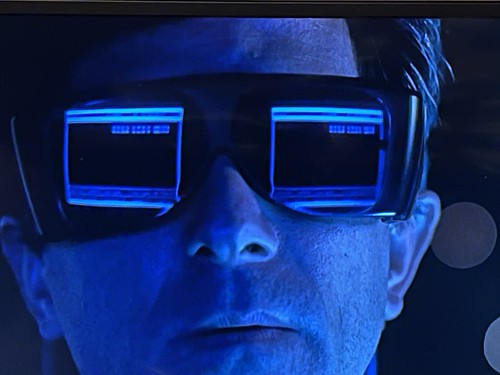
    Keiichi Matsuda took what Apple would call spatial computing to its logical conclusion in this 7 year old film HYPER-REALITY. There are a number of clever aspects to it. Watch when the device reboots in the supermarket and the glyph wearing criminal who escapes identification by the system.

    In reality, hardware will restrict how useable that these products will be. Which is the reason why the Apple Vision Pro looks so cumbersome. More related content here.

    John Glenn

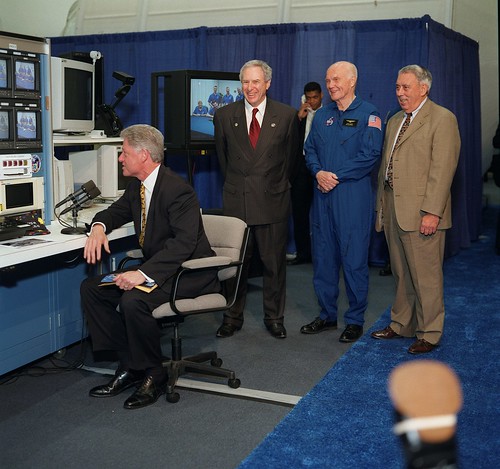
    Great interview with Mercury and Apollo programme astronaut John Glenn covering different aspects of his experience as an astronaut. We hear how astronauts became so involved in the engineering and safety aspects of the Mercury and Apollo programmes.

  • February 2024 newsletter – No.7

    February 2024 newsletter introduction

    Welcome to my February 2024 newsletter which marks my 7th issue. I hope that your year of the dragon is off to a great start.

    Strategic outcomes

    The number 7 is a bit of a mixed bag, depending on how you look at it. In the old testament, the 7th heaven is where God’s throne is, alongside the angels. It had been considered a place of happiness, hence Gwen Guthrie’s Seventh Heaven. In Mandarin, the number is considered generally a positive thing, the number is a homophone for ‘arise’ and ‘life essence’. But that’s only half the story.

    Chinese Ghost Story

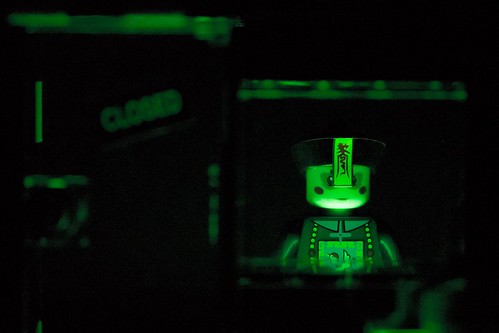
    Indications of 7’s unlucky nature include the seventh month in the lunar calendar being a ‘ghost month’. In Cantonese, it is a homophone for a vulgar way of saying penis. I hope your February wasn’t a dick of a month. 

    For film buffs it’s almost 28 1/2 years since the transgressive crime thriller Seven was released. It was a break out hit and became the seventh highest grossing film of 1995, behind Die Hard with a Vengeance, Toy Story and Apollo 13. It beat out other films like Braveheart in box office earnings, but Braveheart ran away with the Oscars. 

    Let’s hope that feng shui master Michael Chiang is correct in terms of the positive energies from the year of the dragon.

    New reader?

    If this is the first newsletter, welcome! You can find my regular writings here and more about me here

    Things I’ve written.

    • FOOH – and the ethical and marketing challenges it presents with a thought experiment harking back to the golden age of pornography.
    • Technonationalism – how current technological developments mirror the cold war and the 20th century Asian economic miracle.  
    • Innovation signalling – how innovation is used by brands for show, rather than for genuine progress.
    • Pipes by Yahoo – a remarkable web service that also causes us to reflect on the post modern web of today.
    • Hong Kong measurements – how something as simple as measurement units are a melding of culture, history, modernity and politics in a time of change.
    • Y2K was always more than a fashion phase, but it seems to have faded from the zeitgeist which means the fashion takes have no context. Here’s a bit of context for you.

    Books that I have read.

    • What the Taliban Told Me by Ian Fritz. Fritz writes really, really well, otherwise I probably wouldn’t have been able to complete his personal memoir about his upbringing, service in Afghanistan onboard an AC-130 gunship and depression. In some ways it reminded me of Jarhead – Anthony Swofford’s memoirs of his life up to the time of being in the US Marines during the first Gulf War. Swofford’s book came out a decade and a half after his service. Fritz’ book feels much more immediate and without the flashes of humour and beauty that was in Swofford’s book.
    • Leftover Women: The Resurgence of Gender Inequality in China by Leta Hong Fincher. This was originally written in 2016, but has been updated to incorporate changes over subsequent years. It shows how government policy, ethnographic-nationalism, law enforcement, the legal system, collective punishment and community pressure is applied on modern women. I still find the content covering domestic violence shocking. This isn’t the China of Mao where in theory women hold up half the sky, instead it seems to be on a trajectory that would eventually see it closer to Mao’s view of China’s population, or Ceaușescu’s Decree 770 and other associated pro-natalist laws. This is a world away from the equally oppressive one-child policy, which had been brought in to deal with population related problems from the Mao-era.
    • The Big Book of Cyberpunk edited by Jared Shurin. I am huge fan of cyberpunks better known authors: William Gibson, Neal Stephenson and Bruce Sterling. This collection of 100+ stories written by authors from 25 countries is a mixed bag, but that’s no bad thing.

    Things I have been inspired by.

    J Walter Thompson Wunderman Thompson VML Intelligence launched their annual Future 100 report. It’s a great read and its continuity over the years makes it stand apart from the plethora of trends reports that get published every year. Their trends which intersect luxury and health are particularly interesting:

    • Althluxe
    • Bioharmonizing spas
    • Longevity resorts
    • Idyllic idleness

    Author Cory Doctorow’s essay for Locus magazine plays devil’s advocate in considering the future of the crypto-based ecosystem and artificial intelligence is well worth a read. Doctorow speculates on what kind of bubble artificial intelligence is likely to become and the effect that its deflation may have. He draws on the outcomes of tech bubbles in the past including the dot com bubble and the telecoms bubble that accompanied it.

    Just Conecting published a report on what seems to work on LinkedIn. It’s an interesting snapshot of what works at the moment, I am sure things will change over time as the algorithm evolves. Much of the focus seems to be orientated towards personal branding over business brands.

    Over at Japan House, I marvelled at the exhibition Ainu Stories: Contemporary Lives by the Sara River. The Ainu are native to Japan’s northern islands and have survived for millenia in the extreme cold. Historically they were discriminated against, but now there is an appreciation of their culture. The art pieces on display are unique in their design, but share the attention to detail one sees in other Japanese work.

    The Science Museum has an amazing exhibition on: Zimingzhong 凝时聚珍: Clockwork Treasures from China’s Forbidden City. Prior to the opium wars, UK craftsmen created fantastic clockwork-powered creations that were given as gifts to the emperor of China. The exhibition finishes on June 2, 2024. I went during Chinese new year. I came away with a refreshed appreciation of modern watchmaking complications, in particular devices like ‘minute repeaters’.

    NS Lyons magnus opus The China Convergence is read by Regina Doman. Lyons’ premise is that western systems have converged with China’s approach to governance due to the rise of the technocrat. In this respect his perspective is similar to that shared by documentary maker Adam Curtis. Like Curtis, Lyons’ The China Convergence asks uncomfortable questions of us. Are we basically a less extreme version of the same system to the presses of mass and scale?

    While we’re talking China, I can recommend the China Update YouTube account that provides a concise summary of Chinese business news and economic analysis garnered from a wide range of Chinese and western business publications.

    Finally, IPSOS ongoing collection of reports this time reflects on the power of nostalgia. This time focusing on youth culture from cottage-core, Barbie mania, vinyl to vintage technical clothing and streetwear and the underlying drivers behind it. Why Nostalgia Is So ‘Fetch’ Right Now by Samira Brophy is well worth a read.

    2023 Global Trends Report by ACROSS Health is a great census of healthcare professional media preferences and insight into omnichannel communications trends for pharmaceutical marketing. It is good reading and indicates that pharma clients who have an excessive efficiency bias and want to go to digital-only customer journeys will be left behind by peers taking a mixed approach.

    Things I have watched. 

    Agent Hamilton – Carl Gustaf Hamilton is a Swedish answer to James Bond or Jack Ryan. Hamilton was the main character in a series of books written by a former investigative journalist, Jan Guillou, who served time in Sweden for exposing illegal intelligence operations. Guillou wrote the first Hamilton book in 1986 and the last one in 2012.

    Blake and Mortimer – if you’re a fan of TinTin, you’ll like Blake and Mortimer as both come from the French -Belgian comic tradition. This cartoon series is based on the adventures of an eminent Scottish scientist and a British military intelligence officer in mid-century Europe. It’s nice light entertainment and I can recommend the graphic novels as well of which there are now 30+ stories including the Before Blake and Mortimer off-shoots. The authors have also wrote other excellent series like XIII.

    Useful tools.

    Audio Hijack 4.3

    Rogue Amoeba’s Audio Hijack has been a mainstay on my Mac for far more years than I care to mention. It was great for everything from recording conference talks to putting together quick and dirty talk tracks that concepting films can be cut too. Version 4.3 features OpenAI’s Whisper transcription software that can cater to transcribing dozens of languages. I have found it better than tools like Otter.ai for me.

    Krisp

    Krisp.ai is a freemium service providing intelligent noise cancellation, call transcripts and meeting notes all in one. It works with Teams, Google Meetup, Slack and Zoom.

    Obsidian

    Just like Evernote back in the day, Obsidian has become a bit of a cult app for those that find it really useful. At its heart, it is a note taking and writing application. It will sync between desktop and mobile devices, but that costs $8/month – which is expensive. I haven’t been using it beyond a quick trial, as I have a well-defined set of tools that I use and Obsidian didn’t really slot in well. But I can appreciate the value of it to others. One thing I would be leery of, if you are moving to Obsidian is the cottage industry in snake oils salespeople hawking the ‘ultimate’ online course for Obsidian. Instead check out Obsidian’s own community pages of courses.

    Todoist

    Todoist is a shareable to do list that places it somewhere between quick and dirty project management and personal productivity. I am giving it a try following a recommendation from a friend. It’s not about whether products like this are good or not, but usually if it fits into your style of working, so your mileage may vary.

    Personal Update.

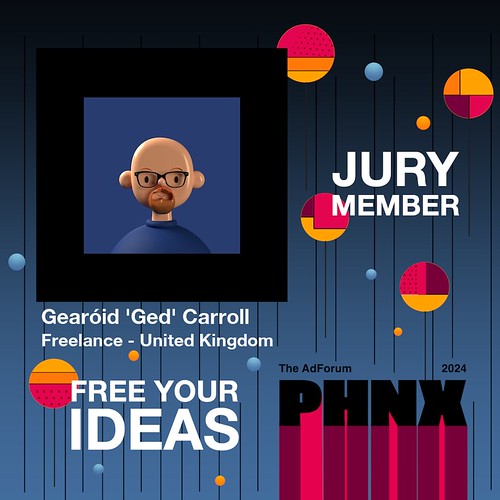
    the adforum phnx 2024 jury badge

    More details on the awards here.

    The sales pitch.

    Now taking bookings for strategic engagements (from the end of April onwards) or discussions on permanent roles. Contact me here.

    More on what I have done to date here.

    bit.ly_gedstrategy

    The End.

    Ok this is the end of my February 2024 newsletter, I hope to see you all back here again in a month. Be excellent to each other.

    Don’t forget to share and subscribe!

    Let me know if you have any recommendations to be featured in forthcoming issues. 

  • Y2K

    Early last year, fashion started to pillage the late 1990s and early 2000s for fashion inspiration, which became a Y2K trend on social platforms and in the fashion media. But this divorced Y2K from its original meaning. Y2K was technologist short hand for a calendar problem in a lot of legacy systems that were designed around a two digit date for years.

    The rise of micro-processors had meant that the world had more computers, but also more computer control of processes from manufacturing to building air conditioning systems.

    The HBO documentary Time Bomb Y2K leaned into the American experience of Y2K in an Adam Curtis type archival view, but without his narrative.

    Millennium layers

    There was so much to unspin from the documentary, beyond the Y2K bug, including the largely alarmist commentary. The run-up to the millennium had so many layers that had nothing to do with Y2K, but were still deeply entwined with anxiety around what might happen with Y2K.

    This included:

    • Internet adoption and more importantly the idea of internet connectedness on culture through the lens of cyberpunk – which in turn influenced the spangliness of fashion around this time and the preference for Oakley mirror shades that looked as if they were part of the wearer. The internet was as much a cultural construct and social object as it was a communications technology. It memed AND then got people online.
    This week
    • Telecommunications deregulation. In the United States the Telecommunications Act of 1996, saw a levelling playing field be set out and allow for new entrants across telecoms networks to television. They also defined ‘information services’ which internet platforms and apps fitted into giving them many freedoms and relatively few responsibilities. You had similar efforts at telecoms deregulation across what was then the EEC. This saw a rise in alternative carriers who then drove telecoms and data commuunications equipment sales, together with a flurry of fibre-optic cables being laid. There was a corresponding construction of data centres and ‘internet hotels‘ to provide data services. With these services came an expectation that the future was being made ‘real’. Which in turn fed into the internet itself as cultural phenomenon. The provision of new data centres, opportunities for computer-to-computer electronic data interchange (EDI) and services that can be delivered using a browser as interface also drove a massive change in business computing.
    s98_05016
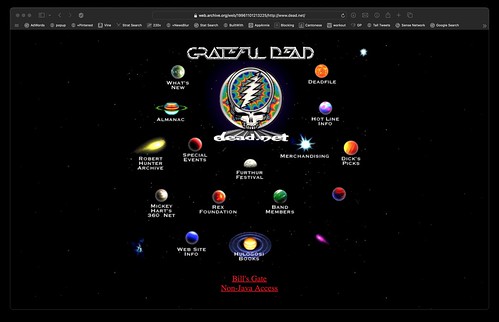
    • An echo boom of the hippy back to the land movement, many of the people involved in that movement were early netizens. Hippy favourites The Grateful Dead had been online since at least 1996 and were pioneers in the field of e-commerce. The Whole Earth ‘Lectronic Link (or The WeLL) had founders from hippy bible The Whole Earth Catalog. There was also a strong connection through Stewart Brand to Wired magazine. Long time ‘Dead lyricist Jon Perry Barlow created a Declaration of the Independence of Cyberspace – a libertarian totem for netizens up to the rise of social media platforms like Facebook.
    Dead.net circa 1996
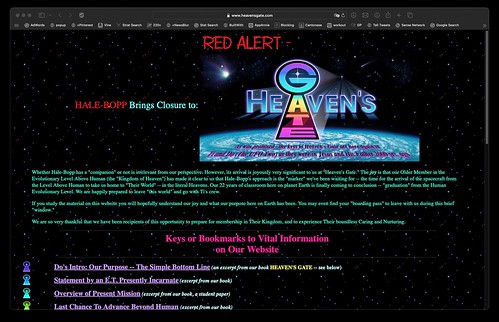
    Heaven's Gate's final home page update

    The confluence of noise around Y2K drove some anxiety and a lot of media chatter.

    Advertisers did their bit to fuel insecurities as well.

    However by October 1999, American consumers who responded to a poll by the Gallup Organisation were pretty confident that glitches would be unlikely

    • 55% considered it unlikely ATMs would fail.
    • 59% believed direct deposit processing wouldn’t be a problem.
    • 60% said they felt that temporary loss of access to cash was unlikely.
    • 60% believed credit-card systems were unlikely to fail.
    • 66% felt that problems with check processing were unlikely.
    • 70% had received Y2K-readiness information from their banks.
    • 90% were confident their bank was ready for Y2K.
    • 39% said they would definitely or probably keep extra cash on hand.
    Y2K: More Signs of the Time | Computerworld (January 10, 2000)

    Experts had felt that the Y2K challenge had largely been beat, but some prudent advice was given. I worked for a number of technology clients at the time including telecoms provider Ericsson and enterprise software company SSA Global Technologies. I had to keep my cellphone with me in case anything went wrong and we would have to go into crisis mode for our clients. Needless to say, I wasn’t disturbed during my night out at Cream by THAT call.

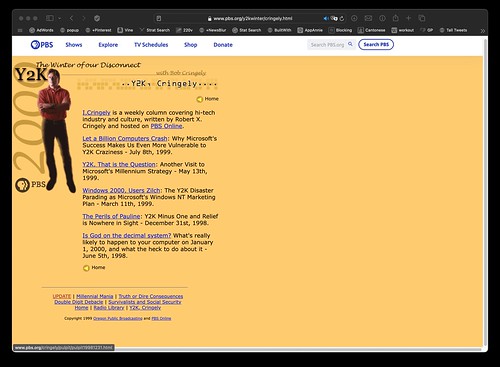
    Technology experts like Robert X. Cringely were rolled out to advise consumers on prudent precautions. Have a bit of cash in your wallet in the unlikely event that card merchant services don’t work at your local shop. Have some provisions in that dont need refrigeration in case there is a power cut. And a battery or solar powered radio just in case.

    All of these are still eminently sensible precautions for modern-day living.

    y2k Cringely

    Why were we ok?

    The warning

    There were several people who voiced warnings during the 1990s. Some of the most prominent were Ed Yourdon and Peter de Jager.

    Risk management

    During the 1990s company auditors were informing boards that they had to address Y2K. Failure to follow this would affect their ability to trade. Their public accounts wouldn’t be signed off and there would be implications for the validity the insurance policies need to run a business.

    Approaches

    IT professionals took Y2K very seriously, which meant that there was little to no impact. Some academics such as UCL’s Anthony Finkelstein posited that the problem was taken too seriously, though it is easier to say that in retrospect. There were a number of approaches taken to combat the risk of failure due to Y2K. In order of least to most ambitious they were:

    • Systems testing
    • Rip and replace
    • Recode

    Systems testing

    The Russian military had tested their systems for vulnerability to the millennium bug and announced this in the last quarter of 1999. Meanwhile businesses were often passing the testing out to contractors like Accenture with teams based in India, the former Soviet Union or the Philippines. There was a thriving market for auditing software to check if applications used two-digit dates or not. One of these was Peregrine Systems ServiceCenter 2000 Y2K Crisis Management software.

    Testing highlighted problems at Oak Ridge Laboratories who process American nuclear weapons, the alarm systems at Japanese nuclear power stations and some kidney dialysis machines.

    Problems would then be addressed by ripping and replacing the systems or recoding the software.

    Rip and replace

    Apple used Y2K as a sales tool to get Macs into businesses, including this campaign from early 1999 where the HAL computer from 2001: A Space Odyssey featured in Apple’s Super Bowl advert.

    Two years earlier IBM CEO had the company re-orientate an offering that he called e-business. There was snazzy advertising campaigns ran over an eight year period.

    Mainframes and high powered UNIX workstations became internet servers running multiple instances of Linux. IBM Consulting learned as they went building the likes of internet retailer Boxman (which would go bust due to IBM’s cack-handed software and the rise of Amazon).

    Timely replacement of business systems with e-business systems, paired with new personal computers like the latest Apple Mac allowed the firm to avoid Y2K and make speedier approaches in digitising their businesses.

    German enterprise software company SAP launched SAP Business Connector in association with webMethods in 1999, this provided an integration and migration layer for SAP and other business software applications. It also allowed the business software to be accessed using a web browser and for it to trigger business processes like email updates.

    Articles (like Robertson & Powell) highlighted the wider business process benefits that could be generated as part of a move to rip-and-replace existing systems with ones that are Y2K compliant. Reducing the amount of systems in place through rationalisation as part of Y2K preparation would then provide benefits in terms of training and expertise required.

    Recode

    Where rip and replace wasn’t an option due to cost, complexity or mission criticality recoding was looked at as an approach. For PC networks there were a few off the shelf packages to deal with low level BIOS issues

    IntelliFIX 2000 by Intelliquis International, Inc. Their product would check hardware, DOS operating system, and software. This version was free and ran a pass/fail test. The full version, which could be purchased for $79, would report the issues and permanently correct date problems with the BIOS and the CMOS real-time clock. In 1999, Stewart Cheifet of the Computer Chronicles rated the product as a very good all-in-one solution for hardware and software.

    National Museum of American History: Y2K collection

    Products similar to IntelliFIX included Catch/21 by TSR Inc.

    Longtime software makers like Computer Associates and IBM provided large companies with tools to audit their existing code base and repair them. IBM’s software charged $1.25 per line inspected. OpenText estimate that there 800 billion lines of COBOL language code out there. So having one of these tools could be very lucrative at the time.

    You might have mainframe code on a system that might not have been altered since the 1970s or earlier. Programmers in the developed world who had skills in legacy languages were looking at the end of their career as more of this work had been outsourced to Indian software factories saw Y2K as a last hurrah.

    COBOL is still very robust and runs business processes very fast, so is maintained around the world today.

    Y2K impact

    Professor Martyn Thomas in a keynote speech given in 2017 documented a number of errors that occurred. From credit card reading failures and process shut downs to of false positive medical test results across the world. But by and large the world carried on as normal.

    Academic research (Anderson, Banker et al) suggests that the most entrepreneurially competitive companies leaned hard into the Y2K focus on IT and used the resources spent to transform their IT infrastructure and software. Garcia and Wingender showed that these competitive returns were shown to provide a benefit to publicly listed company stock prices at the time.

    There were also some allegations that software companies and consultants over-egged the risks. Hindsight provides 20:20 vision.

    IT spending dropped dramatically during 2001 and 2002, and by the middle of 2003 technology started to see replacement of software and equipment bought to address Y2K. But the US department of commerce claimed that was no more than a transient effect on economic growth. This was supported by the Kliesen paper in 2003, which posited that the boom and subsequent economic bust was not as a result of Y2K preparation.

    More information

    Like It or Not, Gaudy Y2K Style Is Roaring Back | Vogue

    These Celebrity Y2K Outfits Weirdly Look Like They’re From 2023 | InStyle magazine

    20 Years Later, the Y2K Bug Seems Like a Joke—Because Those Behind the Scenes Took It Seriously | Time magazine (December 30, 2019)

    National Museum of American History – Y2K collection

    Y2K: a retrospective view by Anthony Finkelstein (PDF)

    Y2K: Myth or Reality? Luis Garcia-Feijóo and John R. Wingender, Jr.
    Quarterly Journal of Business and Economics (Summer 2007)

    Replacing Y2K technology boosts spending | The Record (July 28, 2003)

    Y2K spending by entrepreneurial firms by Mark C. Anderson, Rajiv D. Banker, Ram Natarajan, Sury Ravindran US: Journal of Accounting and Public Policy (December 2001)

    Exploiting the benefits of Y2K preparation by Stewart Robertson and Philip Powell (September 1999) Communications of ACM

    Was Y2K Behind the Business Investment Boom and Bust? Kevin L. Kliesen

    What Really Happened in Y2K? Professor Martyn Thomas (April 4, 2017) (PDF)