I have been listening to this mix of Princes music. Prince had a diverse song book and the mix covers Princes music catalogue in some depth. It gives a great sampling of the talent we lost when Prince died
YouTube has a cornucopia of content including this great documentary on house music interviewing a succession of insiders to tell the story of how house music became a global phenomena.
Spoon + Tamago had an article about how public baths in Japan were providing online videos for the locked-down customers. Whilst one might not be able to enjoy a good soak, they can enjoy at least some of the ambience. It rather reminded me of the slow TV programming that Norwegian channel NRK, (if you get a chance to watch them, they are remarkably soothing). More on Japanese related topics here.
A quick film on the Hyman Archive of magazines. Reputedly the world’s largest collection of magazines according to the Guinness Book of Records. It is more important as a source of cultural insight over time. I do feel that something is lost in the digitising of the archive. Vogue Italia or Japan isn’t only about the pictures but the overall heft and feeling that you have holding the magazine. Digitisation only gets you so far.
A good presentation to listen to on emerging marketing trends. It calls BS on crypto. I’d have been a bit more skeptical on digital and marketing effectiveness. Terence Kawaja and Geoff Ramsey of eMarketer provides some great data points to back up their opinions on emerging marketing trends. It is refreshing to hear them shred crypto. Their approach to trends is very sensible. I always think about Robert X Cringely’s discussion of trends in terms of surfing. That if you go too early you fail to catch the wave.
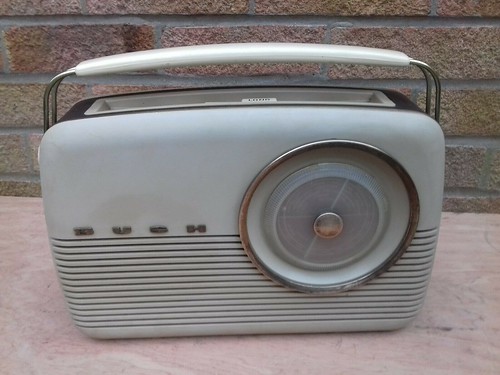
Whilst you might not know the Bush TR 82, if you were from western Europe you’ll recognise its style immediately.
Post-war Britain
In the post-war era Bush Radio Limited tried to fill consumers demands for entertainment.
There were radios that would sit on a sideboard and would have the presence of a TV set. Many of these have fitted out with Bluetooth to create a better sounding sound system. It certainly sounds better than an Amazon Echo. My parents inherited one of these, a Bush VHT 61, which served them well for many years.
There was also radiograms, which is were a cross between a sideboard and a hifi system.
The secret of their warm sound was valve circuits. Before chips with millions of components, were transistors. And before transistors were delicate lightbulb-like valves.
Bush TR 82
David Ogle’s iconic design
Over time manufacturers like Bush managed to make valves small enough to make portable devices. In 1957 the Bush MB60 was launched. This was a portable valve radio designed by David Ogle of Ogle Design. The MB60 didn’t last as even minature valve radios were power hungry and delicate. But David Ogle’s case design lived on.
TR 82
Ogle’s product design was mated to a seven transistor circuit to create the TR 82.The TR 82 was big enough to have a decent sound and small enough to be portable. Alkaline batteries like Duracell were only starting to reach the market about the same same as the TR 82. So a high powered long lasting battery would be a 9 volt lantern style battery. This meant that you got months of use out of one battery, but each battery was expensive. (Similar batteries were still commonly used up until recently in the flashing lanterns used to mark road works currently in progress).
The TR 82 received long wave and medium wave so didn’t need an external aerial. VHF or FM radio wasn’t popular yet. In common with cars from the 1950s the Bush TR 82 had chrome plated brightwork. This was around the front panel around the edge of the circular reception dial. Despite this ornamentation you ended up with a very intuitive radio design, with a simplicity that Dieter Rams would appreciate. There was a large tuning wheel on the front of the radio.
On top, there were two rotating controls:
Volume
A combined tone and on / off switch
Selection between medium wave and long wave reception was done with two large buttons.
The handle ran the length of the case and swivelled at the points at which it was secured. This provided even easier access to the top controls of the radio.
The rear cover was removed by a single central screw. This could be undone with a edge of a coin. Inside the case was a battery compartment at the bottom. The rest of the radio was held on a metal subframe. This rigidity was essential for the tuning mechanism to work seamlessly and for the speaker to provide a good sound.
My personal memories of the TR 82
My own personal memories of a well-used and obsolete Bush TR 82 stem from my time on the family farm in Ireland. The radio lived in the kitchen and provided news at lunch and dinner time. It was also turned on to listen to the latest livestock market prices. This would then affect if, or when livestock and wool were sent to market. It provided live music on a Saturday evening. In essence, it filled many of the tasks that an internet enabled PC would do – if my Uncle and Grandmother had been online.
Radio was the primary media. Ireland had been an early adopter of radio, but a relative latecomer to television. So even into the early 1980s the radio had a pre-eminence in consumer behaviour that was only slowly eroded by the TV.
Television was something only broadcast from after lunch until late evening, apart from the weekends. When the second TV channel launched it only during the evening. By comparison at the time radio broadcast from before 6am in the morning until shutdown just after midnight.
TR 82 and the rise of Sony
The timing of the Bush TR 82 was a high point. The same year Tokyo Tsuskin Kogyo launched the first pocket sized transistor radio – the TR-63. It was the first ‘Sony’ product to be sold in the US. Sony was originally a product line brand for their nascent transistor radio busness. The product was so successful that the founders changed their company name to Sony Corporation. This idea of portable pocket entertainment begat personal stereos, iPods and the smartphone. (You can find more on Sony here.)
By comparison the TR 82 marked the point for Bush Radio as well. Bush Radio had been acquired by Rank in 1945. In 1962, the company was merged with Murphy Radio as Rank Bush Murphy. This was sold to Great Universal Stores in 1978. In 1986, the Bush name was sold to the Alba Group. In 2008 the former Alba Group sold the name for use outside Australasia on to Home Retail Group. Sainsburys acquired Home Retail Group in 2016.
But the iconic Bush TR 82 shape lived on, in more modern, yet poorer quality replicas. Most noticeably the Bush TR 82 DAB which had digital radio, FM, medium wave and long wave. Unfortunately the modern radio didn’t feature the same quality of speaker or internal frame. This meant that the sound suffered from lower power and a muddy sound caused by vibrations in the case. A brief feature on the Bush TR82 by the BBC and the British Museum here.
lifeintaiwan have gone into the economics of YouTube by looking at their own channel in this video. It makes fascinating viewing and provides more questions than answers about the value of ‘influencer’ fees being paid in travel, beauty and FMCG sectors. It will provide additional grist on the economics of YouTube moving forwards
The nth room sex scandal is a mix of dark web fears played out within a private Telegram channel. Some great explanations and vox pops interviews in Korea by Asian Boss. This scandal falls on the back of other sexual exploitation scandals in the Korean media, notably around the Burning Sun club in Seoul. It is also interesting how Telegram had been perceived as a super-safe channel for delivery of services, rather than building a dark web site. More Korea related posts here.
Asian Boss vox pop interviews with the Korean public on the nth room sex abuse scandal
Mark Ritson talks about marketing in the midst of a recession. If you do nothing else this week, get a CMO you know to watch it. The big thing to take away is the concept of eSOV. Although Ritson doesn’t mention this explicitly, this is the foundation of Proctor & Gamble’s success during the Great Depression.
The history of Marriott carpet camouflage. Uniform History do some interesting design story videos and their April’s Fools videos tap into odd but true stories. Apparently this camouflage was for cosplay conventions in the US. The video then goes into a tangled mess of intellectual property, fair use, parody and cultural appropriation of a carpet. The thing has taken a life of its own. When Marriott refreshed its carpet choice the old ones were dumpster dived or bought up by cosplayers so that they could continue the convention tradition that had build up over a few years.
HNA in chaos as internal divisions erupt in public | Financial Times – One investor who sought to buy a large real estate portfolio from HNA in late 2018 said that the deal fell through because it was no longer clear who was in control of the assets – this is interesting when you start about thinking allegations of all Chinese businesses (like Huawei) essentially being state-directed businesses. Especially when you consider it in the context
What really happens to the clothes you donate | Macleans – interesting complex supply chain for fibres and nothing. Also interesting how grading of garments stayed within the Asian diaspora formerly based in the British colonies of East Africa
I didn’t mean to write a post about ruining Oxygene by Jean-Michel Jarre. Instead I had hoped to write a post about the joy of having got my hands on one of Sony’s legendary D-Z555 Discman. That post will have to wait for another time.
Oxygene shot by luna715
I had a 1980s vintage CD of Oxygene. Moving to Hong Kong had seen it go along with a lot of my other belongings. I had wanted to listen to it to hear the quality of the D-Z555. I got a new copy from Amazon. The Oxygene I remembered has highs and lows. It makes use of stereo spacing to move its sweeping sound around you. I paired it with a modern pair of Sony in-ear monitors (MDR-EX800ST) with custom Snugs ear moulds.
This is wasn’t the Oxygene that I’d previously heard. The first thing that I noticed was the that the constant peak across frequencies on the on-board display. Then it stayed loud, when it doesn’t go quiet. So loud it made the hair stand up at the back of my neck and became uncomfortable to continue listening.
I took the CD out and played E2 – E4 by Manuel Göttsching. But this sounded glorious and the onboard display was more what I expected. The highs, the lows. The space that allows all the instruments room to shine.
Tried a new copy of Jean Michel Jarre’s album Magnetic Fields and had a similarly uncomfortable listening experience.
So I went back to the Oxygene CD case. In the small writing it said that the album had been digitally remastered from the original analogue tapes. The same remastering company had also done the Magnetic Fields CD as well.
This remastering process has been what was ruining Oxygene for me. Looking at reviews around the web, it was obvious that this process had been unpopular. Looking at the prices of Oxygene and Magnetics Fields CDs on Discogs showed that there was premium price on the original CD versions. This wasn’t just about rarity. Like Dire Straits and Sade albums, these were commonplace in CD collections.
I delved into reading about the loudness war. I was aware of the loudness war and the effect that it had on pop music. But Jean Michel Jarre isn’t really radio play material. (Although Magnetics Fields had been used as a signature track for an Egyptian numbers station* in the past. His albums whilst popular are slow steady sellers.
A lot of the music that I listen to didn’t need high dynamic range compression. I knew that sampled instruments and digitally synthesised instruments are naturally more compressed, lacking the peak transients of live performances. My friend Joe used to record dance music before building a property empire. His uncle was a long-time musician (ex-Mission, Pulp and Artery) who then left to record electronic music in New Mexico. I vicariously got some of my studio recording knowledge from him through Joe.
Overall I hadn’t really been exposed to large amounts of high dynamic compression in music before. This practice of making loud music. This had started in earnest in the 1990s as digital signal processing put more tools in the hands of the mastering engineers.
Historically compression techniques had been used creatively. Motown frequently pushed the limits of vinyl recordings, particularly 7 inch singles.
Motown was notorious for cutting some of the hottest 45s in the industry
Digital signal processing seems to have led to a dramatic acceleration in this evolution
There’s a 12 to 14dB apparent loudness difference between Black Sabbath, produced in 1977 or so and transferred to compact disc in the early ’80s, and the Black Eyed Peas’ ‘Let’s Get It Started.
Both quotes were from an article written in 2005 and things seem to have got only worse. The reasons for this are myriad:
In-car listening and iPods were considered to blame. But the level of compression is far beyond that
The decline of consumers actively listening to music, using it as audio background
Inexperienced engineers who don’t know what good sounds like
Inexperienced artists think that overly compressed masters sound better
Whilst record label A&R people were considered partly responsible for loud mixes on vinyl singles. By 2005, record labels weren’t considered to be pressuring mastering engineers for louder mixes.
Ruining Oxygene seems to have occurred a few years later as streaming services built up steam. I remember how Yahoo! Music used to master their streams when I worked for Yahoo! Europe. They were ripped straight from CD on a desktop HP computer by whoever had time in the music team.
All of my research into the process of ruining Oxygene seems to have been a vicious circle. Various pressures on compression lowered the bar on what was good and that went through several cycles.
The morals contained the story for music listeners are
Progress doesn’t mean better
We have lost something with the move away from actively listening to music
*Numbers stations are a rabbit hole that you can descend into on the internet. So rather than having to go there, here’s a potted explanation. Countries would have spies embedded abroad, often for years at a time. In order to give them instructions or information, it would be preferable to do it in a manner that didn’t involve directly interacting with the agent. Shortwave radio filled this breach. The signals carry over huge distances. The messages would be concealed in numbers, often read out using speech synthesis – which gives them an other worldly feel.