Interesting session with Marginal Revolution’s Tyler Cowen at the OECD. Tyler Cowen is an economics professor at George Washington University, author, blogger and media commentator. In this discussion Cowen addresses the challenge of Huawei and big tech. Cowen is broadly pro big business, anti-small business and pro big tech in his outlook.
In his discussion in terms of big technology Tyler Cowen has an interesting position, though not something I would agree with. As it doesn’t allow for startups coming through in a winner-takes-all environment. Working agency side for clients as the dot com boom took off, you could see the impact of ‘Microsoft fear’ as it was shed in Silicon Valley. For instance, Yahoo! went out of their way to call themselves a media company rather than a technology company. Supporting big tech means supporting ‘just good enough’ bundled services, rather than a better product. It also reflects a very American-centric viewpoint.
Cowen is very concerned about biometric recognition (facial recognition, finger print analysis and gait analysis). He doesn’t realise that his concerns are at odds with his neo liberal pro-
Tyler Cowen is also very concerned about the dominance of Huawei in 5G network rollout. Whilst I understand his position, it lacks a certain amount of nuance in understanding network rollout and Huawei’s place in the networks (at least in western countries). It is also at odds with his general pro big tech stance.
An interesting nugget from interviews that Cowen has done (in promotion of his books) newspaper journalists were upset about Facebook, all radio journalists are anti-Amazon.
Tyler Cowen’s comments on trust are interesting. The key thrust is that online has allowed elites and their faults to be more available online.
It is well worth giving this a listen over a lunch hour (its 77 minutes long). More from Tyler here. More economics related content here.
Daring Fireball: Apple Removes HKmap.live From App Store – I still haven’t seen which local laws it violates, other than the unwritten law of pissing off Beijing. This is a bad look for Apple, if you think capitulation is a bad look.
The Nike of China Wants to Go Global and Has Xi in Its Corner – Bloomberg – Anta seems better positioned to challenge the Western sporting apparel giants because it’s building a family of brands with reach far beyond China. He says the company has been bolstered by its recent $5.2 billion acquisition of Finland’s Amer Sports Oyj, parent of ski brands Armada, Atomic, and Salomon, as well as high-end outdoor gear company Arc’teryx and equipment company Wilson. “Anta is heading towards the Winter Olympics in much better shape than Li-Ning was in 2008,” Martin says. “With the winter and outdoor sports brands, it’s very relevant. Anta’s already in a better position to leverage the sponsorship.” – (paywall) – interesting article. What isn’t discussed is that Salomon and Arcteryx are key providers to western militaries including special forces units. Arcteryx’s LEAF outfits have a lot of material and design innovations that have aided operators. This is a very real security risk that hasn’t been addressed at all. Buying Salomon and Arcteryx provides Anta with a bumper issue of technology and innovative design
Terminus 2049 | NBA events and national madness – sane Chinese thoughts on the NBA debacle, fascinating read which provides insight into the conundrum of correlation between Chinese national fragility / sensitivity and Chinese power
On-Board ‘Mystery Boxes’ Threaten Global Shipping Vessels | Threatpost – Commercial shipping environments are rife with vulnerabilities, according to researchers – up to and including unpatched “mystery boxes” that no one knows anything about. “In every single [nautical pen] test to date we have unearthed a system or device, that of the few crew that were aware, no one could tell us what it is was for,” said Andrew Tierney, researcher with Pen Test Partners – given the importance of logistics in the global economy this should be frightening. That sounds like a bumper issue of security faults…
Huawei’s 5G Tech Isn’t Worth the Risk – Huawei may assert that it has already taken an unbeatable lead in 5G infrastructure, judging who’s truly ahead in the field means looking at multiple criteria. Such indicators can include commercial contracts, deployed performance, integration with network infrastructure, and real technological innovation. For example, Huawei has claimed that it has more 5G patents than all U.S. companies combined, but quantity does not necessarily correlate with quality—especially in China, where patents are often of dubious value. – Interesting article, it burns Huawei in a different and probably more damaging way if it gained traction
China fact of the day | Marginal Revolution – Starting with the Opium Wars in the 19th century, foreign powers bullied a weak and backward China into turning Hong Kong and Macau into European colonies. Students must memorize the unequal treaties the Qing dynasty signed during that period. There’s even a name for it: “national humiliation education.”
What luxury brands can learn from Golden Week 2019 | Marketing | Campaign Asia – the silver generation has gone on to become the driving force behind holiday consumption. According to data from Alibaba, this demographic is now tech-savvy and will order food delivery, book travel packages online, and purchase high-end skincare and health packages from their phones. As much as luxury brands focus on millennials and Gen-Z, they shouldn’t ignore Chinese seniors, many of whom are retirees willing to splurge on luxury goods and go on luxury holidays. According to a study by the China-Britain Business Council, Chinese seniors who are 60 or older have set aside an average of 15 percent of their annual income for travel.
ADMAP | June 2019 | Tim Doherty on how China is finding its voice – YouTube – Chinese using voice interfaces for entertainment and surf the web, 77% use of voice on smartphones. I wonder how much of this is voice messages on WeChat rather than Siri type interactions? Interesting how strong government support has bolstered voice technology
Handbag Market Dynamics Have Changed | NPD – Today’s consumer is looking for a solution, not just a bag. Consumers expect a lot from the products they are buying, from function and versatility to a brand’s engagement in the social and environmental issues that matter to them, and the luxury market is not immune to these pressures
Here’s How the UK Avoided A “Vape Lung” Epidemic – “I think the difference between the U.K. and the U.S. are due to the American propensity to turn health issues into moral crusades,” University of Louisville doctor and tobacco addiction expert Brad Rodu told Vice. “It appears that policymakers in the U.S. are either completely ignorant of the history of tobacco, or completely ignore it.”
LinkedIn Adds Tools to Help Marketers Sharpen Their Campaign Targeting – Adweek – another Matt Muir zinger: The ability to create targets using Boolean parameters is quite a nice touch (if that sentence fragment meant nothing whatsoever to you then know that I am so, so jealous of your innocence), as is the live view of the exact demographic breakdown of your target audience as you set your ads up (so, for example, you can see what percentage of the overall X,000,000 people you could potentially reach are senior managers, what percentage janitors, etc). Really rather useful, although it doesn’t stop LinkedIn from being a miserable, awful place where joy goes to die
Facebook’s Workplace hits 3M paying users, launches Portal app in a wider push for video | TechCrunch – I’ll leave you with Matt Muir’s critique: – 3million paying users is a lot for a product which, whenever I’ve seen it in use, doesn’t appear to actually fulfil any practical purpose whatsoever other than giving HR another channel through which to spout platitudes about cake-based fundraising initiatives and what’s on the canteen menu today. Still, some people obviously like it (ha! Joke! Noone ‘likes’ this stuff; at best, one tolerates it while one waits for the sweet release of death), and should you be one of said people then you will be THRILLED to hear of a few exciting updates to the service. “Workplace is announcing several steps of its own into video. It’s releasing a special app that can be used on the Portal, Facebook’s video screen; and alongside that, it’s announcing new video features: captioning at the bottom of videos; auto-translating starting with 14 languages; and a new P2P architecture that will speed up video transmission for those who might be watching videos on Workplace in places where bandwidth is constrained.” Oh, and there will be a bunch of new materials and tools available to help the aforementioned HR people to get people to actually use the service, as well as METRICS and ANALYTICS and OTHER STUFF. Lucky, lucky us.
How NBA crisis brings US-China tension into American living rooms – Inkstone – “What used to be the gap between the hard consensus on China in Washington and the ambivalence or bias toward a positive perspective on the street, that gap is closing,” said Jude Blanchette, chair in China studies at the Center for Strategic and International Studies in Washington
Facebook to Pay $40M in Proposed Settlement in Video Metrics Suit | Hollywood Reporter – According to a brief in support of the settlement, Facebook would pay $40 million to resolve claims. Much of that would go to those who purchased ad time in videos, though $12 million — or 30 percent of the settlement fund — is earmarked for plaintiffs’ attorneys. The suit accused Facebook of acknowledging miscalculations in metrics upon press reports, but still not taking responsibility for the breadth of the problem. “The average viewership metrics were not inflated by only 60%-80%; they were inflated by some 150 to 900%,” stated an amended complaint.
That’s the end of this bumper issue of links. Watch out for the next bumper issue that is likely to be equally diverse in nature
Section 4’s Scott Galloway on Louis Vuitton. Professor Scott Galloway talks about the way Louis Vuitton has re-engineered its business to handle the modern luxury consumer consumer’s needs and tastes.
Modern consumers are younger and based in Asia rather than the traditional older luxury purchasers in Europe and the US. This has meant that digital became more important, as had casual luxury over formal luxury.
All of that innovation was extended by Louis Vuitton with streetwear type drops rather than seasons. Shops are a brand experience in their own right. Including online games and pop-up Instagrammable stores. They focused on products that can be driven into the market faster with an agile supply chain.
Casual styling allows you to go to smaller goods with a lower price point and replaceable more often.
The line between streetwear and luxury has been blurred. More on luxury related issues here.
A great mix of the hits of European disco producer Daniel Bangalter (Vangarde). Daniel Bangalter started with a husband and wife team, writing and producing their songs. Around this time, he partnered up with Jean Kluger. Their first project was a pseudo Japanese band called the Yamasuki Singers. It was the early 1970s and a bit strange. Kluger and Bangalter then went on to produce Ottowan including D.I.S.C.O. They also produced the Gibson Brothers song Cuba. You can hear the influence of his sound (and probably at least some of his studio equipment) in the Daft Punk sound.
Daft Punk includes his son Thomas Bangalter. Apparently Daniel helped Daft Punk when they were starting out.
Mark Ritson on 50 years of Effies. Some of the content is as worth watching as listening to Ritson’s commentary.
Scott Galloway on online business. Some interesting points here
Fabio Wibmer does to the Austrian city of Wien (Vienna) what Bullit did to San Francisco.
Apple designed in California and sold in China. Is it now Apple souled out to China? Apple is often cited as being a technology brand with a purpose and profiitable. It is unique in mobile phones, computers, tablets and set top boxes. It has a throw back model to the pre-Windows age of computing. It is vertically integrated.
They make key software for their computer. They make the hardware. And in the case of every device except the Mac, they make the key components. It does all this without owning the means of production.
Apple doesn’t own its factories. It owns some of the machines in assembly plants. But if a legal dispute broke out, it would struggle to get those machines out of a partner factory. It’s production volumes are so vast; this puts a further constraint on partner choice. Apple’s electronic components are made around the world:
Germany
Japan
Korea
Taiwan
China
USA
The device chassis, battery and assembly happens in China.
In software, Apple is reliant on two types of partners:
The open source community. iOS, macOS, watchOS and tvOS are all built on open source software. Apple takes them building blocks and innovates on top of them
The Apple developer community. Apple’s computers are nothing without software. On the iPhone about half the game developers are China based
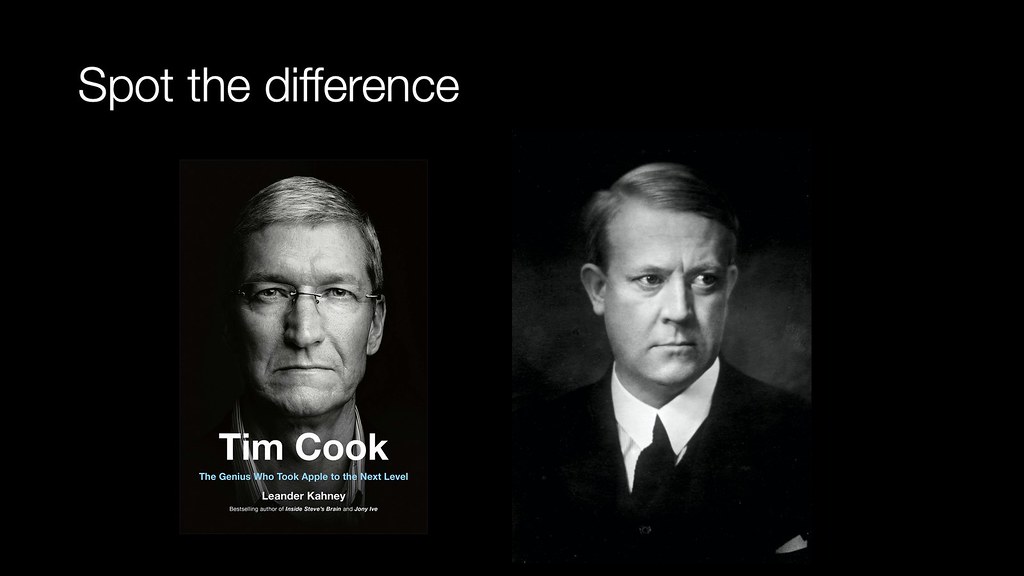
The Apple difference
Their differentiator for the first thirty years or so was computing for non-technologists. Over time this has been articulated as:
Computing for the rest of us. Computers with expert product design that made them friendly in consumer eyes. This was to try and portray computing as an appliance or piece of consumer electronics. Brands as diverse as Sony and Cuisinart cited as inspiration. Critics of the Mac interpreted this focus on product design to call it a toy. They didn’t think that it represented ‘serious’ computing
https://youtu.be/C8jSzLAJn6k
Think different. Apple needed to keep a fraying customer base together. They came up with the brand anthem that highlighted the diverse range of users. This ranged from technologists and scientists to artists and creatives
https://youtu.be/cFEarBzelBs
It just works. It just works was initially used as a way to describe the intuitive Mac interface. My key attraction to the Mac was discovering thoughtful design at every aspect of the software. Even now, once you learn a keyboard short cut it works consistently in all software. In contrast, Ctrl + Q on Windows is inconsistent between some Microsoft apps
Apple extended this process from the iMac onwards, making it easier to:
Get online. The modem was in the iMac’s case. You plugged your phone line into the computer. You plugged the computer in and followed the software instructions. Apple even carefully curated high quality dial-up ISPs (internet service providers)
Set your email up
Get your address book on to your phone – something that became even easier with the iPhone
Get your music on to your phone or iPod
https://youtu.be/rnzCnPSQM7c
The pivot to privacy started back in 2003 with the launch of FileVault. It makes it easy to encrypt a hard drive partition, CD ROM or USB key. This was to help the Mac find acceptability within business. It also benefited consumers. Eight years later Apple launches the iMessage service which encrypts text, image and video messages by default. It also launched FaceTime video calling with encryption. Two years later, Apple builds Secure Enclave into the iPhone; encrypting the entire device. Over time, the technology moved from being business friendly, to consumer differentiator. It gave Apple clear separation from Google and Facebook. Privacy fitted into a Cook narrative about a company that promoted social good. This was part of the move to a post-Jobs Apple. One that thought social purpose was more than addressing the education market with high quality products. Tim Cook and Apple stood up for American civil rights and progressive ideals.
Concepts that in retrospect look rather naive when going into China.
Compromises in China
Apple has already given over control and cryptographic keys of its services in China. Apple users in China do not enjoy the kind of privacy and security protections of users elsewhere. Apple has not gone to the mats on behalf of users. Apple’s service offering has been severely restricted. Apple’s book offering had to be withdrawn. The app store is without whole categories of applications. Apple Music has a much reduced catalogue due to censorship. Check out Six times Apple gave in to China | Abacus for more information.
Compromises to China
The protests in Hong Kong shone a light on corporate kowtowing that has been going on for years. HKMap Live is similar to map / data mashups done for other protest movements. It plotted crowd sourced reports of police on a map.
The data offered is not granular in nature. It might give you a pointer if you commute is going to pop-up in the middle of tear gas and baton rounds.
This means that Tim Cook was gullible, or compromised when he made the following false statement about HKMap.live
“…we received credible information, from the Hong Kong Cybersecurity and Technology Crime Bureau, as well as from users in Hong Kong, that the app was being used maliciously to target individual officers for violence and to victimize individuals and property where no police are present.”
The problem is no one has come out and said in public what these instances were. Apple hasn’t provided any supporting evidence. One could guess that Apple’s calculus was that people can still use Safari to access the HKMap.live site.
But this comes on the back of Apple removing the Taiwan emoji from all iPhones using Chinese language input. That affects:
Chinese
Hong Kongers
Macau residents
Tim Cook has gone from progressive corporate citizen to Tolkein’s Gríma (Wormtongue). So what’s Apple’s pay-off?
Apple’s prospects in China
You could argue that Apple’s best days are behind it in China. WeChat has effectively built a smartphone OS inside its application. This has meant that the iPhone’s differientators and real world performance compared to Android are moot.
Tablets are less relevant due to Chinese preference for large smartphones.
Apple TV is crowded out of the market by Tencent content deals.
The Mac is a niche product that Apple is likely to maintain
In the face of a changing political environment and rising Han nationalism; Apple is in decline. It’s a question of how fast, which means that Apple feels obliged to placate a mercurial Chinese state.
Apple’s prospects on Capitol Hill
Big technology companies under the magnifying glass by lawmakers. Apple doesn’t have the issues that Facebook has. But it did develop most of the tax avoidance measures now used by Facebook, Google and Amazon. And the one thing both Republicans and Democrats can agree on is that China is a bad actor that needs to be confronted. Apple sits nice at the intersection of these two issues. Tim Cook took a high risk gamble positioning Apple in political crosshairs – in the run up to an election. I guess like Mark Zuckerberg, Tim Cook is hoping Elizabeth Warren doesn’t get in.
This also offers other technology companies a unique proposition. Their lobbyists could throw Apple under the regulatory bus for commercial advantage. Amazon’s lobbyists managed to blunt the threat of Apple Books to the Kindle book store. Do you think they or Facebook won’t offer Apple up as the sacrificial lamb?
Thinking about trade specifically. Apple has already moved up to a third of iPhone assembly outside China due to the US | China trade difficulties. This leaves the rest of its products under threat:
From Chinese government action in the supply chain
From US government action against the supply chain
If you’re an American politician, Apple looks like a corporate Quisling. On the right wing, it acquiesces to Chinese government pressure, yet won’t help the FBI. On the left, it avoids its tax responsibility and kowtows to an authoritarian regime that wants to displace America.
Apple’s prospects with western consumers
One can understand why Apple has thought it could get away with Chinese practices. It was something that other companies do:
Apple hasn’t had significant pushback or scrutiny of its Chinese practices. Unfortunately, Chinese government hubris, 愤青 (fenqing) and the NBA has brought Apple into sharp focus.
The HKmap.live app is just the tip of a China iceberg:
It has handed over all the cryptographic keys for iCloud services in China to the government
iCloud hosting in China has been handed over to a Chinese state-owned company
Apple has censored books and music on behalf of the Chinese government
Apple has got rid of whole categories of apps like VPNs at the request of the Chinese Communist Party
It has pulled the Taiwan flag emoji from many devices
It’s handing over data to Tencent that bundles IP addresses with URLs. Apple claims its technique protects privacy, unlikely from the Chinese government technologists. Given a wide enough data sets and enhanced interrogation, you can whittle it down
Apple has requested that content providers on its new TV service censor themselves – not to offend the feelings of 1.4 billion Chinese people. Guessing South Park won’t be making content for Apple TV+
This makes Apple look like a hypocrite.
The San Bernardino lawsuit looks less like a stand for privacy a la Edward Snowden. Instead Apple looks like it prioritises the interests of the Chinese government over the US.
There is a breach of trust for some Apple customers. Can you now trust Apple in other areas such as privacy?
How much of a threat would China have to make in order for Apple to hand over the keys to mail and messaging globally?
Or maybe just countries along the Belt & Road, which would include the European Union
Access to Apple’s global data would be an intelligence trove of kompromat. China wouldn’t be able to resist.
If you’re an Apple customer, you know Apple just isn’t cool. The trust in Apple’s privacy USP is blown. You can’t be sure what Apple won’t do to make China or other governments happy.
Western consumers are waking up to Apple having shattered an unwritten moral covenant, set by its progressive actions.
In trying to avoid hurting the feelings of 1.4 billion Chinese people, Apple has burnt the trust of everyone else. And most of those 1.4 billion Chinese people Apple avoids offending won’t buy an Apple product. Which doesn’t look that great when you’re a shareholder.
Apple and developers
Prominent developers like Maciej Cegłowski (founder of pinboard.in) have been active in supporting Hong Kong protestors. It has put Silicon Valley developers on the opposite side to Apple. Cook will realise that there will be Apple insiders who sympathise with the Hong Kong protest movement.
Taking the morality out of the equation for the moment, if you’re an Apple developer or employee; you know Apple won’t have your back. Why should you help them? Why would you help facilitate them use your open source code to build their products?
TV shopping channels are huge in Korea. Asian Boss did this great interview with Choi Hyun woo, one of the most successful shopping TV pitchmen (pitchwoman) in Korea.
Looking at data from home shopping company CJ ENM Commerce division, sales are starting to focus more on premium and luxury products from international brands like Karl Lagerfeld and Vera Wang. Overall TV viewship has been declining; but TV home shopping has been steadily growing.
Good document on how consumer behaviour and technology will affect the future of retailing and e-commerce by Sparks & Honey. Its a book rather than a presentation.
We’re in a golden age of TV drama and it looks like thins are only going to get more interesting with this trailer from HBO’s adaptation of The Watchmen universe. This seems to go in a very different direction to the original Watchman series. It is picks up from the end of the original book when a ‘trans-dimensional’ invasion fails. It doesn’t have the cold war orientation of the original series and is instead a show for our times. The HBO series focuses on issues of race and class. It looks as if it could be more entertaining than the original film adaptation that felt a bit flat.
https://youtu.be/-33JCGEGzwU
McDonalds have pushed these ads about trust and they play on human truths like the discomfort of formal restaurants or the tyranny of choice in grocery stores. A classic example of this tension is that many people I know refuse to eat on their own in a restaurant. I don’t have that hang up at all. McDonalds deserves credit for really listening to consumer insights and playing them back tot the audience for added brand resonance.