Blog

  • Hells Club + more things

    Hells Club -an amazing film mash-up, spot the different appearances. In the words of the maker

    There is a place where all fictional characters meet. . Outside of time, Outside of all logic, This place is known as HELLS CLUB, But this club is not safe
    TERMINATOR VERSUS TONY MONTANA VERSUS TOM CRUISE VERSUS CARLITO BRIGANTE VERSUS BLADE VERSUS JOHN TRAVOLTA VERSUS AL PACINO VERSUS PINEAD VERSUS THE MASK VERSUS ROBOCOP VERSUS DARTH VADER VERSUS MICHAEL JACKSON.

    The film editing that went into Hells Club is impressive.

    Colin Faver, one of the first pioneers of house and techno in the UK died on September 5. Faver who co-founded Kiss FM and played all the big seminal nights in London and beyond even merited his own obituary in The Telegraph – I am sure that the irony of this wouldn’t have been lost on him. Mr C did a great tribute mix to Faver highlighting some of the tracks that he had championed, with a particular focus on his house music legacy. The mix is 3 hours and 3 minutes in length (3:03) a nod to the Roland TB-303 that is responsible for the ‘acid’ sound. Listen to it and spare Colin a thought.

    Ok the next two things that I want to share with you are a bit weird (but not in an NSFW way) so sit down and buckle up. And before you wonder about my internet habits these where shared with my by colleague Jenn Russell who worked on video stuff with me and is based out of Hong Kong.

    Southern Comfort have put a couple of ad spots on their YouTube channel. These spots feature a campaign message ‘SHOTTA SoCo’ which I guess is what some aging advertising copywriters thought was how young people would say a shot of Southern Comfort (presumably for their Bourbon whiskey and Coke).

    The video looks as if it has been made by Next Media Animation (out of Taiwan) or some similar high throughput CGI shop. I think that I can see the reason for this; NMA videos are quite popular online, it looks a bit like machinima (which young people love because they are on their consoles all the time).

    Ok, so far so good? These videos wouldn’t have been that expensive since they are all pre-existing models so maybe $20,000 a pop spend with NMA. There are a couple more including one that warns about the perils of drink driving.

    SHOTTASoCo seems to be something that Southern Comfort are doubling down on, but they don’t seem to have spent any money on advertising to promote the videos and get them views. The NMA style videos have garnered between 3,000 – 13,000 views – so somewhere on the bell curve of viewership that I have seen on other consumer accounts I have worked on. Southern Comfort also invested in (presumably more expensive) SHOTTASoCo videos by American producers Funny Or Die – none of which have over 600 views – weird or what? And why aren’t spending on paid to amplify campaigns like this? More marketing related content here

    Dark ambient veterans Autechre have put together a four hour mix that is like a history of electronica (taking in Kraftwerk, electro, freestyle, post disco, house and back again) for the Dekmantel podcast series. It is well worth a listen to cleanse the audio palette after Disclosure et al.

    Bonus mention, a dinner at Wagamama Hammersmith (in a converted fire station) with some of my former Racepoint colleagues.
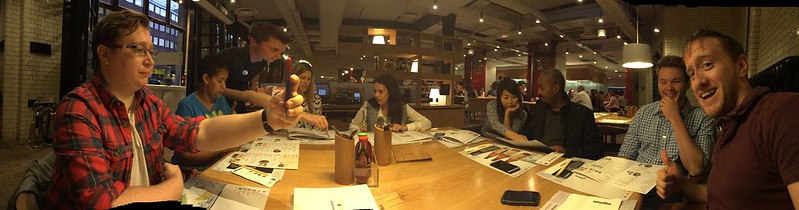
    Dinner with former Racepoint colleagues
    More on this trip out from a digital point-of-view on a later post.

  • Nielsen TV data + more things

    Facebook and Google, Two Giants in Digital Ads, Seek More – The New York Times – Facebook combining Nielsen TV data, treating its ads like TV. and Google plays catch-up with targeting by email address. I think that this doesn’t make a lot of sense from a data perspective. But I can understand why Nielsen TV / Facebook deal was done from a commercial perspective. It will be interesting to see if any comparative data on effectiveness comes out from Nielsen TV

    “Negropodamus” disses Internet of Things, predicts knowledge pills | Ars Technica – I think Negroponte gets it right on a lot of IoT applications. More related posts here.

    Two HN Announcements – Y Combinator Posthaven – big move but interesting why they felt now was the right time

    Volkswagen Faces Harsher Penalties Than a U.S. Company Might | NYTImes – interesting that the New York Times admits discriminatory prosecution practices against foreign firms

    China’s smartphone market continues online shift | TelecomAsia – implied no carrier subsidies and probable show rooming behaviour. For handsets like Xiaomi and OnePlus this is likely to be trying a friend’s device

    Valuing Vodafone | Digital Evangelist – Liberty was a joker of a bid anyway, Ian give its a more in-depth response

    Sony to skip PlayStation Vita 2, blames mobile gaming for handheld’s decline | ExtremeTech  – When the DS debuted and promptly tanked, I wondered if there was still a market for dedicated handhelds. Nintendo proved there was, provided you hit price points and committed to supporting it over the long term. Sony didn’t — and that fact explains far more of the difference between the two companies than all the smartphones in the world

    Could Didi Kuaidi take on Uber Internationally, and Win? | SocialBrandWatch.com – probably not but it is gaining traction

    Apple Is Sourcing A9 Chips From Both Samsung and TSMC | Chipworks – interesting because of the work that has to go into two different taping out processes

    Google To Let Advertisers Upload And Target Email Lists In AdWords With Customer Match – not terribly surprised by this, Facebook and Twitter have done this for a good while. Sina Weibo have been doing it

    The Royal Spanish Botnet Army | Motherboard – interesting article on political social media spam in Spain

    The Switch – I love the idea of this Netflix switch and the way they have approached making it available

    NHS Approved Health Apps Could be Leaking Your User Data | Lifehacker – which makes it harder to encourage adoption

    Guess what: Millennials aren’t all the same when it comes to news consumption » Nieman Journalism Lab – not terribly surprising, though the millennials I have worked with don’t read news in the traditional sense

    Smaller, Faster, Cheaper, Over: The Future of Computer Chips – The New York Times – new directions required as Moore’s Law is running out of steam

    Is Android a monopoly? | The Verge – I don’t necessarily agree with the author’s argument, although I could see that you could argue consumer benefit. I could also see how the government can see clear parallels between Microsoft’s bundling policies which got them in hot water and Google’s bundling of its own services on Android

    Here’s what happens in tech when the money runs dry – Business Insider – “Uber for X” or gaggle of startups that want to recreate everything their mom did for them – probably the best descriptor of many start-ups today

    China Company Directors and China Criminal Liability | China Law Blog – interesting piece on the differences in Chinese company director convictions and those in the west. It’s about direct responsibility

    What Happens Next Will Amaze You | Idlewords – the title is ironic, great downbeat summary on the state of the web

    An NPR Reporter Raced A Machine To Write A News Story. Who Won? : Planet Money : NPR – so if machines can turn out stories where does that leave press release writing and media relations?

  • Ron Arad’s tablet design concept for LG

    Ron Arad is more famous for his architecture and art than product design. I went along to see him speak at an event that is part of London Design Festival last week thanks to the China-Britain Cultural Exchange Association. Arad’s presentation felt largely unplanned as the curator of the talk asked him to jump around from project to project rather than a clear narrative being presented. Arad showed imagery or video that he then talked around.

    During the presentation he showed off the design concept that he did for LG that pre-dated the iPad. It sounded at the event like Ron Arad had started his thinking in 1997, but the sources I looked at online stated that this project was done in 2002 and the video copy I found on YouTube states that the copyright is 2003.


    The video is quite prescient in a number of ways

    • The device was primarily about content consumption and messaging
    • He nailed the in-home use case, with the exception of realising that the iPad may be a communal shared device rather than belonging to an individual
    • It has a flat design interface (though this might be a limitation of their ability to create it on video and a spin on the circular LG logo)
    • The soft keyboard on screen
    • There is no stylus
      There was auto-rotation of the screen
    • It has no user serviceable parts (this was at the time when cellphones and laptops came with detachable batteries)
    • Inductive charging with a table rather than the small pad used by the like of the Microsoft/Nokia Lumia devices
    • The way the controls where superimposed on footage of the user working with the device is reminiscent of the way TV and films are now treating parts of a plot that involves messaging

    There were a few things that it got wrong:

    • Arad clearly didn’t understand the significance of the iPod, so the device had an optical drive rather than side loaded video content
    • The device is really big, more like a laptop screen than a phablet, a la the iPad Mini or Galaxy Tab
    • The form factor was too thick, understandably so when they are trying to squeeze a battery and optical drive in the device, the thickness had a benefit in that the device was self-standing. Apple relied on covers and cases to provide the standing mechanism

    More gadget-related posts here.

    More information

    The Israeli designer who (almost) invented the iPad | Times of Israel
    The Simple Way “Sherlock” Solved Hollywood’s Problem With Text Messaging | Fast Company

  • Traackr – beyond the buzzword event

    Thanks to Delphine at Traackr UK for inviting me alone to their event last week. I started to make notes about what was being presented but in the end also started writing reactive notes as thoughts occurred to me.  Here they are below (with the spelling corrected).
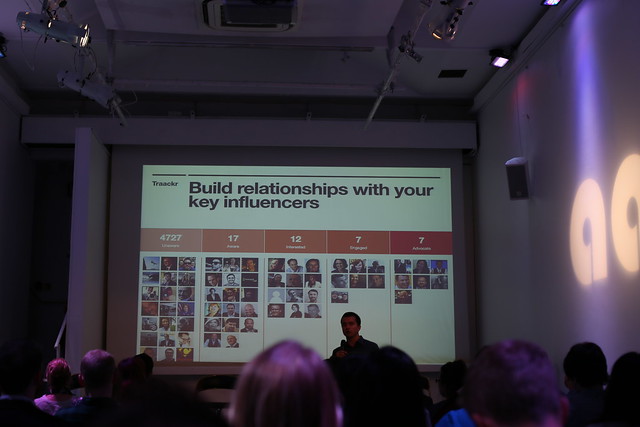
    IMG_7976The event was given the theme of ‘beyond the buzzword’ which has multiple interpretations – Traackr looks at influencers more like a granular taxonomy than around keywords, but it also signifies a mainstreaming of ‘influencer marketing’.

    There was an explanation of why influencer marketing
          • Authoritative content
          • The ability to better scale high touch relationships, something that traditional public relations isn’t able to do. The mix of people in the room from marketing agencies and PR agencies gives an idea of how ‘blended’ the concept of influencer marketing is. PR agencies see it as an extension of PR, specialist agencies see it in a different light and mainstream marketing agencies see it as an extension of their content marketing divisions

    What became apparent to me during listening to the introduction and the presentations was that Traackr and the people on stage hadn’t met the same requirements I’d heard from clients with regards a business case for influencer marketing. Influencer marketing wasn’t quite taken as an article of faith, but considered to be a good thing. There was a focus on measurement benchmarking and a lack of concern over RoI or the lack of econometric data to back up the decision. The lack of econometric data to support PR is starting to become an issue and may affect where PR sits (at least in B2B environments at least for those companies with a strong marketing automation programme in place). IMG_7966
    There was some hints that influencer marketing was looked at in a similar to customer services, in particular the advocacy journey above reminded me of customer service models.

    Coca Cola

    Coca-Cola focus the majority of their influencer relations programmes on what Brian Solis calls the Magic middle, the point at between the head and the long tail in a ‘long tail distribution’, the man from Coca-Cola defined this as  ‘people who don’t have agents and strong bonds with followers’. They are likely to know the majority of their followers personally. They use interaction and prize give-aways as a way of encouraging brand advocacy and continued heavy consumption patterns. In a similar way to on pack tokens and giveaways would have done in pre-internet times.
    They also like to do activities that encourage co-creation and in-real-life (IRL) interaction was consider the acme of these campaign interactions. When asked about whether they use sponsored / affiliate marketing of magic middle influencers – Coca-Cola generally don’t touch them. They only pay for a-listers and this seems to be on a market-by-market basis.
    Interestingly, they use Traackr to consolidate programme data, keep things up to date, integrate with rest of the toolbox. I wonder what would be economics of this approach rather than using Salesforce’s tools to provide the customer records?
     The objectives for influencer marketing at Coca-Cola where around brand love, brand affinity and purchase intent – which makes sense given the dynamics of the mature market oligarchy that they operate in.

    De Grisogono

    De Grisogono is a Swiss-based jewellery brand that also make mens watches. They discussed their use of influencer marketing as part of a panel discussion. Historically luxury brands had been slow to react to social platforms due to their perception of exclusivity and what it meant to be exclusive. In many cases social was imposed by customers on the brands. De Grisogono sees social and influencer marketing as an extension of their IRL social events. Since they are a relatively new brand there was  also no heritage as baggage.
    There overall intent is to drive footfall into stores, however it was interesting that they don’t look at location-based services like Swarm/Foursquare and instead focus on content channels. They don’t need to look at customer segmentation, since their approach to pricing does that for them.
    They qualify influencers based on expertise and passion. Generally their jewellery influencers have 30-50,000 followers, mens watch influencers have less. This is in sharp contrast to fashion bloggers who may have millions of followers.
    When thinking about influencer relations they put a focus on how they design content and experiences. They also pay a lot of attention to provide clients and prospects at any IRL events that influencers attend with adequate privacy.
    The brand produces content that features influencer, to keep the production levels high. User generated content is not obvious for for a luxury brand (despite customers taking selfies) – De Grisogono take a more graduated control of visual content than other brands.
    In trying to define the ROI, De Grisogono said that they don’t measure it explicitly but have noticed a causality between influencer coverage  and a 300 percent increase in press coverage.
  • Total app time + more things

    Smartphone App Users Spend Half of Their Total App Time With Their Favorite One | Marketing Charts – which had big implications for the app economy. Total app time is an extreme example of the long tail

    EPIC – Decision by EU Legal Advisor Signals End of “Safe Harbor” – big affect on American marketing companies and requires cloud providers to have European data shards if they don’t already

    Bye Bye U-2: CIA Legend Allen Predicts End Of Manned Reconnaissance « Breaking Defense – inevitable. Not having to have the payload of a pilot, with supporting supporting safety and life support systems

    Corporate reputation cannot be managed, built or protected by PR people alone | Marketing Interactive – interesting article not so much because of its assertions about social media, but that it implies PR is becoming a philosophy, think ‘marketing orientated organisations’ versus ‘sales orientated organisations’ as marketers used to discuss them

    Groupon Is Laying Off 1,100 At A Cost Of $35M, Shutters Operations In 7 Countries | TechCrunch – I was surprised to see Taiwan and Thailand on these lists

    Luxury brands can be their own worst enemy | CNBC – devaluing and diluting their brand. More luxury related content here.

    Atlas by Quartz – a great resource to find research

    Goldman Sachs is using Snapchat stories to lure millennials into its workforce | BusinessInsider – interesting use of SnapChat for corporate marketing

    Lenovo appoints ex-McKinsey executive Gordon Orr to board as group diversifies from PCs to mobile and enterprise | South China Morning Post – Orr, who currently also serves as a non-executive director at Hong Kong-listed conglomerate Swire Pacific, retired from McKinsey last month. (Paywall)

    Urban Networks: Spreading the flow of goods, people and ideas – Glaeser, Ponzetto & Zau – interesting study on how architecture impacts use, adoption and effects of technology – puts a new take on smart cities (PDF)

    U.S. and China Seek Arms Deal for Cyberspace – The New York Times – this isn’t going to solve US problems around data breaches

    Alibaba Shares, Down 45% From Their Peak, Have Had A Wild First Year – TheStreet – whilst the Chinese economy is quieter, there is still a growth opportunity in disrupting bricks-and-mortar stores. Chinese department stores have suffered financially, its a train that isn’t likely to stop

    Legendary CPU architect Jim Keller leaves AMD – HEXUS.net – its amazing how AMD’s fortunes have changed since I worked on them nine years ago. At that time they were a worthy challenger in desktop and server market

    D-Link Private Code-Signing Keys Leaked | Threatpost – so potentially lots of compromised routers that can be built into a distributed bot net with the right skills….

    Facebook Now Lets Advertisers Pay Only For Fully Visible Ads | Fast Company – which will appeal a lot to big advertisers like Unilever

    Samsung’s S Health is now available for all Android smartphones | Android Central – interesting the way they have expanded it, originally this would have been a Samsung USPP, there must be a gain in having a wider data pool?

    Coca-Cola Sees No Sales Impact From Online Buzz; Says Digital Display As Effective As TV | CMO Strategy – Advertising Age – really interesting study on the effect of social. One problem is that of data quality

    Unilever Finds Social-Media Buzz Really Does Drive Sales | Advertising Age – interesting how social doesn’t help Coca-Cola but does help Unilever, context is much more nuanced

    EPA accuses Volkswagen, Audi of evading emission laws | USA Today – this is huge. The potential reputation damage to VW group brands is huge. It’s also an impressive hack

    Beijing goes up against Uber, Didi Kuaidi with its own car-hailing app | SCMP – I thought that Didi Kuaidi was the government’s champion but it isn’t apparently. A bit like ZTE is an outsider compared to Huawei. Is Didi Kuaidi’s expansion abroad through investing in Lyft a factor in this? (paywall)